
Mar 21, 2026
The Futures Day Trading Landscape in 2026
Futures day trading in 2026 looks nothing like it did five years ago.
The retail trader of 2021 was typically glued to a single NinjaTrader chart, maybe watching the DOM, maybe following a few alerts in a Discord server. The retail trader of 2026 is running ICT concepts on one screen, Bookmap order flow on another, managing three funded prop firm accounts, and copying trades across all of them automatically.
The tools got better. The education got cheaper (in many cases, free). The prop firms made capital accessible. And copy trading made scaling possible without hiring a team.
But with all this access comes a real question: What actually works?
This article breaks down the current state of play — the dominant trading methodologies, the best educators to learn from, the prop firm landscape, and how copy trading fits into the modern trader's workflow. Whether you are just getting started or looking to scale what you already have, this is the lay of the land right now.
The Instruments Everyone Is Trading
The biggest shift in futures over the last few years has been the dominance of micro contracts.
Micro E-mini Nasdaq 100 (MNQ) now trades roughly 2.2 million contracts per day. Micro E-mini S&P 500 (MES) follows at around 1.6 million per day. Together, micro equity index contracts account for over 45% of total equity index volume on the CME — and their liquidity now rivals the full-sized contracts that institutional desks have traded for decades.
This matters because it means retail traders are no longer trading in a liquidity desert. The fills are clean. The spreads are tight. And the margin requirements make it possible to trade with small accounts or prop firm evaluations without blowing up on a single tick.
Here is what most active day traders are focused on in 2026:
MNQ / NQ — The Nasdaq contracts. Higher volatility, wider ranges, and the instrument of choice for traders who want fast moves and bigger profit targets.
MES / ES — The S&P contracts. Smoother price action, tighter spreads, and the benchmark for institutional volume.
CL (Crude Oil) — Still the "king of commodities" with over 1 million daily contracts. Ideal for traders who thrive on momentum and macro-driven moves.
GC (Gold) — Elevated interest in 2026 driven by macro uncertainty, central bank accumulation, and rate policy positioning.
ZN (10-Year Note) — The quieter giant at ~2.8 million daily contracts, heavily influenced by Fed policy and rate expectations.
For most retail day traders, MNQ and MES are the starting point — and for many, they remain the entire focus.
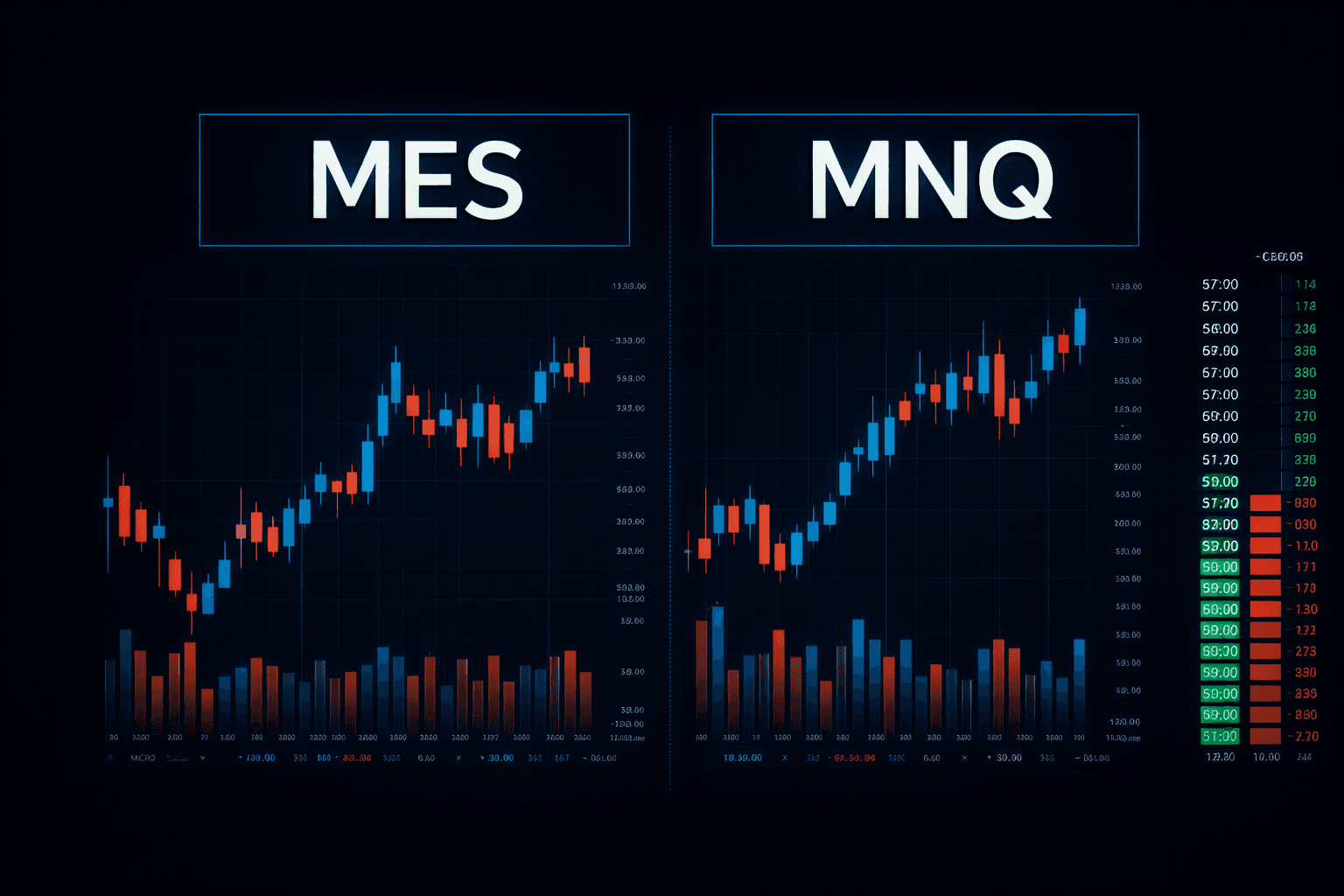
Micro E-mini futures contracts have become the most popular instruments for retail day traders in 2026
ICT: The Most Influential Framework in Retail Trading
No conversation about retail futures trading in 2026 is complete without talking about ICT — the Inner Circle Trader methodology created by Michael J. Huddleston.
With over 1.8 million YouTube subscribers and thousands of hours of free content, Huddleston has arguably done more to shape how retail traders think about markets than anyone else in the last decade. His framework has become the default language for an entire generation of traders.
The Core Concepts
If you have spent any time on trading Twitter, Discord, or YouTube, you have seen these terms everywhere:
Order Blocks — Price zones where institutional players accumulate positions without causing sharp price moves. These zones often form near swing highs and lows and can precede reversals. Think of them as footprints left by large participants.
Fair Value Gaps (FVGs) — A three-candle pattern where price moves so aggressively that it leaves an imbalance — a gap between the high of the first candle and the low of the third candle. The idea is that price tends to return to fill these inefficiencies before continuing.
Optimal Trade Entry (OTE) — A Fibonacci retracement zone (typically the 62–79% level) used to enter trades in the direction of the larger move. It is essentially a method for timing pullback entries.
Kill Zones — Specific 2–3 hour windows during the London and New York sessions when institutional activity peaks. The logic is simple: not all hours are created equal, and volatility clusters around session opens.
Judas Swing — A false move (typically during the London or New York open) designed to sweep liquidity above or below a prior session range before reversing in the true direction. It is the ICT framework's answer to "stop hunts."
Silver Bullet — A time-based setup executed during specific one-hour windows. The most popular is the 10:00–11:00 AM New York window, where the market often establishes its real directional move after the opening noise clears. The London open (3:00–4:00 AM ET) is another favored window.
Liquidity Sweeps — Moves that target resting stop-loss orders above swing highs or below swing lows before reversing. The core thesis is that "smart money" needs retail liquidity to fill large orders.
Why ICT Resonates
The appeal is real. Before ICT, most retail traders were drowning in lagging indicators — MACD crossovers, RSI divergences, moving average ribbons. Huddleston offered something different: a narrative framework that explains why price moves, not just what it does after the fact.
The idea that markets are driven by institutional order flow, that liquidity pools are targeted intentionally, and that certain time windows produce higher-probability setups — these concepts give traders a mental model that feels coherent. And for many, it genuinely improves how they read charts.
The Criticism
ICT is not without controversy. Huddleston entered the 2024 Robbins Cup trading competition and struggled to demonstrate profitability under public scrutiny. He temporarily removed educational videos from YouTube before restoring them. And the community around ICT has occasionally taken on a cult-like intensity where any criticism is dismissed rather than engaged with.
The deeper structural criticism is about discretion. Two experienced ICT traders can look at the same chart and disagree on which order block matters, whether a displacement is "strong enough," or which fair value gap is valid. That ambiguity is fine for experienced traders who have internalized the framework through thousands of hours of screen time. It is a problem for newer traders who treat every FVG as a guaranteed setup.
None of this makes ICT useless. It means the framework is a starting point, not a complete system.
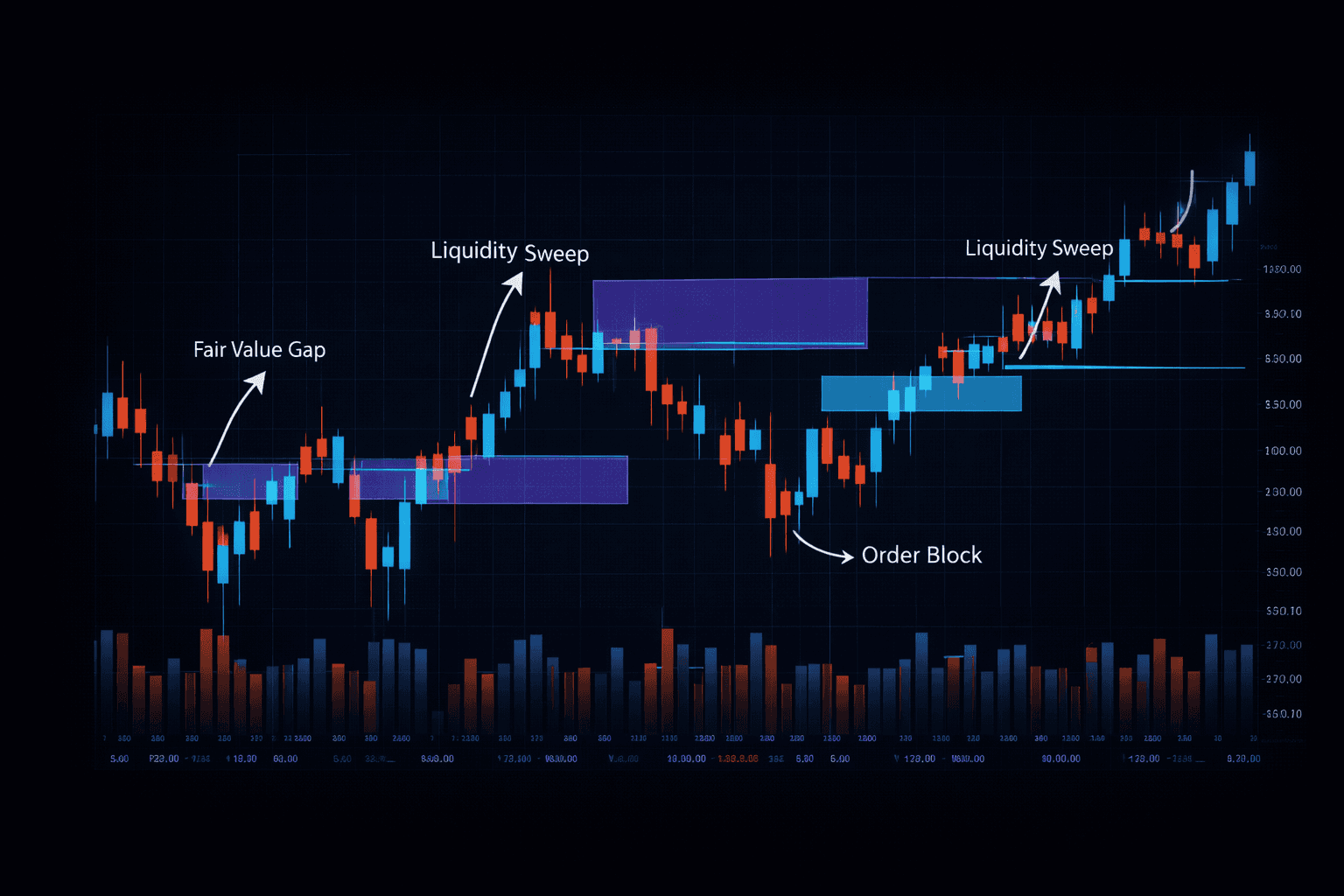
ICT concepts like fair value gaps, order blocks, and liquidity sweeps mapped on a futures chart
ICT Educators Worth Watching
Huddleston's original content is extensive but can be dense and unstructured. Several educators have built followings by making ICT concepts more accessible and practical for futures traders:
Powell Trades — Known for his proprietary "Wick Theory" framework — a price action approach focused on identifying high-probability rejection blocks and engineered liquidity on candlestick wicks. He trades NQ and ES futures and runs a paid Discord community and mentorship. Reviewers say his mentorship produces results within roughly 3 months and that he emphasizes both strategy and trading psychology. He has a strong TikTok presence where his strategies get widely discussed, making him one of the more social-media-native ICT educators out there.
PB Trading (Blake and Patrick) — One of the best entry points for beginners trying to learn ICT. With over 260,000 followers across platforms, Blake and Patrick are known for simplifying ICT concepts without losing the substance. Their "ICT for Dummies" series and videos like "5 Years of ICT Trading Knowledge in 23 Minutes" have become go-to resources. They developed "PB Theory" — their own proprietary framework built on top of ICT principles — and their mechanical model reportedly targets a 70–80% win rate at 1:1 to 1:1.5 risk-reward. They run a community on Whop with over 1,000 reviews averaging 4.86/5, plus a paid 1-on-1 mentorship program. If you want ICT concepts explained clearly with live daily trades, start here. Website: pbtrading.io
BNQ Ronan — The psychology coach within the PB Trading ecosystem. Trading psychology is the thing that kills most traders long before their strategy fails them, and Ronan focuses on exactly that — the mental side of execution, discipline, and emotional regulation. He operates primarily within the PB Trading community and posts ICT-related content on TikTok (@bionicnq). If you have the strategy down but still blow accounts because of revenge trading or FOMO, the psychology work Ronan emphasizes is probably what you are missing.
Dodgy (Ryan Wilson) — A 21-year-old funded futures trader who built an entire ecosystem around the iFVG (Inversion Fair Value Gap) strategy. His free community alone has over 41,000 members, and his TradingView indicator — iFVG Ultimate+ — automates detection of inversion fair value gaps, liquidity sweeps, and displacement events. He runs free Sunday night classes, uploads genuinely educational YouTube content, and offers a 12-week paid mentorship. What makes Dodgy stand out is that he productized his edge into a tool rather than just selling courses — and his community reviews back it up (4.76/5 across 562 reviews on Whop). He trades NQ futures and specializes in helping traders pass prop firm evaluations. Website: dodgysdungeon.com
The Inner Circle Trader (Official) — Huddleston's own channel with 1.8 million subscribers. The content is free, comprehensive, and continuously updated. The challenge is volume — there are hundreds of hours of lectures, and the teaching style assumes a high level of commitment. Start with his 2022 mentorship series if you want the most condensed version of the methodology.
Order Flow: The Institutional Edge Retail Traders Can Actually Use
While ICT dominates YouTube and social media, order flow trading dominates the desks where money actually changes hands.
Order flow is not a narrative framework. It is the direct observation of buying and selling activity in real time — who is hitting the bid, who is lifting the offer, where liquidity is stacking, and where it is pulling.
In futures markets, this information comes from the central limit order book — the actual queue of resting buy and sell orders at every price level. Unlike equities, where order flow is fragmented across dark pools and multiple exchanges, futures trade on a single exchange (CME for most US contracts), which means the data is complete and transparent.
What Order Flow Traders Actually Watch
Depth of Market (DOM) — The live order book showing resting bids and asks at every price. Traders watch for large orders appearing, disappearing, or being absorbed.
Footprint Charts — Volume-at-price data that shows how many contracts traded on the bid vs. the ask at each price level. Imbalances (where one side significantly outweighs the other) can signal directional intent.
Volume Profile — A histogram showing total volume traded at each price over a given period. High-volume nodes represent accepted value; low-volume nodes represent price levels the market moved through quickly.
Time and Sales (Tape) — The raw feed of every executed trade. Experienced tape readers can detect large institutional orders, iceberg orders, and momentum shifts in real time.
Liquidity Heatmaps — Visual representations of where resting orders are concentrated in the book. Tools like Bookmap render this as a real-time heatmap, making it easy to see where liquidity is building and being pulled.
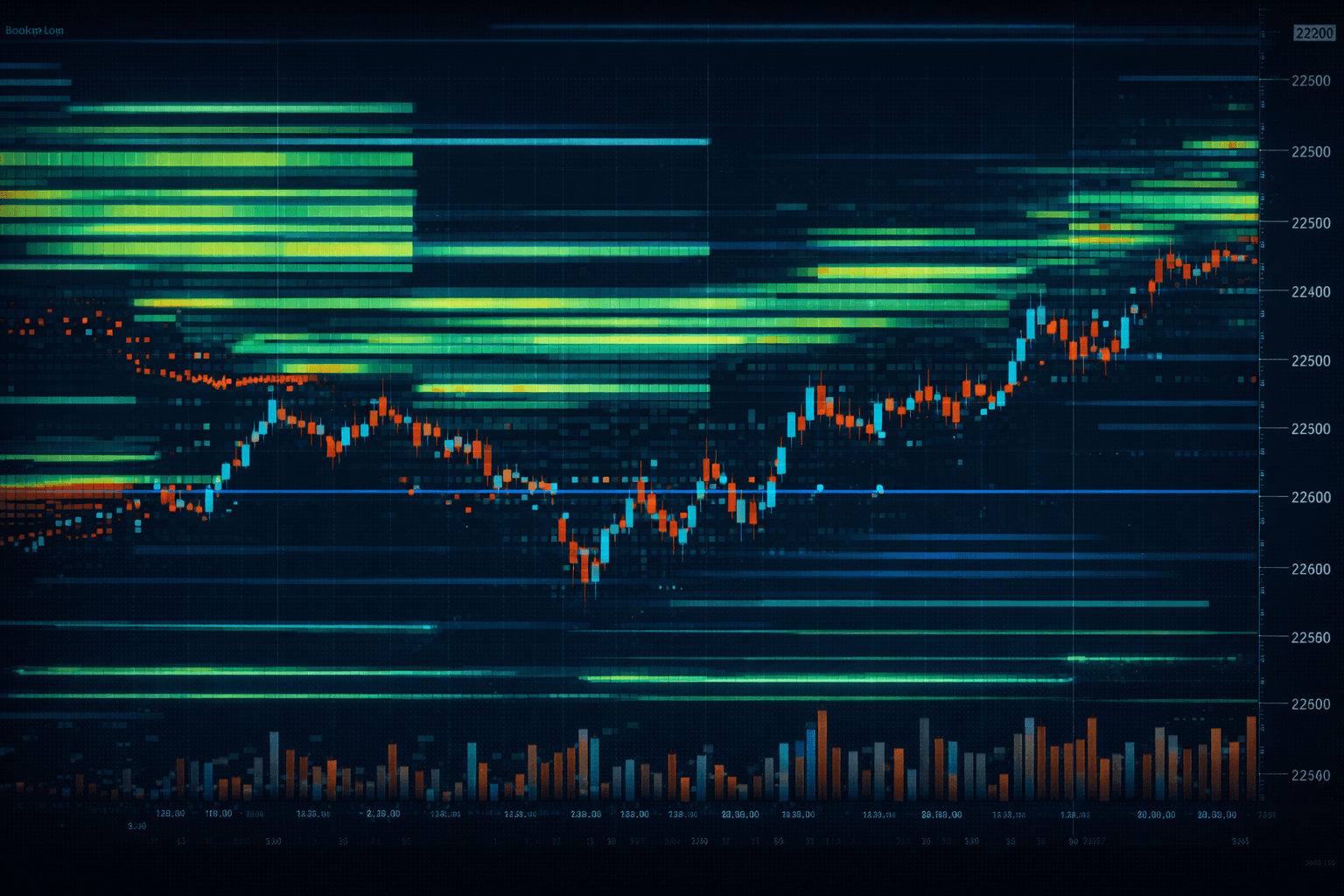
A Bookmap-style liquidity heatmap showing real-time order flow and depth of market
Why Order Flow Works for Execution
The fundamental advantage of order flow is that it deals in observable evidence, not interpretation.
When a large buyer lifts 2,000 contracts off the ask in NQ, that happened. You can see it. When resting liquidity gets pulled from above the market just before a selloff, that is visible in real time. When price pushes into a level and aggressive sellers are getting absorbed with no downside follow-through, that information is in the tape.
You do not need to debate whether a candle qualifies as "displacement." The data either confirms your thesis or it does not.
This is why order flow tends to produce tighter entries and better risk management than purely chart-based methods. You are making decisions based on what is happening in the market right now, not what happened on a historical candle.
Order Flow Educators and Platforms
The Platforms
Bookmap — The most popular order flow visualization tool. Its real-time liquidity heatmap shows where orders are resting and how they change over time. It is the closest thing to "seeing the matrix" in futures trading. Bookmap also offers free educational courses on their platform for traders learning order flow for the first time.
Sierra Chart — The power user's platform. If Bookmap is a heatmap, Sierra Chart is a spreadsheet with a trading engine attached. It offers Market Depth Historical Graph, Numbers Bars (footprint charts), custom studies, and support for multiple data feeds. The learning curve is steep, but the customization is unmatched.
Jigsaw Trading — The DOM specialist. Jigsaw's Daytradr platform is built for traders who execute from the depth of market. One-click execution, real-time reconstruction of market depth, and tools specifically designed for scalping ES, NQ, and CL. If your edge lives in the DOM, Jigsaw is hard to beat.
OrderFlow Labs — Builds professional-grade order flow algorithms that automate studies like Market Generation Index (MGI), rebid/reoffer detection, and trapped trader identification. Offers both free and premium editions. A great supplement to any of the platforms above. Website: orderflowlabs.com
The Educators
FuturesTrader71 (Morad Askar) — A Chicago-based veteran with over 18 years of experience in volume profiling and order flow. He is the real deal — a working trader who built both a brokerage (EdgeClear) and a trading education firm (Convergent Trading). His 5-week Accelerator Program covers execution, trade management, psychology, and risk. If you want to learn order flow from someone who actually trades for a living, start here. Active on Twitter/X as @FuturesTrader71.
Axia Futures — A London-based professional trading firm that trains proprietary traders and offers public education. Their 35.5-hour order flow course and 8-week Career Programme cover market microstructure, auction theory, volume profiling, and macro event trading. The training methodology is built on cognitive frameworks — awareness, practice, feedback, and adjustment. It is more rigorous and more expensive than most retail education, but the depth is institutional-grade. Website: axiafutures.com
ICT vs Order Flow: Which Should You Learn?
This is the debate that will not die on trading Twitter. Here is a honest framework for thinking about it:
ICT is better for:
Building a macro narrative (where price might be drawn to)
Understanding session behavior and time-of-day patterns
Identifying key structural levels (previous day high/low, session liquidity pools)
Giving new traders a coherent mental model for why price moves
Order flow is better for:
Execution timing (getting in and out with precision)
Confirming or invalidating a thesis in real time
Reading market participation and intent
Managing risk at the point of entry
The honest answer is that the best traders use both.
They use ICT-style thinking to establish a bias — "price swept sell-side liquidity during the London session and we are entering the NY kill zone, so I am looking for longs." Then they use order flow to confirm — "buyers are absorbing at this level, the tape is showing aggressive buying, and resting offers above are getting pulled."
That combination — structure for bias, order flow for confirmation — is probably the highest-probability approach available to retail futures traders right now.
If you are forced to pick one, start with order flow. It teaches you to read the market as it is, not as you hope it will be. You can add ICT concepts later as a contextual layer.
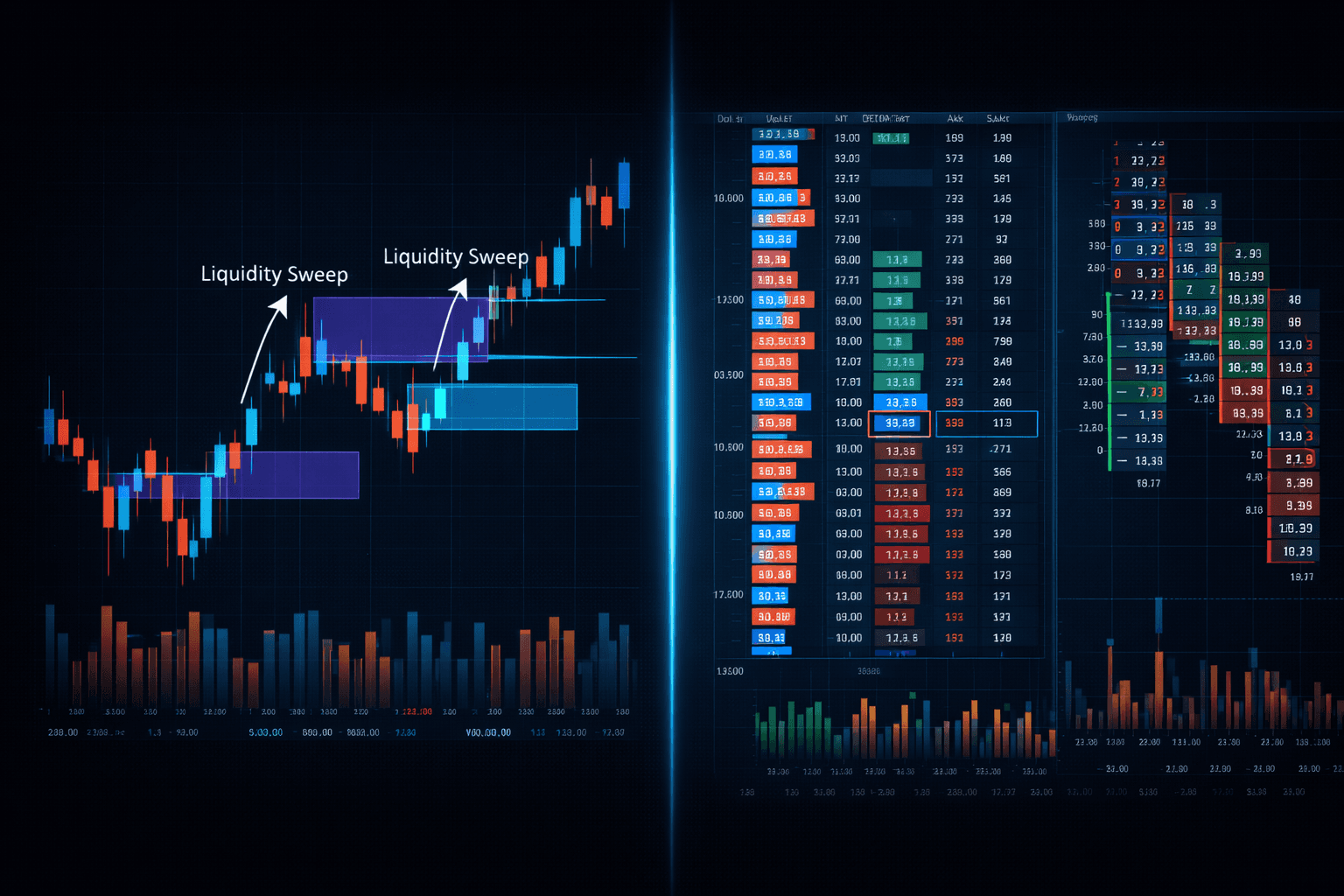
ICT vs order flow — structure for bias, order flow for confirmation
The Prop Firm Revolution
The prop firm landscape has fundamentally changed how retail traders access capital.
Instead of saving up a $25,000 account over years, a trader can now pay a $150–$300 evaluation fee, pass a simulated challenge, and receive a funded account with $50,000–$300,000 in buying power. The economics are straightforward: prop firms make money from evaluation fees. Traders make money from payouts on profitable funded accounts.
The Major Players in 2026
Apex Trader Funding — The most popular option right now. One-step evaluation (no multi-phase process). No daily drawdown limit — just a trailing drawdown. Accounts up to $300K. Traders keep 100% of the first $25,000 in profits, then a 90/10 split. Integrates with NinjaTrader 8 and TradingView.
Topstep — The original futures prop firm and still one of the most trusted. More structured evaluations with stricter daily loss limits. Traders keep 100% of the first $10,000, then 90% thereafter. Offers free coaching, performance analytics, and educational tools built into the platform.
Other notable firms: Bulenox, Earn2Trade, Take Profit Trader, My Funded Futures. Competition among these firms has driven evaluation fees down and payout terms up — which is good for traders.
The Key to Prop Firm Success
The strategy that works best in prop firms is not necessarily the strategy with the highest win rate or the biggest average winner. It is the strategy that survives the rules.
Most prop firms enforce some version of:
A maximum daily loss limit
A trailing drawdown (your max loss trails your highest equity point)
Consistency requirements (you cannot make all your profit in one lucky day)
This means the ideal prop firm strategy is one that produces small, consistent winners with controlled risk per trade. High-frequency scalping, session-based setups with fixed stop losses, and strategies built around the first 1–2 hours of the New York session tend to perform well in this environment.
If your strategy occasionally produces a +$5,000 day but also produces -$3,000 days, it will have a hard time surviving trailing drawdown rules — even if the overall expectancy is positive.
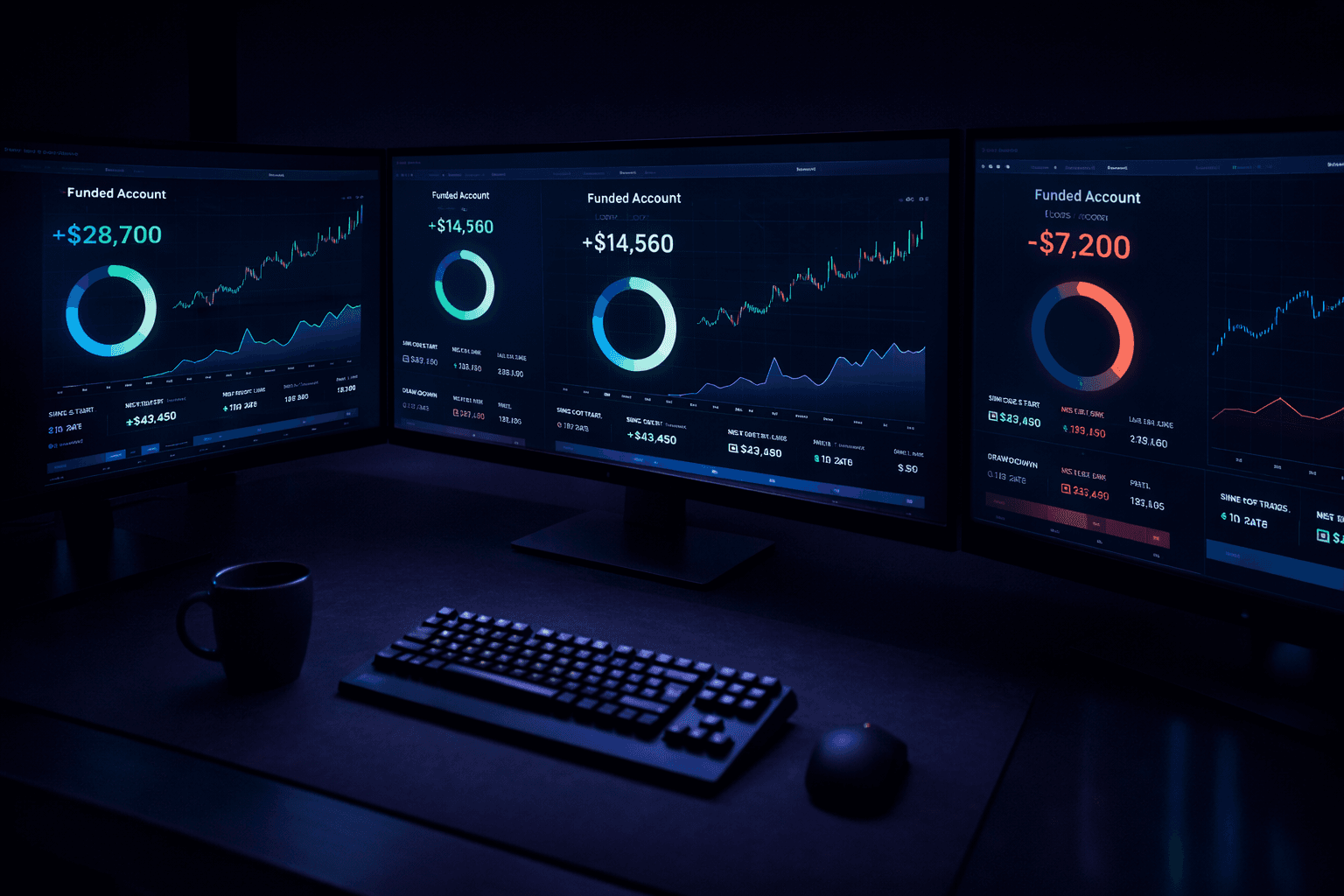
Prop firm funded accounts have become the primary way retail traders access capital in 2026
Copy Trading: The Multiplier Nobody Talks About
Here is where things get interesting.
Once you have a consistent strategy and a funded account, the next logical question is: How do I scale this?
You cannot just "trade bigger" on a prop firm account — the rules constrain your position size. And saving up for a personal account large enough to be meaningful takes years.
The answer that more and more traders are discovering is copy trading.
The concept is simple: you trade one account normally, and a copy trading tool mirrors your trades across multiple other accounts simultaneously. Same entries, same exits, same risk management — just multiplied.
Interest in copy trading has grown over 120% since 2020, with search trends rising roughly 20% year over year. And the primary use case driving that growth in futures is not the social "follow a guru" model. It is prop firm account multiplication.
Here is how it works in practice:
You develop a consistent strategy and prove it works
You pass one prop firm evaluation
You pass several more evaluations using the same strategy
You trade your leader account and copy trades to all funded accounts automatically
Instead of one $50K account paying out $2,000/month, you have five accounts paying out $10,000/month
The math is compelling. And it is entirely legitimate — most prop firms allow copy trading across your own accounts as long as you are the one executing the trades.
The Technical Requirements
Copy trading in futures is not as simple as clicking "follow" on eToro. The execution needs to be fast (ideally sub-second latency), the risk parameters need to match across accounts, and the system needs to handle edge cases like partial fills and connection drops.
This is exactly the problem TradeDupe was built to solve. It connects directly to the Tradovate API, mirrors trades from your leader account to your follower accounts in real time, and gives you control over which contracts get copied and which accounts are active. No NinjaTrader plugin required. No third-party middleware. Just your accounts, your trades, multiplied.
If you are already profitable and trading prop firm accounts, copy trading is the highest-leverage move you can make.
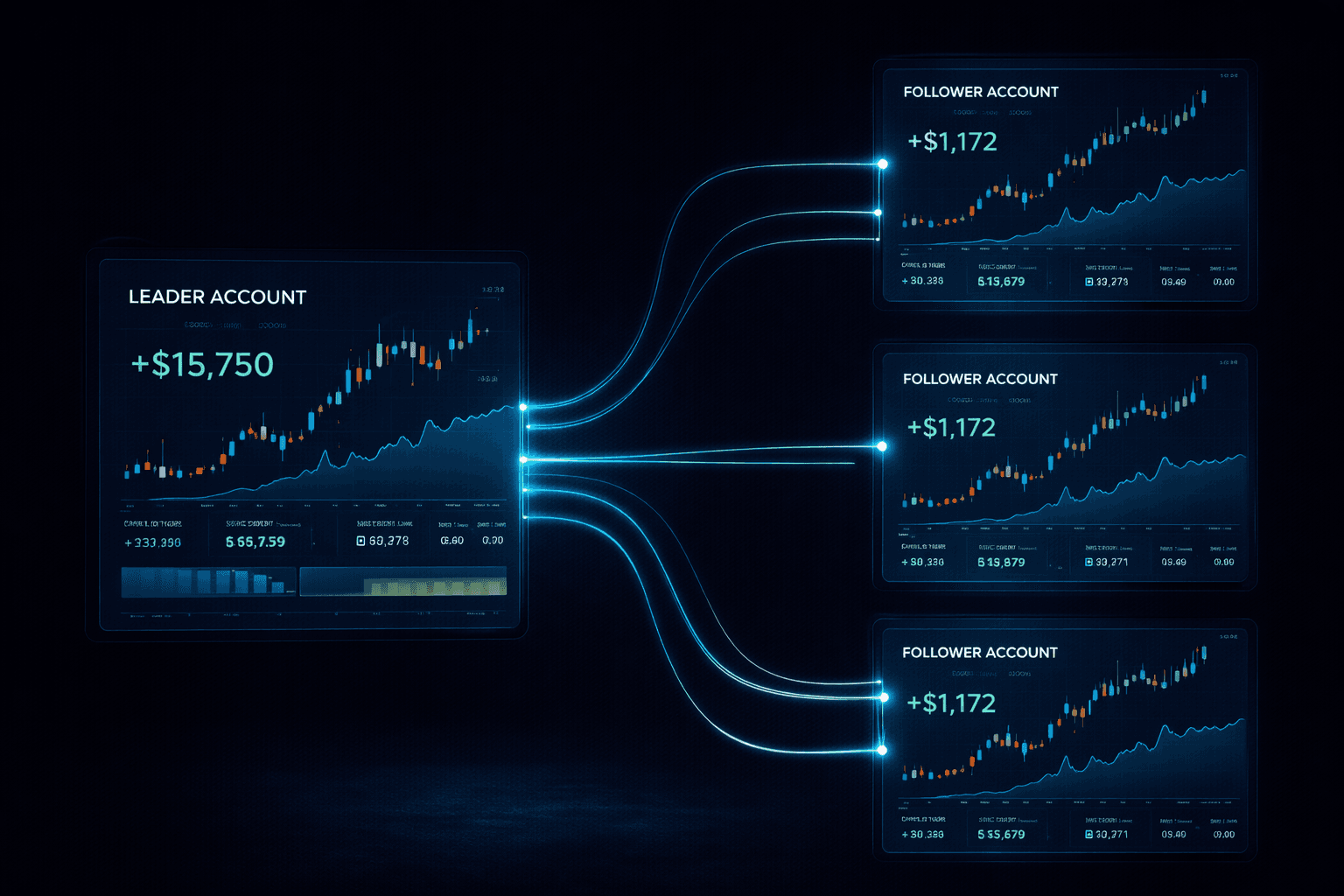
Copy trading lets you mirror one leader account across multiple funded accounts automatically
What Actually Works in 2026
After everything — the frameworks, the platforms, the educators, the prop firms — here is what actually separates profitable futures traders from everyone else:
1. They trade during specific sessions, not all day. The 9:30–11:00 AM New York window produces the cleanest setups on most days. The ICT community calls this the kill zone. Order flow traders see it as the period with the most aggressive institutional participation. Whatever you call it, the data supports focusing your energy here rather than watching charts for 8 hours.
2. They have rules, not just concepts. The difference between a concept and a strategy is specificity. "I trade fair value gaps" is a concept. "I trade 15-minute FVGs that form during the 9:30–10:00 AM window after a liquidity sweep of the previous session low, with a stop below the FVG and a 2R target" is a strategy. The second version can be copied. The first version cannot.
3. They manage risk before they manage entries. The best entry in the world is worthless if your position size is wrong, your stop is too wide, or you do not have a daily loss limit. Every consistently profitable trader has a risk model that runs independently of their entry model. For prop firms, this usually means risking 0.5–1% of the account per trade and having a hard daily loss cutoff.
4. They scale through systems, not effort. The ceiling on manual trading is real. You can only watch so many charts, manage so many accounts, and execute so many trades per day before quality degrades. Traders who break through that ceiling do it by building systems — whether that means automated execution, copy trading, or both.
5. They keep learning but stop method-hopping. The trader who spends six months deeply learning order flow will outperform the trader who spends six months bouncing between ICT, Wyckoff, Elliott Wave, and supply and demand. Depth beats breadth in trading education. Pick a methodology, commit to it for at least 6 months, and only layer on additional frameworks once the first one is internalized.
Next Article