
Mar 21, 2026
Best Futures Trading Strategy for Copy Trading (Updated March 10, 2026)
If you searched for the best futures trading strategy, order flow trading strategy, ICT concepts, or copy trading futures, you are probably trying to solve the same problem:
How do I build a strategy that is profitable, repeatable, and clean enough to scale across multiple accounts?
That last part matters more than most traders realize.
A strategy can look great on screenshots and still fail in real execution because it is too vague to repeat. That is why the real comparison is not just ICT vs order flow as a social media debate. The better question is:
Which framework creates clearer decisions under pressure and can still work in a prop-firm or copy-trading environment?
My view is straightforward:
Order flow is usually better for execution
ICT concepts can still be useful for context
The best practical model for most futures traders is structure for bias, order flow for confirmation, and strict risk rules for scaling
Why Strategy Choice Matters When You Copy Trade Futures
When you trade one account manually, you can get away with a lot of discretion.
When you move into futures copy trading or prop firm copy trading, discretion becomes expensive.
A copy-trading-ready strategy needs:
A clear session window
A clear entry trigger
A clear invalidation point
A fixed risk model
A consistent exit plan
If your strategy depends on "feel," hindsight markup, or changing definitions from day to day, it becomes very hard to mirror across multiple accounts with confidence.
This is the main reason many traders searching for a copy trading strategy eventually move away from overly subjective models. They realize that scaling rewards clarity more than complexity.
If you need the basics first, read What Is Copy Trading? and Best Trade Copier for Prop Firms.
What Order Flow Trading Actually Means
Order flow trading focuses on what the market is doing right now at the point of execution.
Depending on your platform, that can include:
Depth of market
Bid and ask behavior
Aggressive buyers versus aggressive sellers
Volume traded at price
Pace and absorption near key levels
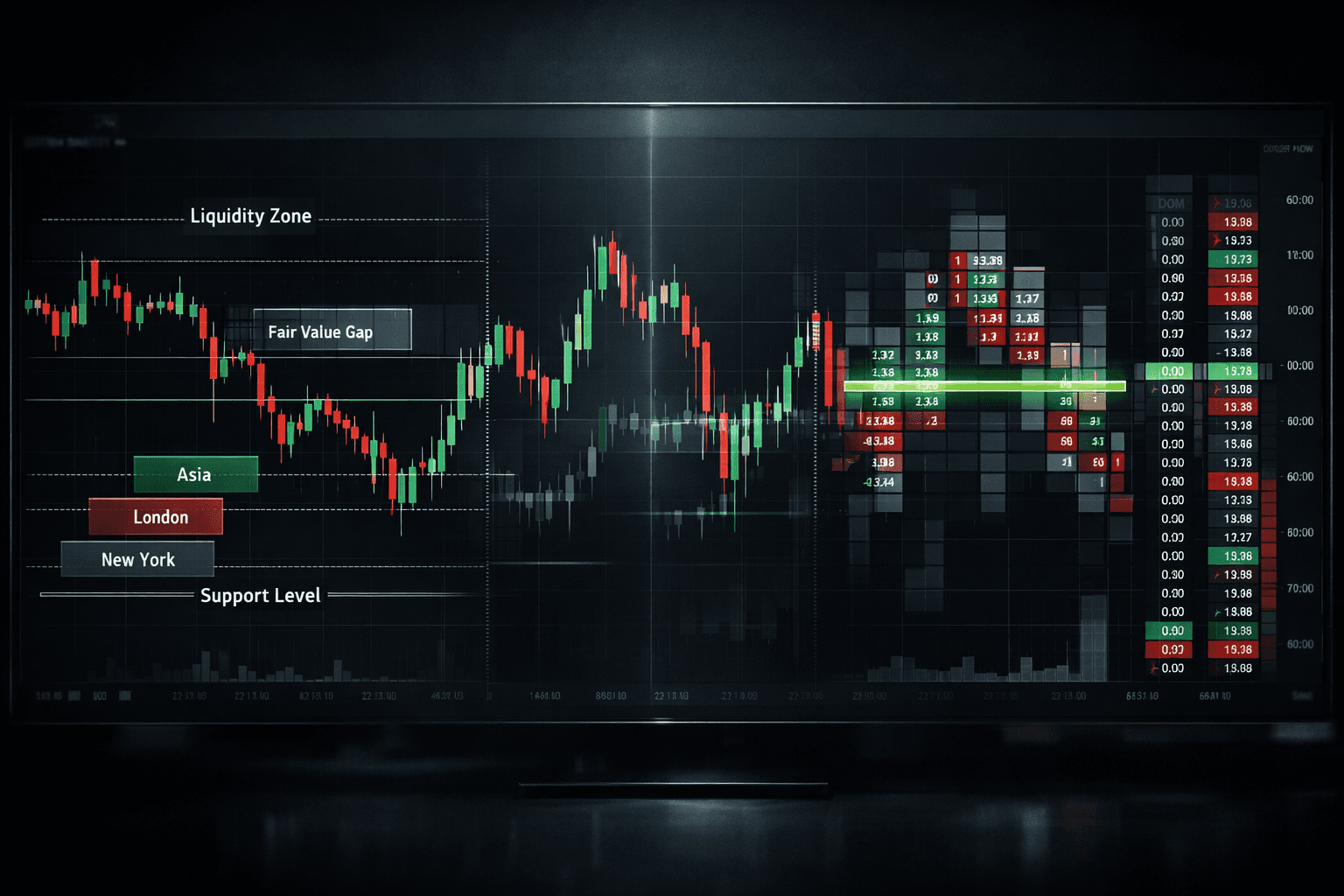
This matters in futures because the central limit order book gives traders a live view of liquidity and participation. CME Group's Market by Order material describes order-based data as a way to see individual queue position, full depth of book, and the size of individual orders at each price level. CME also describes liquidity using bid-ask spread, book depth, and cost to trade in its Liquidity Tool resources.
In practical terms, order flow traders are not asking only, "Is price near my level?"
They are also asking:
Is liquidity thinning or stacking here?
Is the market accepting this price or rejecting it?
Are aggressive buyers actually moving price, or getting absorbed?
Is the tape confirming my thesis or contradicting it?
That makes order flow trading futures especially useful for execution timing.
What ICT Concepts Actually Mean
ICT concepts usually refer to a set of price-action ideas built around liquidity, displacement, market structure, fair value gaps, dealing ranges, and session timing.
The appeal is obvious:
The framework gives traders a narrative for why price might move toward liquidity
It encourages thinking in terms of structure rather than random indicators
It often gives traders a more organized way to study session behavior
That part is useful.
The problem is that many ICT-style setups become highly discretionary in live trading. Two traders can look at the same chart and disagree on:
Which liquidity level matters most
Whether a displacement move is strong enough
Which fair value gap is valid
Whether the market has actually shifted structure
That does not make ICT concepts useless. It just means they often need additional filters before they become a scalable best strategy for futures trading candidate.
Order Flow vs ICT: The Core Difference
The real difference is this:
ICT gives a market narrative
Order flow gives execution evidence
ICT-style analysis often helps answer:
Where price may be drawn
Which session or structure matters
Where liquidity may sit
Order flow helps answer:
Whether buyers or sellers are actually in control now
Whether your level is being defended or traded through
Whether the move has real participation behind it
That is why traders who only use ICT concepts often struggle with late entries and avoidable stop-outs. The chart idea may be fine, but the execution is still blind.
On the other hand, traders who only use order flow can become too reactive. They see every burst of activity as meaningful and lose the higher-timeframe map.
So if you want a serious answer to order flow vs ICT, it is this:
ICT is often more useful for context
Order flow is usually more useful for execution
Copy trading works best when the execution piece is objective
Which Strategy Fits Prop Firm Accounts Better
The best futures strategy for a personal account is not always the best futures strategy for a prop account.
Prop firms reward consistency, clean risk, and survivability under rule pressure. That means your strategy has to fit:
Trailing or maximum drawdown rules
Daily loss limits
Minimum day or payout pacing requirements
The reality that oversized outlier wins can still create problems later
If you have not studied that side yet, read How to Trade Prop Firms and Prop Firm Consistency Rule Guide.
In that environment, the winning strategy profile is usually:
Session-specific
Selective, not all-day
Easy to size in micros first
Based on tight invalidation rather than wide hope stops
Able to stop after a normal daily target or daily loss
That tends to favor order-flow-assisted setups over pure discretionary storytelling. Not because order flow is magic, but because it gives a more measurable way to confirm or reject a trade near your planned level.
Which Strategy Is Better for Copy Trading
If the question is specifically what is the best futures trading strategy for copy trading, my answer is:
The one another account can follow without your interpretation.
That usually means order flow has the edge.
Why?
It forces you to define what confirmation actually is
It reduces hindsight chart-markup bias
It makes it easier to train one set of actions across many accounts
It creates cleaner post-trade review because the trigger is observable
A scalable copy trading strategy might sound like this:
Mark prior day high, prior day low, overnight high, overnight low, VWAP, and a key higher-timeframe level
Trade only during your chosen session window
Wait for price to test a planned level
Enter only if order flow confirms rejection or continuation in a specific way
Risk a fixed amount per trade
Stop after one to three planned attempts or at your daily limit
That is a strategy. "I saw a liquidity sweep and it felt weak" is not a strategy yet.
The more objective you make the trigger, the better your results tend to be when you scale with copy trading.
The Best Practical Model: Context Plus Execution
For most traders, the highest-quality answer is not choosing one camp forever.
It is combining the best parts of both.
A practical hybrid model looks like this:
Use structure and session logic to create bias
Use key liquidity areas and prior reference points to define trade location
Use order flow to decide whether to execute, wait, or cancel the idea
Use fixed risk and fixed process rules to protect the account
Example workflow:
Higher timeframe says price is approaching a prior day low in a larger intraday uptrend
Your plan says you want a long only if the low is swept and reclaimed during your main session
Price trades below the low
You watch for selling to stall, absorption to appear, and responsive buying to lift price back above the level
You enter only after that evidence appears
This solves the biggest weakness in each style:
Structure without execution becomes vague
Execution without structure becomes noisy
For traders trying to rank for or solve searches like best futures trading strategy or order flow trading strategy, this hybrid approach is usually the most defensible answer.
Turn Your Strategy Into a Copy Trading System
If you want to scale one strategy across multiple accounts, treat your system like an operator would, not an influencer.
Use this checklist:
Define the market and session
Which contract?
Which hours?
Which volatility conditions are acceptable?
Define the setup
What exact level are you trading?
What has to happen before you are interested?
Define confirmation
What order flow behavior says go?
What behavior says no trade?
Define risk
Fixed dollar risk
Fixed contract count or ratio
Hard daily stop
Define exits
First target
Runner logic or no runner
Time stop if nothing happens
Define invalidation
What cancels the setup before entry?
What proves the thesis wrong after entry?
When those rules are written cleanly, your strategy becomes much easier to execute manually and much easier to scale through tools like TradeDupe.
Just as important, it becomes easier to review honestly. You can see whether the issue was analysis, execution, or discipline.
Sources and References
Final Take
If your goal is better screenshots, almost any framework can look impressive in hindsight.
If your goal is a real copy trading futures workflow that survives live markets, prop-firm rules, and execution pressure, the best strategy is usually simpler:
Build context with structure
Confirm with order flow
Keep risk fixed
Review everything in rules, not stories
That is the kind of strategy you can actually repeat.
Next Article