
Master Sub Account Copier: The Pro Trader's 2026 Guide
TradeDupe
11 min read
Unlock your trading potential with a master sub account copier. Manage multiple accounts efficiently and boost your trading success now!
A master sub account copier is software that replicates trades instantly from one master trading account to multiple sub-accounts, giving professional traders a single control point for an entire account fleet. The industry standard term for this workflow is trade mirroring or multi-account trade replication, and the master sub account copier is the engine that makes it work. Prop traders managing Apex, Tradeify, Lucid Trading, or Alpha Futures accounts use this technology to execute one decision and see it reflected across every funded account simultaneously. Done right, it multiplies efficiency. Done wrong, it multiplies losses at the same speed.
What does a master sub account copier require to set up?
Setting up a trade copier system starts with the right account structure. Brokers like Interactive Brokers offer Financial Advisor (FA) accounts that manage unlimited sub-accounts from one master login. That structure is the foundation. Without it, you are manually logging into each account, which defeats the purpose entirely.

Regulatory requirements apply when you trade on behalf of others. Series 65 registration is required in the U.S. for traders managing client capital. Prop firm traders operating their own funded accounts face fewer licensing hurdles, but broker terms of service still govern what is permitted.
The software layer is where most traders underinvest. A capable automated trading copier needs four core features:
- Real-time order replication with sub-100ms latency
- Per-account risk controls including daily loss limits and auto-liquidation triggers
- Symbol mapping to handle broker-specific naming conventions
- Rogue trade detection to catch and block errant orders before they propagate
Professional-grade platforms range from $49 to $150+ per month for SaaS solutions with advanced features like rogue trade detection and AI analysis. Free or open-source tools exist, but they lack the per-account toggle controls and auto-liquidation triggers that funded prop accounts require.
Pro Tip: Run each sub-account in an isolated virtual environment or separate browser profile. Brokers track multiple accounts via IP address and browser fingerprinting. Account isolation prevents detection that can lead to account closures and frozen funds.
How does a master sub account copier operate?
The two core execution modes in any trade copier are Orders mode and Executions mode. Understanding the difference is not optional. It is the single most consequential configuration decision you will make.
Orders mode places trades on sub-accounts the moment the master account sends an order, before the master fill is confirmed. This creates lockstep trade placement across all accounts simultaneously. Orders mode suits prop firm compliance because it mirrors the exact order structure, including stop-loss and take-profit levels, without waiting for fill confirmation.
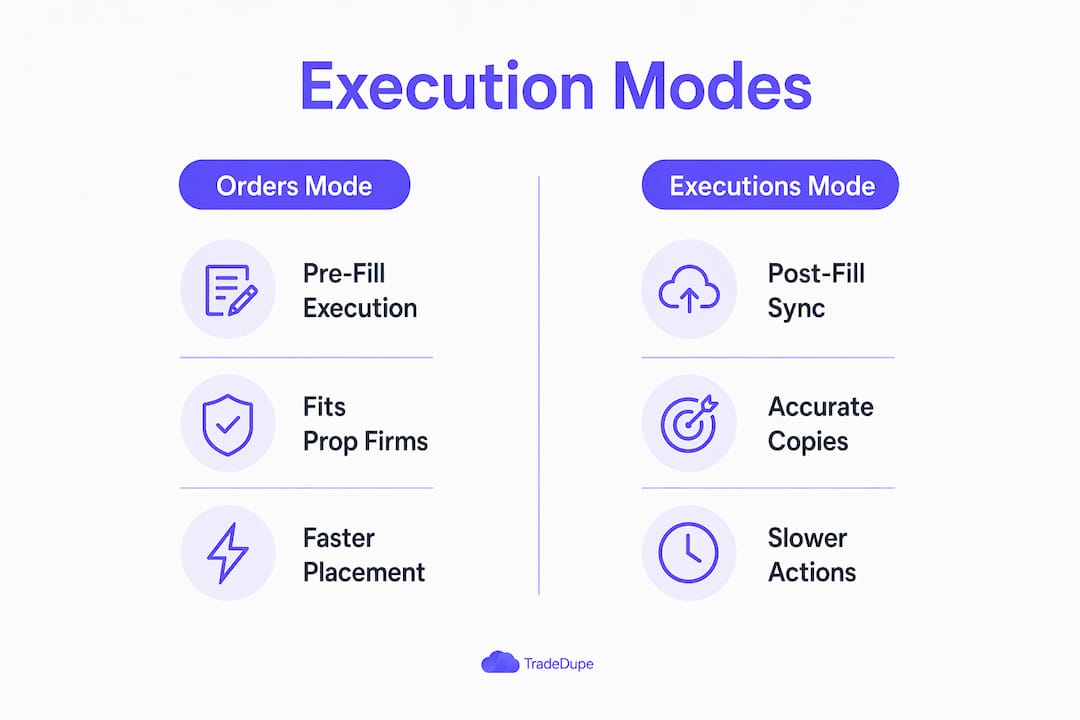
Executions mode waits for the master trade to fill, then replicates the filled position to sub-accounts. This is simpler and more forgiving, but it introduces latency between the master fill and sub-account entry. For fast-moving futures markets, that gap matters. Choosing the wrong mode is a leading cause of non-compliance with prop firm risk parameters.
Beyond mode selection, three additional mechanics govern how trades flow:
- Trade size scaling: Sub-accounts can receive proportional or fixed contract sizes relative to the master. A master trading 10 contracts can scale each sub-account to 1 or 2 contracts independently.
- Symbol mapping: When the master trades "XAUUSD" but the sub-account broker lists it as "GOLD," the copier silently ignores the trade without throwing an error. Symbol mismatches cause silent failures that are notoriously difficult to diagnose.
- Latency and fill propagation: Tradedupe reports a median replication latency of 34ms, which is fast enough for most futures strategies. Higher latency platforms can cause meaningful price divergence between master and sub-account fills.
Pro Tip: After every symbol mapping configuration change, place a small test trade and verify the fill on every sub-account before running live size. Silent mapping failures will not alert you. Only a confirmed fill on each account proves the connection is working.
Step-by-step guide to running a multi-account copier
A structured setup process prevents the most common configuration errors. Follow these steps in order:
- Open your master and sub-accounts. Apply for the appropriate account type at your broker. For Tradovate-based prop firms like Apex or Tradeify, each funded account is a separate sub-account that connects to the copier as a follower.
- Install and authenticate the copier software. Connect your master account credentials securely. Use API-based authentication where available. Never share raw login credentials across accounts.
- Configure allocation profiles per sub-account. Set contract size scaling, daily loss limits, and profit targets independently for each follower account. Granular risk controls per account are not optional. Relying solely on master account performance risks compliance failure across the entire fleet.
- Map all symbols. Cross-reference every instrument you trade against each broker's symbol naming convention. Document the mapping in a spreadsheet and verify it in the software configuration panel.
- Run a synchronization test. Place a minimum-size test trade on the master account and confirm the fill appears on every sub-account within your expected latency window.
- Enable automated risk controls. Set auto-liquidation triggers, daily drawdown limits, and rogue-trade detection at the sub-account level. These controls are your last line of defense when a bad trade fires.
The most overlooked step is number six. Traders configure the master account's risk parameters carefully and then leave sub-accounts on default settings. That gap is where funded accounts get blown.
| Setup phase | Key action | Common error |
|---|---|---|
| Account structure | Open master and follower accounts | Using one login for all accounts |
| Software connection | API authentication per account | Sharing raw credentials |
| Risk configuration | Per-account loss limits and targets | Master-only risk settings |
| Symbol mapping | Cross-reference all broker symbols | Assuming symbols match automatically |
| Testing | Confirm fills on every sub-account | Skipping test trades before live size |
Common pitfalls and risk management best practices
The most dangerous property of a master sub account copier is also its greatest strength: speed. A single error in the master account replicates to every sub-account in milliseconds. A strategic mistake in the master account multiplies exponentially across all sub-accounts, potentially causing large financial damage.
Operational risk concentrates in three areas:
- Trade errors at scale: A mistyped contract size or wrong symbol on the master account fires across the entire fleet before you can intervene. Pre-trade checklists and order confirmation dialogs are not bureaucratic overhead. They are mandatory safeguards.
- Liquidity and slippage: Aggregated trades across many sub-accounts can move prices unfavorably. Fleet-scale liquidity management requires monitoring total position size across all accounts, not just the master.
- Credential exposure: Each sub-account needs isolated credentials. A single compromised login can give an attacker access to every account in the fleet simultaneously.
> Pre-trade risk management is the trader's core responsibility. Software is a tool that must be paired with strong automated daily loss limits per account. Automation handles speed. The trader handles judgment. Confusing those roles is how accounts get blown at scale.
Regulatory and broker compliance adds another layer. Prop firms like Apex and Tradeify have specific drawdown rules that apply per account, not per fleet. Automated daily loss limits and auto-liquidation per sub-account are the only reliable way to enforce those rules without manual monitoring.
Pro Tip: Set up automated alerts for any sub-account that hits 50% of its daily loss limit. That threshold gives you time to intervene before the account breaches its funded rules. Waiting for the auto-liquidation trigger is too late for a clean recovery.
For a deeper look at practical risk management frameworks that apply directly to multi-account environments, the principles of pre-trade controls and position sizing translate cleanly to copier setups.
How to optimize efficiency and compliance across sub-accounts
Efficiency in a multi-account setup is not about speed alone. It is about consistency. Every sub-account should behave identically under the same market conditions, and that requires deliberate configuration at each account level.
The highest-impact optimizations are:
- Match execution mode to account type. Orders mode for prop firm funded accounts. Executions mode for simpler replicated accounts where fill timing is less critical.
- Use exit shields and contract type picking. Advanced software features like exit shields prevent sub-accounts from holding positions after the master exits. Contract type picking ensures futures contracts map correctly across expiration cycles.
- Set automated profit targets per sub-account. A sub-account that hits its daily profit target should stop copying new trades for that session. This prevents over-trading on accounts that have already met their funded evaluation targets.
- Run on a VPS or cloud-hosted solution. A local machine that goes offline takes the entire fleet offline with it. Cloud-based copier infrastructure provides 24/7 uptime without depending on your internet connection or hardware.
Tradedupe's architecture addresses this directly. Its cloud-hosted infrastructure maintains real-time sync with a median 34ms latency, and its per-account toggle controls let you pause individual sub-accounts without interrupting the master or other followers. That granularity is what separates professional-grade platforms from entry-level field apps.
Pro Tip: Review sub-account performance reports weekly, not just the master account's P&L. Divergence between master and sub-account results signals a configuration problem, a symbol mapping error, or a latency issue that needs immediate attention.
Key Takeaways
A master sub account copier works reliably only when execution mode, symbol mapping, and per-account risk controls are configured correctly before any live trading begins.
| Point | Details |
|---|---|
| Execution mode selection | Orders mode suits prop firm compliance; Executions mode suits simpler replicated accounts. |
| Symbol mapping validation | Test every symbol mapping with a live trade before running full size to catch silent failures. |
| Per-account risk controls | Set daily loss limits and auto-liquidation triggers on each sub-account, not just the master. |
| Account isolation | Use separate browser profiles or VPS environments to prevent broker detection via fingerprinting. |
| Fleet-scale error risk | A single master account error replicates instantly across all sub-accounts, so pre-trade checks are mandatory. |
What I've learned running multi-account copier setups
The first time I watched a bad trade fire across 12 accounts simultaneously, I understood immediately why pre-trade controls matter more than any other configuration decision. The copier did exactly what it was designed to do. The problem was upstream, in the master account, where a misread signal turned into a position that should never have been placed.
That experience changed how I think about automation. A copier is not a risk management system. It is a replication engine. The risk management has to exist before the order reaches the copier. Consistent risk management strategies at the master account level are the foundation everything else depends on.
The second lesson took longer to learn: sub-account performance divergence is a diagnostic signal, not a nuisance. When one account fills at a different price or misses a trade entirely, that is the system telling you something is wrong. Traders who ignore those discrepancies eventually face a compliance failure on a funded account they thought was running perfectly.
The platforms that handle this best give you per-account visibility in a single dashboard, not just aggregate fleet stats. That granularity is the difference between managing a fleet and just hoping it runs correctly.
> — Andres
Tradedupe: built for professional multi-account trading
Tradedupe is a cloud-hosted trade mirroring platform built specifically for prop traders operating within the Tradovate ecosystem. It supports real-time synchronization across Apex, Tradeify, Lucid Trading, and Alpha Futures accounts with a median latency of 34ms.
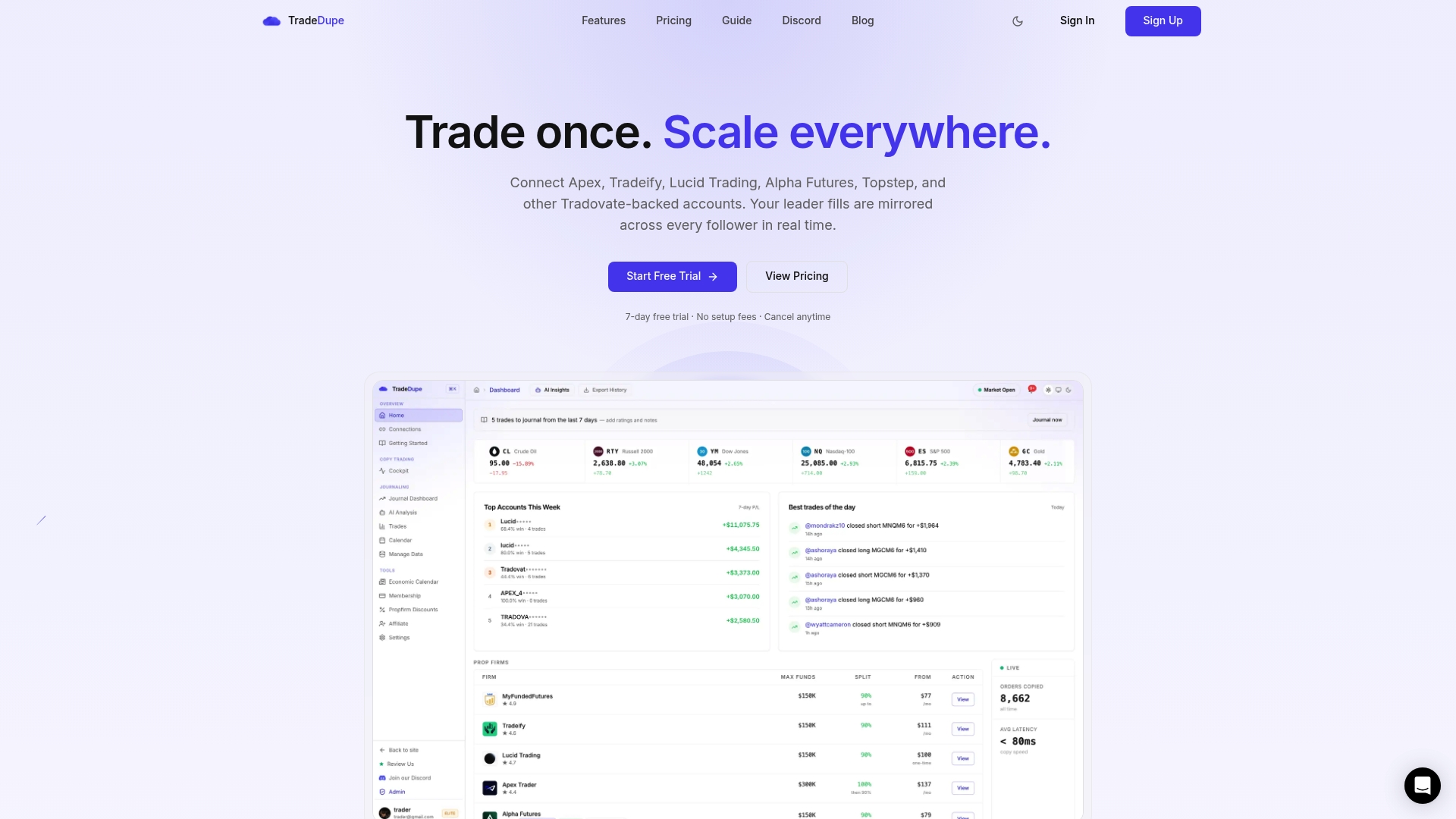
The platform includes rogue-trade detection, auto-recovery, and per-account toggle controls that let you pause individual follower accounts without disrupting the master or the rest of the fleet. Automated daily loss limits and auto-liquidation triggers enforce funded account drawdown rules at the sub-account level. For traders ready to scale their futures trade copier setup with full compliance controls, Tradedupe's tiered plans cover individual traders through enterprise-level prop desks. You can also explore the full platform at tradedupe.com to see how it fits your current account structure.
FAQ
What is a master sub account copier?
A master sub account copier is software that replicates trades from one master account to multiple sub-accounts in real time. It gives professional traders a single execution point for managing an entire account fleet.
What is the difference between Orders mode and Executions mode?
Orders mode replicates trades before the master fill is confirmed, which suits prop firm compliance requirements. Executions mode waits for the master fill and then copies the position, introducing more latency but simpler configuration.
Why do symbol mapping failures cause silent errors?
When the master account uses a symbol name that differs from the sub-account broker's naming convention, the copier ignores the trade without throwing an error. Common examples include "XAUUSD" on one broker and "GOLD" on another.
Do I need a license to use a master sub account copier?
Trading your own funded prop firm accounts generally does not require a license. Trading client capital in the U.S. typically requires Series 65 registration and compliance with applicable regulatory frameworks.
How do I prevent broker detection when managing multiple accounts?
Run each sub-account in an isolated virtual environment or separate browser profile. Brokers track multiple accounts via IP address and browser fingerprinting, and failure to isolate accounts can lead to closures and frozen funds.