
Futures Prop Desk Risk Models: A 2026 Trader's Guide
TradeDupe
11 min read
Explore the types of futures prop desk risk models that empower traders. Protect capital while enhancing performance with effective frameworks.
Futures prop desk risk models are automated frameworks that combine drawdown rules, exposure management, and behavioral controls to protect firm capital while enabling trader performance. The types of futures prop desk risk models in active use today span static and trailing drawdown systems, A-book and B-book routing structures, position sizing protocols, and real-time behavioral detection engines. Standard industry thresholds set daily loss limits at 4–5% and total drawdown caps at 8–12% of account size. These benchmarks are not arbitrary. They reflect the minimum guardrails a prop desk needs to stay solvent while funding multiple traders simultaneously.
1. Types of futures prop desk risk models: an overview
Prop desk risk models fall into five functional categories: drawdown enforcement models, routing and exposure cap models, position sizing frameworks, behavioral anomaly detection systems, and real-time risk engines. Each category addresses a different failure point. Drawdown models cap cumulative losses. Routing models manage how trade risk is absorbed or hedged. Position sizing rules prevent overexposure on any single trade. Behavioral systems catch rule exploitation that static limits miss. Risk engines tie all of these together in real time.
No single model type is sufficient on its own. The most effective prop desks layer all five categories into an integrated risk architecture. Understanding each one separately is the first step toward building or evaluating a complete system.

2. Static vs. trailing drawdown models
Static drawdown models fix the loss threshold at a set dollar amount below the starting account balance. If a $50,000 account has a $4,000 static drawdown limit, that limit never moves. The trader can run up profits and still lose $4,000 from the original balance before hitting the breach point.
Trailing drawdown models work differently. The loss limit follows the account's equity high, resetting upward as profits accumulate. On a $50,000 account with a $3,000 trailing drawdown, a run to $53,000 in equity moves the breach point up to $50,000. The trader cannot give back those gains without risking account termination.
- Intraday trailing models reset the high-water mark tick by tick throughout the session. Normal intraday equity swings can trigger a breach even when the trader ends the day profitable.
- End-of-day trailing models only reset the high-water mark at session close. This gives traders more room to manage positions during the day.
- Static models offer the most predictable risk environment and are generally easier to pass during evaluations.
Intraday trailing drawdown is the most expensive mistake new prop traders make. The model penalizes normal intraday equity fluctuations, which means a technically sound trade can still breach the account if the drawdown high-water mark moves against the trader mid-session.
Pro Tip: Before choosing a prop firm evaluation, confirm whether the trailing drawdown resets intraday or end-of-day. That single distinction changes your position sizing strategy entirely.
3. Exposure caps and routing models: A-book, B-book, and hybrid
Exposure cap models define how much total risk a prop desk carries at any moment. Routing models determine whether that risk is hedged externally or held internally.
A-book routing sends trader positions to external liquidity providers. The prop desk hedges its exposure and eliminates tail risk from large winning traders. The tradeoff is hedging cost, which reduces the desk's margin on profitable accounts.
B-book routing keeps all risk internal. The desk takes the opposite side of every trade. There are no hedging costs, but the desk absorbs the full variance of trader outcomes. A cluster of winning traders in the same instrument at the same time creates concentrated exposure.
Most prop firms use a hybrid routing model in 2026: evaluation accounts are B-booked, and funded accounts are selectively A-booked based on trader performance and position size. This approach balances risk retention during the evaluation phase with cost-controlled hedging for consistently profitable funded traders.
| Feature | A-book | B-book |
|---|---|---|
| Risk destination | External liquidity provider | Internal desk book |
| Hedging cost | Yes | No |
| Tail risk exposure | Low | High |
| Best suited for | Funded, profitable traders | Evaluation accounts |
| Margin impact | Reduced by hedging fees | Full variance retained |
Layered exposure caps add a second layer of control on top of routing decisions. These caps operate at four levels: per-account limits, per-instrument aggregate limits, cohort limits for groups of traders in the same market, and firm-wide aggregate limits. Overexposure to correlated trades is a key failure point in prop desk risk models. Managing instrument concentration and cohort clustering is what separates well-run desks from those that blow up during high-volatility events.
4. Position sizing frameworks aligned with prop desk risk assessments
Position sizing in futures prop trading must be calculated against available drawdown room, not total account balance. This distinction is critical. A trader with a $50,000 account and a $2,500 drawdown buffer is not a $50,000 trader. That trader is managing a $2,500 risk pool.
Risking more than 1% of drawdown room per trade is considered poor risk management in funded account environments. At 1–2% per trade, a trader can absorb a meaningful losing streak without breaching the account. At 5% or more per trade, three consecutive losses can end the account entirely.
Key principles for prop desk position sizing:
- Base risk on drawdown room. A $2,500 drawdown buffer at 1% risk per trade means $25 maximum risk per position.
- Account for tick value. In ES futures, one tick equals $12.50. In NQ, one tick equals $5.00. Position size must reflect the instrument's actual dollar movement.
- Reduce size on correlated positions. Portfolio heat limits cap total open risk at 5–6% of equity. Holding two correlated long positions in ES and NQ simultaneously counts as a single directional bet.
- Adjust for volatility regimes. During high-volatility sessions like FOMC announcements, the same contract size carries more dollar risk per tick. Reduce size or sit out.
Pro Tip: Use Tradedupe's position size calculator to calculate exact contract counts based on your current drawdown room and tick value before entering any trade.
5. Behavioral and anomaly detection models
Static limits define what traders cannot do. Behavioral models detect what traders are actually doing. These are two different problems, and most prop desks underinvest in the second one.
Prop firm risk systems must monitor anomalies including hedging between accounts, cross-account abuse, and exploitative news trading. Rule enforcement alone cannot detect behavioral manipulation effectively. A trader who hedges a long position in one account with a short in a second account technically violates no individual account rule. Only cross-account behavioral analysis catches it.
Common behavioral anomalies that advanced detection models flag:
- Multi-accounting: One trader operating multiple evaluation accounts simultaneously to increase statistical odds of passing.
- Copy trading rings: Coordinated groups mirroring trades across accounts to pass evaluations at scale.
- Latency arbitrage: Exploiting execution delays between the prop firm's data feed and the underlying market.
- News trading exploitation: Entering positions immediately before scheduled economic releases to capture guaranteed moves.
Behavioral pattern monitoring is the front line of defense against multi-accounting, latency arbitrage, and copy trading rings that threaten firm solvency. Automation flags anomalous behavior for human review, supplementing rule enforcement with pattern recognition.
> "Rule-based models set the floor for risk control. Behavioral models are what keep sophisticated actors from gaming that floor. A prop desk that relies only on static limits is one clever trader away from a serious problem."
Consistency rules add another layer. Many prop desks require that no single trading day account for more than 30–40% of total profits. This prevents traders from taking one outsized risk to pass an evaluation and then trading conservatively on the funded account. Payout verification systems cross-reference trading patterns against consistency thresholds before releasing funds.
6. Real-time risk engines and automated enforcement
The risk engine is the operational backbone of a prop desk. It functions as a live nervous system, sitting between the trading platform and the back office, enforcing every rule in real time without human intervention.
Prop firm risk engines monitor every price tick in real time, enforce rules instantly, and flag fraud patterns without manual review. That speed is what makes scaling possible. A desk running 500 funded accounts cannot have a compliance officer watching each one. The engine does it automatically.
Rules enforced by a modern risk engine include:
- Daily loss limits: Breach triggers an immediate account lock for the remainder of the session.
- Trailing drawdown thresholds: Equity monitoring fires the moment the high-water mark minus current equity hits the limit.
- Consistency rules: Profit distribution checks run at payout request to verify no single day dominates the record.
- Restricted trading windows: News blackout periods block order entry during designated high-risk intervals.
- Instrument restrictions: Certain contracts or asset classes may be blocked entirely for specific account tiers.
Automated kill switches monitor real-time equity and close all open positions when accounts approach breach thresholds. Human discipline alone is insufficient under losing streak pressure. The kill switch removes the decision entirely. Scenario analysis extends this further by modeling adverse price move impacts on margin in real time, giving the desk a forward-looking view of potential exposure before a breach occurs.
The difference between balance-based checks and equity-based checks matters here. Balance-based systems only update after a trade closes. Equity-based systems track open position mark-to-market continuously. A real-time risk engine uses equity monitoring, not balance monitoring, because unrealized losses are just as dangerous as realized ones.
Key takeaways
The most effective futures prop desk risk models combine static and trailing drawdown enforcement, layered exposure caps, behavioral anomaly detection, and real-time automated engines into a single integrated architecture.
| Point | Details |
|---|---|
| Drawdown model type matters | Intraday trailing models are harder to pass and penalize normal equity swings more than end-of-day models. |
| Routing model shapes firm risk | Hybrid A-book/B-book structures balance hedging costs against tail risk across evaluation and funded accounts. |
| Size to drawdown room, not balance | Risk 1–2% of available drawdown room per trade, not 1–2% of total account size. |
| Behavioral models catch what rules miss | Cross-account anomaly detection is the only reliable defense against multi-accounting and copy trading rings. |
| Risk engines enable scale | Real-time equity monitoring and automated kill switches are what allow a prop desk to run hundreds of accounts safely. |
My take on building a risk model that actually holds up
A practitioner's view on futures prop desk risk models
Most traders focus on passing the evaluation. Most risk managers focus on protecting the firm. The models that work long-term serve both goals simultaneously, and that alignment is harder to achieve than it looks.
The biggest gap I see in prop desk risk architectures is the assumption that static limits are sufficient. They are not. A trader who understands the rules can operate right at the edge of every limit without technically breaching anything. Behavioral monitoring is what closes that gap. If your desk is not running cross-account pattern analysis, you are relying on trader honesty as a risk control. That is not a model. That is hope.
Position sizing discipline is the other area where I see consistent failures. Traders calculate risk as a percentage of account balance and wonder why they blow up in three trades. The correct reference point is always the drawdown buffer. Treat that buffer as your entire capital base, and size accordingly. For practical guidance on passing and keeping funded accounts, the prop firm playbook at Tradedupe covers this in detail.
The firms that survive volatile markets are the ones that stress test their models before the volatility arrives. Run scenario analysis on your worst-case correlated exposure. Know exactly what happens to your aggregate book if ES drops 80 points in 15 minutes. If the answer is "I'm not sure," that is the risk model gap to fix first.
> — Andres
Tradedupe's role in prop desk risk model execution
Prop desk risk models define the rules. Tradedupe handles the execution layer that keeps those rules intact across multiple accounts simultaneously.
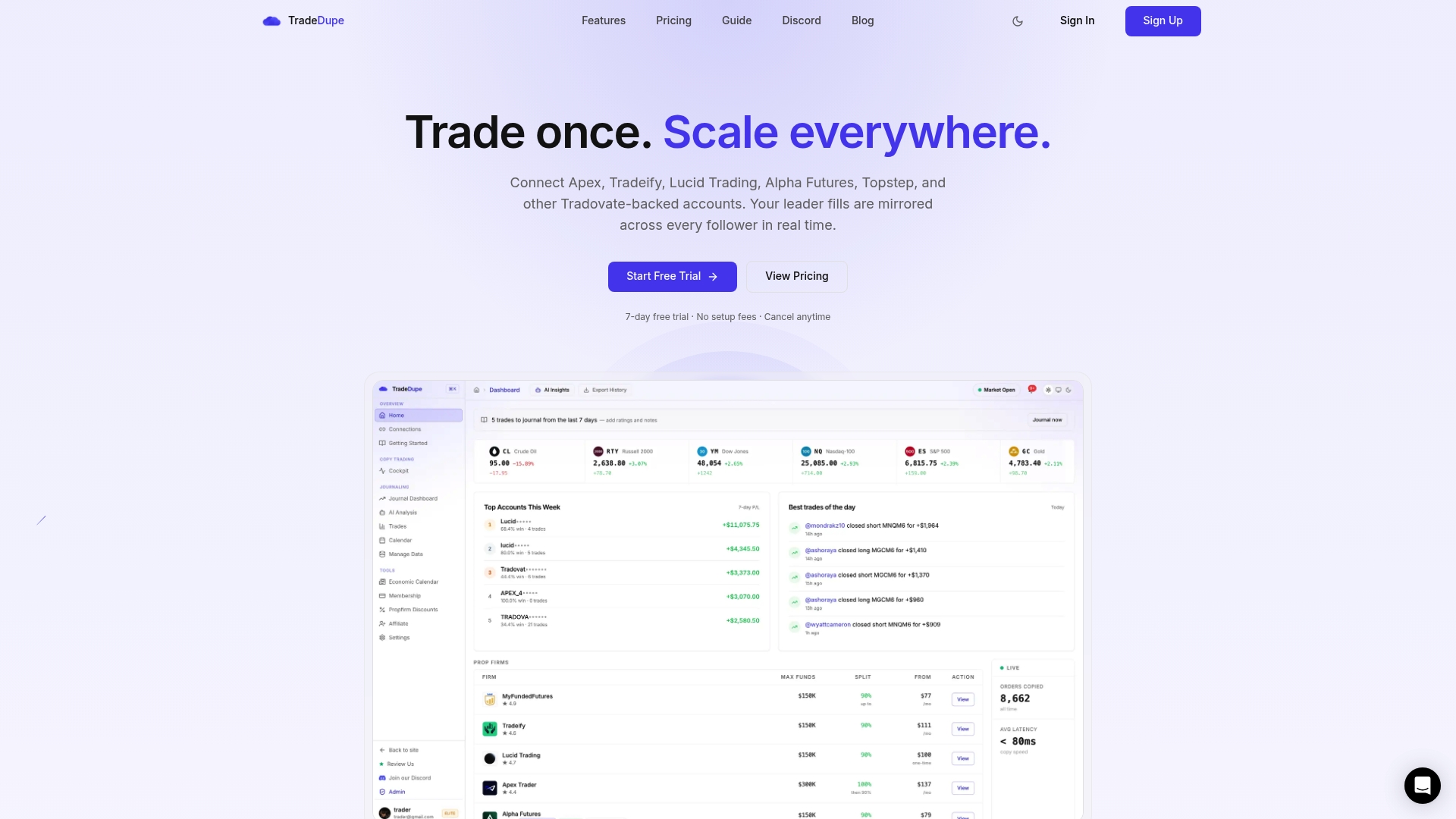
Tradedupe mirrors trades from a single lead account to multiple follower accounts on Tradovate with a median latency of 34ms. That speed matters for risk model compliance. A delayed copy trade can enter at a worse price, distort position sizing, and push a follower account closer to its drawdown limit than the leader account. Tradedupe's rogue-trade detection and per-account toggle controls give risk managers the ability to pause, adjust, or isolate any account in real time. For prop desks running Apex, Tradeify, Lucid Trading, or Alpha Futures accounts, Tradedupe's futures trade copier integrates directly with the account structures those firms use. Explore Tradedupe's platform to see how synchronized account management supports your risk framework at scale.
FAQ
What are the main types of futures prop desk risk models?
The main types are drawdown enforcement models (static and trailing), routing models (A-book, B-book, and hybrid), position sizing frameworks, behavioral anomaly detection systems, and real-time risk engines. Each addresses a distinct failure point in prop desk operations.
What is the difference between static and trailing drawdown?
A static drawdown fixes the loss limit at a set dollar amount below the starting balance. A trailing drawdown moves the limit upward as equity grows, locking in gains and reducing the buffer available for future losses.
How should position sizing work on a prop desk account?
Position sizing should be based on available drawdown room, not total account balance. Risking 1–2% of the drawdown buffer per trade is the standard for funded account risk management.
What does a prop firm risk engine actually do?
A risk engine monitors every price tick in real time, enforces daily loss limits, trailing drawdown thresholds, and consistency rules, and triggers automated kill switches when accounts approach breach points, all without manual intervention.
Why is behavioral monitoring part of futures risk management?
Static rules define limits but cannot detect cross-account manipulation, copy trading rings, or latency arbitrage. Behavioral anomaly detection identifies patterns that technically comply with individual account rules while exploiting the system at a broader level.