
How Prop Firms Onboard New Traders in 2026
TradeDupe
11 min read
Discover how prop firms onboard new traders in 2026. Learn the steps to fast-track your journey to funded accounts and profit sharing!
Prop firm onboarding is the structured, multi-phase process through which proprietary trading firms evaluate a trader's skill and risk discipline before granting access to firm capital. Understanding how prop firms onboard new traders matters because the process determines not just who gets funded, but how quickly you can activate a live account and start earning profit splits. The trader onboarding process at firms like Topstep, FTMO, and Kraken Prop follows a consistent arc: simulated challenge, identity verification, and funded account access. Each phase filters for behavioral discipline as much as raw trading ability.
What are the typical stages in a prop firm trader onboarding process?
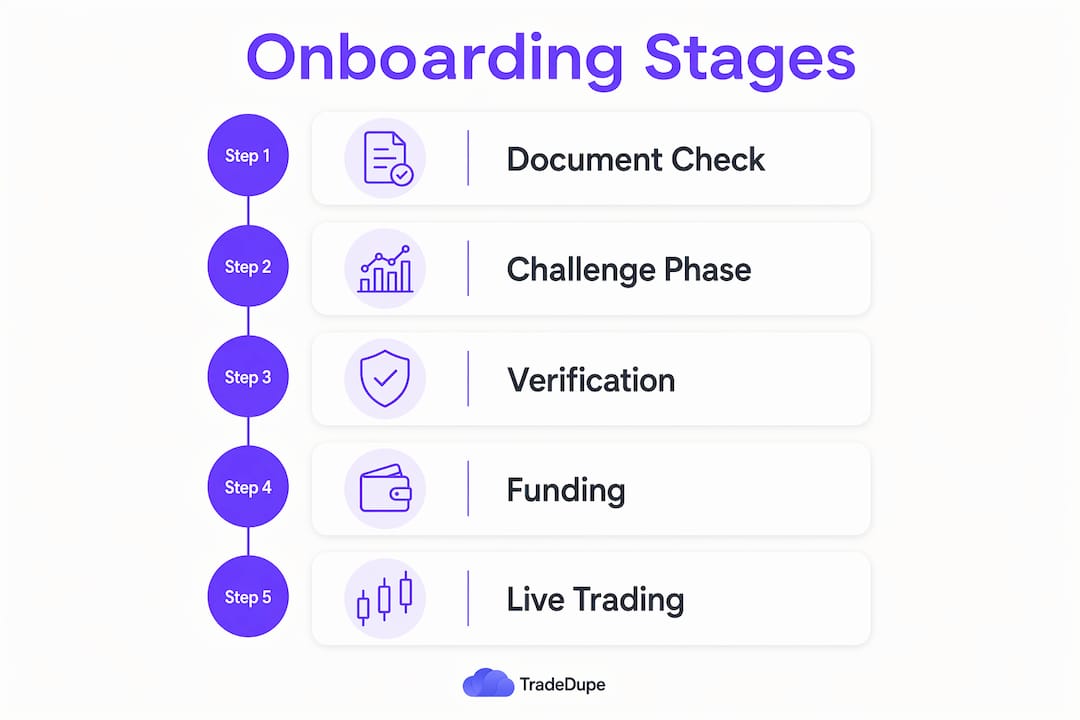
Prop firm onboarding follows a defined sequence that most firms treat as non-negotiable. The multi-stage evaluation begins with a simulated trading challenge and ends with a live funded account, with compliance checks inserted at the right moment to reduce friction for unqualified candidates. Here is how the standard progression breaks down:
- Trading challenge. You trade a simulated account with specific profit targets, typically 8 to 10%, while staying within a daily drawdown limit of around 5% and a maximum drawdown of 10 to 12% over 30 to 60 days. This phase tests whether your risk management holds under pressure, not just whether you can generate returns.
- Verification or second-phase evaluation. Many firms add a consistency phase after the initial challenge. The goal is to confirm that your first-phase performance was repeatable and not a product of one outsized trade or lucky session.
- KYC identity verification. Once you pass the evaluation, firms trigger Know Your Customer checks. FTMO, for example, delays KYC until after evaluation success, which reduces unnecessary friction for traders who do not qualify. You will typically need a government-issued photo ID and a proof of address document dated within 60 to 90 days.
- Funded account activation. After KYC clears, you receive access to a live or simulated-live funded account with a defined profit split, usually between 70% and 90% of net gains.
Pro Tip: Prepare your KYC documents before you even start the challenge. Name and address on your documents must match your trading profile exactly. Mismatches are the single most common cause of activation delays.
How do different prop firms structure their onboarding and evaluation?

Firms share the same general framework but differ meaningfully in account sizes, fee structures, platform integration, and payout speed. The table below compares three firms that represent the current range of approaches.
| Firm | Evaluation structure | Account sizes | Profit split | Payout speed |
|---|---|---|---|---|
| Topstep | Trading Combine → Express Funded Account → Live Funded Account | $50K, $100K, $150K | 90% after first $10K | Weekly |
| FTMO | Challenge → Verification → FTMO Account | $10K to $200K | Up to 90% | On-demand after 14 days |
| Kraken Prop | Simulated evaluation → Funded crypto account | $5K to $200K | 80% to 90% | Within 24 hours |
Topstep's stepwise path from Trading Combine to Express Funded Account to Live Funded Account is one of the most structured progressions in the futures space. Traders use the TopstepX platform throughout, which means the interface, order types, and data feeds stay consistent from evaluation to live trading. That consistency matters because it removes one variable from an already high-pressure transition.
Kraken Prop, built after Kraken's acquisition of Breakout, takes a different approach. It targets crypto traders specifically, offering leverage up to 5x across more than 60 pairs and processing payouts within 24 hours. The tight coupling between Kraken Prop and Kraken Pro tools means traders who already use Kraken's infrastructure face almost no learning curve during onboarding.
FTMO sits between these two in terms of speed and flexibility. Its two-step challenge is well-documented, and its decision to trigger KYC only post-evaluation reflects a deliberate design choice to keep unqualified applicants from clogging compliance queues. The practical implication for you: do not expect to submit identity documents until you have actually passed.
What compliance and operational systems support prop firm onboarding?
Prop firms managing thousands of active evaluations simultaneously cannot rely on manual review. Institutional-grade infrastructure with CRM systems and real-time risk monitoring has become the operational baseline for any firm running at scale. This infrastructure shapes your onboarding experience in ways that are not always visible but are always consequential.
The core systems at work during onboarding include:
- CRM lifecycle tracking. Firms log every stage of your journey from signup through funding. This data feeds automated triggers, such as sending KYC prompts after evaluation success or flagging accounts that approach drawdown limits.
- Real-time risk monitoring. Automated systems track your position size, daily loss, and drawdown in real time during the challenge. Breaching a limit typically results in immediate account suspension, not a warning.
- Document verification workflows. KYC turnaround typically runs 24 to 72 hours after submission, but only if documents are clean and match profile data. Discrepancies restart the clock.
- Regulatory compliance screening. Firms operating in or serving US-based traders are increasingly moving inside CFTC oversight boundaries, which means onboarding workflows are being updated to reflect new regulatory requirements.
> "Prop firms treat onboarding less as conventional training and more as structured risk-and-discipline integration. The evaluation enforces drawdown limits specifically to observe trader behavior under loss conditions, not just to filter for profitability." — growyourpropfirm.com
Understanding the compliance procedures prop firms enforce during evaluation helps you anticipate where friction points appear and prepare accordingly.
What practical tips help new traders succeed during onboarding?
Passing a prop firm evaluation requires more than a profitable strategy. The behavioral and logistical dimensions of onboarding trip up traders who are technically skilled but operationally unprepared. These are the areas that separate traders who activate quickly from those who stall at verification or repeat challenges.
- Match your documents to your profile before you apply. Your government ID name, address, and date of birth must align exactly with the information you enter during registration. A single mismatch, such as a middle name included on your ID but omitted from your profile, can delay activation by days.
- Simulate evaluation conditions before you start. Trading under strict drawdown rules on a demo account that mirrors the firm's platform builds the emotional discipline you will need when real money is on the line. Topstep's own Trading Combine guidance recommends this approach explicitly.
- Know the rules in detail, not just in outline. Daily drawdown limits, maximum position sizes, restricted trading hours, and consistency requirements vary by firm and account tier. Reading the rulebook once is not enough. Map each rule to a specific behavior in your trading plan.
- Use the firm's native platform during preparation. Platform coupling between evaluation and funded trading reduces dropout rates because traders who practice on the same interface they will use when funded face fewer surprises at the transition point.
Pro Tip: Treat the evaluation period as if your funded account is already live. Traders who mentally separate "challenge mode" from "funded mode" tend to take risks during evaluation that they would never take with real capital, which is exactly the behavior firms are designed to detect and disqualify.
How does the onboarding process impact funded trading and payouts?
Once you clear onboarding, the funded account phase introduces a new set of rules and expectations. The profit split structure, payout schedule, and ongoing compliance requirements all flow directly from how the firm designed its onboarding criteria. Understanding this connection helps you plan your trading activity from day one of funding.
| Parameter | Typical range | Notes |
|---|---|---|
| Profit split | 70% to 90% | Higher splits often unlock after reaching a profit milestone |
| Payout frequency | Weekly to bi-weekly | Some firms offer on-demand payouts after a minimum holding period |
| Minimum profit threshold | Varies by firm | Often $100 to $500 before first payout is eligible |
| Ongoing drawdown rules | Same as evaluation | Breaching limits results in account suspension or reset |
| Scaling eligibility | After consistent performance | Firms like Topstep offer account size increases for top performers |
The transition from evaluation to funded trading is where many traders discover gaps in their preparation. Ongoing risk monitoring does not stop after onboarding. Firms continue to track your drawdown, position sizing, and trading patterns in real time. Accounts that show erratic behavior or sudden strategy shifts after funding are flagged for review. For traders managing multiple funded accounts, this monitoring layer becomes even more significant. Knowing what happens after you get funded and how scaling works is as important as passing the initial challenge.
Key takeaways
Prop firm onboarding is a structured evaluation of both trading skill and risk discipline, and traders who prepare for the behavioral and compliance dimensions of the process activate faster and retain funded accounts longer.
| Point | Details |
|---|---|
| Multi-stage evaluation | Most firms run a challenge plus verification phase before granting funded access. |
| KYC timing matters | Firms like FTMO trigger identity checks only after evaluation success to reduce friction. |
| Platform consistency | Using the firm's native platform during preparation reduces dropout at the funded transition. |
| Document readiness | Mismatched KYC documents are the most common cause of activation delays. |
| Ongoing compliance | Risk monitoring continues after funding, with the same drawdown rules as the evaluation phase. |
The part of onboarding most traders underestimate
Most traders approach prop firm onboarding as a performance test. They focus on win rate, risk-reward ratios, and hitting the profit target. That framing is incomplete, and it costs a lot of people their challenge fees.
What firms are actually measuring is behavioral consistency under constraint. The drawdown limits are not just risk controls. They are behavioral probes. A trader who hits 8% profit but takes three days of maximum daily drawdown to get there tells the firm something very different from a trader who reaches the same target with controlled, repeatable session management. The first trader is a liability at scale. The second is someone worth funding.
The platform alignment point is also underappreciated. I have seen traders pass evaluations on one interface and then struggle in the funded phase because the execution environment felt different. Firms like Topstep and Kraken Prop have built tight coupling between their evaluation and funded platforms precisely because they know this dropout pattern exists. If you are preparing for a challenge, trade on the exact platform the firm uses, not a generic demo account.
Finally, expect onboarding processes to keep evolving. Regulatory pressure, particularly from CFTC-adjacent oversight in the US, is pushing firms to update their compliance workflows regularly. The KYC requirements you read about today may be stricter six months from now. Build the habit of checking a firm's current onboarding documentation before you start, not just when you are ready to submit documents.
> — Andres
How TradeDupe supports your funded trading workflow
Once you clear onboarding and enter the funded phase, managing multiple prop accounts becomes the next operational challenge. TradeDupe is built for exactly this stage.
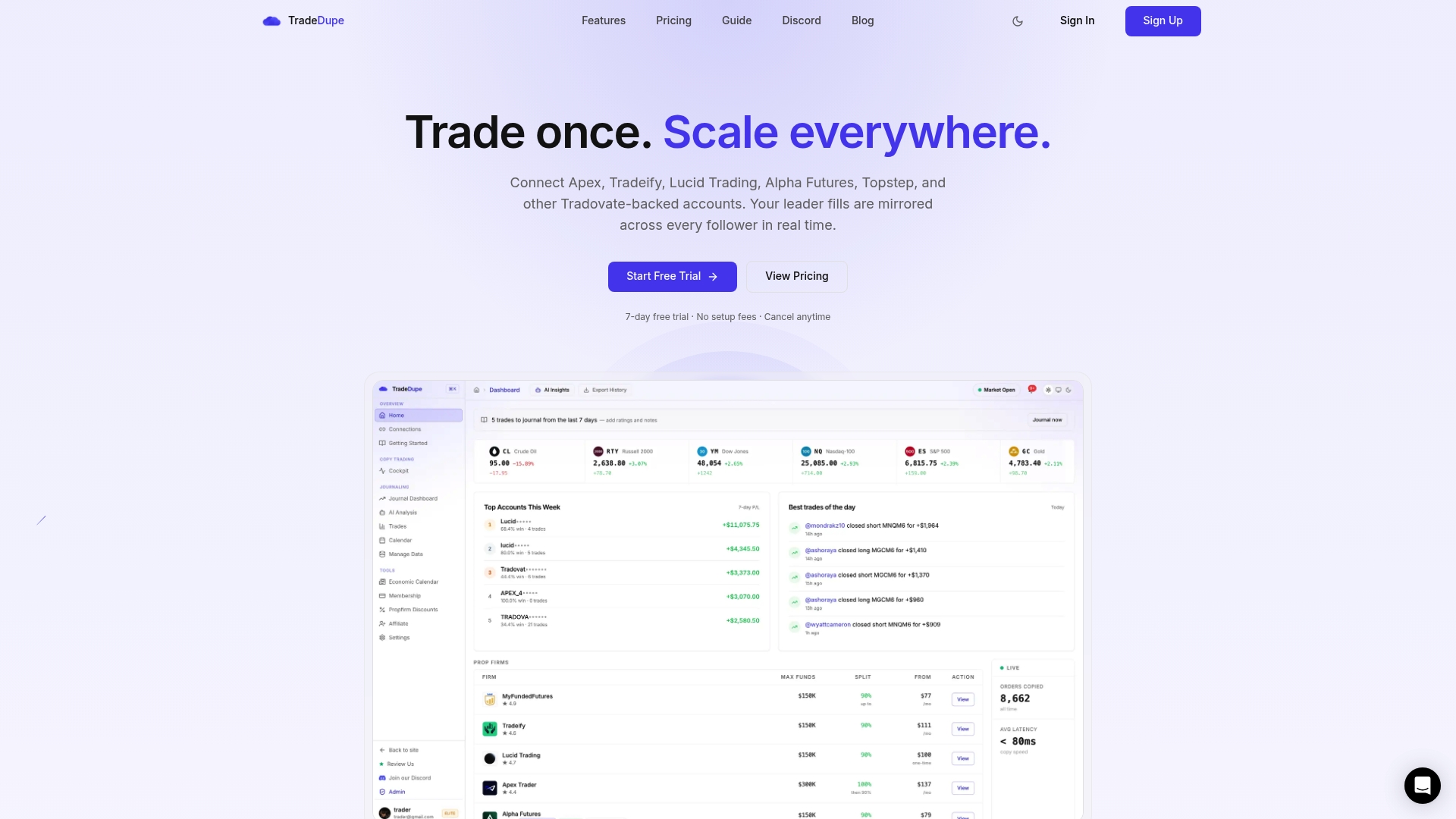
TradeDupe's real-time trade mirroring replicates positions from a single lead account across multiple follower accounts with a median latency of 34ms, supporting prop firm accounts on Apex, Tradeify, Lucid Trading, Alpha Futures, and Topstep. The platform includes rogue-trade detection, auto-recovery, and per-account toggle controls so you stay within each firm's risk parameters without manual oversight. For traders scaling from one funded account to several, TradeDupe's copy trading platform provides the infrastructure to do it without multiplying your operational workload. You can also explore the getting started guide to set up Tradovate copy trading in under 10 minutes.
FAQ
What is trader onboarding at a prop firm?
Trader onboarding is the process by which a prop firm evaluates a new trader through a simulated challenge, verifies their identity, and grants access to a funded account. The process tests both trading performance and risk discipline before any firm capital is deployed.
How long does prop firm onboarding take?
The evaluation phase typically runs 30 to 60 days, followed by KYC verification that takes 24 to 72 hours after submission. Total onboarding time from signup to funded account activation ranges from a few weeks to two months depending on the firm and how quickly you meet the trading objectives.
What documents are required for prop firm KYC?
Most firms require a government-issued photo ID and a proof of address document dated within 60 to 90 days. The name and address on your documents must match your trading profile exactly to avoid delays.
What profit split do funded traders typically receive?
Funded traders generally earn between 70% and 90% of net profits, with some firms offering higher splits after traders reach an initial profit milestone. Kraken Prop, for example, offers 80% to 90% splits with payouts processed within 24 hours.
Can you trade multiple prop firm accounts after onboarding?
Yes, and many professional traders do. Managing multiple funded accounts requires consistent risk discipline across each account, since each firm monitors drawdown and position sizing independently. Tools that synchronize trades across accounts help reduce the manual overhead of multi-account management.
Recommended
- How to Trade Prop Firms (2026): A Practical Playbook to Pass and Keep a Funded Account | TradeDupe Blog
- Best Futures Prop Firms 2026 — Updated Rankings | TradeDupe Blog
- The Futures Day Trading Landscape in 2026: ICT, Order Flow, Prop Firms, and What Actually Works | TradeDupe Blog
- How Prop Firm Rules Affect Trade Copying in 2026 | TradeDupe Blog