
How Prop Firm Rules Affect Trade Copying in 2026
TradeDupe
10 min read
Discover how prop firm rules affect trade copying in 2026. Understand the complexities to avoid costly mistakes and ensure compliance.
Most prop traders assume copy trading is either fully permitted or fully banned. The reality sits in a much more complicated middle ground, and misreading it costs traders real accounts. Understanding how prop firm rules affect trade copying is not optional for anyone running multi-account operations in 2026. The rules vary by firm, by account type, and even by the automation method you use. What one firm tolerates, another will flag as a violation on day one. This article breaks down exactly what those rules are, why they exist, and how to stay on the right side of them.
Table of Contents
- Key Takeaways
- How prop firm rules affect trade copying
- Risk management and compliance under copy trading rules
- Allowed practices versus common violations
- Strategies for navigating copy trading regulations
- My perspective on where this is all heading
- How Tradedupe supports compliant multi-account trading
- FAQ
Key Takeaways
| Point | Details |
|---|---|
| Internal copying has strict limits | Most prop firms allow copying only between accounts under the same owner, typically capped at two accounts. |
| Automated bots are widely banned | Third-party signal providers and external bots can trigger immediate account termination at most firms. |
| Account type matters significantly | Some firms permit copy trading during evaluation phases but prohibit it entirely on funded accounts. |
| Real-time monitoring is active | Firms use pattern detection to flag identical trade execution across accounts, even for manual trades. |
| Compliance requires written confirmation | Assuming copy trading is allowed without written firm approval creates serious account loss risk. |
How prop firm rules affect trade copying
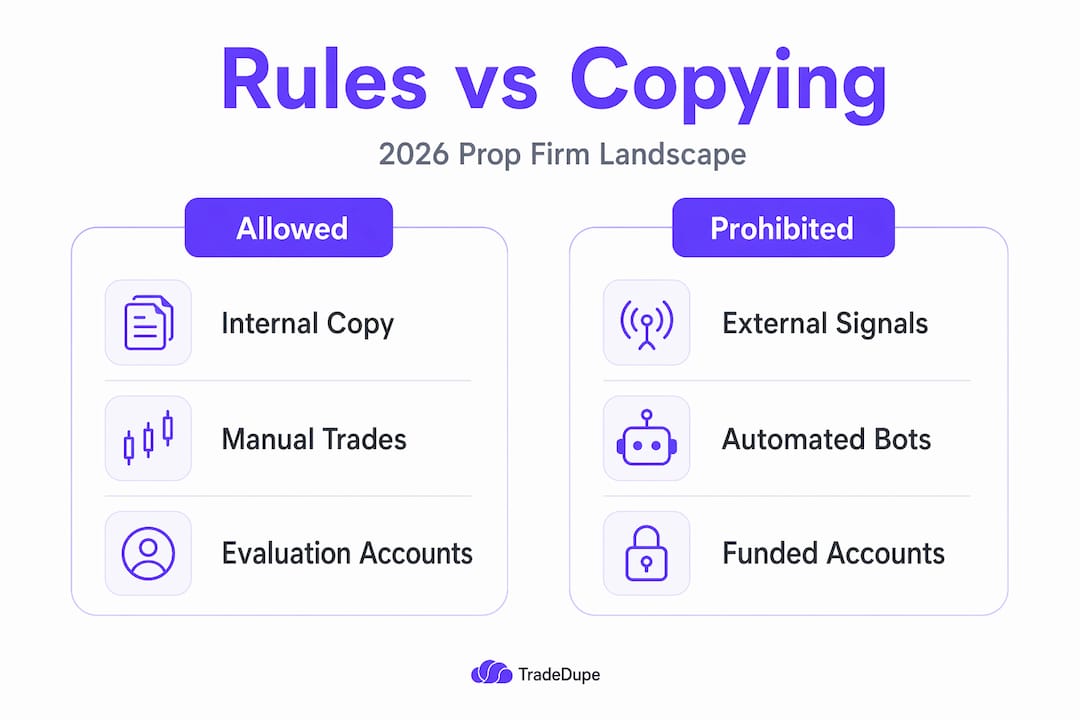
The first thing to understand is that most prop firms prohibit third-party copy trading entirely while permitting internal copying between accounts under the same owner, but with firm restrictions. That distinction matters more than traders realize. Internal copying typically means replicating trades from one evaluation account to another account you personally own. Even then, the majority of firms cap this at two accounts maximum and require manual trade execution on at least one side of the transaction.
The rules break down into several concrete categories:
- Third-party signal providers: Subscribing to an external signal service and letting it fire orders into your prop account is banned at virtually every major firm. This includes copy-trading networks, social trading platforms, and algorithmic signal bots operating from external servers.
- Automated execution bots: Running an expert advisor or automated script that places orders without your direct manual input is treated as a distinct violation. The key distinction is whether a human is making the execution decision.
- Account count limits: Firms that do allow internal copying typically permit it across a maximum of two accounts simultaneously. Running a single strategy across five or ten accounts simultaneously is a common violation pattern.
- Hold time requirements: Tradeify enforces a 10-second minimum hold rule, requiring that most profits come from trades held longer than 10 seconds, specifically to prevent high-speed copying that mimics scalping bots.
- Profit consistency caps: Several firms enforce daily profit caps in the 30% to 50% range. Blowing past these thresholds, even legally, triggers review.
Pro Tip: Read the firm's Terms of Service and their specific "prohibited trading practices" section before running any multi-account setup. General policy pages often omit the granular details that actually get accounts flagged.
Understanding prop firm copy trading policies before you trade is the clearest way to avoid running afoul of rules that feel obvious only in retrospect.
Risk management and compliance under copy trading rules
Prop firms do not write these rules arbitrarily. Their rationale is grounded in protecting firm liquidity, maintaining fairness across their trader pool, and verifying that traders possess genuine skill rather than borrowed signals. Third-party bots and signals create concentrated correlated risk across multiple accounts simultaneously, which is exactly the exposure that prop firms cannot absorb without threatening their own capital base.
Here is how enforcement actually operates in practice:
- Pattern detection monitoring: Firms use real-time systems that flag identical trade execution patterns across multiple accounts. If your accounts are entering and exiting positions at the same millisecond with the same contract size, that pattern is detectable even if the execution appears manual.
- Cross-account hedging flags: Holding opposing positions across different accounts within the same firm is a serious red flag. Cross-account hedging that creates overlapping offsetting positions beyond short thresholds triggers forced liquidation and review.
- Daily drawdown correlation: When multiple accounts breach daily drawdown limits on the same instrument at the same time, the risk desk takes notice. Correlated drawdown across accounts signals a shared strategy, not independent trading.
- Performance anomaly review: Artificial performance, meaning results that are statistically inconsistent with genuine discretionary trading, can prompt manual review even before a specific rule is breached.
> "Assuming copy trading is allowed without explicit confirmation risks account loss; rules can change retroactively." — Copy Trading And Prop Firms: Rules, Risks & Reality
The penalties for violations range from profit forfeiture to permanent account termination. Firms that publish clear automation policies see 90-day trader survival rates of 62% compared to the industry average of 41%, which tells you that clarity in rules, not leniency, is what actually protects traders long-term.
Allowed practices versus common violations
Not all copy trading activity falls into a gray area. There are genuinely clear distinctions between what most firms permit and what reliably triggers sanctions. The table below maps these categories using commonly observed firm policies.
| Practice | Status | Notes |
|---|---|---|
| Internal copying between 2 owned accounts | Generally permitted | Manual execution required; same-owner accounts only |
| External signal subscription service | Prohibited | Treated as third-party automation regardless of execution method |
| Automated bot execution | Prohibited | Applies even to bots built on the trader's own strategy |
| Copy trading during evaluation phase | Firm-dependent | Some firms allow it in evaluations but not on funded accounts |
| Cross-account hedging | Prohibited | Overlapping opposing positions trigger forced liquidation |
| Proportional scaling across accounts | Permitted with limits | Position sizing must align with each account's contract limits |
| High-frequency copying under 10 seconds | Prohibited at some firms | Tradeify's 10-second rule is a concrete example of this restriction |
The account-type distinction is worth examining more closely. Copy trading is frequently restricted to evaluation accounts and forbidden on funded accounts. The reasoning is straightforward: funded accounts represent real firm capital, so firms require demonstrated individual skill rather than replicated signals before deploying that capital.
Automation adds another layer of complexity. A trader running a manually coded strategy that places orders through a script is often treated the same as someone using a third-party bot, because the distinction the firm cares about is human discretion at the execution moment, not the origin of the signal. The impact of prop firm rules on automation strategies is therefore more restrictive than many traders initially assume when they read a generic "automated trading is allowed" clause in a firm's FAQ.
Strategies for navigating copy trading regulations
Staying compliant while running multi-account operations requires more than good intentions. It requires a deliberate operating framework built around each firm's specific rule set. Here is how experienced prop traders and firm operators approach this correctly:
- Verify rules in writing before execution: Contact your prop firm's support team and request written clarification on copy trading permissions. Verbal or chat-based confirmations are not sufficient. Rules can change retroactively, and written records are your only protection.
- Use proportional position sizing: Scaling contract sizes proportionally across accounts based on each account's size and drawdown limits prevents the "identical pattern" signature that monitoring systems target. A 5-contract position on a $150K account and a 2-contract position on a $50K account tells a different story than 5 contracts on both.
- Manage latency deliberately: Latency under 100ms and proportional sizing help avoid accidental rule violations during multi-account copying. Firms interpret ultra-low-latency identical fills as evidence of automated bot activity. A copying tool with controllable latency settings gives you the ability to stay within acceptable parameters.
- Segment your account types: Keep evaluation accounts separate from funded accounts in your copy trading setup. Apply copy trading only to evaluations if the firm permits it there, and switch to fully independent execution on funded accounts.
- Monitor your own accounts as a risk desk would: Check for correlated drawdown, overlapping position timing, and daily profit concentration. If your monitoring dashboard shows patterns that would flag a review, adjust before the firm's system catches it.
- Choose technology built for prop firm compliance: Not all trade copying tools treat prop firm rule sets as a design constraint. A platform built specifically for prop firm environments will include per-account toggles, latency controls, and rogue-trade detection as standard features.
Pro Tip: Risk managers who rely on copy trade systems for efficiency find that per-account toggle controls are non-negotiable. The ability to instantly disable copying on a single account without disrupting others is a critical compliance tool, not a nice-to-have.
Why risk managers rely on copy trade systems comes down to control, not just speed. The firms with the healthiest multi-account operations are the ones that treat compliance as infrastructure, not an afterthought.
My perspective on where this is all heading
I've watched traders lose funded accounts over copy trading violations they genuinely did not know were violations. That is the uncomfortable truth about this space. The rules are not always well-publicized, and firms have historically been inconsistent about enforcement, which creates a false sense of security for traders who have been copying for months without incident.
What I've learned from observing how prop firms evolve their policies is that enforcement tightens as firms mature. A firm that ignored internal copying across three accounts in 2023 may have automated detection for exactly that pattern in 2026. Treating copy trading permissions as permanent guarantees is the single biggest mistake I see traders make.
The balance between automation and compliance is real, but it is not impossible to manage. The traders who do it well are the ones who read rules as if they will be enforced strictly on day one, request written confirmations before they need them, and build their multi-account setups around technology that was designed for prop firm constraints from the ground up.
Firms with clear copy trading rules see account retention that is 40% higher than firms with vague policies. That number tells you something important. Clarity benefits traders as much as it benefits firms. When the rules are specific, traders can build compliant systems confidently. When the rules are vague, everyone loses.
The advice I would give to any prop trader or operator entering this space: treat your copy trading permission as a privilege that requires ongoing verification, not a checkbox you clear once during onboarding.
> — Andres
How Tradedupe supports compliant multi-account trading
Managing copy trading compliance across multiple prop firm accounts is operationally demanding, and the margin for error is thin. Tradedupe was built specifically for this environment.
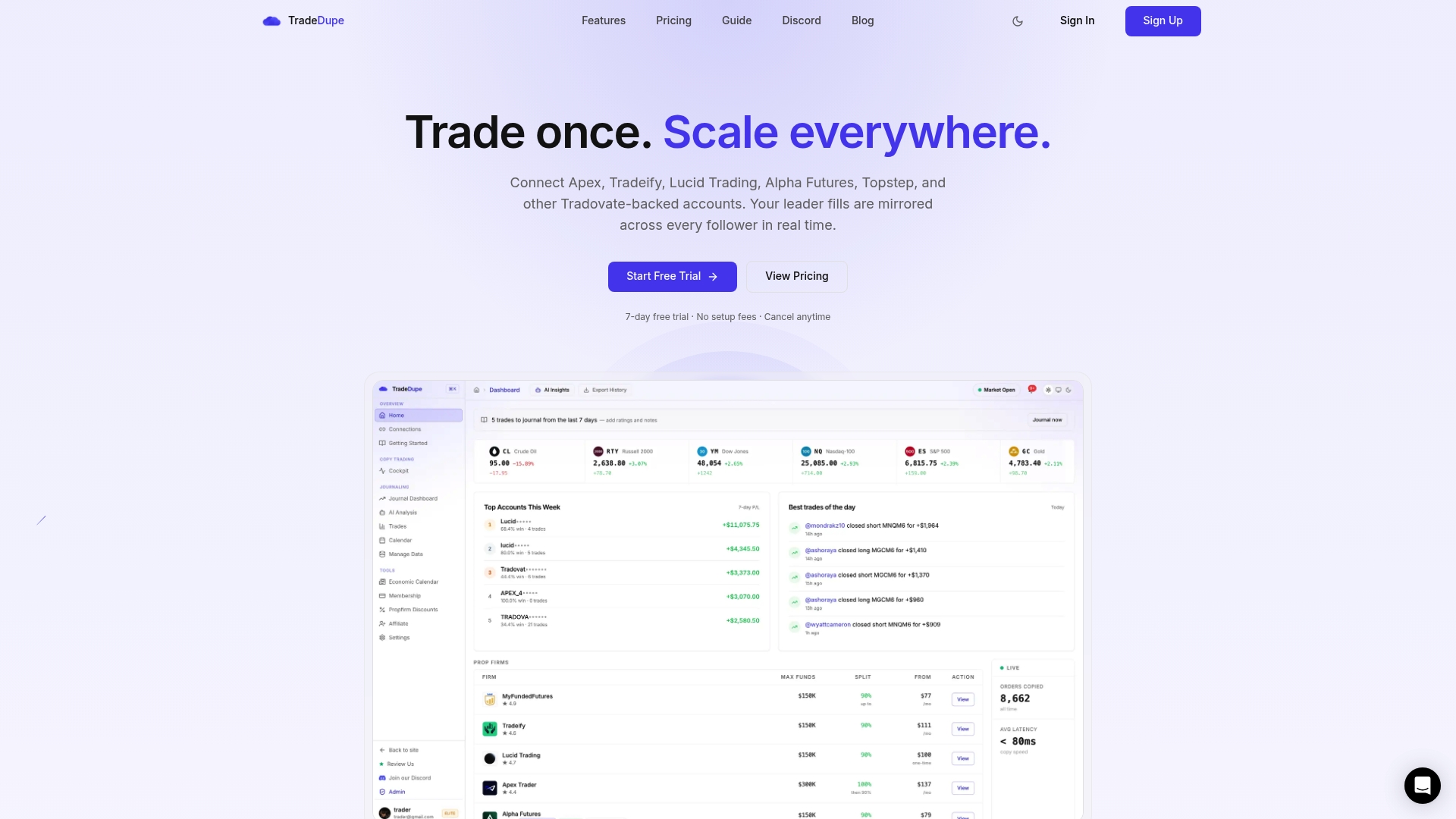
Tradedupe integrates natively with Tradovate and supports accounts at Apex, Tradeify, Lucid Trading, Alpha Futures, and Topstep, the prop firms where multi-account management is most common. Its real-time trade mirroring operates at a median latency of 34ms, with per-account toggle controls that let you enable or disable copying on any individual account without interrupting others. Rogue-trade detection and auto-recovery features add another layer of oversight that risk managers and firm operators need when running scaled operations. If you are building a prop trading operation that needs to stay inside firm rules while scaling across accounts, explore Tradedupe's platform to see how the toolset maps to your compliance requirements. The Tradovate trade copier functionality is designed with prop firm rule sets as a core constraint, not a secondary consideration.
FAQ
What copy trading is typically allowed at prop firms?
Most prop firms allow internal copying between a maximum of two accounts owned by the same trader, provided manual execution is used and the firm's consistency rules are met.
Can automated bots be used for copy trading in prop firms?
Using third-party signal providers or automated bots typically results in immediate account termination, as firms prohibit automation that removes human discretion from trade execution.
Does copy trading work the same on evaluation and funded accounts?
No. Some firms permit copy trading during evaluation phases but prohibit it on funded accounts, where demonstrating independent trading skill is required.
How do prop firms detect prohibited copy trading?
Firms use real-time monitoring to identify identical trade execution patterns, correlated drawdown across accounts, and timing signatures consistent with automated copying, even when trades appear manual.
Why do prop firms restrict copy trading so heavily?
Prop firms restrict copy trading to protect firm liquidity, maintain fairness across their trader base, and verify that individual traders possess genuine skill rather than relying on borrowed signals.