
Why risk managers rely on copy trade systems for efficiency
TradeDupe
12 min read
Discover why risk managers use copy trade systems to enhance efficiency, precision, and scalability in their trading operations. Learn more!
Copy trading is widely misunderstood as a retail feature, something retail investors use to follow popular traders on social platforms. For risk managers overseeing multiple proprietary accounts within the Tradovate ecosystem, the reality is far more consequential. Copy trade systems are operational infrastructure. They determine whether a firm's execution model scales cleanly or fractures under the weight of manual processes, inconsistent sizing, and human error. This guide breaks down why these systems matter, how they work in practice, where they fall short, and what risk managers can do to extract maximum reliability from them.
Table of Contents
- The core purpose: Precision and scale for risk managers
- How copy trade systems work in a risk-managed environment
- Critical limitations: What risk managers must account for
- Best practices for maximizing reliability and performance
- A deeper look: Copy trading isn't full automation—here's what most risk managers miss
- Ready to strengthen your risk management with reliable copy trading?
- Frequently asked questions
Key Takeaways
| Point | Details |
|---|---|
| Automate with confidence | Copy trading systems let risk managers efficiently control many accounts while reducing manual errors. |
| Watch for limitations | System gaps like delayed replication or missed bracket orders require ongoing monitoring. |
| Partial automation, not a cure-all | No system is fully hands-off; expertise and vigilance are vital to manage risk effectively. |
| Enhance oversight with best practices | Routine audits, clear logs, and standardized risk models boost copy trading reliability. |
The core purpose: Precision and scale for risk managers
Now that you understand why copy trading is more than just a retail feature, let's examine what it actually delivers for institutional risk management.
At its foundation, copy trading solves a scaling problem. When a risk manager oversees five accounts, manual entry is inconvenient. When that number climbs to fifteen or thirty accounts across multiple prop firm evaluations, manual replication becomes a genuine operational liability. A single missed entry or miscalculated position size can skew the risk profile of an entire account group.
Risk managers use copy-trade systems primarily to scale a single execution and risk model across many accounts while keeping manual effort low and reducing human error. That single sentence captures the core value proposition. Automation removes the human bottleneck between signal and execution.
Here is what reliable copy trading actually delivers for a risk management operation:
- Uniform position sizing across all follower accounts, based on predefined ratios or fixed contract counts
- Simultaneous order placement, eliminating the fill-time gaps that occur when manually entering trades account by account
- Reduced cognitive load, freeing risk managers to focus on strategy refinement and exception handling rather than repetitive data entry
- Consistent application of the risk model, so that drawdown limits, position limits, and trade types are applied identically across the portfolio
- Audit-ready execution records, since automated systems log every replicated order with timestamps and fill data
Understanding copy trading strategies that align with your firm's risk model is essential before configuring any replication setup. The strategy layer and the execution layer must be compatible for automation to add value rather than amplify errors.
> "Scaling execution and risk management is impossible without reliable, automated replication—manual copying is a risk manager's bottleneck."
The overhead reduction argument is particularly compelling for firms running multiple funded accounts across platforms like Apex, Topstep, or Tradeify. Each account carries its own rules, drawdown limits, and contract restrictions. A well-configured copy system applies those parameters automatically, rather than requiring a risk manager to mentally context-switch between account environments on every trade. For a thorough foundation, reviewing a guide to copy trading helps teams align on terminology and workflow before deployment.
How copy trade systems work in a risk-managed environment
Understanding the basics, let's dig into the nuts and bolts of how these systems are implemented and used by risk managers.
The core architecture of any copy trading system is the leader-follower model. A single leader account, sometimes called the master account, executes trades based on the risk manager's strategy. Those trades are then detected and replicated to one or more follower accounts, either at a fixed contract size or at a ratio proportional to each follower's account size.
Risk managers rely on copy systems' mechanics including leader-to-follower replication with predefined contract and position sizing ratios, to maintain consistency across accounts. The speed of this replication matters enormously in futures markets, where price can move significantly in the seconds it takes to manually enter a second or third order.
Here is a step-by-step view of how a risk manager typically configures and supervises a multi-account copier:
- Define the leader account. Identify which account will serve as the execution source. This is typically the account where the primary strategy runs.
- Connect follower accounts. Link each follower account to the platform, assigning sizing logic (fixed contracts or proportional ratio) to each one individually.
- Set per-account parameters. Configure account-level controls such as maximum daily loss limits, allowed instruments, and whether bracket orders should be attempted on the follower side.
- Run a test sequence. Place small test orders on the leader account and verify that each follower receives and fills the replicated order within acceptable latency thresholds.
- Go live in stages. For large portfolios, stagger the go-live process rather than activating all follower accounts simultaneously. This isolates any configuration issues before they affect the full account group.
- Monitor in real time. Use the platform's dashboard to track sync status, fill confirmation, and any flagged deviations between leader and follower fills.
The following table summarizes the key parameters that risk managers typically configure within a copy trading environment:
| Parameter | Description | Typical setting |
|---|---|---|
| Sizing method | How follower contracts are calculated | Fixed count or proportional ratio |
| Trade types copied | Which order types trigger replication | Market orders, limit orders |
| Latency threshold | Maximum acceptable delay for replication | Under 100ms for futures |
| Fill spread tolerance | Acceptable price difference between leader and follower fills | 1 to 2 ticks |
| Bracket order handling | Whether stop loss and take profit orders are replicated | Platform-dependent |
| Per-account toggle | Ability to pause replication for a single account | Enabled on advanced platforms |
Pro Tip: Always test new copier setups with small, single-contract orders on a non-critical session before going live with full position sizes. Stagger activation across follower accounts to isolate configuration errors before they affect the entire portfolio.
For teams evaluating futures trading copier software, the key differentiator is not just replication speed but the granularity of per-account controls and the quality of real-time monitoring available to the risk manager.
Critical limitations: What risk managers must account for
While these systems can automate much of the process, it is critical for risk managers to recognize their current limits.
No copy trading system operates without edge cases. Copy systems may face edge cases like latency, order-type limitations, and incomplete replication of bracket orders, all of which may alter realized risk across follower accounts. Understanding these gaps before they surface in live trading is what separates proactive risk management from reactive damage control.
The most common failure points include:
- Latency spikes during high-volatility periods, where the leader fills at one price but followers receive a significantly different fill due to market movement in the intervening milliseconds
- Bracket order gaps, where the leader's stop loss and take profit orders are not replicated to followers, leaving follower accounts with unprotected open positions
- Partial fill mismatches, where the leader fills a five-contract order in two partial fills but the follower receives only the first partial, creating a size discrepancy
- Platform-imposed restrictions, where the native copy tool limits which instruments or order types can be replicated
- Network interruptions, where a brief connectivity loss causes a follower account to miss an entry or exit entirely
Some platform-native copiers intentionally limit what can be copied, which requires risk managers to treat copy systems as partial, not full, automation. This is a critical mindset shift. Treating any copy system as a complete hands-off solution without ongoing monitoring is how silent errors accumulate.
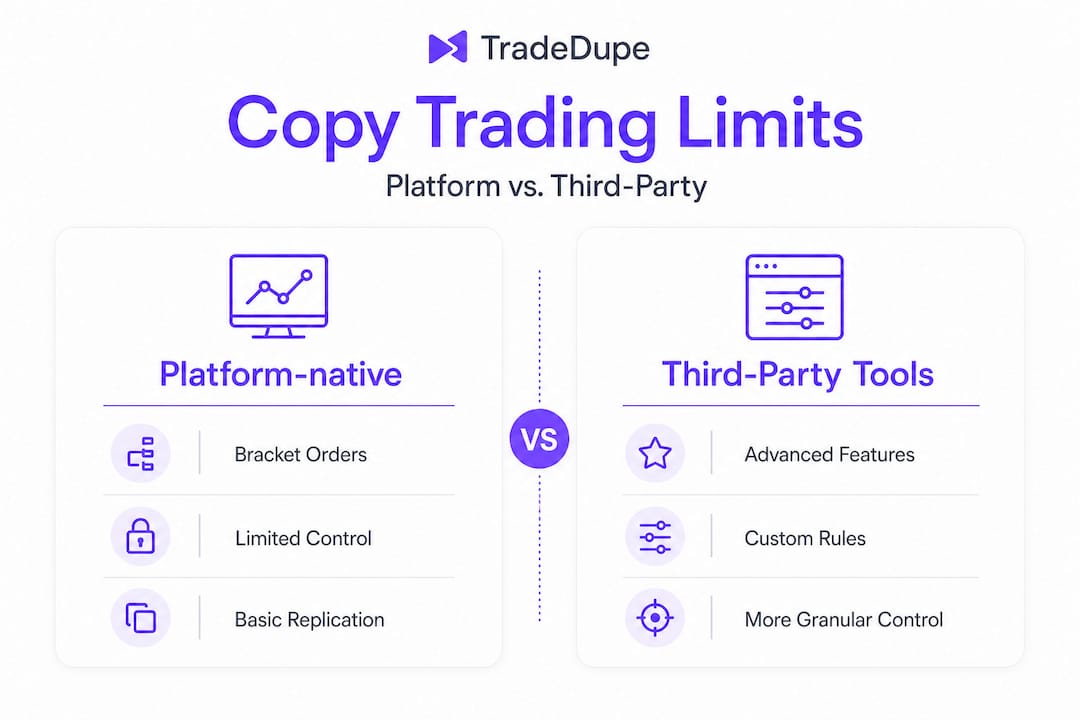
The comparison below illustrates how platform-native and third-party copier tools differ in handling these limitations:
| Feature | Platform-native copier | Third-party tool (e.g., TradeDupe) |
|---|---|---|
| Bracket order replication | Often not supported | Supported with configuration options |
| Latency | Variable, platform-dependent | Optimized (median 34ms in advanced tools) |
| Error handling | Minimal or none | Auto-recovery and rogue-trade detection |
| Per-account toggle | Rarely available | Standard feature |
| Real-time monitoring dashboard | Basic | Comprehensive with alerting |
| Supported prop firm integrations | Limited | Apex, Topstep, Tradeify, and others |
For teams evaluating their options, reviewing a copy trader comparison or exploring TradeCopia alternatives provides a structured framework for identifying which tool best fits a specific risk management workflow. You can also review a TradeSyncer vs TradeCopia breakdown to understand how feature sets differ across the major third-party options.
Pro Tip: Schedule a weekly audit of all follower accounts, comparing their trade logs against the leader account's execution record. Even a single missed trade or size discrepancy can compound into meaningful P&L and risk exposure differences over time.
Best practices for maximizing reliability and performance
So what can top-performing risk managers do to ensure their automation delivers robust, repeatable results?
Copy trading platforms are framed as solving replication, consistent risk and size logic, and overhead reduction for scaling. But the tool only performs as well as the process built around it. The following practices separate firms that get consistent results from those that treat copy trading as a black box.
- Standardize your risk model before automating it. Define position sizing rules, maximum daily loss limits, and allowed instruments in writing before connecting any accounts. Automation amplifies whatever model it replicates, including flawed ones.
- Run edge-case dry runs. Simulate scenarios like partial fills, rapid reversals, and simultaneous entries across multiple instruments to verify how your copy system handles each situation before it occurs in live trading.
- Implement real-time alerting. Configure your platform to send notifications when a follower account deviates from the leader's position by more than a defined threshold. Silent mismatches are the most dangerous.
- Maintain detailed execution logs. Every replicated order should be logged with timestamps, fill prices, and account identifiers. These logs are essential for post-session audits and for identifying patterns in replication failures.
- Create a manual override protocol. Define in advance which team member has authority to pause replication for a specific account, and under what conditions. An unplanned override during a fast market is not the time to establish that process.
- Train your full team on both capabilities and limitations. Every team member who interacts with the copy system should understand what it does and does not automate. Overconfidence in automation is a risk factor in itself.
- Review your setup after major platform updates. Brokerage platforms and third-party tools update their APIs and features regularly. A configuration that worked last month may behave differently after an update.
For firms running Apex-funded accounts, reviewing the specific Apex copy trading setup documentation ensures that account-specific rules are correctly reflected in the copier configuration. When you are ready to build or refine your workflow, the setup Tradovate copy trading guide walks through the technical steps in a structured sequence.
A deeper look: Copy trading isn't full automation—here's what most risk managers miss
Here is the uncomfortable truth that experienced risk managers eventually arrive at: copy trading systems are powerful, but they are not autonomous. They are precision instruments that require skilled operators.
The most common misconception is that deploying a copy system transfers accountability from the risk manager to the software. It does not. Some workflows and platform-native copiers intentionally limit what can be copied, which shifts risk management toward manual overrides or external tools. That shift does not disappear when you add automation. It gets redistributed.
What actually happens in a well-run operation is that automation handles the high-frequency, low-complexity tasks, specifically, order replication, sizing consistency, and simultaneous execution. The risk manager's role evolves toward exception management, system oversight, and strategic calibration. That is a more valuable use of a skilled professional's time, but it is still active work.
The firms that struggle with copy trading are usually those that deploy a system, reduce their monitoring cadence, and then discover weeks later that a bracket order gap or a latency spike has been silently distorting their follower accounts' risk profiles. By the time the discrepancy surfaces in a drawdown report, the accumulation is significant.
> "Treating copy trade systems as full portfolio automation exposes firms to silent, accumulative errors. Smart risk managers treat these as tools, not replacements."
The future of risk management in multi-account prop trading environments is layered. It combines robust automation for execution with real-time monitoring for exception detection and flexible manual overrides for edge cases. No single layer is sufficient on its own. Reviewing an advanced copier comparison helps firms identify which tools support all three layers rather than just the automation component.
The risk managers who get the most out of copy trading systems are those who treat them as force multipliers for their own judgment, not substitutes for it.
Ready to strengthen your risk management with reliable copy trading?
If you want to bridge the gap between insight and action, here is how to level up your risk operation.
TradeDupe is purpose-built for exactly the workflows this article describes. It delivers real-time trade mirroring across multiple Tradovate accounts with a median latency of 34ms, rogue-trade detection, auto-recovery, and per-account toggle controls that give risk managers the granular oversight that platform-native tools simply do not offer.
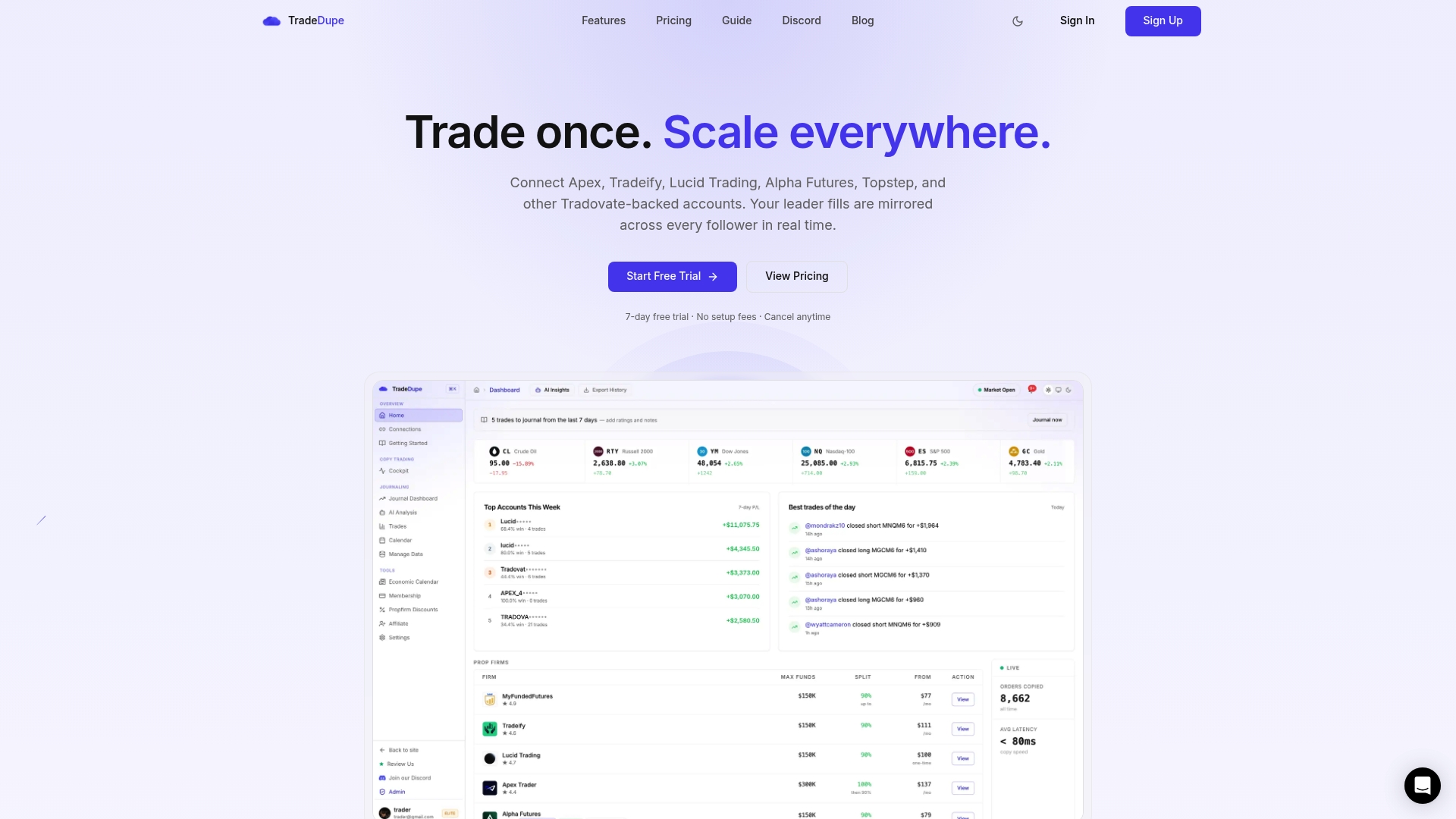
Whether you are managing a small group of funded accounts or running an enterprise-level prop desk across Apex, Topstep, Tradeify, and other integrations, TradeDupe scales to fit your operation. Before committing, it is worth reviewing the TradeDupe vs TradeCopia breakdown to understand exactly how the feature sets compare, and the TradeSyncer vs TradeCopia comparison to see where TradeDupe stands in the broader competitive landscape. Setup takes minutes, and the monitoring dashboard gives you real-time visibility from day one.
Frequently asked questions
Do copy trade systems eliminate all trading risks?
No. Copy trading reduces manual errors and improves execution consistency, but it cannot eliminate market risk, fill slippage, or platform-specific failures. Copy systems face limitations such as latency and incomplete order replication that can still alter realized risk.
What types of trades or orders might not be copied?
Bracket orders, specifically stop loss and take profit orders, are frequently not replicated in native Tradovate setups. Tradovate-native copying is market-order based and does not copy bracket stop-loss or take-profit orders, leaving follower accounts without automated exit protection.
How do risk managers handle errors in copy trade systems?
The best practice is to audit follower accounts regularly and maintain documented manual override procedures for order mismatches. There is no built-in error handling for follower order failures in many systems, so proactive monitoring is the primary defense.
Are copy trade systems suitable for all trading platforms?
Not all platforms support robust copy trading natively. Platform-native copiers often have trade type and error handling limitations, making specialized third-party tools a practical necessity for full-featured, reliable replication within the Tradovate ecosystem.