

How to Pass a Prop Firm Challenge Copier in 2026
TradeDupe
11 min read
Learn how to pass prop firm challenge copier in 2026. Discover key strategies, risk management tips, and tools for success in trading.
A prop firm challenge copier is a trade replication tool that mirrors positions from one master account to multiple follower accounts in real time, giving traders a repeatable, rule-compliant way to run evaluations at scale. Only about 7% of traders who begin a prop firm evaluation ever reach their first payout. That number exposes a brutal truth: the challenge itself is not the hard part. Surviving it with consistent risk management across multiple accounts is. A well-configured copier, paired with disciplined position sizing and firm-specific rule compliance, is the most direct path to prop firm challenge success.
What are prop firm challenges and why is manual risk management so hard?
Prop firm evaluations impose strict performance rules that most traders underestimate. A typical challenge requires traders to hit a profit target, usually 8–10% of account size, while staying within a daily drawdown limit of 4–5% and a maximum drawdown of 8–10%. Many firms also enforce a minimum trading day requirement, often 10 days, and a consistency rule that caps how much of your total profit can come from any single day.
These rules create a narrow corridor. You must grow the account fast enough to hit the target but slowly enough to avoid breaching drawdown limits. 80–90% of traders fail because they chase targets too aggressively, risking 3–5% per trade instead of the recommended 0.5–1%. That behavior is not a skill problem. It is a behavioral one, driven by urgency and loss aversion.
Managing multiple challenge accounts manually compounds every one of these problems. When you trade three or four accounts simultaneously, execution timing drifts. You miss entries on one account, size incorrectly on another, and forget to close a position before the daily drawdown limit triggers. The cognitive load alone degrades decision quality. This is exactly the gap that automated trade copying fills.
- Daily drawdown limit: Typically 4–5% of account balance; breaching it ends the challenge immediately.
- Maximum drawdown: Usually 8–10%; this is the hard ceiling across the entire evaluation.
- Minimum trading days: Most firms require 10 or more active trading days to prevent one-session pass attempts.
- Consistency rule: Limits profit per day to 30–50% of total profits, blocking overnight-success strategies.
How does a trade copier work for prop firm challenges?
A trade copier operates on a master/slave architecture. The master account sends trade signals, and follower accounts replicate those trades automatically, adjusting position size based on a scaling multiplier. The key distinction for prop firm use is that the copier replicates your own trades, not third-party signals. Most reputable prop firms permit copiers only when you are copying your own accounts. Subscribing to a shared signal service violates group-trading rules and results in immediate disqualification.
The technical components that determine whether a copier actually protects your accounts are latency, symbol mapping, and risk controls. A latency delay of even 500ms causes significant slippage and can push a follower account past its drawdown limit when the master account stays safe. VPS hosting in financial hubs like New York or London keeps execution tight. Symbol mapping handles differences in contract naming between brokers, so a trade on NQ on one platform copies correctly to a platform using a different ticker format.

Risk controls built into the copier are what separate a professional setup from a dangerous one. The most critical feature is the global daily loss limit, which automatically closes all positions across every follower account when a combined loss threshold is hit. This fail-safe prevents multi-account blowouts during flash crashes or high-impact news events. Proportional scaling, rather than fixed lot copying, adjusts position size relative to each follower account's balance, keeping risk consistent across accounts of different sizes.
Pro Tip: Use a demo account as your master rather than a live challenge account. This removes emotional pressure from the master account and forces you to trade conservatively, since the demo has no financial consequence but the followers do.
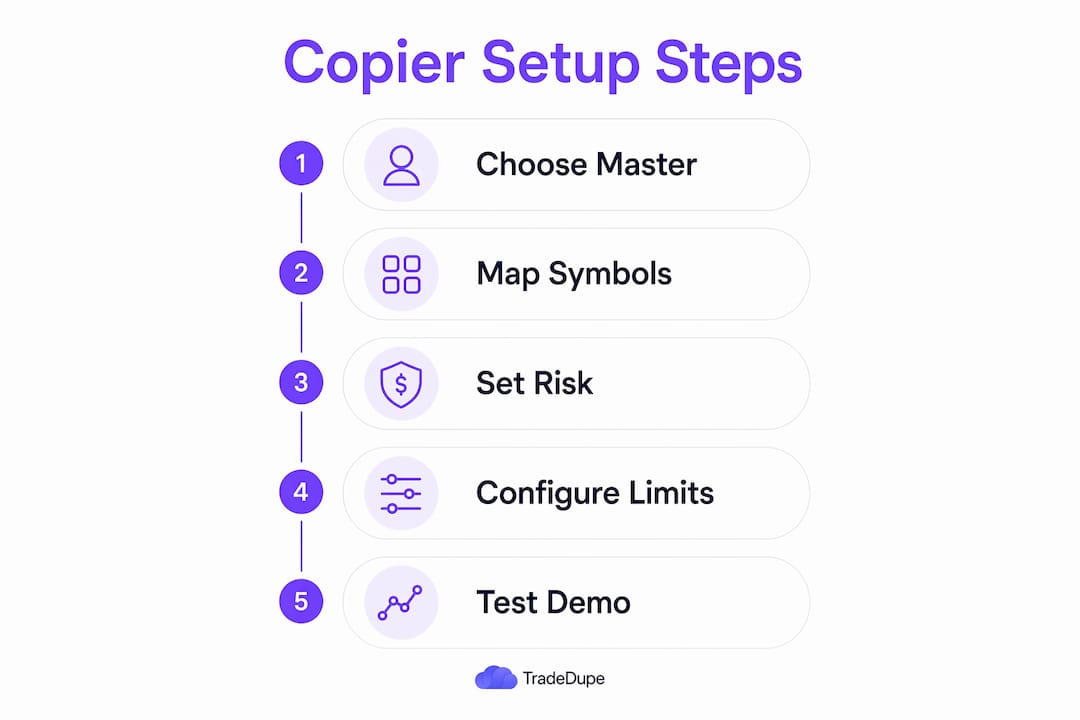
Step-by-step setup for a prop firm challenge copier
Getting the configuration right before you start a challenge is non-negotiable. A single misconfigured parameter can breach a drawdown limit on every follower account simultaneously.
- Choose your master account. Select the account with the tightest rules or use a demo master. Successful traders often use a demo master to enforce emotional discipline, since real money only flows through the follower accounts.
- Select your copier platform and VPS. Place your VPS in a data center close to your broker's servers. For Tradovate-based prop firms like Apex, Tradeify, Lucid Trading, and Alpha Futures, Tradedupe runs with a median latency of 34ms, which keeps execution tight enough to protect drawdown limits.
- Map your symbols. Confirm that every instrument on the master account maps correctly to the equivalent contract on each follower. A mismatch here causes the copier to skip trades or open the wrong instrument entirely.
- Configure risk parameters. Set per-trade risk at 0.5–1% of each follower account's balance. Apply a global daily loss limit at 80% of the firm's stated daily drawdown limit. This internal buffer gives you a margin of safety before the firm's hard limit triggers.
- Set scaling multipliers. If your master account is $10,000 and a follower account is $50,000, a 5x multiplier keeps risk proportional. Proportional scaling prevents the fixed-lot signature patterns that prop firms flag as group-trading violations.
- Run a simulation. Execute test trades on the master and verify that every follower replicates correctly, with the right size, the right symbol, and within the expected latency window. Fix any discrepancies before the live challenge begins.
Pro Tip: Set your internal copier daily loss limit 1–2% tighter than the firm's stated limit. This buffer absorbs slippage and spread costs during volatile sessions without triggering a hard breach.
For a detailed walkthrough of multi-account copier setup on Tradovate, Tradedupe's documentation covers each configuration step with platform-specific screenshots.
What trading strategies work best with a copier during a challenge?
The copier handles execution. Your trading plan handles the decisions. These two layers must align, or the copier amplifies bad habits instead of containing them.
Risking 1% per trade with a 1:2 reward-to-risk ratio can raise pass rates to as high as 40%, compared to the industry-wide average of 7–12%. That improvement comes entirely from behavioral discipline, not from finding better setups. The copier enforces that discipline mechanically by preventing you from manually overriding position sizes on follower accounts.
> "The copier is not a shortcut. It is a constraint system. When configured correctly, it makes it structurally difficult to blow a drawdown limit, because the risk parameters are baked into the execution layer, not left to willpower in the heat of a trade."
A few strategy principles that pair well with copier-based execution:
- Trade fewer, higher-quality setups. Overtrading is the fastest way to erode an account through commission drag and small losses. The copier multiplies every trade across all accounts, so a bad trade costs you on every account simultaneously.
- Respect minimum trading day rules. Do not rush to hit the profit target in three days. Spread trades across the required minimum days. Some copier platforms let you schedule trading windows to enforce this automatically.
- Plan for slow, compounding gains. A 0.5% daily gain across 20 trading days clears most 10% profit targets with room to spare. This pace also keeps you well within consistency rules.
- Use the copier's fail-safe during news events. High-impact economic releases like Non-Farm Payrolls or FOMC decisions cause slippage that can breach drawdown limits in seconds. Configure the copier to pause or close positions automatically during these windows.
- Review global fund management principles when scaling across multiple funded accounts, since drawdown management at the portfolio level differs from single-account thinking.
Common mistakes that cause copier-related challenge failures
Most copier failures are configuration errors, not market failures. Knowing the most common ones lets you eliminate them before they cost you an account.
- Using shared signal services. Copying trades from a third-party signal provider violates group-trading rules. Firms use HFT-style fingerprinting to detect identical trade timing and order sizes across accounts. The ban is often permanent.
- Fixed lot sizing instead of proportional scaling. Copying one contract from a $10,000 master to a $100,000 follower creates a 10x risk mismatch. It also creates an identical order-size signature that flags group-trading detection algorithms.
- Ignoring VPS latency. Running the copier on a home PC or a distant server introduces execution delays. Even a 500ms lag can mean the follower account fills at a worse price, pushing it closer to the drawdown limit than the master account.
- Incorrect symbol mapping. A trade on ES on one platform that maps to the wrong instrument on a follower account either fails to execute or opens an unintended position. Always verify mapping during the simulation phase.
- No internal loss limit on the copier. Without a global daily loss limit, a flash crash or runaway position can wipe every follower account before you can intervene manually.
- Ignoring firm-specific rules. Some firms impose news blackout periods or require that no positions be held overnight. Configure the copier to enforce these rules automatically, since manual monitoring across multiple accounts is unreliable.
Pro Tip: Read each firm's terms of service specifically for language around "copy trading," "mirroring," and "group accounts." The rules vary by firm, and what is permitted at one firm may be a bannable offense at another. Check the prop firm rules guide before connecting any copier.
Key Takeaways
Disciplined risk management combined with a correctly configured trade copier is the most reliable method for achieving prop firm challenge success across multiple accounts simultaneously.
| Point | Details |
|---|---|
| Low industry pass rates | Only 7% of traders reach their first payout; risk discipline closes most of that gap. |
| Proportional scaling is mandatory | Fixed lot copying triggers group-trading detection and risks immediate disqualification. |
| Global daily loss limits protect all accounts | This copier feature automatically closes positions before firm drawdown limits are breached. |
| VPS latency determines execution quality | Place your VPS in New York or London to keep latency below the threshold that causes slippage. |
| Internal loss limits must be tighter than firm limits | Set your copier's daily stop 1–2% below the firm's stated limit to absorb spread and slippage costs. |
The copier is a discipline tool, not a workaround
I have watched traders approach copier setup the same way they approach a new indicator: with the assumption that the tool does the work. It does not. What a well-configured copier actually does is remove the worst version of you from the equation. It stops you from doubling your position size on a revenge trade. It closes your accounts before a flash crash turns a bad day into a blown challenge. That is not automation. That is structure.
The traders I have seen pass consistently are not the ones with the best entries. They are the ones who treat the evaluation phase like a professional audit. Every trade is sized correctly. Every session ends before the daily limit is approached. The copier enforces that behavior mechanically, which is why it works.
Tradedupe's approach to this is worth noting. The platform's 34ms median latency and per-account toggle controls mean you can pause a single follower account without disrupting the others. That granularity matters when one account is near its drawdown limit and the others are not. You do not have to choose between stopping all accounts or risking one. That kind of control is what separates a professional multi-account trading setup from a blunt instrument.
My honest advice: treat the copier configuration as seriously as you treat your trading plan. Spend more time on the setup than you think you need. Test every parameter. Then trade conservatively enough that the copier's fail-safes rarely trigger. If they trigger often, the problem is your position sizing, not the tool.
> — Andres
Tradedupe's copier for prop firm challenge accounts
Tradedupe is built specifically for prop traders running Tradovate-based accounts at firms like Apex, Tradeify, Lucid Trading, and Alpha Futures. Its real-time mirroring engine replicates trades from a single master account to unlimited follower accounts with a median latency of 34ms, keeping execution tight enough to protect drawdown limits across every account in your portfolio.
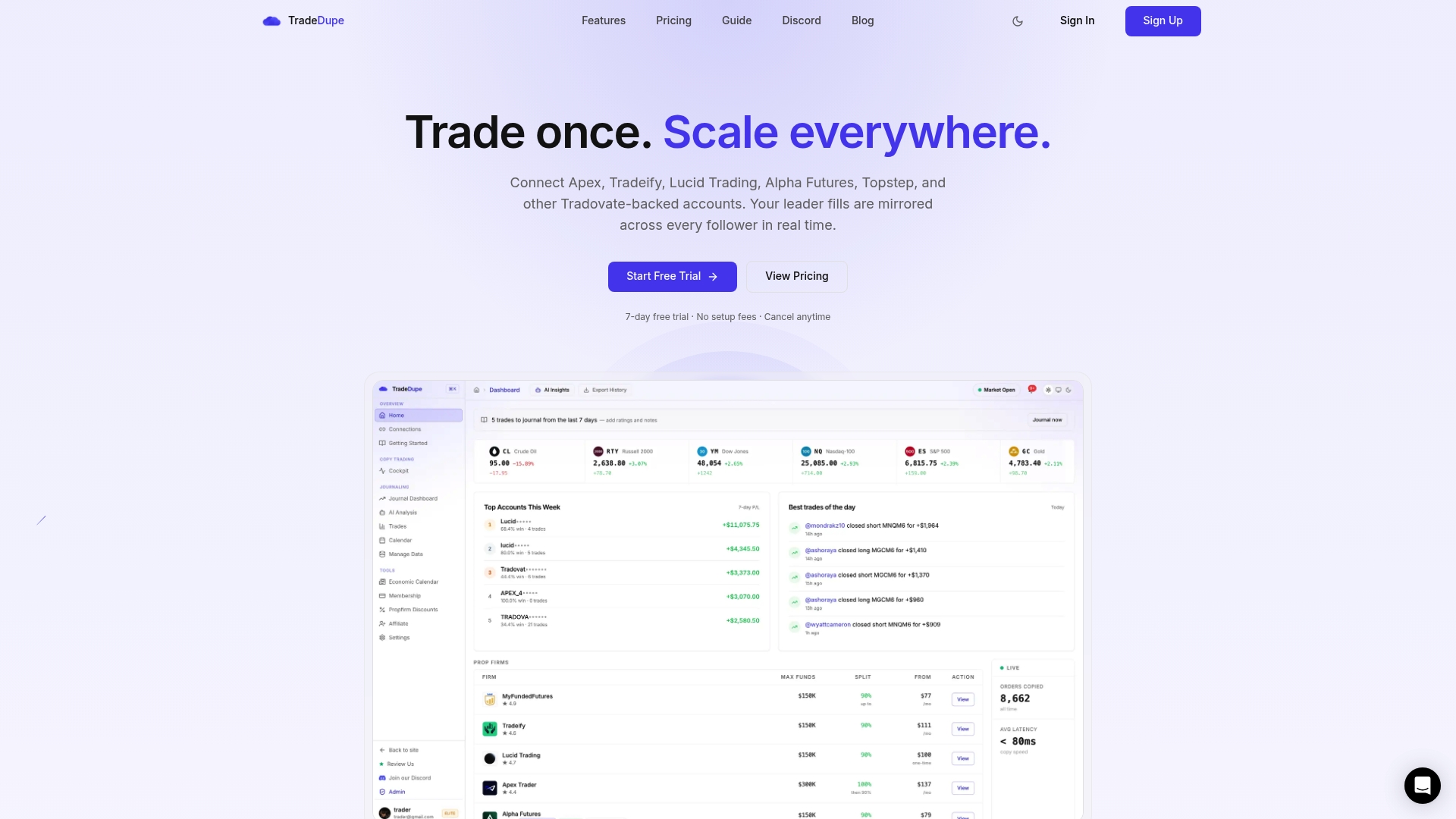
The platform includes global daily loss limits, proportional scaling, rogue-trade detection, and per-account toggle controls. These features directly address the compliance requirements that cause most copier-related disqualifications. Setup takes under 10 minutes, and the dashboard gives you live sync status and risk metrics across every account. Traders managing multiple funded accounts can start with Tradedupe and scale their challenge workflow without adding manual execution overhead.
FAQ
What is a prop firm challenge copier?
A prop firm challenge copier is software that replicates trades from one master account to multiple follower accounts in real time. It automates multi-account execution while applying risk controls like proportional scaling and daily loss limits.
Are trade copiers allowed by prop firms?
Most reputable prop firms permit copiers only when you copy your own accounts. Copying third-party signals or sharing trades with other traders violates group-trading rules and results in disqualification.
What risk settings should I use in a copier for a prop firm challenge?
Set per-trade risk at 0.5–1% of each follower account's balance and configure a global daily loss limit at 1–2% below the firm's stated daily drawdown limit. This buffer absorbs slippage without triggering a hard breach.
How does latency affect a trade copier during a prop firm challenge?
A latency delay of 500ms or more causes slippage that can push a follower account past its drawdown limit even when the master account stays safe. Use a VPS in New York or London to keep execution latency low.
Can I use a demo account as the master in a copier setup?
Yes. Using a demo master removes emotional pressure from the execution layer and forces conservative trading, since the financial risk sits entirely in the follower accounts. This is a widely used approach among experienced prop traders.
Recommended
- How to Trade Prop Firms (2026): A Practical Playbook to Pass and Keep a Funded Account | TradeDupe Blog
- Best Trade Copier for Prop Firms in 2026 | TradeDupe
- Futures Trade Copier for Prop Firms (2026): Mirror One Account to Many on Tradovate
- Best Trade Copier for Prop Firms in 2026 (Honest Comparison) | TradeDupe Blog