
How to Trade Multiple Funded Accounts: 2026 Guide
TradeDupe
11 min read
Discover how to trade multiple funded accounts effectively. Learn the essential tools, strategies, and discipline to maximize your trading success.
Trading multiple funded accounts is defined as running two or more proprietary trading accounts simultaneously, each with independent rules, drawdown limits, and payout schedules. Knowing how to trade multiple funded accounts without triggering violations or compounding losses requires three things: the right software, a business-like risk framework, and strict execution discipline. Most major prop firms allow multiple funded accounts simultaneously, but each account carries its own daily loss caps, trailing drawdowns, and hedging restrictions. Treating them as one combined fund is the fastest path to losing all of them.
How to trade multiple funded accounts: essential tools
The right software is not optional when trading multiple accounts. Manual order entry across two or more platforms introduces execution delays, missed fills, and costly mistakes that compound quickly at scale.

Trade copier software is the core tool. It replicates orders from a single master account to multiple follower accounts in real time. Trade-copying software replicates orders within 2 milliseconds, which is the threshold required for scalping strategies to avoid slippage across accounts. That speed matters because a 50-millisecond delay on a fast-moving futures contract can mean a completely different fill price on each account.
Beyond the copier itself, traders need several supporting tools:
- Virtual Private Server (VPS): Hosts your trading software 24/7 with low-latency connections to broker servers. A VPS eliminates the risk of a home internet outage killing your positions mid-trade.
- Multi-account dashboard: Provides a single view of all account balances, drawdown levels, and open positions. Tradedupe's real-time dashboard, for example, shows sync status and leader/follower activity across all connected accounts simultaneously.
- Aggregator or tracking tool: Converts raw trade data into structured reports per account. Aggregated dashboards like PropTally convert trading into a structured small business, improving tracking and decision-making across accounts.
- Account profile manager: Separates software configurations per prop firm so that a rule change on one account does not accidentally affect another.
Pro Tip: Create a separate software profile for each prop firm account. Label each profile with the firm name and account number. This prevents accidental order placement on the wrong account during fast market conditions.
The table below summarizes the core tool categories and their primary function:
| Tool Category | Primary Function |
|---|---|
| Trade copier software | Replicates orders from master to follower accounts in real time |
| Virtual Private Server | Maintains uptime and low-latency connectivity to broker servers |
| Multi-account dashboard | Monitors balances, drawdowns, and sync status across all accounts |
| Aggregator/tracker | Generates per-account performance reports and payout records |
| Account profile manager | Isolates configurations per firm to prevent cross-account errors |
How do traders structure risk management across multiple accounts?
Risk management across multiple funded accounts requires treating each account as a separate business unit, not a pool of combined capital. The moment you start mentally aggregating your accounts, you begin making decisions that violate individual account rules.
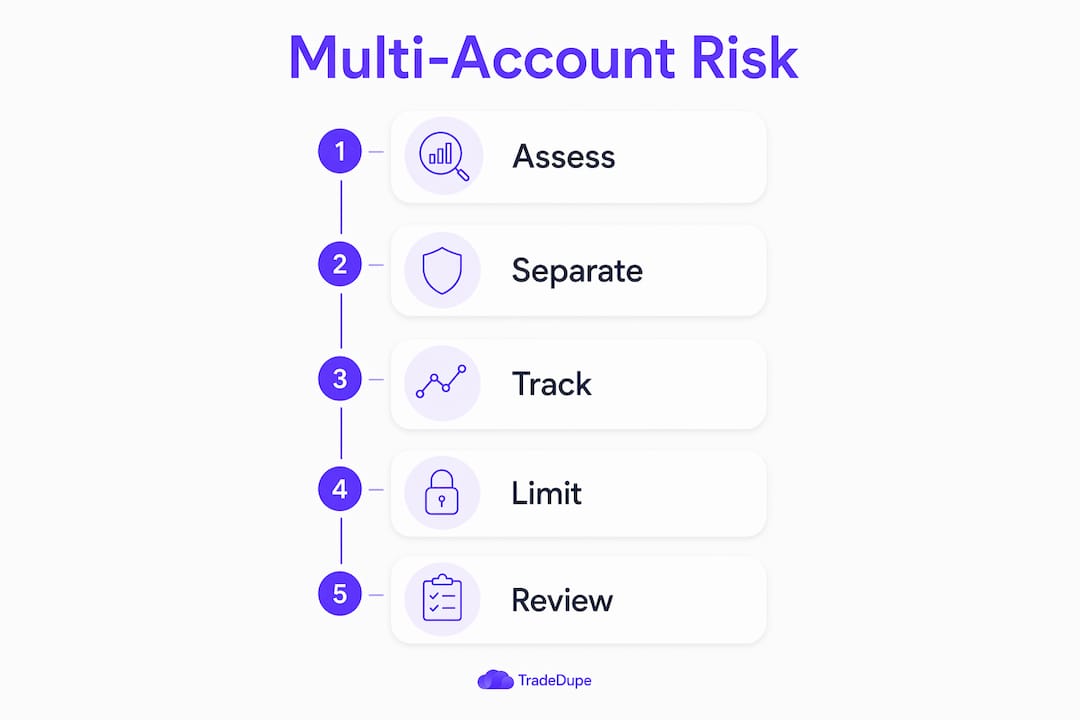
The most dangerous trap is emotional recovery trading. The biggest risk in managing multiple accounts is emotional decision-making and violation of stop rules. One bad session on Account A should never influence position sizing on Account B. The accounts are legally and operationally separate, and your risk decisions must reflect that.
Apply these principles across every account you manage:
- Fixed risk per trade: Set a maximum risk per trade as a percentage of each account's balance independently. Do not adjust this figure based on results in other accounts.
- Aggregate stop threshold: Set internal cumulative stop-trading rules tighter than firm limits. Four accounts with 5% max drawdown each should carry an aggregate internal limit well below 20% to preserve capital across the portfolio.
- Daily loss cap enforcement: Track each account's daily loss separately. Hitting the daily cap on one account means stopping trading on that account for the day, regardless of how other accounts performed.
- Payout schedule staggering: Staggering payout requests across multiple prop firms maintains consistent cash flow and simplifies tax planning. Schedule payouts on different weeks from each firm to avoid large, irregular lump sums.
> Treating each funded account as its own small business, with its own budget, rules, and performance review, is the only framework that scales. The moment you blur the lines between accounts, you create risk that no software can protect you from.
Pro Tip: Build a simple spreadsheet or use a dedicated tracker to log each account's daily P&L, drawdown used, and payout date. Review it every Friday. This weekly audit catches rule violations before they become account breaches.
For traders dealing with multi-currency financial structures, managing payouts from multiple prop firms across different currencies adds another layer of complexity that warrants a dedicated business account.
What are the practical steps to set up and execute trades across accounts?
Setting up a multi-account trading operation follows a clear sequence. Skipping steps, especially the calibration phase, is the most common reason traders experience inconsistent fills across accounts.
Follow this numbered workflow:
- Select your master account. Choose the account with the most permissive rules or the one you are most comfortable trading. This account places all live orders. Master/follower account setups use one master to place trades copied instantaneously to multiple followers, preserving execution consistency.
- Install and configure your trade copier. Connect the copier to your master account and each follower account. Assign position sizing rules per follower: equal contracts, proportional to account equity, or custom fixed sizing per firm rules.
- Create isolated account profiles. Set up a separate profile in your trading platform for each prop firm account. Verify that each profile connects only to its designated broker login.
- Calibrate position sizing per account. Each prop firm has different contract limits and drawdown rules. A 150K Apex account and a 50K Tradeify account require different position sizes even if the trade signal is identical.
- Run a latency test. Place a test order on the master account and verify that all follower accounts receive and fill the order within acceptable latency. For scalping, latency below 2 milliseconds for trade replication is critical to avoid slippage.
- Verify compliance settings. Confirm that each follower account's copier settings respect that firm's hedging restrictions, daily loss caps, and maximum position size rules.
- Go live with a single account first. Run the master and one follower for one full trading week before adding additional accounts. This surfaces configuration errors before they affect your entire portfolio.
| Step | Action | Verification Check |
|---|---|---|
| 1. Select master account | Choose account with most permissive rules | Confirm login credentials and broker connectivity |
| 2. Configure trade copier | Link master and all follower accounts | Test order replication with a demo or micro trade |
| 3. Isolate account profiles | Separate platform profiles per firm | Confirm no cross-account order bleed |
| 4. Calibrate position sizing | Set contracts per account equity and firm rules | Review max position limits per firm |
| 5. Latency test | Measure fill time from master to followers | Target under 2ms for scalping strategies |
| 6. Compliance check | Map each firm's hedging and loss cap rules | Cross-reference copier settings with firm rulebook |
| 7. Staged go-live | Start with one follower, then scale | Monitor for one full week before adding accounts |
What common mistakes occur when managing multiple funded accounts?
The most expensive mistakes in multi-account trading are not technical. They are behavioral. Software can replicate orders in milliseconds, but it cannot override a trader's decision to break their own rules.
> Scaling accounts before mastering a single one is the most reliable way to multiply losses, not profits. The discipline required to manage one funded account correctly is the same discipline required to manage ten.
The most common pitfalls include:
- Treating accounts as a single fund: Aggregating risk across accounts arbitrarily leads to position sizes that violate individual account rules. Each account's drawdown limit is a hard ceiling, not a suggestion.
- Ignoring hedging restrictions: Some prop firms explicitly prohibit hedging between accounts at the same firm. Violating this rule, even accidentally through a copier misconfiguration, results in account termination.
- Manual order entry on multiple devices: Entering orders manually across two or more platforms simultaneously creates execution errors, duplicate fills, and missed exits. A trade copier eliminates this entirely.
- Skipping daily loss cap reviews: Traders must stop all trading activity when execution or risk discipline falters, regardless of individual account results. Ignoring a daily loss cap on one account while continuing to trade others is a rule violation waiting to happen.
- Overtrading to justify account fees: Running more accounts than your strategy can support forces you to take marginal setups. Successful traders focus on high-quality setups and capital allocation, not increasing total trade count.
Pro Tip: Set automated daily loss alerts on every account. When any account hits 80% of its daily loss cap, stop trading that account for the day. Schedule a fixed review day each week to audit all accounts for rule compliance and performance drift.
The mindset shift that actually makes multi-account trading work
The traders I have seen succeed with multiple funded accounts share one trait: they stopped thinking like traders and started thinking like operators. The accounts are not a casino with multiple tables. They are a portfolio of small businesses, each with its own budget, rules, and performance targets.
The temptation when you first scale to three or four accounts is to trade more. More setups, more contracts, more activity. That instinct is wrong. More accounts mean better allocation on high-conviction setups, not more trades. The best multi-account traders I know take the same two or three setups they have always traded and replicate them correctly across accounts. The edge does not change. The scale does.
Technology is a force multiplier, but it does not replace judgment. A trade copier running on a reliable VPS will execute your orders faster and more consistently than you ever could manually. But if the setup you are copying is marginal, the copier just loses money faster across more accounts. The review process, the weekly audit, the discipline to sit on your hands when conditions are unclear: those are not optional habits. They are the actual job.
Emotional resilience matters more at scale than it does with a single account. A bad day on one account feels manageable. A bad day across four accounts, even if each loss is within rules, tests your psychology in a different way. Build the habit of separating account performance from personal performance. The accounts are tools. You are the operator.
> — Andres
Tradedupe: built for traders running multiple funded accounts
Traders who manage several funded accounts on Tradovate need a tool built specifically for that workflow. Tradedupe's futures trade copier replicates orders from a single master account to unlimited follower accounts with a median latency of 34ms, well within the execution window required for futures strategies.
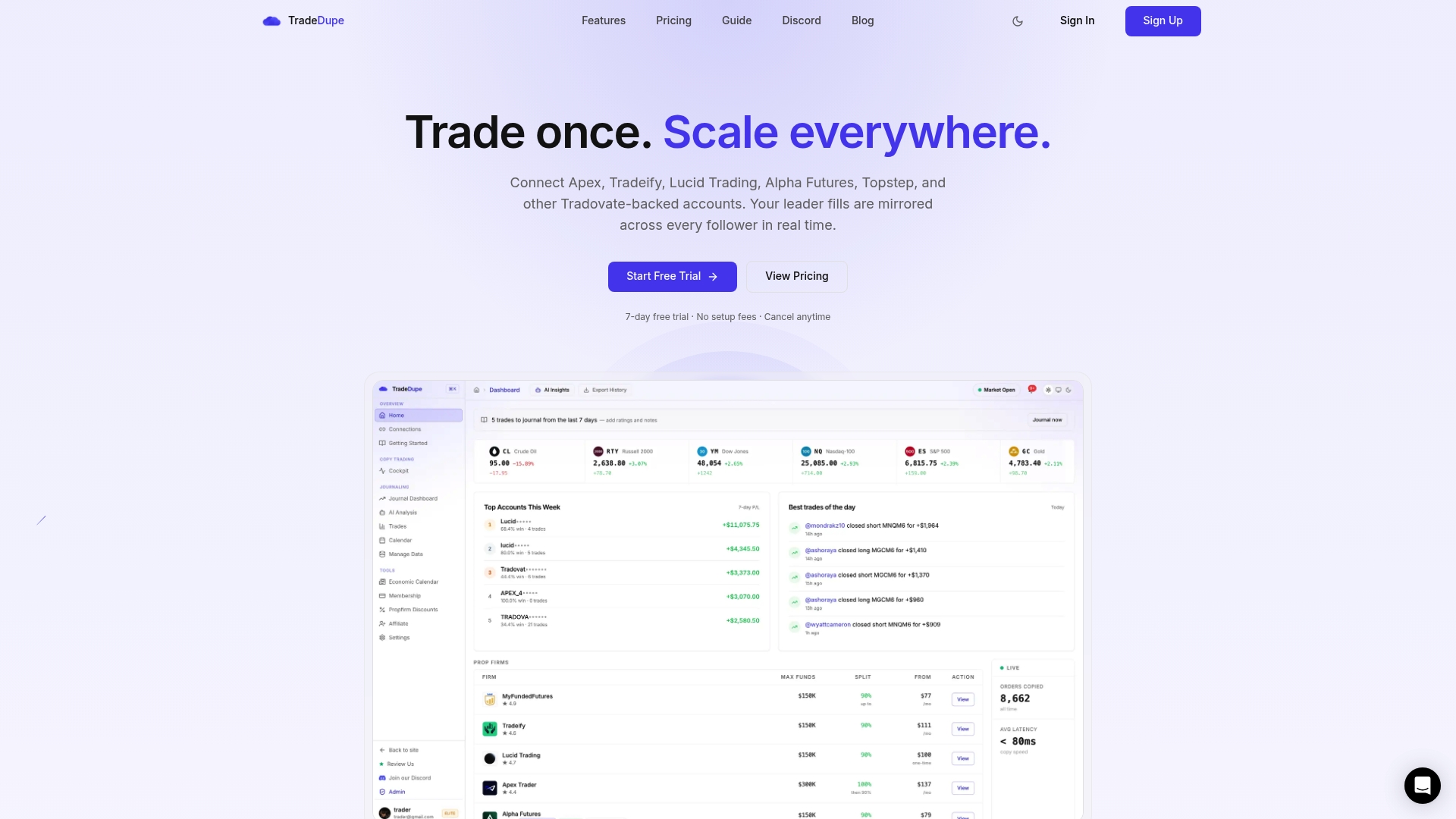
Tradedupe supports prop firm accounts across Apex, Tradeify, Lucid Trading, and Alpha Futures, with per-account toggle controls, rogue-trade detection, and auto-recovery built in. Setup takes minutes through the desktop authentication page, and the real-time dashboard gives you a live view of every account's sync status, drawdown, and activity. For traders ready to scale without adding manual complexity, Tradedupe is the infrastructure that makes it possible.
Key Takeaways
Trading multiple funded accounts successfully requires automation, strict per-account risk rules, and a business operator mindset applied consistently across every account in your portfolio.
| Point | Details |
|---|---|
| Use a trade copier | Replicate orders from one master account to all followers within milliseconds to eliminate manual errors. |
| Treat each account independently | Apply separate drawdown caps, daily loss limits, and position sizing rules per account, never aggregate arbitrarily. |
| Set aggregate stop thresholds | Keep your internal cumulative stop level well below the combined maximum drawdown of all accounts. |
| Stagger payout schedules | Request payouts from different firms on different weeks to maintain steady cash flow and simplify tax reporting. |
| Scale quality, not quantity | Add accounts only when your core strategy is consistently profitable, then replicate the same high-conviction setups. |
FAQ
Can you trade multiple funded accounts at the same firm?
Most major prop firms permit multiple funded accounts simultaneously, but each account must comply with its own independent rules. Hedging between accounts at the same firm is often prohibited, so review each firm's rulebook carefully.
What is the best way to manage risk across multiple funded accounts?
Set a fixed risk percentage per trade on each account independently, and establish an internal aggregate stop threshold below the combined maximum drawdown of all accounts. Stop trading any account that hits its daily loss cap, regardless of performance on other accounts.
Do I need a VPS to trade multiple funded accounts?
A VPS is not strictly required, but it significantly reduces latency and eliminates the risk of home internet outages affecting open positions. For scalping strategies, where replication latency below 2 milliseconds is critical, a VPS is the standard professional setup.
How do I avoid violating prop firm rules when using a trade copier?
Configure each follower account's copier settings to respect that firm's specific daily loss caps, maximum position sizes, and hedging restrictions. Run a compliance check against each firm's rulebook before going live, and test with a single follower account for one full week before scaling.
How many funded accounts should a trader manage at once?
The right number depends entirely on your strategy's consistency and your capacity to monitor each account. Start with one master and one follower, then add accounts only after demonstrating consistent rule compliance and profitability over at least one month.
Recommended
- What Happens After You Get Funded? Scaling a Prop Firm Account the Right Way | TradeDupe Blog
- Funded Futures Family Copy Trading (2026): Mirror Every Account | TradeDupe
- MyFundedFutures (MFFU) Copy Trading (2026): Mirror Every Account | TradeDupe
- How to Trade Prop Firms (2026): A Practical Playbook to Pass and Keep a Funded Account | TradeDupe Blog