

How Traders Pass Prop Firm Evaluations in 2026
TradeDupe
9 min read
Discover how traders pass prop firm evaluations in 2026. Learn key strategies to meet profit targets and manage risk effectively.
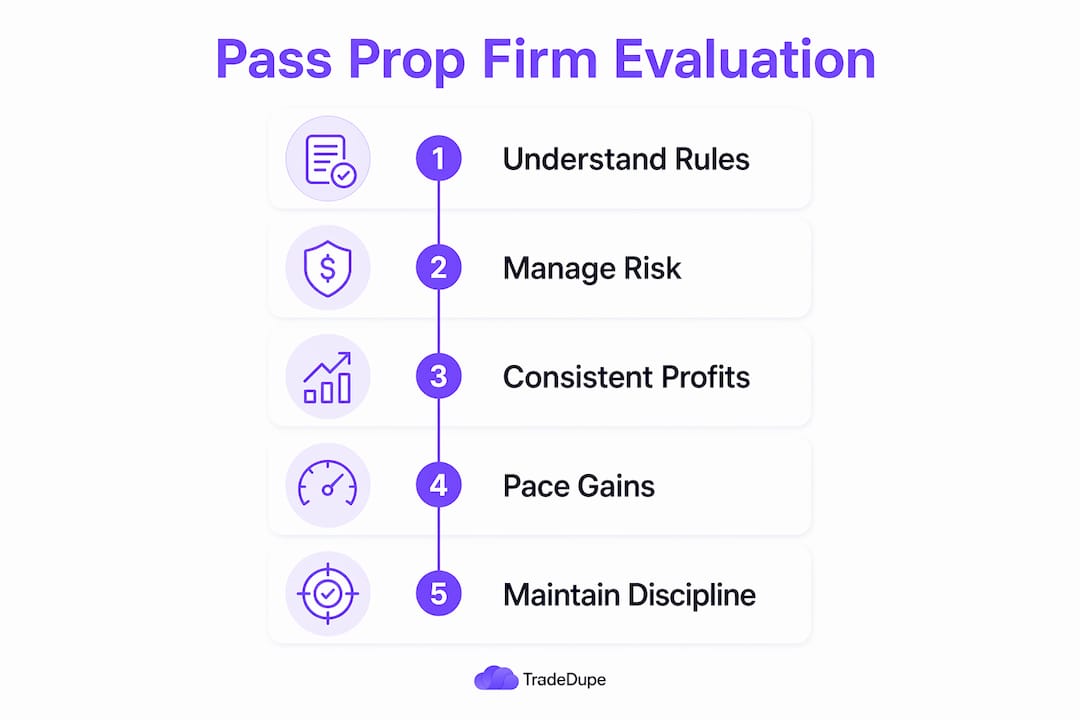
Passing a prop firm evaluation is defined as meeting a firm's profit target without breaching its drawdown, daily loss, or consistency rules. Industry pass rates range from 5% to 25%, and most failures come from rule violations, not bad trading. Firms like FTMO, TopStep, Apex, and Tradeify are not testing whether you can make money. They are testing whether you can manage risk under pressure. Understanding how traders pass prop firm evaluations means understanding that discipline and rule adherence are the real performance metrics.
How traders pass prop firm evaluations: the core framework
The evaluation process at most prop firms follows a standard structure. You receive a simulated account, a profit target, a maximum drawdown limit, a daily loss cap, and a minimum number of trading days. You must hit the target without triggering any of the limits. The rules vary by firm, but the framework is consistent.
Profit targets typically range from 6% to 10% of account size. Drawdown limits come in two forms: static and trailing. A static drawdown is fixed at a set dollar amount below your starting balance. A trailing drawdown moves up as your account equity rises, which means a big winning day can actually shrink your margin for error on future days. Trailing drawdown penalizes early large gains by reducing the buffer available for subsequent sessions.

Daily loss limits cap how much you can lose in a single session, usually 2%–5% of account size. Consistency rules add another layer by capping how much of your total profit target you can earn in a single day. Minimum trading day requirements force you to spread activity across multiple sessions, typically 5–10 days. Some firms also prohibit holding positions overnight or trading through major news events.
The table below shows how rule structures differ across common futures prop firms.
| Rule | TopStep | Apex | Tradeify | FTMO |
|---|---|---|---|---|
| Profit target | 6% | 6% | 6% | 10% |
| Max drawdown | Trailing | Trailing | Static | Static |
| Daily loss limit | Yes | Yes | Yes | Yes |
| Consistency rule | No | No | Yes | No |
| Overnight holds | Restricted | Allowed | Allowed | Allowed |
Pro Tip: Read the consistency rule breakdown for Topstep, Apex, Tradeify, and MFFU before you register. Choosing the wrong firm for your trading style is one of the most common and most avoidable mistakes.
What risk management strategies help traders stay within prop firm limits?
Risk management in a prop firm evaluation is not about maximizing returns. It is about surviving long enough to accumulate consistent gains without a single session wiping out your progress.
The most effective approach starts with sizing by failure buffer, not by total account equity. Your failure buffer is the distance between your current equity and your daily loss limit. Sizing based on the failure buffer prevents a single losing streak from ending your evaluation before you have a real chance to recover. If your daily loss limit is $3,000, your personal stop should sit at $1,800–$2,100, which is 60%–70% of the firm's allowed loss.
Here is a step-by-step approach to applying these principles:
- Calculate your daily failure buffer. Subtract your current equity from your daily loss limit floor. That number is your true daily risk budget.
- Set a personal daily stop at 60%–70% of the firm's limit. If the firm allows a $3,000 daily loss, stop trading at $1,800–$2,100. This buffer protects you from hitting the hard limit on a bad day.
- Risk 0.5%–1% of account size per trade. Low per-trade risk lets you absorb a losing streak of 5–10 trades without approaching your daily stop.
- Use rest days deliberately. No prop firm sets a maximum trading day limit. Resting on unclear market days satisfies minimum day rules without forcing bad trades.
- Scale down position size as you approach the profit target. Reducing size near the target cuts volatility spikes and protects gains you have already built.
Pro Tip: Set a hard alarm 10–15 minutes before market close. Forgetting to close positions before the session ends is one of the most preventable causes of evaluation failure.
How should traders pace profits across the evaluation period?
Pacing is where many technically skilled traders fail. They hit a strong setup on day two, run up 70% of the profit target in a single session, and then spend the rest of the evaluation trying to coast. That approach backfires in multiple ways.
Consistency rules cap single-day profits at 30%–50% of the total profit target. Exceeding that cap on any single day can trigger disqualification, even if your overall account is profitable. Firms like Tradeify enforce this rule strictly, while others like Apex and TopStep do not. Knowing your firm's specific rule before you trade is not optional.
Spreading gains across 5–10 trading days also builds statistical validity. A single large winning day proves nothing about your consistency. Ten days of controlled, positive sessions demonstrate the kind of disciplined behavior prop firms are paying for. The prop firm consistency rule guide from Tradedupe breaks down exactly how each major firm applies these caps.
Key pacing principles to follow:
- Calculate your daily profit cap before each session. Divide the total profit target by the number of minimum trading days. That number is your soft ceiling per day.
- Stop trading once you hit your daily profit cap. Continuing to trade after reaching your cap adds risk with no upside.
- Avoid forced trades to meet minimum day requirements. Forced trading on low-conviction days causes more account damage than simply sitting out.
- Close winning trades before session end under trailing drawdown rules. Exiting winners before close resets your equity baseline and widens your buffer for the next session.
- Treat the final two days of the evaluation as a defense phase. Once you are within one good session of the profit target, reduce size and protect what you have built.
What psychological habits boost the chance of passing prop firm evaluations?
The single biggest mindset shift required for trader success in prop firm assessments is treating the evaluation as a risk control test, not a speed trial. Most traders fail by treating evaluations as performance tests rather than demonstrations of systematic risk management. That framing change affects every decision you make.
A defense-first mindset means you define your maximum acceptable loss before you define your profit goal. You trade only setups from your validated edge. You do not add to losing positions, and you do not revenge trade after a bad session. These are not abstract principles. They are the specific behaviors prop firms observe in your trading log when they review funded accounts.
Pro Tip: Build a pre-session emotional control routine before each evaluation day. Traders who enter sessions without a defined stop and a clear setup checklist are the ones who blow accounts on day three.
The discipline challenge does not end when you pass. Many traders fail funded accounts by dropping their defense-first habits once the profit target pressure is removed. The evaluation is the audition. The funded account is the job. The same rules that got you through the evaluation are the ones that keep your payouts coming.
Choosing a firm whose rules match your natural trading style also reduces the psychological load. A swing trader forced into a no-overnight-hold account will face constant rule anxiety. A scalper in a firm with wide daily loss limits will have more room to operate naturally. Fit matters as much as skill.
Key Takeaways
Passing a prop firm evaluation requires strict rule adherence, disciplined position sizing, and consistent profit pacing across the full evaluation period.
| Point | Details |
|---|---|
| Rule adherence beats raw profit | Most evaluation failures come from rule violations, not poor trading performance. |
| Size by failure buffer | Set personal daily stops at 60%–70% of the firm's allowed daily loss limit. |
| Pace profits deliberately | Consistency rules cap single-day gains at 30%–50% of the total target; spread profits across sessions. |
| Rest days are a tool | Sitting out on low-conviction days satisfies minimum trading day rules without forced bad trades. |
| Discipline must continue post-evaluation | Many funded traders fail by abandoning the risk habits that got them through the evaluation. |
The part most traders skip when preparing for evaluations
The traders I see struggle most are not bad traders. They are good traders who picked the wrong firm for their style, then spent the entire evaluation fighting their own instincts. A swing trader in a trailing drawdown account with no overnight hold allowance is not being tested on skill. They are being tested on how well they can suppress their edge.
My strongest advice is to treat firm selection as part of your evaluation strategy, not a preliminary step. Read the best futures prop firms rankings with your actual trading behavior in mind. If you hold trades overnight, filter for firms that allow it. If you trade through news, find firms that permit it. Mismatched rules do not just make passing harder. They make you trade worse.
The second thing most traders skip is building a written daily plan before each evaluation session. Not a vague intention to "trade well." A specific document: the setups you will take, the maximum loss you will accept, and the profit level at which you stop for the day. Traders who write this down before the session starts make far fewer emotional decisions during it.
Passing is repeatable when you treat it as a process. The traders who pass multiple evaluations across firms like Apex, Tradeify, and TopStep are not luckier. They have a documented process they execute the same way every day.
> — Andres
How Tradedupe supports systematic execution during evaluations
Traders managing multiple evaluation accounts simultaneously face a real execution problem. Manually replicating the same trade across several Apex, Tradeify, or Lucid Trading accounts introduces timing errors and inconsistent sizing, both of which can trigger rule violations.
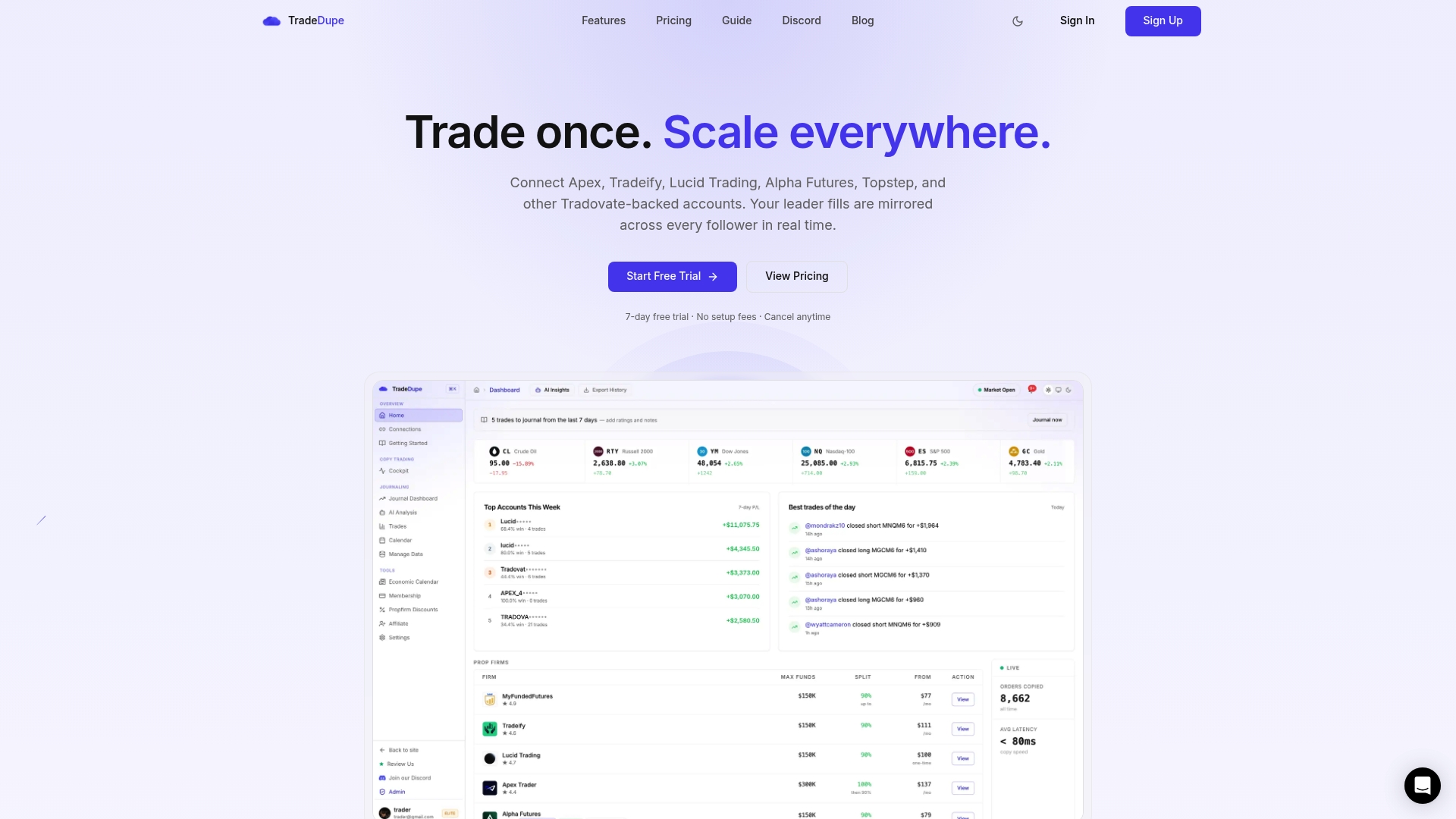
Tradedupe solves this with real-time trade mirroring across multiple Tradovate accounts, with a median latency of 34ms. One lead account executes the trade. Every follower account mirrors it instantly. Rogue-trade detection and per-account toggle controls keep each account within its own risk parameters. For traders running parallel evaluations or managing a funded account alongside active challenges, Tradedupe's Tradovate copy trading platform removes the manual execution layer entirely. Setup takes under 10 minutes with the getting started guide.
FAQ
What is the pass rate for prop firm evaluations?
Industry pass rates range from 5% to 25% on first attempts, with most failures caused by drawdown breaches and consistency rule violations rather than unprofitable trading.
What is the difference between static and trailing drawdown?
Static drawdown is fixed at a set dollar amount below your starting balance. Trailing drawdown rises with your equity, meaning a big winning day reduces your buffer for future sessions.
How do consistency rules affect evaluation strategy?
Consistency rules cap single-day profits at 30%–50% of the total profit target, requiring traders to spread gains across multiple sessions rather than hitting the target in one or two trades.
Should I trade every day during a prop firm evaluation?
No. Resting on unclear market days is a valid strategy. There is no maximum trading day limit, so sitting out low-conviction sessions protects your account without violating any rules.
How do I avoid failing a prop firm evaluation at the end?
Scale down position size as you approach the profit target, close all positions before market close, and treat the final sessions as a defense phase to protect accumulated gains.