
Key benefits of copy trading multiple accounts
TradeDupe
12 min read
Discover the benefits of copy trading multiple accounts. Streamline your trading, enhance performance, and minimize risks effectively.
Managing trades across multiple proprietary accounts simultaneously is one of the most operationally demanding challenges in professional futures trading. Whether you run five Apex accounts or a full prop desk with dozens of Tradovate connections, manual execution simply cannot keep pace with the speed markets demand. This article breaks down the concrete performance benefits, risk reduction frameworks, and execution limitations you need to understand before committing to a multi-account copy trading setup, giving you the criteria to make the right infrastructure decision for your operation.
Table of Contents
- Why copy trading multiple accounts matters
- Performance advantages: From speed to scalability
- Risk reduction and advanced allocation strategies
- Execution synchronization and limitations to watch for
- What most traders miss about multi-account copying
- Optimize Tradovate copy trading with specialized tools
- Frequently asked questions
Key Takeaways
| Point | Details |
|---|---|
| Efficient trade replication | Copy trading lets you replicate master trades instantly across multiple accounts, saving time and reducing manual effort. |
| Better risk control | Using account groups and allocation strategies helps minimize overexposure and improve overall risk management. |
| Enhanced scalability | Multi-account setups allow you to scale trading strategies efficiently, adapting position sizes with contract ratios. |
| Execution limitations | Not all order types are copied perfectly, so manual adjustments or external tools may be needed for stop-loss and take-profit syncing. |
| Strategic flexibility | Professional traders benefit most when they customize risk allocation and synchronization settings rather than copying trades blindly. |
Why copy trading multiple accounts matters
For professional prop traders, managing a single account is straightforward. Managing ten with consistent execution is a different problem entirely. The moment you introduce multiple follower accounts, you face compounding operational complexity: order timing, contract sizing, account-specific drawdown rules, and prop firm evaluation constraints all interact simultaneously.
Trade copier software addresses this complexity by automating the replication process from a single lead account to any number of followers. Rather than executing each trade manually across every account, you execute once and the system distributes it. This eliminates the reaction-time bottleneck that causes slippage to compound across accounts during fast-moving market conditions.
The proprietary trading advantages of running multiple funded accounts are well documented: increased total position capacity, diversified evaluation timelines, and the ability to generate parallel income streams from different prop firm programs. But realizing those advantages requires infrastructure that can actually keep all accounts synchronized.

As established in the Tradovate ecosystem, account grouping on Tradovate is the foundational mechanism where trades from the lead account are replicated to other accounts with predefined contract ratios. That ratio system matters enormously. A $50,000 account and a $150,000 account should not receive the same number of contracts unless your sizing model explicitly calls for it.
Key reasons why copy trading across multiple accounts matters for professional operations:
- Speed at scale: A single click or algorithmic signal fires simultaneously across all follower accounts, removing the human execution bottleneck.
- Consistency: Every account sees the same entry and exit prices, eliminating behavioral drift where some accounts capture a move and others miss it.
- Operational efficiency: One trader or one algorithm can effectively manage capital across ten or more funded accounts without additional headcount.
- Evaluation alignment: During prop firm evaluation phases, consistent execution ensures all accounts track the same P&L curve, making performance predictable.
Pro Tip: Set up a dedicated master account that receives no trades from external sources, used solely as the leader. This isolates the signal source and prevents accidental execution on the wrong account from corrupting your follower chain.
For traders scaling Apex copy trading operations specifically, this architecture is especially relevant because Apex accounts come with strict daily loss limits and trailing drawdown rules that demand disciplined, synchronized entries rather than staggered manual ones.
Performance advantages: From speed to scalability
Speed and scalability are the two performance pillars that make automated copy trading operationally superior to manual multi-account management. But the details of how these advantages materialize are worth examining closely.
Latency reduction is the most immediate gain. When you manually execute across accounts, even a skilled trader introduces 200 to 800 milliseconds of delay between the first and last account entry. In liquid futures markets like ES or NQ, that latency translates directly to fill price differences. Automated replication collapses that window dramatically, with high-quality systems achieving sub-50ms median execution times across follower accounts.
The real-time sync capability in a well-architected copy trading setup means that slippage asymmetry between your leader and followers stays within a tight band rather than widening unpredictably during news events or open-range breakouts. This matters most when you are trading momentum setups where a 1-tick difference in entry price meaningfully affects the risk-to-reward ratio.
Scalability is the longer-term performance advantage. Manual execution has a hard ceiling: most traders can realistically manage three to four accounts before execution quality degrades. Automated copying removes that ceiling, allowing a single strategy to operate across dozens of accounts without execution quality degrading as account count grows. This aligns with copy trade efficiency principles that risk managers apply when designing multi-account prop desk operations.
The contrast between manual and automated approaches becomes stark when you map it out:
| Factor | Manual execution | Automated copy trading |
|---|---|---|
| Execution latency | 200 to 800ms per account | Under 50ms across all accounts |
| Accounts manageable | 3 to 4 maximum | Unlimited with proper infrastructure |
| Error rate | High during volatile conditions | Near zero for supported order types |
| Consistency | Degrades with account count | Maintained regardless of account count |
| Operational cost | Scales with accounts | Fixed platform cost |
One important nuance from the MT4 trade copier tutorial ecosystem applies here: more accounts do increase the overall infrastructure load, and systems that lack proper queue management can introduce sequencing errors under high-frequency conditions. Choosing a platform built specifically for the Tradovate API, rather than a generic multi-broker tool, directly addresses this concern.
The scalability advantage only compounds over time. As you pass prop firm evaluations and activate funded accounts, each new account can be added to the follower pool without changing anything about your underlying strategy or execution workflow.
Risk reduction and advanced allocation strategies
Here is where many professional traders underestimate the complexity. Adding more accounts does not automatically reduce risk. In fact, poorly configured multi-account setups can dramatically increase aggregate exposure without the trader realizing it.
The core danger: portfolio-wide overexposure caused by correlation and sizing or leverage mismatches means that copying the same trade one-to-one across ten accounts multiplies your market exposure by ten. If each account holds two contracts on ES and a gap event occurs overnight, you are managing twenty simultaneous losing positions, not two. Robust setups treat total risk as an aggregate first and then allocate across accounts, which is a fundamentally different calculation than account-by-account sizing.
> "Global risk means thinking beyond individual positions. The question is not how much each account risks, but how much your entire operation risks on any single market event."
Effective risk reduction through copy trading requires a structured allocation approach. Follow these steps to prevent leverage mismatches and overexposure:
- Calculate aggregate dollar risk first. Determine the maximum total dollar loss you can absorb across all accounts combined before sizing any individual account's position.
- Apply a ratio-based sizing model. Assign contract ratios to each follower account based on its account size and drawdown rules, not a flat one-to-one copy of the leader.
- Set global daily loss caps. Use platform-level controls to halt replication across all accounts when total portfolio drawdown reaches a predefined threshold.
- Segment by prop firm rules. Group accounts by their specific evaluation or funded rules. Apex accounts, for example, have trailing drawdown mechanics that differ from Topstep's daily loss structure.
- Monitor correlation across accounts. If all accounts hold the same directional position in the same instrument, your effective concentration risk equals the sum of all positions, not a diversified portfolio.
Pro Tip: Always optimize your allocation ratios for each account's specific risk profile rather than copying a flat multiplier. A $25,000 funded account with a $1,500 daily loss limit needs a very different contract allocation than a $100,000 account with a $3,000 limit, even if your strategy trades two NQ contracts on the leader.
When scaling Apex accounts specifically, the trailing drawdown mechanism makes this even more critical. An outsized loss on all accounts simultaneously could breach multiple trailing thresholds at once, eliminating accounts that took weeks to fund. The risk is not just financial, it is also operational: recovering from simultaneous multi-account breaches is far more costly than preventing them through proper allocation design.
A useful copy trader comparison will always highlight how different platforms handle global risk controls. Some tools offer only basic position mirroring; professional-grade platforms include per-account toggles, global drawdown stops, and rogue-trade detection that can automatically pause replication if an anomalous order appears. That last feature is especially valuable during API connectivity issues or broker-side errors. Referencing risk management in automation frameworks confirms that automated systems without circuit breakers introduce operational risk that manual oversight cannot reliably catch in real time.
Execution synchronization and limitations to watch for
Understanding what copy trading systems handle well, and where they fall short, is essential before you deploy a live multi-account setup. The limitations are real and can create exactly the kind of risk exposure you were trying to avoid.
Order type support is the most common constraint. As confirmed by Tradovate copy trading analysis, many copier implementations natively support market orders but do not mirror stop-loss or take-profit bracket behavior exactly. This means your leader account enters a bracketed trade with a defined stop and target, but follower accounts may receive only the entry order. The brackets either do not transfer or transfer inconsistently, leaving follower accounts exposed without protective stops.
The execution desynchronization risk is particularly dangerous with limit orders. When a limit order on the leader account receives a partial fill, follower accounts may receive a different fill quantity, a no-fill, or a delayed fill depending on market depth at that exact moment. Over time, this creates diverging account states where followers hold different position sizes than the leader, which quietly distorts your risk allocation model.
Common limitations to monitor in any Tradovate copy trading setup:
- Bracket order replication gaps: Stop-loss and take-profit legs may not transfer reliably to all follower accounts.
- Partial fill divergence: Limit orders filled partially on the leader can cause follower accounts to hold inconsistent position sizes.
- API rate limiting: High-frequency strategies that fire multiple orders per second may hit Tradovate API limits, causing delayed or dropped order replication on some accounts.
- Network latency spikes: Even low-latency systems experience occasional network delays that create short windows of desynchronized account states.
- Manual override conflicts: If a follower account has an open manual trade when a copy order arrives, the resulting combined position may breach that account's risk parameters.
Pro Tip: Use external bracket management tools or platform-level stop-loss features to protect follower accounts independently of the copy order. Do not rely on the leader's bracket orders transferring perfectly. Treat every follower account's stop-loss as a separate configuration task, not an automatic byproduct of the copy relationship.
For TPT copy trading operations and similar prop firm setups, these synchronization limitations carry additional weight because prop firm accounts have zero tolerance for technical errors that create unauthorized positions or breach daily loss limits. A missed stop-loss transfer on a volatile trading day is not just a P&L problem; it is an account-ending event.
What most traders miss about multi-account copying
The dominant conversation around copy trading focuses almost entirely on speed and scale. More accounts, faster replication, bigger total position capacity. That framing leads traders to optimize for the wrong variables and, in many cases, into the exact overexposure problems described above.
The uncomfortable truth is that control matters more than throughput. A system that replicates trades at 34ms median latency is only valuable if you can also pause a single account's replication instantly, detect an anomalous order before it reaches followers, and verify that every follower's position state matches the leader's intended position. Without those controls, speed is just a faster way to compound a mistake.
There is also a strategic dimension most traders overlook. Copy trading is not a duplication machine; it is a capital deployment framework. The risk manager insights perspective treats multi-account operations as a portfolio construction problem, not a mechanical replication task. Each follower account represents a capital allocation decision, and the copy trading infrastructure is the tool that executes that decision with precision.
The right settings genuinely do outperform brute force scaling. A trader running six well-configured accounts with proper ratio sizing, global risk caps, and bracket protection will consistently outperform a trader running fifteen accounts with flat one-to-one copying and no circuit breakers. The first operation is sustainable and recoverable from drawdown. The second is a correlated risk bomb waiting for a volatile session to detonate.
Prioritize risk-adjusted strategies over pure account replication. Think about what each account needs from a risk control perspective before adding it to your follower pool, not after.
Optimize Tradovate copy trading with specialized tools
The performance advantages and risk frameworks covered in this article are only as effective as the platform executing them. Generic copy trading tools built for retail forex traders simply do not account for the specific mechanics of Tradovate-based prop firm operations: trailing drawdown rules, API rate limits, per-account toggle requirements, and bracket order handling.
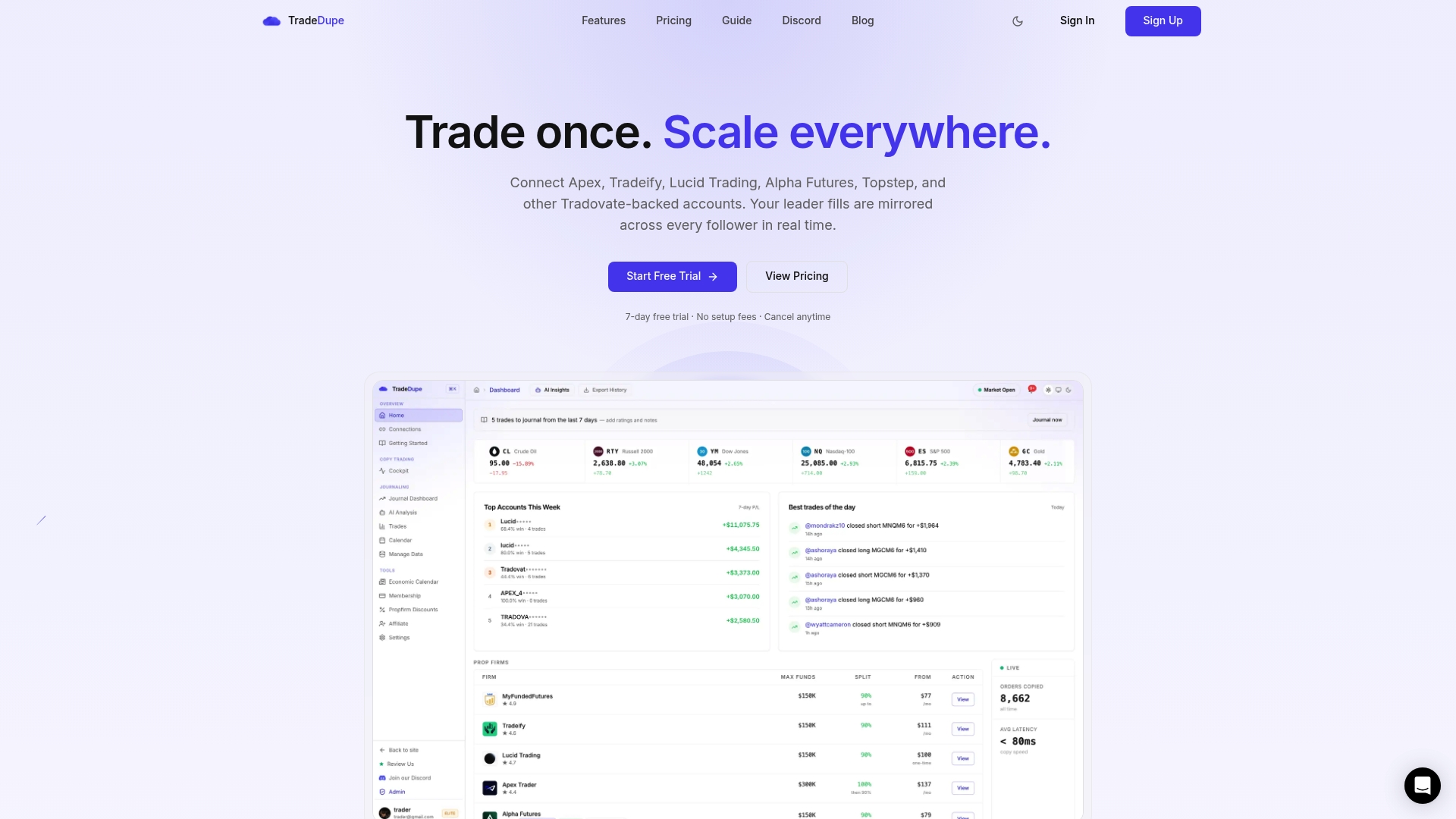
TradeDupe is purpose-built for exactly this environment, offering real-time trade mirroring with 34ms median latency, rogue-trade detection, and per-account controls designed for professional prop desk operations. Whether you are comparing platforms with a detailed TradeDupe vs TradeCopia analysis or ready to configure your first multi-account setup, the path forward starts with infrastructure that matches your operational needs. Explore getting started with TradeDupe to see how the platform maps to your specific Tradovate workflow, or review the full feature set available through TradeDupe for prop firms to evaluate enterprise-level controls for larger operations.
Frequently asked questions
How does Tradovate copy trading work across multiple accounts?
Tradovate uses account grouping and predefined contract ratios to replicate trades from a lead account to follower accounts, enabling scalable multi-account setups within the Tradovate ecosystem.
What is the main risk of copy trading multiple accounts?
The main risk is portfolio-wide overexposure caused by mismatched sizing and leverage across accounts, which can amplify aggregate losses significantly during adverse market conditions.
Do copy trading systems replicate stop-loss and take-profit orders accurately?
Many copier implementations only support market orders natively, often requiring manual configuration or external tools to ensure accurate bracket order replication across all follower accounts.
How can traders minimize risk when copy trading?
Traders should establish global risk caps and use ratio-based allocation that fits each account's specific drawdown rules, rather than applying flat one-to-one position copying across all accounts. Robust setups treat total risk as an aggregate first, then allocate across accounts accordingly.