Risk Management for Copy Trading Followers: 2026 Guide
TradeDupe
11 min read
Discover effective risk management for copy trading followers. Learn crucial strategies to safeguard your investments in 2026 and beyond.
Risk management for copy trading followers is defined as the systematic application of capital allocation limits, stop-loss rules, diversification controls, and ongoing performance monitoring to protect a follower's account from trader-driven losses. Copy trading automates execution, but it does not automate judgment. The follower who treats it as a passive, set-and-forget activity is the one who absorbs the full downside when a lead trader's strategy deteriorates. This guide covers the exact controls you need: allocation caps, drawdown exits, kill switches, and correlation risk, with 2026 guidance built in throughout.
What are the best allocation and diversification strategies for copy trading followers?
Capital allocation is the first line of defense in any copy trading risk strategy. The allocation caps recommended by current best practices sit at 15–20% of your total copy budget per trader, with the full copy trading budget capped at 20–30% of your total investable capital. That structure means a single trader blowing up cannot take your whole account with them.

Diversification across traders is equally critical, but more is not always better. Spreading across 2–5 traders with distinct styles, instruments, or timeframes gives you genuine diversification. Copying 10 traders who all trade ES futures on momentum setups is not diversification. It is concentration with extra steps.
Here is a practical allocation framework to follow:
- Per-trader cap: 15–20% of your copy trading budget
- Total copy trading budget: No more than 20–30% of total capital
- Number of traders: 2–5 with meaningfully different strategies
- Asset concentration: Cap single-asset exposure below 30% across all copied positions
- Net directional exposure: Keep combined long or short bias under 60% of portfolio value
- Leverage adjustment: Scale your copied position size relative to your equity, not the lead trader's equity
| Allocation Parameter | Conservative Setting | Aggressive Setting |
|---|---|---|
| Per-trader budget cap | 10–15% | 20–25% |
| Total copy trading budget | 20% of capital | 30% of capital |
| Number of traders | 4–5 | 2–3 |
| Single-asset exposure cap | 20% | 30% |
| Net directional exposure cap | 40% | 60% |
Pro Tip: Never mirror a lead trader at a 1:1 size ratio unless your account equity exactly matches theirs. A $10,000 follower copying a $100,000 lead at full size is taking 10x the proportional risk on every trade.
Which stop-loss and exit rules should followers implement?
Mechanical exit rules outperform discretionary ones in copy trading because emotional attachment to a trader's past performance clouds judgment. A mechanical drawdown exit at 15% loss from peak equity after you start copying is a widely cited threshold for stopping the bleed before it becomes catastrophic. The key word is "after you start copying." Your entry point is the reference, not the trader's all-time peak.
Design your exit rules in two layers, as recommended by two-layer risk limit frameworks:
- Per-trade risk cap: Limit any single copied trade to 1–2% of your account value. This prevents a single outsized position from doing structural damage.
- Rolling drawdown stop: Set a daily loss limit and a rolling 5-day drawdown ceiling. If the trader hits both, you stop copying automatically.
- Strategy drift trigger: If the trader's average trade size, holding period, or instrument mix changes materially, treat that as a red flag requiring review.
- Follower base change: A sudden drop in the number of copiers following a trader often signals that informed participants have already exited.
- Prolonged losing streak: Three or more consecutive losing weeks without a clear market-driven explanation warrants a pause, not patience.
The debate between discretionary and mechanical exits is real. Mechanical rules remove emotion but can trigger during temporary drawdowns that the trader recovers from quickly. Discretionary exits allow nuance but invite rationalization. The practical answer is a hybrid: set hard mechanical stops at the outer boundary, and use discretionary review within that boundary for softer signals like strategy drift.
Pro Tip: Set your drawdown stop relative to your entry equity, not the trader's historical peak. A trader who was up 80% before you joined and is now down 15% from that peak may still be down significantly from your actual entry point.
How can ongoing monitoring improve risk management for followers?
Regular monitoring at least weekly is the single most effective habit for detecting strategy degradation before it costs you. The "set-and-forget" framing that copy trading platforms use in their marketing is operationally convenient but strategically dangerous. Even the best traders change their approach, face drawdown cycles, or encounter market conditions that break their edge.
Here is what to track in your weekly review:
- Drawdown from your entry point: Not the trader's historical max drawdown, but the drawdown measured from when you started copying. These are often very different numbers.
- Trade size and leverage changes: A trader who suddenly doubles their average position size is taking on more risk, whether or not they disclose it.
- Market condition alignment: A trend-following trader underperforming in a choppy, range-bound market is expected. The same trader underperforming in a strong trending market is a warning sign.
- Execution quality: Watch for trade delays or slippage that widen the gap between the lead trader's reported results and your actual fills.
- Fee drag on net returns: Performance fees and spreads materially reduce what you actually keep. A trader showing 20% gross returns may deliver 12% net after fees. That gap changes your risk-adjusted assessment entirely.
Treating trader rank or short-term ROI as a proxy for safety is a common follower misconception. Maximum drawdown and risk-adjusted returns measured from your own entry are the metrics that actually matter for your account.
What operational safety features protect copy trading followers?
Operational safety is the layer of risk control that most followers ignore until they need it urgently. Theoretical risk limits fail if you cannot disconnect quickly or close trades instantly. The platform you use determines whether your risk controls are real or just numbers on a settings page.
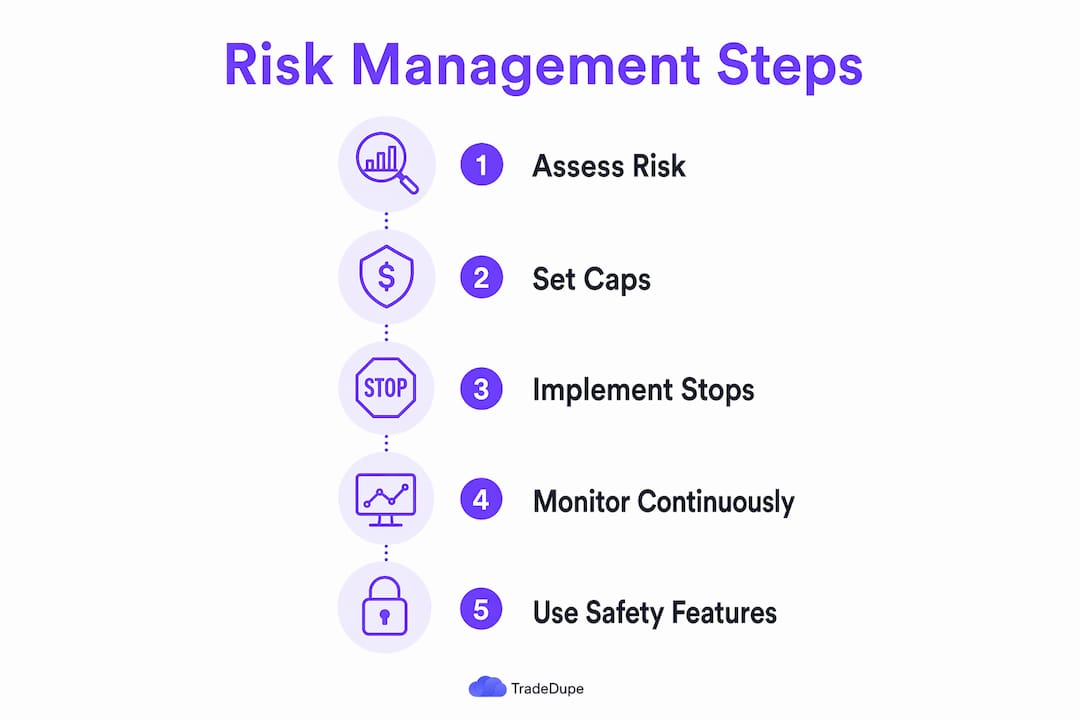
Before you connect any account, verify these five operational controls:
- Kill switch availability: The platform must offer an instant disconnect that closes all copied positions simultaneously. Test it with a small funded account before committing full capital.
- Maximum drawdown stop-copy: An automated rule that halts copying when your account hits a predefined loss threshold, without requiring manual action.
- Daily loss limits: A hard ceiling on losses within a single trading session, independent of the drawdown stop.
- Per-trade risk caps: Position-level limits that prevent any single copied trade from exceeding a set percentage of your account.
- No withdrawal rights required: Avoid any platform that requests access to withdraw funds from your account. Read-only or trade-execution-only permissions are the standard.
| Safety Feature | Why It Matters | What to Check |
|---|---|---|
| Kill switch | Stops all exposure instantly | Test before funding |
| Drawdown stop-copy | Automates exit at loss threshold | Confirm it closes positions, not just pauses |
| Daily loss limit | Caps session-level damage | Verify it resets daily |
| Per-trade cap | Prevents single-trade ruin | Set at 1–2% of account |
| Withdrawal rights | Protects your capital | Reject any platform requiring them |
Regulatory frameworks now require clear risk disclosures and fair treatment standards for copy trading services. That regulatory pressure is increasing demand for transparent platforms that show followers exactly what they are copying and what the real risks are.
Pro Tip: Run a full exit test on a demo or small live account before scaling. Confirm that your kill switch actually closes open positions, not just stops new ones from opening. The difference matters enormously during a fast-moving market.
How do correlation and hidden leverage risks affect copy trading portfolios?
Correlation risk is the most underestimated threat in copy trading portfolios. Multiple traders may hold correlated positions without any of them disclosing it, creating hidden concentration that your per-trader allocation caps do not catch. You think you are diversified across four traders. In reality, all four are long crude oil futures through different instruments, and a single macro event wipes out your entire copy portfolio simultaneously.
The fix requires portfolio-level thinking, not just trader-level thinking:
- Asset-level exposure caps: Cap single-asset exposure below 30% across all copied positions combined, regardless of how many traders hold it.
- Net directional limits: Keep your aggregate long or short bias under 60% of total copy portfolio value to avoid being fully exposed to a single market direction.
- Cross-trader correlation review: At least monthly, map out what each trader is actually holding and identify overlapping positions.
Hidden leverage is the second overlooked risk. Some platforms offer Fixed Ratio sizing modes that automatically scale your copied exposure upward after gains. The mechanism sounds appealing because it compounds winners. The problem is that it also means your exposure is at its highest right before a potential drawdown, since account equity peaks just before reversals. Pair any Fixed Ratio or scaling mode with an explicit total-stop safeguard that overrides the scaling logic when your drawdown threshold is hit.
| Risk Type | How It Appears | Mitigation |
|---|---|---|
| Correlation risk | Multiple traders long same asset | Asset-level cap at 30% |
| Directional concentration | Portfolio skewed long or short | Net exposure cap at 60% |
| Fixed Ratio scaling | Exposure grows automatically after gains | Pair with hard drawdown stop |
| Hidden leverage | Lead trader uses leverage not visible in copy settings | Verify position sizing method before copying |
Key takeaways
Effective risk management for copy trading followers requires predefined allocation caps, mechanical stop-loss rules, regular monitoring, and operational safety checks working together as a system.
| Point | Details |
|---|---|
| Allocation caps protect capital | Limit each trader to 15–20% of your copy budget and cap total copy trading at 30% of total capital. |
| Mechanical exits beat discretion | Set a 15% drawdown stop from your entry equity and automate it so emotion cannot override it. |
| Weekly monitoring is non-negotiable | Review drawdown, trade size changes, and fee drag at least once per week to catch strategy drift early. |
| Operational safety must be tested | Verify your kill switch closes open positions before funding, not after a crisis forces your hand. |
| Correlation risk requires portfolio-level caps | Cap single-asset exposure at 30% and net directional exposure at 60% across all copied traders combined. |
The uncomfortable truth about copy trading risk
Most followers I have observed get the allocation math right and then ignore everything else. They set a 15% per-trader cap, diversify across three traders, and then never look at their accounts again for six weeks. That is where the real losses happen.
The traders who consistently protect capital in copy trading treat it like an active allocation decision, not a passive investment. They review weekly. They track drawdown from their own entry point, not the trader's historical peak. They test their kill switch before they need it. And they are willing to stop copying a trader they like when the data says the edge is gone.
The hardest part is not the math. It is accepting that a trader who made you money for three months can still be the wrong trader to copy today. Strategy drift, changing market conditions, and leverage escalation through modes like Fixed Ratio sizing can all erode an edge silently. You will not see it in the headline return number. You will see it in the drawdown pattern and the trade size changes, if you are looking.
One more thing: check your platform's prop firm rule compliance before you copy across evaluation accounts. Prop firms have specific rules about trade copying that can invalidate your account if violated. That is an operational risk most followers never think about until it is too late.
> — Andres
How Tradedupe supports your copy trading risk controls
Tradedupe is built specifically for prop traders who need real risk controls, not just the appearance of them. The platform's per-account toggle controls let you pause or stop copying on any individual follower account instantly, without affecting others. Rogue-trade detection and auto-recovery add a layer of automated protection that runs continuously in the background.
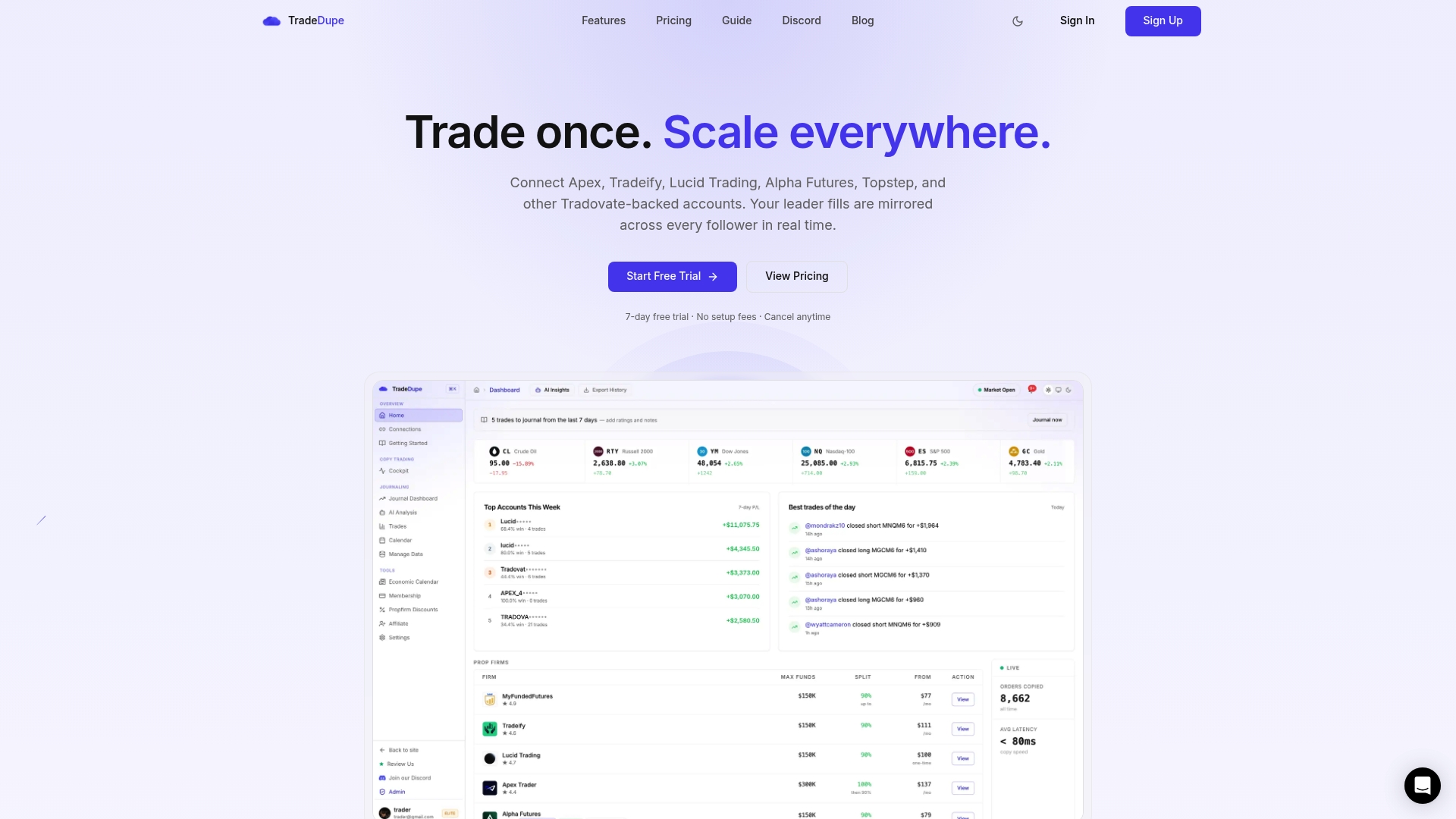
For followers managing multiple Tradovate accounts across Apex, Tradeify, Lucid Trading, or Alpha Futures, Tradedupe's dashboard gives you real-time sync status, leader and follower activity, and risk metrics in one place. The median trade latency of 34ms means your copied positions open and close at prices that actually match the lead. Start your setup today and put real risk controls behind your copy trading operation.
FAQ
What is the recommended allocation cap per trader in copy trading?
The standard guidance caps each trader at 15–20% of your total copy trading budget. Your total copy trading budget should not exceed 20–30% of your overall investable capital.
How do i set a stop-loss for copy trading?
Set a mechanical drawdown stop at 15% loss from your entry equity on each copied trader. Pair it with a daily loss limit and a per-trade cap of 1–2% of your account to cover both session-level and trade-level risk.
What is correlation risk in copy trading?
Correlation risk occurs when multiple traders you copy hold similar positions in the same asset or direction, creating hidden concentration. Cap single-asset exposure at 30% and net directional exposure at 60% across your full copy portfolio to manage it.
Why does a kill switch matter for copy trading followers?
A kill switch lets you instantly disconnect from a lead trader and close all copied positions simultaneously. Operational safety experts confirm that risk limits are meaningless if you cannot exit quickly during a fast-moving market.
Should i monitor copy trading accounts weekly?
Weekly monitoring is the minimum recommended frequency to detect strategy degradation, trade size changes, and fee drag. Even automated copy trading requires active follower oversight to catch performance drift before it compounds into significant losses.
Recommended
- How Prop Firm Rules Affect Trade Copying in 2026 | TradeDupe Blog
- Getting Started with TradeDupe: Set Up Tradovate Copy Trading in 10 Minutes
- Best Futures Trading Strategy for Copy Trading (2026): Order Flow vs ICT Concepts | TradeDupe Blog
- What Is Copy Trading? A Real Guide to Social and Automated Trading | TradeDupe Blog