
TP SL Mirroring Copier: Pro Trader's 2026 Guide
TradeDupe
10 min read
Discover the TP SL mirroring copier for seamless synchronization of Stop Loss and Take Profit orders. Maximize gains in your trading strategy!
A TP SL mirroring copier is a system that synchronizes Stop Loss (SL) and Take Profit (TP) orders between a master trading account and one or more follower accounts in real time. The industry term for this technology is trade mirroring or copy trading with order-level synchronization. For prop traders and trading firms managing multiple accounts simultaneously, accurate SL and TP replication is not optional. A missed stop or a misplaced take profit on a follower account can wipe out a day's gains or trigger a prop firm drawdown violation in seconds. Professional trade copiers achieve sub-second synchronization, with Tradedupe reporting a median latency of 34ms, setting the benchmark for what serious multi-account operations should expect.
How does TP SL mirroring copier technology actually work?
The core mechanism behind any trade mirroring system is order-level replication. When the master account opens a position with defined SL and TP values, the copier reads those values and transmits them to follower accounts. The critical technical question is how those values are transmitted.
Two methods exist: absolute price copying and distance-based copying. Absolute price copying sends the exact SL and TP price levels from the master to the follower. Distance-based copying calculates the number of points between the entry price and the SL or TP on the master, then applies that same distance to the follower's entry price.

Copying absolute SL and TP prices can trigger premature stop-outs because different brokers have different spreads and price feeds. A stop set at 4,520.00 on the master may sit safely above the spread on Broker A, but get hit immediately on Broker B where the spread is wider. Distance-based synchronization eliminates this problem by recalculating levels relative to the follower's actual entry price.
Pro Tip: Always confirm your copier uses point-based or distance-based SL/TP synchronization, not absolute price copying. This single setting determines whether your follower accounts maintain the master's intended risk-reward ratio.
The synchronization logic also handles modifications. When the master trader moves a stop to breakeven or adjusts a take profit mid-trade, a well-built copier detects the change and pushes the update to all follower accounts within milliseconds. Point-based SL/TP synchronization preserves the master's risk-reward profile even when broker feeds diverge.
Key mechanisms in professional-grade mirroring systems include:
- Real-time order monitoring that detects SL/TP changes on the master account as they happen
- Dynamic recalculation that adjusts follower SL/TP levels based on each account's actual fill price
- Buffer settings that add a small point cushion to account for spread variation between brokers
- Modification propagation that pushes stop adjustments, trailing stops, and partial closes to all followers simultaneously
What features and setup options matter most in a TP SL copier?
Choosing a trade mirroring solution involves more than latency specs. The configuration options determine whether the system fits your actual trading operation or creates new risk.
- Lot multipliers and scaling. The master may trade 5 contracts while a follower account is funded for 1. Lot multipliers let you set a fixed ratio or a percentage-based scaling factor per follower. Modern trade copiers include lot multipliers, reverse copying, and automated SL/TP management as standard features.
- Symbol mapping. Broker A may list the ES futures contract as "ES" while Broker B lists it as "ESU24." Without a symbol mapping table, the copier fails to open the trade on the follower. Symbol mapping resolves name mismatches between brokers and prevents silent synchronization gaps.
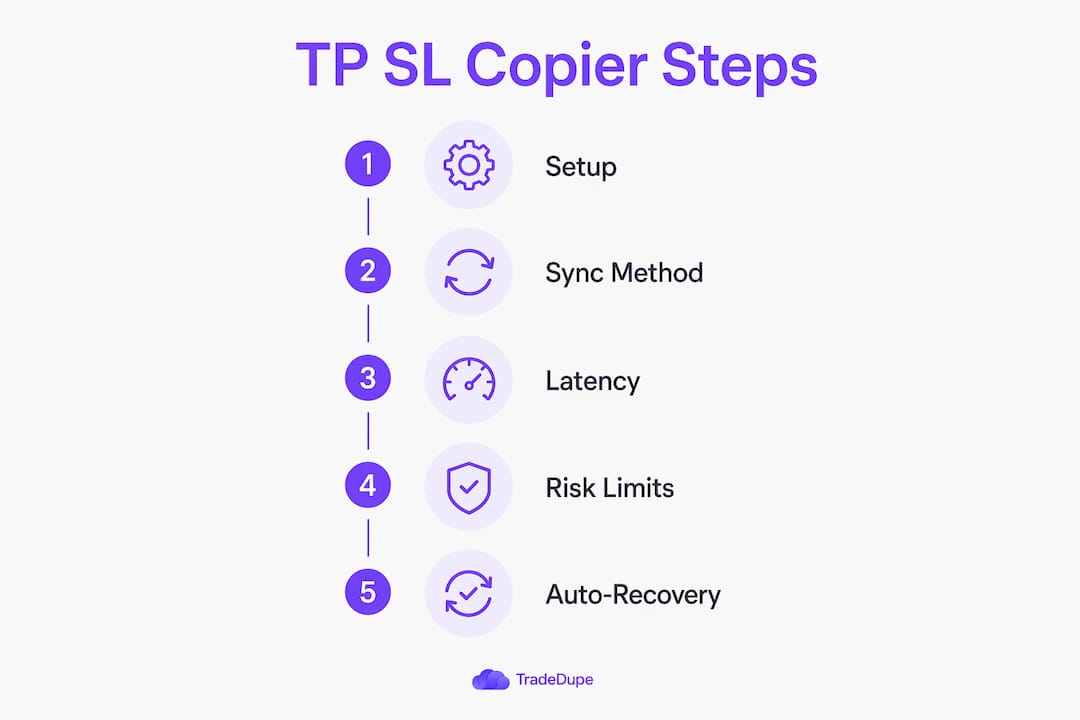
- Hard risk limits. Every professional setup needs maximum daily drawdown caps, lot size ceilings, and automatic follower disconnection rules. These limits protect follower accounts from unexpected drawdowns caused by rogue trades or master account errors. Hard risk limits prevent catastrophic losses when the master account behaves unexpectedly.
- Auto-recovery. Network interruptions happen. A copier without auto-recovery leaves follower accounts in an unmanaged state during reconnection. Auto-recovery restores synchronization and checks for missed trades when the connection resumes.
- Trade filtering and delay settings. Some traders want to exclude trades below a certain lot size or delay copying by a fixed number of seconds to test execution before committing follower capital.
Pro Tip: Set your hard risk limits before you go live, not after your first bad day. A maximum daily drawdown of 2% per follower account, enforced at the copier level, gives you a safety net that no manual monitoring can match.
Good risk management practices treat the copier's risk controls as a second line of defense, not a replacement for sound trading strategy on the master account.
How does latency affect TP SL synchronization accuracy?
Latency below 1 second is the minimum acceptable threshold for professional trade mirroring. Higher latency increases slippage risk especially during volatile news events, when prices move faster than a slow copier can transmit SL and TP updates.
Two architectures address this problem differently.
| Architecture | Latency Profile | Privacy | Best For |
|---|---|---|---|
| Local copier (same machine) | Near-zero, sub-50ms | Full, no internet | Single-machine multi-account setups |
| Cloud-based copier | 100ms–500ms typical | Depends on provider | Remote or distributed account setups |
| Hybrid (local bridge + cloud) | 50ms–150ms | Moderate | Firms with mixed infrastructure |
Local copiers use inter-process communication between trading platform instances on the same machine, bypassing internet routes entirely. This produces zero network latency and keeps all trade data private. The tradeoff is that all accounts must run on the same physical machine or local network.
Cloud-based copiers introduce network hops. A well-optimized cloud copier routes through low-latency servers, but even sub-second delays can cause execution issues when the market moves sharply. Tradedupe's median latency of 34ms places it firmly in the local-equivalent performance tier for Tradovate-based operations.
Cross-platform compatibility adds another layer of complexity. Supporting MT4 to MT5 copying avoids broker lock-in and operational risk when signal providers use a different platform than the follower accounts. For futures traders on Tradovate, platform-native integration removes this problem entirely, since the copier communicates directly with the Tradovate API rather than bridging two different terminal formats.
Auto-recovery is not a luxury feature. When a copier loses its connection mid-trade, follower accounts hold open positions with no active SL/TP management. A copier with auto-recovery detects the disconnection, reconnects, and reconciles the follower account state against the master before resuming normal operation.
What are the most common pitfalls when using TP SL mirroring copiers?
Most synchronization failures trace back to a small set of avoidable configuration errors. Traders who understand these pitfalls before going live save themselves significant capital and operational stress.
- Copying absolute price SL/TP across brokers. This is the most common and most damaging mistake. Different broker feeds produce different price levels for the same instrument. Always use distance-based or point-based copying.
- Missing symbol mapping. A copier that cannot find the matching symbol on the follower broker silently skips the trade. The master is in a position; the follower is flat. This creates an unhedged risk gap that compounds over time.
- No hard risk thresholds on follower accounts. Without a maximum drawdown cap enforced at the copier level, a single bad trade on the master can breach the follower's prop firm evaluation limits. Implementing hard risk limits such as maximum daily drawdowns, lot size caps, and automatic disconnection prevents this outcome.
- Ignoring synchronization health monitoring. A copier that appears to be running may have silent failures. Monitoring dashboards that show real-time sync status, follower account positions, and latency metrics catch problems before they become losses.
- Poor handling of partial closes and manual overrides. When the master partially closes a position, the copier must scale the follower's position proportionally. Copiers that treat partial closes as full closes leave follower accounts overexposed.
- Neglecting lot step adjustments. Brokers enforce minimum lot steps. A calculated lot size of 0.37 may round to 0.3 or 0.4 depending on the broker's rules. Without proper rounding logic, the copier either rejects the trade or opens the wrong size.
The best trade copier setups for prop firms address all of these points in the initial configuration, not as afterthoughts.
Key Takeaways
A TP SL mirroring copier must use distance-based synchronization, enforce hard risk limits, and maintain sub-second latency to reliably protect follower accounts across multiple brokers.
| Point | Details |
|---|---|
| Use distance-based copying | Point-based SL/TP replication prevents premature stop-outs caused by broker spread differences. |
| Map symbols before going live | Symbol mismatches silently skip trades, creating unhedged risk gaps on follower accounts. |
| Set hard risk limits at the copier level | Maximum daily drawdown caps and auto-disconnect rules protect follower accounts from master account errors. |
| Prioritize low-latency architecture | Local or hybrid copiers with sub-50ms latency reduce slippage risk during volatile market events. |
| Monitor sync health continuously | Real-time dashboards catch silent failures before they translate into capital losses. |
Why risk framework beats raw speed every time
Traders shopping for a mirroring solution fixate on latency numbers. I understand the instinct. Speed matters. But in my experience working with multi-account prop trading operations, the firms that blow up are almost never the ones with a 200ms copier. They are the ones with a 34ms copier and no hard drawdown limits configured on their follower accounts.
Speed without risk controls is just a faster way to lose money. The copier that fires in 34ms and also enforces a 2% daily drawdown cap per follower is categorically safer than the one that fires in 20ms with no guardrails. The latency difference is imperceptible in most market conditions. The missing drawdown limit is catastrophic exactly when you need it most.
The second thing I have learned is that platform heterogeneity is coming for every trading firm, whether they plan for it or not. A firm running purely on one platform today will face a signal provider, a new prop firm integration, or a regulatory requirement that forces them onto a second platform within 18 months. Copiers that handle cross-platform trade copying natively are not a nice-to-have. They are operational insurance.
Finally, live dashboards are not a monitoring tool. They are a risk management tool. The moment you cannot see the real-time sync status of every follower account, you are flying blind. Build the monitoring habit before you need it.
> — Andres
Tradedupe's approach to real-time TP SL mirroring for prop firms
Prop traders running multiple Tradovate accounts need a mirroring solution built for that specific environment, not a generic copy trading tool adapted from retail forex.
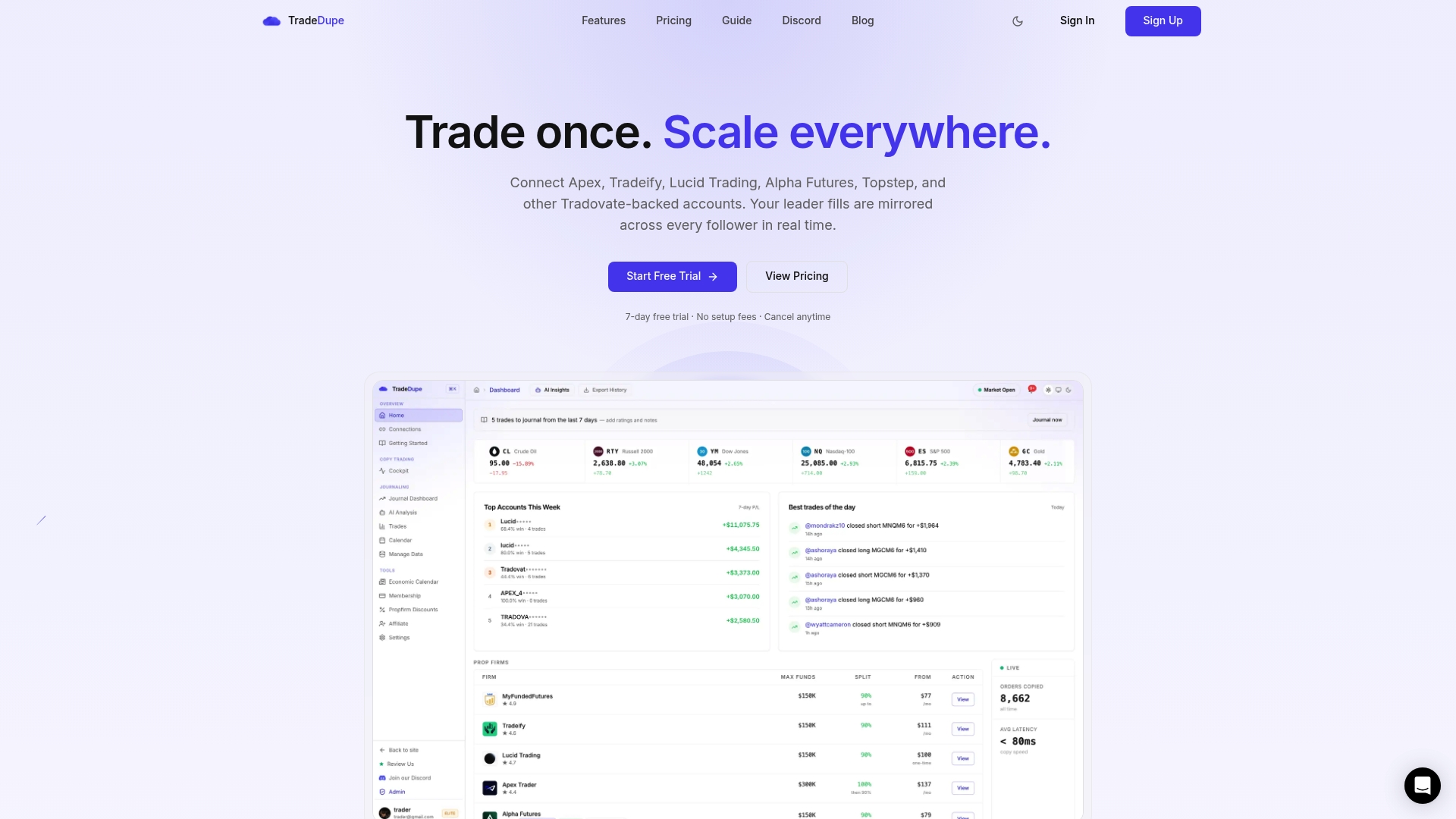
Tradedupe is built specifically for Tradovate-based prop trading operations. It delivers a median latency of 34ms, distance-based SL/TP synchronization, rogue-trade detection, and per-account toggle controls from a single dashboard. Supported integrations include Apex, Tradeify, Lucid Trading, and Alpha Futures. Whether you manage two accounts or twenty, Tradedupe's futures trade copier scales without adding operational complexity. The platform includes auto-recovery, real-time sync monitoring, and configurable hard risk limits. You can be set up and copying live trades in under 10 minutes.
FAQ
What is a TP SL mirroring copier?
A TP SL mirroring copier is a system that replicates Stop Loss and Take Profit orders from a master trading account to one or more follower accounts in real time. It preserves the master's risk-reward parameters across all connected accounts.
Why should I use distance-based instead of absolute price copying?
Absolute price copying transfers the exact SL/TP price levels, which can trigger premature stop-outs when follower brokers have different spreads. Distance-based copying recalculates SL and TP relative to each follower's actual entry price, maintaining the intended risk-reward ratio.
How fast should a trade copier be for professional use?
Latency below 1 second is the minimum for professional use, with local copiers achieving sub-50ms performance. Tradedupe reports a median latency of 34ms for Tradovate-based operations, which reduces slippage risk during fast-moving markets.
What happens if the copier loses its connection mid-trade?
Without auto-recovery, follower accounts hold open positions with no active SL/TP management until the connection is manually restored. A copier with auto-recovery detects the disconnection, reconnects, and reconciles follower account states against the master automatically.
Do I need symbol mapping if I use the same broker for all accounts?
Symbol mapping is only required when follower accounts use different brokers or platforms with different instrument naming conventions. If all accounts run on the same broker and platform, symbol names match automatically and no mapping is needed.