
Trade Duplicator: Multi-Account Automation Guide
TradeDupe
10 min read
Discover how a trade duplicator automates multi-account trading to enhance efficiency and accuracy. Simplify your trading strategy today!
A trade duplicator is software that automatically replicates trades from one lead account to multiple follower accounts in real time, synchronizing entries, exits, and stop-loss adjustments across every connected account simultaneously. This is the standard mechanism behind what the industry formally calls trade copying or copy trading automation. Platforms like Tradedupe, PFACopySuite, and Duplikium each implement this core function differently, but the goal is identical: execute one decision and have it reflected across your entire account stack without manual intervention. For prop traders managing multiple funded accounts or risk managers overseeing a trading desk, this capability is not a convenience. It is an operational necessity.
How do trade duplicators work across multiple accounts?
A trade duplicator operates on a leader/follower architecture. The lead account executes a trade, and the software captures that order event, then broadcasts it to all designated follower accounts within milliseconds. Every modification to the lead trade, including stop-loss adjustments, profit target changes, and partial closes, propagates to followers automatically.
The technical challenge is not replication itself. The challenge is idempotency, which means ensuring each trade event is processed exactly once, even when network timeouts or retries cause the same message to arrive multiple times. Without idempotency controls, a single order can fire twice across follower accounts, inflating positions and triggering compliance violations.

Advanced systems address this with cryptographic fingerprints and composite keys to identify unique trade events. SHA-256 hashing assigns each trade message a unique fingerprint. Composite business keys combine instrument, direction, timestamp, and account ID to create a second layer of verification. Bloom filter probabilistic structures then screen millions of trade messages per day at microsecond latency, catching duplicates before they reach execution.
Key mechanics to understand:
- Order capture: The lead account's broker API fires an event on every order state change.
- Deduplication window: A short time window (typically 50–500 milliseconds) catches retried messages before they execute twice.
- Proportional sizing: Follower accounts can receive scaled position sizes based on account equity or fixed lot rules.
- Latency budget: Total round-trip time from lead execution to follower fill determines how closely follower fills track the lead price.
Pro Tip: Test your duplicator's deduplication behavior by simulating a network dropout during an active trade. If the system fires a second entry on reconnect, your idempotency controls are insufficient.
What are the different types of trade duplication systems?
Trade duplication systems fall into three broad categories: cloud-based platforms, locally installed software, and broker-native copy tools. Each carries distinct tradeoffs in latency, cost, and platform support.
Cloud-based vs. local trade duplicators
Cloud-based duplicators like Duplikium run on remote servers and support MT4, MT5, cTrader, and TradingView. The cloud approach removes dependency on a local machine staying online, which matters for traders who cannot guarantee 24-hour uptime. The tradeoff is that cloud routing adds a network hop between the lead account and the cloud server, which can add 10–50 milliseconds of latency depending on server location.
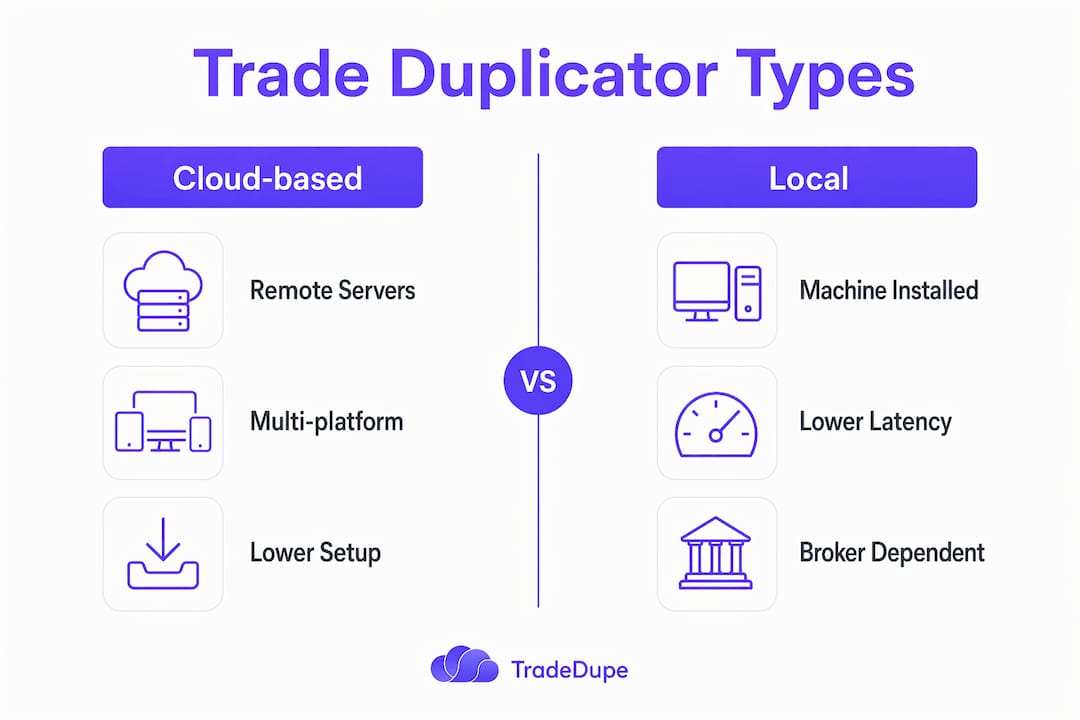
Local trade copiers run directly on your machine or VPS. They offer lower latency for accounts on the same broker but require you to manage uptime, updates, and connectivity yourself. FX Blue Personal Trade Copier is a well-known local option for MetaTrader environments.
Platform and broker support comparison
| Platform | Broker/Exchange Support | Best For |
|---|---|---|
| Tradedupe | Tradovate (Apex, Tradeify, Lucid Trading, Alpha Futures) | Prop firm futures traders |
| PFACopySuite | NinjaTrader, TradingView, Tradovate | Multi-platform futures copying |
| Duplikium | MT4, MT5, cTrader, TradingView | Forex and CFD traders |
| MultiFi | Retail copy trading accounts | Social/retail investors |
NinjaTrader Trade Copier via PFACopySuite supports automatic replication of orders including stop-loss and profit target adjustments across brokers and platforms in real time. That cross-platform capability is critical for traders who split execution across NinjaTrader and Tradovate simultaneously.
Retail social copy trading vs. prop firm duplication
Retail copy trading platforms like MultiFi allow investors to replicate trades with as little as $100, with proportional sizing and no access granted to the master trader's account. This model prioritizes accessibility and transparency, offering trader statistics and risk metrics so followers can evaluate who they copy.
Prop firm duplication is a different use case entirely. Here, the trader controls both the lead and follower accounts. The goal is not to follow someone else's strategy. The goal is to execute one strategy across multiple funded accounts simultaneously, passing evaluations and generating payouts at scale. Compliance constraints from prop firms add a layer of complexity that retail platforms do not face.
What are the benefits and risks of using trade duplicators?
The primary benefit of a trade duplicator is execution consistency. When you manage five accounts manually, small timing differences between entries create divergent P&L outcomes. A duplicator eliminates that variance by firing all entries from a single trigger.
Core benefits:
- Operational efficiency: One decision executes across all accounts. No manual re-entry, no missed fills on secondary accounts.
- Scalability: Adding a new follower account requires a configuration change, not a new workflow.
- Risk control: Per-account position sizing and adjustable risk limits let you tailor exposure to each account's drawdown rules.
- Transparency: Platforms like MultiFi provide real-time monitoring and statistics so you can audit every copied trade against the lead.
Key risks to manage:
- Position inflation: Duplicate trade detection failures caused by network retries can open double positions, breaching prop firm drawdown limits instantly.
- Latency slippage: High-volatility moments like news events widen the spread between lead fills and follower fills. A 200-millisecond lag on a fast-moving ES contract can mean several ticks of difference.
- Compliance exposure: Prop firms monitor for unusual account correlation. Running identical trades across multiple accounts at the same firm can trigger rule violations depending on the firm's terms. Review prop firm rules affecting trade copying before scaling.
- Single point of failure: If the lead account experiences a connectivity issue mid-trade, follower accounts may hold open positions without a corresponding close signal.
Pro Tip: Always configure an independent stop-loss on each follower account at the broker level. If the duplicator loses connection, the broker-side stop acts as a safety net independent of the software.
How to choose and implement a trade duplicator for your operations
Selecting the right system requires matching the platform to your broker, your account structure, and your latency tolerance. Follow this process:
- Confirm broker and platform compatibility. Tradedupe works exclusively within the Tradovate ecosystem, making it the correct choice for Apex, Tradeify, Lucid Trading, and Alpha Futures accounts. PFACopySuite fits traders using NinjaTrader or TradingView alongside Tradovate. Duplikium covers MT4 and MT5 environments. Mismatching your duplicator to your broker is the most common setup error.
- Define your position sizing rules. Decide whether follower accounts replicate the lead at a 1:1 ratio or at a scaled ratio based on account equity. A $50,000 lead account copying to a $25,000 follower should use 0.5x sizing to maintain proportional risk. Most platforms including PFACopySuite support per-account position sizing as a standard configuration option.
- Set latency benchmarks before going live. Run the duplicator in paper trading mode and measure the time between lead fill and follower fill across 50–100 trades. Tradedupe reports a median latency of 34 milliseconds on its Tradovate infrastructure. If your measured latency consistently exceeds 150 milliseconds, investigate your VPS location or network routing before trading live capital.
- Configure rogue-trade detection and auto-recovery. These controls catch scenarios where a follower account receives an order that does not match the lead's current position state. Tradedupe includes rogue-trade detection and auto-recovery natively. For platforms that do not, set manual position reconciliation checks at the start of each session.
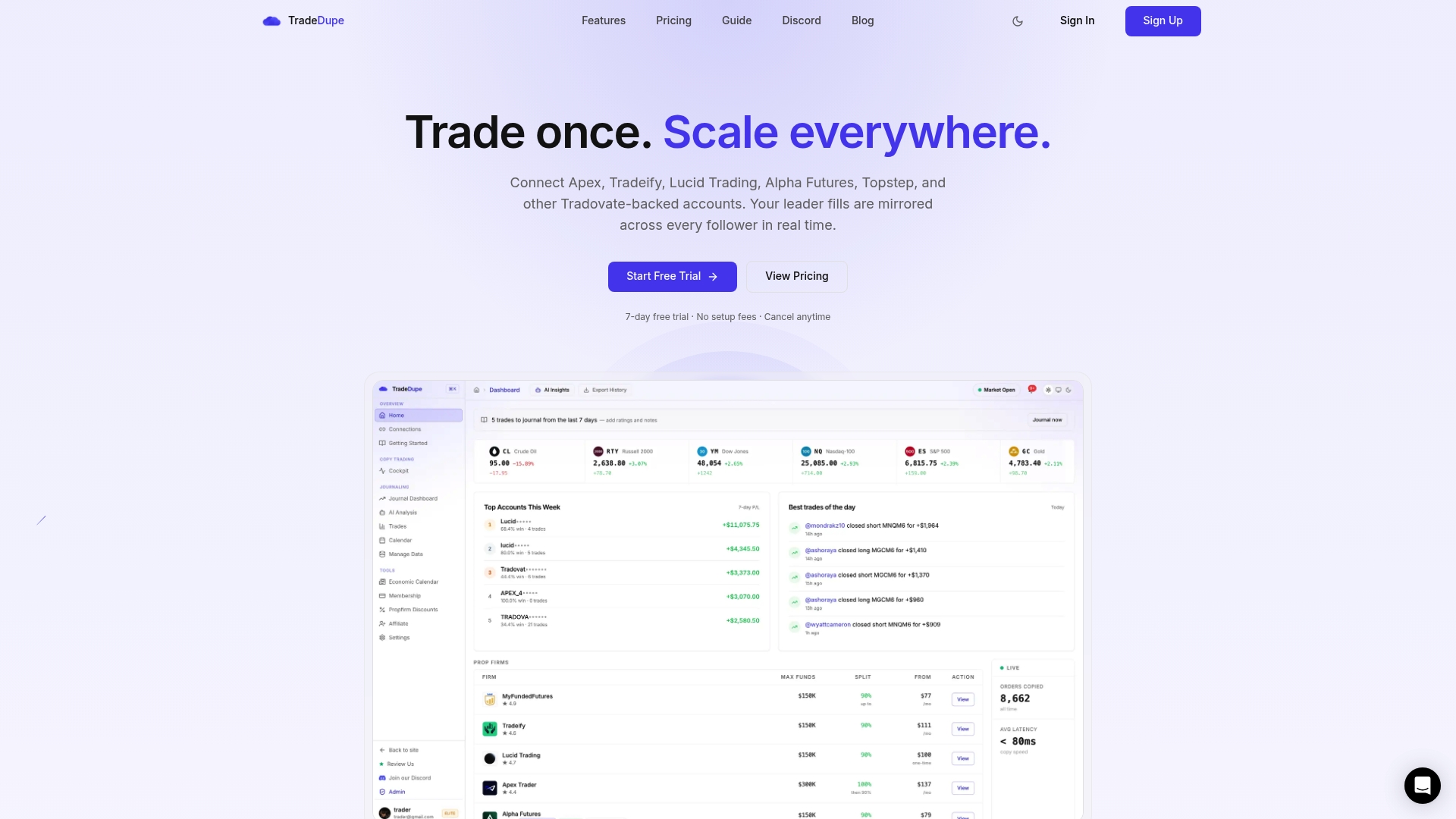
- Monitor the dashboard during live sessions. A real-time sync status view shows you whether each follower account is connected and current. Tradedupe's dashboard displays leader and follower activity side by side, making it straightforward to spot a disconnected account before it causes a position mismatch. You can also review the Tradovate copy trading setup guide for a detailed walkthrough of the configuration process.
- Review analytics weekly. Compare lead P&L against follower P&L on a trade-by-trade basis. Consistent slippage on specific instruments or session times indicates a latency or liquidity problem that configuration changes can address.
Key takeaways
A trade duplicator is the most direct method for achieving consistent, scalable execution across multiple funded accounts without manual re-entry.
| Point | Details |
|---|---|
| Idempotency is non-negotiable | Use SHA-256 fingerprinting and composite keys to prevent duplicate order execution. |
| Match platform to broker | Tradedupe fits Tradovate prop accounts; PFACopySuite covers NinjaTrader and TradingView setups. |
| Latency determines fill quality | Benchmark median latency below 150ms before trading live; Tradedupe targets 34ms on Tradovate. |
| Compliance risk is real | Prop firm correlation rules can flag identical multi-account trades; review firm terms before scaling. |
| Per-account controls protect capital | Configure independent broker-side stops and scaled position sizing on every follower account. |
What I've learned from watching traders scale too fast
The most common mistake I see is traders treating a trade duplicator as a set-and-forget system. They configure it once, verify it works on a few trades, and then stop monitoring it. That works fine until a network event or broker API change causes a silent failure. The duplicator appears connected, but follower accounts stop receiving updates. The lead account closes a trade. The followers stay open. By the time the trader notices, the drawdown on a follower account has breached the prop firm's daily loss limit.
The second mistake is scaling account count before validating the strategy. Copying a marginally profitable strategy across ten accounts does not multiply profits. It multiplies the drawdown exposure during losing streaks. I would argue that no trader should run more than three follower accounts until the lead account has demonstrated at least 90 days of consistent performance with a clearly defined maximum drawdown.
The technology itself is mature. Bloom filter deduplication, SHA-256 fingerprinting, and sub-50-millisecond latency are solved problems for platforms built on modern infrastructure. The human side, specifically the discipline to monitor, audit, and constrain the system, is where most implementations break down. Automation handles execution. You still own the risk management decisions that sit above it.
The future of trade duplication is moving toward AI-assisted position reconciliation, where the system not only copies trades but flags anomalies in follower account behavior relative to the lead. Tradedupe already includes AI-powered trade analysis in its higher-tier plans. That direction is correct. The goal is not just speed. The goal is a system that tells you when something is wrong before the P&L does.
> — Andres
How Tradedupe supports prop firm trade duplication
Tradedupe is built specifically for prop traders running multiple Tradovate accounts across firms like Apex, Tradeify, Lucid Trading, and Alpha Futures. Its real-time mirroring infrastructure delivers a median latency of 34 milliseconds, with rogue-trade detection and auto-recovery handling the edge cases that generic copy tools miss. Setup takes under ten minutes, and the dashboard gives you live sync status across every connected account.
If you are managing multiple prop firm evaluations or payout accounts and need a reliable, compliant copy trading platform built for Tradovate, start with Tradedupe today. For a direct comparison of how it stacks up against alternatives, the honest prop firm copier comparison covers the key differences in detail.
FAQ
What is a trade duplicator?
A trade duplicator is software that automatically copies trades from one lead account to multiple follower accounts in real time, including entries, exits, and stop-loss adjustments. It is also referred to as a trade copier or copy trading automation system.
How fast does a trade duplicator execute across accounts?
Execution speed depends on the platform and infrastructure. Tradedupe reports a median latency of 34 milliseconds on its Tradovate-based system, while cloud-based platforms like Duplikium may add 10–50 milliseconds depending on server proximity.
Can trade duplicators cause compliance violations at prop firms?
Yes. Duplicate detection failures caused by network retries can inflate positions and breach drawdown limits. Some prop firms also flag high account correlation as a rule violation, so reviewing firm-specific terms before deploying a duplicator is required.
What is the difference between retail copy trading and prop firm duplication?
Retail copy trading, as offered by platforms like MultiFi, lets investors follow experienced traders with minimal capital and proportional sizing. Prop firm duplication is trader-controlled, replicating one trader's own strategy across multiple funded accounts simultaneously for scaled payouts.
How do I set up a trade duplicator for Tradovate accounts?
Connect your Tradovate lead account to the duplicator platform, configure follower accounts with per-account position sizing and risk limits, then run a paper trading session to verify latency and fill accuracy before going live. Tradedupe's quick-start setup guide walks through the full process in under ten minutes.