

Automate Trade Duplication for Prop Firm Clients
TradeDupe
10 min read
Learn how to automate trade duplication for prop firm clients, eliminate errors, and scale efficiently across accounts with top tools.
Automated trade duplication is defined as the process of executing a trade on one master account and instantly replicating it across multiple funded prop firm accounts you own and operate. For prop traders managing several Apex, Tradeify, or Topstep accounts simultaneously, this eliminates manual re-entry errors, reduces execution lag, and makes scaling capital across accounts a repeatable, systematic process. Platforms like TradeDupe and tools built around NinjaTrader 8 and Tradovate have made this workflow accessible to individual traders, not just institutional desks. The core benefit is straightforward: one decision, executed consistently across every account you control.
What do you need to automate trade duplication for prop firm clients?
Before you configure a single follower account, the infrastructure underneath your setup determines whether it holds up under live market conditions. Multi-platform duplication requires upfront planning for broker-session licensing constraints, and this is where most traders underestimate the complexity.

Software and platform requirements
The foundation for most futures-based setups is NinjaTrader 8, which connects to brokers via Rithmic, Tradovate, and CQG. The free NinjaTrader license supports only one broker connection. Running multiple prop firm accounts simultaneously across different brokers requires a paid NinjaTrader license at $99 per month or $1,499 for a lifetime purchase. That licensing cost is the first practical hurdle most traders hit, and it is not optional.
For the copy layer itself, your main options are:
- TradeDupe: A SaaS platform purpose-built for Tradovate-based prop accounts. It supports Apex, Tradeify, Lucid Trading, Alpha Futures, and Topstep with a median replication latency of 34ms. Real-time dashboards, rogue-trade detection, and per-account toggle controls are included.
- PFACopySuite: Handles diverse broker connections with independent sizing per account, randomized submission order, and per-account risk settings. Designed for NinjaTrader-based multi-firm setups.
- Platform-native group trading: Tradeify and some Tradovate-integrated firms offer built-in group trading features that copy between owned accounts without third-party software.
Infrastructure and compliance prerequisites
A VPS (Virtual Private Server) is not optional for serious multi-account operation. Local machines introduce downtime risk from power outages, internet drops, and OS updates. A VPS running in a data center near your broker's servers keeps the copier active 24 hours a day.
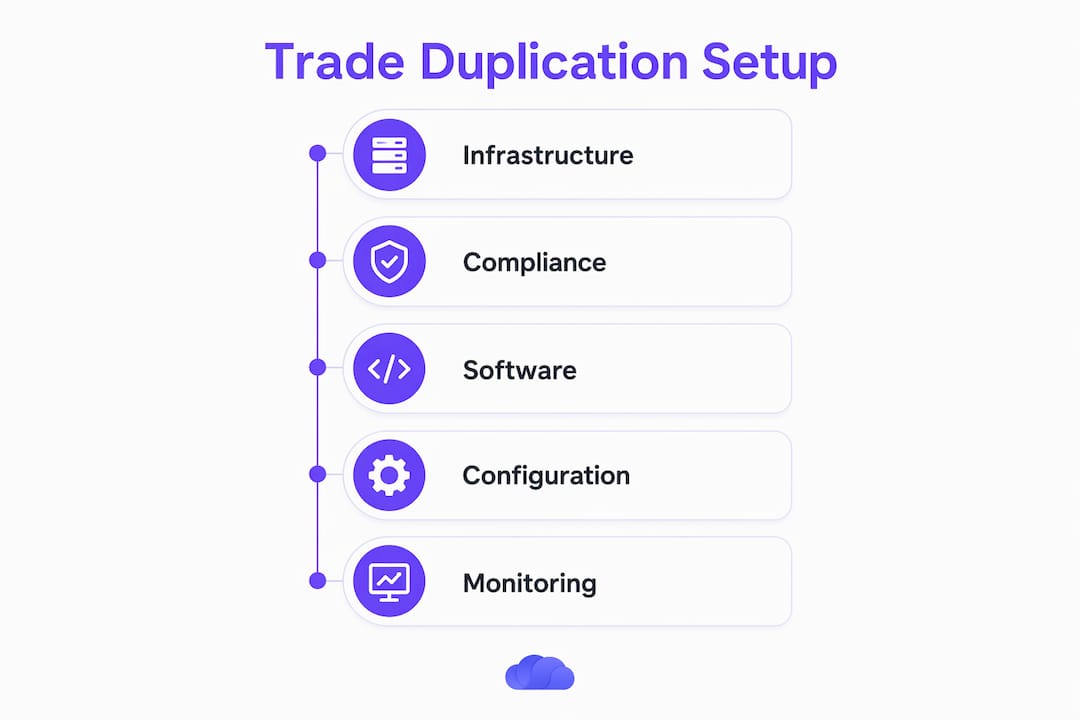
Compliance is the other non-negotiable. Prop firms treat trade copying as sensitive, and violations can result in fee forfeits, account termination, or permanent bans. Confirm each firm's copying policy before connecting any accounts.
Pro Tip: Before purchasing any copier software, verify that your prop firms explicitly permit third-party trade copiers. Some firms only allow copying through their own native tools.
*
How do you configure automated trade replication across multiple accounts?
Configuration is where the setup either holds together or falls apart. The steps below apply to a Tradovate-based workflow using TradeDupe, though the logic maps directly to NinjaTrader setups using PFACopySuite.
- Connect your accounts. Log into your copier platform and authenticate each prop firm account. In TradeDupe, each Tradovate-connected account appears as a separate node. Designate one account as the leader (master) and all others as followers.
- Set position sizing rules per follower. Each follower account can have independent sizing logic. Common methods include:
- Ratio: Follower trades a fixed ratio of the leader's size (e.g., 0.5x for a smaller account).
- Fixed contracts: Every follower always trades a set number of contracts regardless of leader size.
- Account value scaling: Follower size adjusts proportionally to account equity.
- Configure risk parameters. Set maximum daily loss limits, maximum position size, and instrument filters per account. This prevents a single bad trade from breaching a funded account's drawdown rules.
- Run a dry-run test. Before going live, simulate trades in a paper or demo environment to confirm that follower accounts receive and execute orders correctly. Check for latency, missed fills, and sizing errors.
- Enable real-time monitoring. TradeDupe's dashboard shows sync status, leader and follower activity, and any desync events. PFACopySuite provides similar mismatch alerts. Monitor this actively during your first week of live operation.
Pro Tip: Use state-based mirroring rather than order-replay mirroring where your platform supports it. State-based mirroring targets the desired position rather than replaying each order event, which dramatically reduces desync risk on partial fills.
The table below compares the two primary sizing approaches for multi-account prop setups:
| Sizing method | Best use case | Risk consideration |
|---|---|---|
| Ratio-based | Accounts with different capital tiers | Oversizing on small accounts if ratio is miscalibrated |
| Fixed contracts | Uniform account sizes across same firm | Ignores account equity changes over time |
| Account value scaling | Mixed account sizes with dynamic equity | Requires accurate real-time equity data feed |
*
How do you stay compliant when copying trades across prop firm accounts?
Compliance is the single biggest risk in any automated duplication setup. Trade copying detection is based on correlated execution signatures, and firms use high-resolution timing analysis and behavioral clustering to identify it. Manual copying is often still detected because the timing correlation is too tight.
The rules that govern compliant copying are clear. Copying is allowed only when you own and operate every account involved. Copying trades from signal services, group trading rooms, or other traders' accounts is forbidden regardless of the platform used. This is not a gray area.
Key compliance practices to follow:
- Use firm-approved tools only. Platform-native copying is viewed more favorably by prop firms than third-party software. When a firm offers a built-in group trading feature, use it.
- Never copy across firms. Running a leader account at Apex and copying into a Topstep account creates cross-firm correlation that both firms can detect. Keep copying within the same firm's ecosystem where possible.
- Document ownership. Maintain clear records that all accounts are registered under your name and funded with your capital. This documentation matters if a firm questions your activity.
- Avoid identical sizing across all accounts. Uniform sizing across every follower creates a detectable pattern. Use the independent sizing controls in TradeDupe or PFACopySuite to introduce natural variation.
> "Failure of trade copying is mostly due to firms detecting correlated replication as bypassing risk evaluation, not technical malfunction." — NexusFi Academy
Understanding prop firm copying policies before you build your setup is not optional. It is the difference between a scalable operation and a banned account.
*
Troubleshooting common issues in automated trade duplication
Even a well-configured setup encounters problems. The most common issues fall into three categories: connection failures, execution mismatches, and sizing errors.
Connection and order rejection issues:
- Broker session timeouts cause follower accounts to drop from the copier. A VPS with auto-reconnect logic resolves most of these. TradeDupe includes auto-recovery to restore sync after connection drops.
- Order rejections at the broker level often result from position limit violations or insufficient margin. Review each account's current exposure before the trading session.
- Instrument mismatches occur when the leader trades a contract the follower account does not have permission to trade. Map instruments explicitly in your copier configuration.
Latency and fill quality:
Latency affects fill quality across follower accounts, particularly when multiple accounts submit orders in rapid sequence. Good copiers use randomized submission sequencing to distribute execution fairness. PFACopySuite's shuffle algorithm ensures no single account is always first or last in the order queue. TradeDupe's 34ms median latency keeps replication tight enough that fill slippage across accounts stays minimal.
Pro Tip: If you notice consistent fill discrepancies on specific follower accounts, check whether those accounts are on a different broker routing path. Rithmic and Tradovate have different latency profiles, and a mixed setup can create uneven fills.
Failover and emergency controls:
Every live setup needs a kill switch. TradeDupe provides per-account toggle controls and a flatten function that closes all positions across follower accounts instantly. PFACopySuite offers an emergency stop that halts all new order submissions. Test these controls before going live. Knowing exactly how to stop the copier under pressure is as important as knowing how to start it.
*
Key takeaways
Automated trade duplication works reliably only when ownership, compliance, and infrastructure are all in place before the first live trade fires.
| Point | Details |
|---|---|
| Licensing is a hard prerequisite | NinjaTrader's paid license is required for multiple simultaneous broker connections. |
| Compliance determines longevity | Copy only between accounts you own and operate; cross-firm or signal-based copying risks permanent bans. |
| State-based mirroring reduces desync | Target-position mirroring handles partial fills better than order-replay methods. |
| Randomized dispatch protects fill quality | Shuffle algorithms in copiers like PFACopySuite prevent execution bias across follower accounts. |
| Native tools carry less compliance risk | Firm-provided group trading features are viewed more favorably than third-party copier software. |
*
Why infrastructure beats strategy in multi-account prop trading
The traders I see struggle most with automated duplication are not struggling because their trading strategy is weak. They are struggling because they underestimated the operational layer. Licensing, VPS stability, broker session management, and compliance documentation are unglamorous work. But they are the actual foundation.
My honest view is that the industry is moving toward native copy trading features built directly into prop firm platforms. Firms like Tradeify are already there. That trend benefits compliant traders who build their setups around approved tools rather than trying to work around firm detection systems. The traders who will scale successfully over the next few years are the ones treating their multi-account operation like a small business, not a workaround.
I also think the obsession with latency is slightly misplaced for most retail prop traders. A 34ms replication window, which TradeDupe delivers, is more than adequate for futures trading on instruments like ES, NQ, or CL. The bigger risk is not latency. It is a misconfigured sizing rule that blows a drawdown limit on a funded account before you even notice. Spend more time on risk parameter configuration than on chasing sub-10ms execution.
Finally, document everything. If a prop firm questions your activity, the first thing they want to see is proof that all accounts are yours. A simple spreadsheet with account numbers, registration dates, and funding records has saved traders from account reviews that could have gone badly.
> — Andres
*
Scale your prop accounts with TradeDupe
TradeDupe is built specifically for prop traders running multiple Tradovate-connected accounts across firms like Apex, Tradeify, Lucid Trading, Alpha Futures, and Topstep. Its real-time trade mirroring operates at a median latency of 34ms, with per-account sizing controls, rogue-trade detection, and auto-recovery built in from day one.
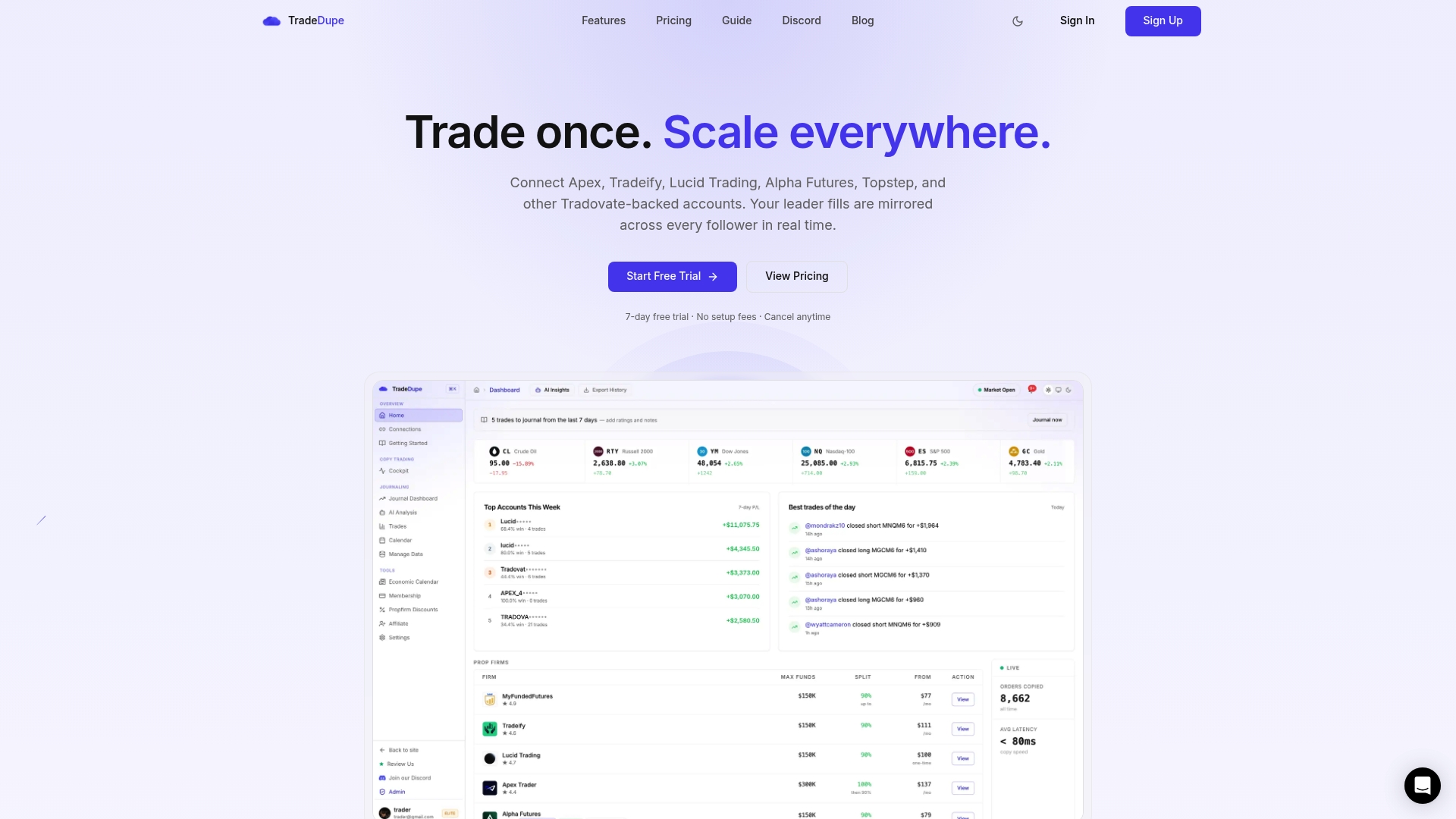
Setup takes under 10 minutes. The TradeDupe getting started guide walks you through connecting your first leader and follower accounts with no prior configuration experience required. For traders managing Apex accounts specifically, the Apex copy trading setup page covers firm-specific rules and configuration steps in detail. Start your free trial at TradeDupe and replicate your first trade today.
*
FAQ
What is automated trade duplication for prop firms?
Automated trade duplication is the process of executing a trade on one master account and automatically replicating it across multiple funded prop firm accounts you own. It eliminates manual re-entry and reduces execution inconsistency across accounts.
Is copying trades between prop firm accounts allowed?
Copying is permitted only when you own and operate all accounts involved. Copying from signal services, other traders, or across firms you do not control is forbidden and can result in account termination.
What software do I need to automate trade replication?
The core tools are a trade copier platform such as TradeDupe or PFACopySuite, a compatible trading platform like NinjaTrader 8 with a paid license for multiple broker connections, and a VPS for continuous uptime.
How does latency affect trade duplication across multiple accounts?
Higher latency creates fill discrepancies between the leader and follower accounts. Platforms that use randomized submission sequencing distribute execution fairly so no single account consistently receives worse fills.
Can prop firms detect automated trade copying?
Yes. Firms use high-resolution timing analysis and behavioral clustering to identify correlated execution patterns. Using firm-approved tools and introducing natural sizing variation across accounts reduces detection risk significantly.