How Prop Firms Reduce Operational Overhead at Scale
TradeDupe
9 min read
Discover how prop firms reduce operational overhead through automation. Learn strategies that allow scaling trader volume without eroding margins.
Operational overhead in a prop firm is defined as the total cost of running trading operations beyond direct trading expenses, including staff, compliance workflows, account management, and technology maintenance. How prop firms reduce operational overhead determines whether they can scale trader volume without watching margins erode in lockstep. The firms that grow profitably share one structural advantage: they break the link between headcount and trader capacity through automation and system integration. Manual onboarding caps at roughly 50 traders per day per operator, while automated workflows support over 5,000 traders without adding staff. That single data point defines the entire efficiency argument.
How prop firms reduce operational overhead through automation
Automation targets the three processes that consume the most operator time in a growing prop firm: onboarding, account provisioning, and payout processing. Each of these is repetitive, rule-based, and error-prone when handled manually at scale.
Onboarding and KYC represent the first bottleneck. Manual identity verification, document review, and account setup require dedicated staff time for every new trader. Automating KYC checks through integrated verification vendors removes this constraint entirely. The result is that KYC and account activation complete in under one minute, compared to hours or days under manual review. That time compression directly reduces the labor cost per funded trader.

Account provisioning across multiple platforms compounds the problem when done manually. A prop firm running evaluation accounts on Apex, Tradeify, Lucid Trading, and Alpha Futures must coordinate account creation, rule assignment, and breach monitoring across each environment. Automated provisioning systems handle this through API connections, applying trading rules consistently and flagging violations without human review at each step.
Payout workflows are where manual processes create the most financial risk. Incorrect payout amounts, missed breach flags, and compliance gaps all carry real cost. Automating payout reviews removes the proportional headcount increase that manual payout scaling demands. Firms that automate payouts report that operations staff can manage far larger trader pools without adding headcount.
- Automated KYC reduces per-trader onboarding time from hours to under one minute
- Account provisioning via API eliminates manual rule assignment across platforms
- Automated payout workflows decouple staff growth from trader volume growth
- Breach detection automation prevents compliance gaps that create financial liability
- Real-time account monitoring replaces manual status checks across multiple platforms
Pro Tip: Map every step of your current onboarding process before touching automation tools. Automating a flawed workflow entrenches inefficiency rather than eliminating it. Fix the process first, then automate.
How does integrating operational systems reduce errors and overhead?
Fragmented systems are the hidden cost driver in most prop firm operations. When account data, rule enforcement, breach records, and payout history live in separate tools, every workflow requires manual data transfer between systems. That transfer step is where errors enter.
Firms with fragmented operational systems face increased human error risks that lead to reputation damage through incorrect settings or breach enforcement failures. A trader who should have been flagged for a drawdown breach continues trading because the breach data never reached the payout system. That failure costs real money and creates compliance exposure.
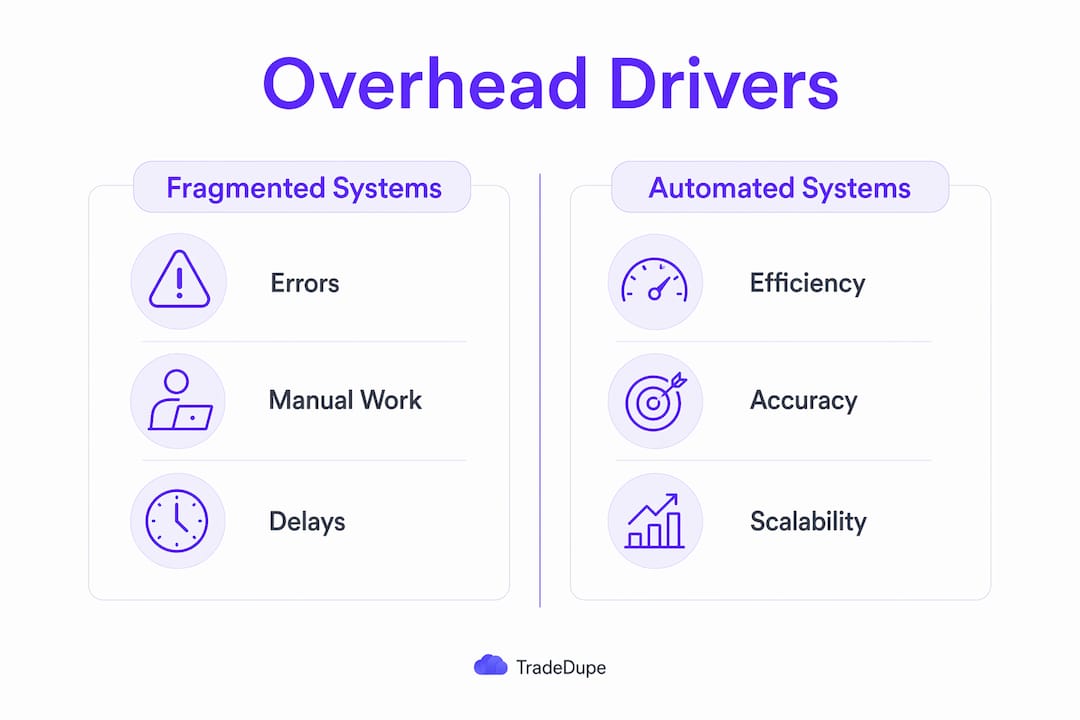
A purpose-built prop firm CRM solves this by acting as the single operational backbone. An integrated CRM manages accounts, rules, breaches, and payout workflows in one system, creating a centralized audit trail and eliminating the data transfer gaps where errors occur. This is not generic contact management. It is operational control infrastructure.
| Risk area | Fragmented systems | Integrated systems |
|---|---|---|
| Breach enforcement | Manual cross-check required | Automatic rule application |
| Payout accuracy | Error-prone data transfer | Single source of truth |
| Audit trail | Scattered across tools | Centralized and searchable |
| Support ticket volume | High due to data gaps | Reduced through self-service |
| Compliance exposure | Elevated by process gaps | Contained by automated checks |
Pro Tip: Before evaluating CRM platforms, audit your current support ticket categories. If the top five categories all trace back to data inconsistencies between tools, system integration will cut that volume faster than any other single investment.
What infrastructure and vendor strategies minimize operational costs?
Technology infrastructure is a controllable cost that most prop firms underestimate until it becomes a constraint. The choice between on-premise servers and cloud hosting carries a direct financial impact. Cloud migration reduces average IT costs by 15–40% compared to on-premise infrastructure. That range reflects differences in firm size and existing technical debt, but the direction is consistent.
The less obvious savings come from vendor contract management. Annual vendor contract renegotiations save an additional 10–20% on existing agreements. Most firms sign contracts and forget them. Vendors rarely volunteer price reductions. Scheduling annual reviews with every major vendor, including payment processors, data providers, and platform licensors, creates consistent savings without operational disruption.
Payment processor optimization deserves specific attention. Prop firms processing payouts across multiple geographies face significant fee variation by processor and payment method. Selecting processors based on fee structure and geographic coverage for your specific trader base reduces payout costs directly.
- Move from on-premise servers to cloud hosting to cut IT infrastructure costs by 15–40%
- Schedule annual vendor contract reviews for every major supplier
- Audit payment processor fees against your actual payout geography and volume
- Evaluate outsourcing non-core functions such as customer support and compliance documentation
- License purpose-built platform solutions rather than building and maintaining custom infrastructure
Engineering teams managing internal infrastructure spend roughly 60% of their bandwidth maintaining legacy systems. Licensing a purpose-built platform reverses that ratio, freeing engineering capacity for features that generate revenue rather than maintenance that prevents outages.
What workflow redesign principles improve efficiency without cutting staff?
Reducing operational costs without layoffs requires a different mental model than cost-cutting. The goal is eliminating wasted capacity, not eliminating people. Lean methodology applied to prop firm workflows reduces operational costs by 15–25% by removing unnecessary approval layers and redundant reporting steps.
The process starts with mapping what actually happens, not what the procedure manual says should happen. Shadow processes, the unofficial workarounds that staff develop to compensate for broken systems, represent real labor cost that never appears in any budget line. Identifying and eliminating these before automation prevents the classic failure mode of encoding bad habits into automated systems.
A practical workflow redesign sequence for prop firm operators:
- Document every manual task performed by operations staff in a two-week period, including informal workarounds and one-off requests.
- Identify redundant steps where the same data is entered, checked, or transferred more than once across the workflow.
- Remove approval layers that exist for historical reasons rather than current compliance requirements.
- Map dependencies between tasks to identify which steps block downstream processes and create queue buildup.
- Automate only after cleaning the workflow. Automating a process with redundant steps locks in the inefficiency permanently.
- Reinvest saved capacity into higher-value work such as trader support quality, risk analysis, and product development.
Middleware layers between operational dashboards and trading platform APIs are a technical detail that carries real operational weight. Rate-limiting and batching API requests through a middleware layer prevents system crashes when trader volume spikes. Without this architecture, scaling creates instability rather than efficiency.
Key Takeaways
Prop firms that reduce operational overhead sustainably do so by automating rule-based workflows, integrating systems into a single operational backbone, and applying lean principles to eliminate waste before deploying new technology.
| Point | Details |
|---|---|
| Automate onboarding first | Automated KYC and provisioning scale trader capacity without adding operations staff. |
| Integrate before adding tools | A unified CRM with breach and payout management eliminates the error-prone data transfers between fragmented systems. |
| Cloud and vendor audits cut fixed costs | Cloud migration saves 15–40% on IT costs; annual vendor reviews save an additional 10–20%. |
| Map workflows before automating | Automating a flawed process entrenches inefficiency. Fix the workflow first. |
| Reinvest saved capacity | Redirect hours freed by automation into trader support, risk analysis, and product quality. |
The real cost of treating operations as an afterthought
I've watched prop firms build impressive trading infrastructure and then run it on spreadsheets and email chains. The operational side gets treated as a back-office problem until it becomes a front-office crisis. A payout error at scale is not a minor inconvenience. It is a trust event that traders remember and discuss publicly.
The firms I've seen scale past 1,000 funded traders without operational chaos share one trait: they treated operations as an engineering problem from the start. They mapped their workflows before they had volume problems. They integrated their systems before fragmentation caused errors. They automated KYC and payouts before the manual process became a bottleneck.
The counterintuitive insight is that the best time to invest in operational infrastructure is before you need it. Retrofitting automation onto a firm that already has 2,000 traders and a fragmented tech stack is far more expensive than building it correctly at 200. The multi-account trading complexity that feels manageable at small scale becomes unmanageable fast without the right architecture underneath it.
Cultural buy-in matters as much as the technology. Operations and risk teams that understand why automation exists will maintain it correctly. Teams that feel automation was imposed on them will work around it, recreating the shadow processes you just eliminated. Treat the rollout as a change management exercise, not just a software deployment.
> — Andres
Tradedupe's approach to scaling prop firm operations
Prop firm operators running multiple funded accounts on Tradovate face the exact overhead problem this article describes: managing trade execution, account sync, and risk monitoring across dozens or hundreds of accounts without proportional staff growth.
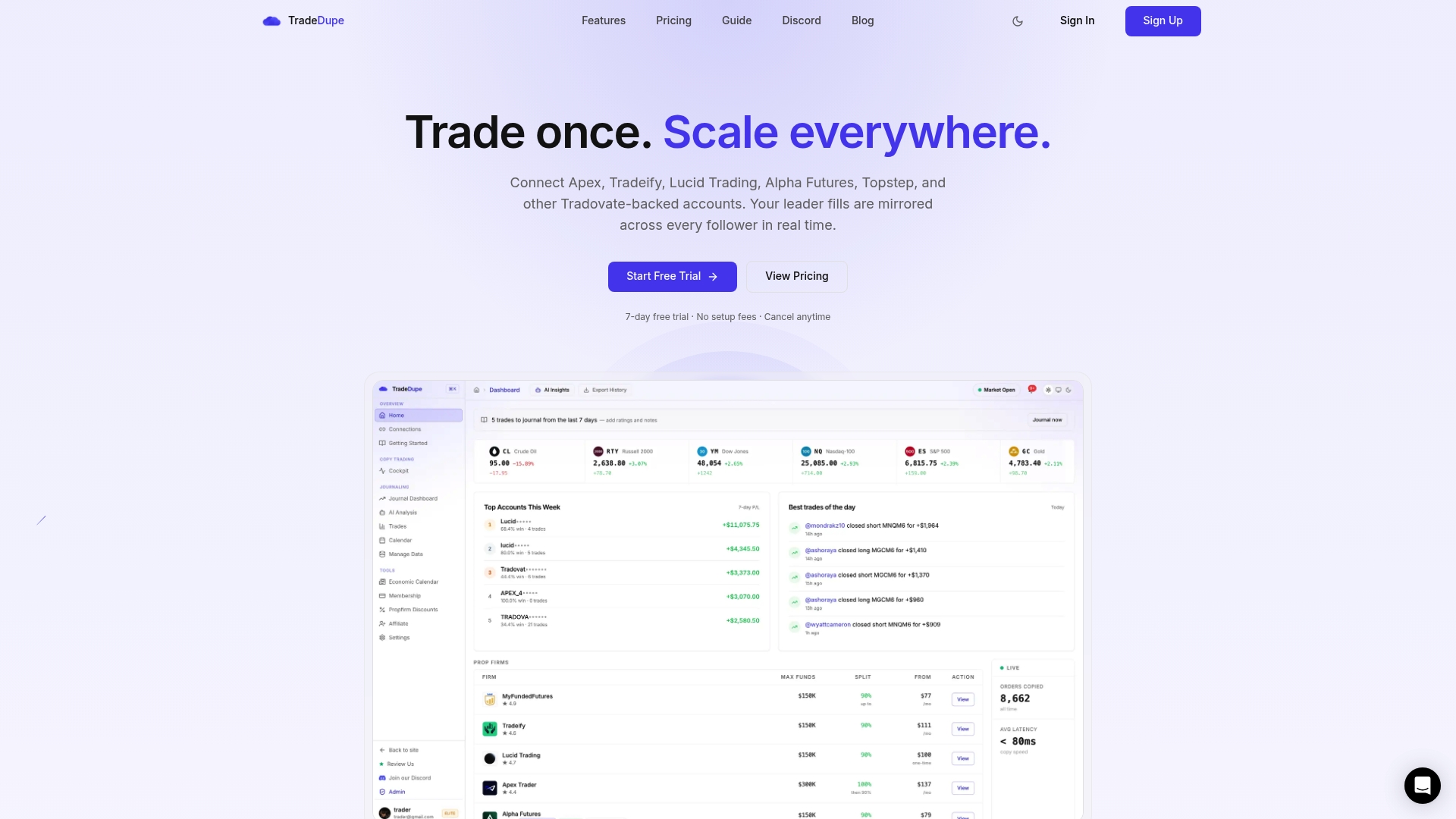
Tradedupe addresses this directly through real-time trade mirroring with a median latency of 34ms, replicating a single lead account across unlimited follower accounts on Tradovate. Supported integrations include Apex, Tradeify, Lucid Trading, and Alpha Futures. The platform includes rogue-trade detection, auto-recovery, and per-account toggle controls, giving operators the account-level control that manual management cannot provide at scale. Firms looking to cut the overhead tied to multi-account trade execution can explore Tradedupe's tiered plans, including enterprise options built for prop desks managing high trader volumes. Start with the full platform overview to see how the architecture fits your current stack.
FAQ
What is operational overhead in a prop firm?
Operational overhead in a prop firm covers all costs beyond direct trading, including staff, compliance workflows, account management, and technology maintenance. Reducing it means scaling trader volume without proportional cost increases.
How does automation reduce prop firm overhead?
Automating KYC, account provisioning, and payout workflows removes the manual labor cost tied to each new trader. Fully automated onboarding can support over 5,000 traders without adding operations staff, compared to a manual ceiling of roughly 50 traders per day per operator.
Why do fragmented systems increase operational costs?
Fragmented systems require manual data transfer between tools, which introduces errors in breach enforcement and payout processing. An integrated CRM that manages accounts, rules, breaches, and payouts in one system eliminates these transfer gaps and reduces support ticket volume.
How much can cloud migration save a prop firm on IT costs?
Cloud migration reduces average IT costs by 15–40% compared to on-premise infrastructure. Annual vendor contract renegotiations can add a further 10–20% in savings on top of that.
What is the biggest mistake prop firms make when automating operations?
The most common mistake is automating before cleaning up the underlying workflow. Automating a process with redundant steps or broken logic locks in the inefficiency at scale. Map and fix the actual workflow first, then apply automation to the corrected process.
Recommended
- Prop Firm Profit Calculator | TradeDupe
- What Happens After You Get Funded? Scaling a Prop Firm Account the Right Way | TradeDupe Blog
- Prop Firm Consistency Rule Guide (2026): Topstep, Apex, Tradeify, MFFU Rules Explained | TradeDupe Blog
- Best Futures Prop Firms 2026 — Updated Rankings | TradeDupe Blog