
How to Pass Prop Firm Evaluations on Multiple Accounts
TradeDupe
10 min read
Learn how to pass prop firm evaluations multiple accounts effectively. Discover strategies to manage risk and enhance your trading success.
Passing prop firm evaluations on multiple accounts simultaneously is the most direct path to building a scalable, risk-managed trading business. Industry pass rates sit at 15–25% on the first attempt, and 85–90% of failures trace back to behavioral issues like ignoring risk rules, not a lack of trading skill. That statistic reframes the entire challenge. The goal is not to trade brilliantly. The goal is to prove you will not blow up. Running multiple accounts under evaluation at once amplifies both the opportunity and the risk, which makes a systematic approach non-negotiable.
What are the essential rules for passing multiple prop firm evaluations?
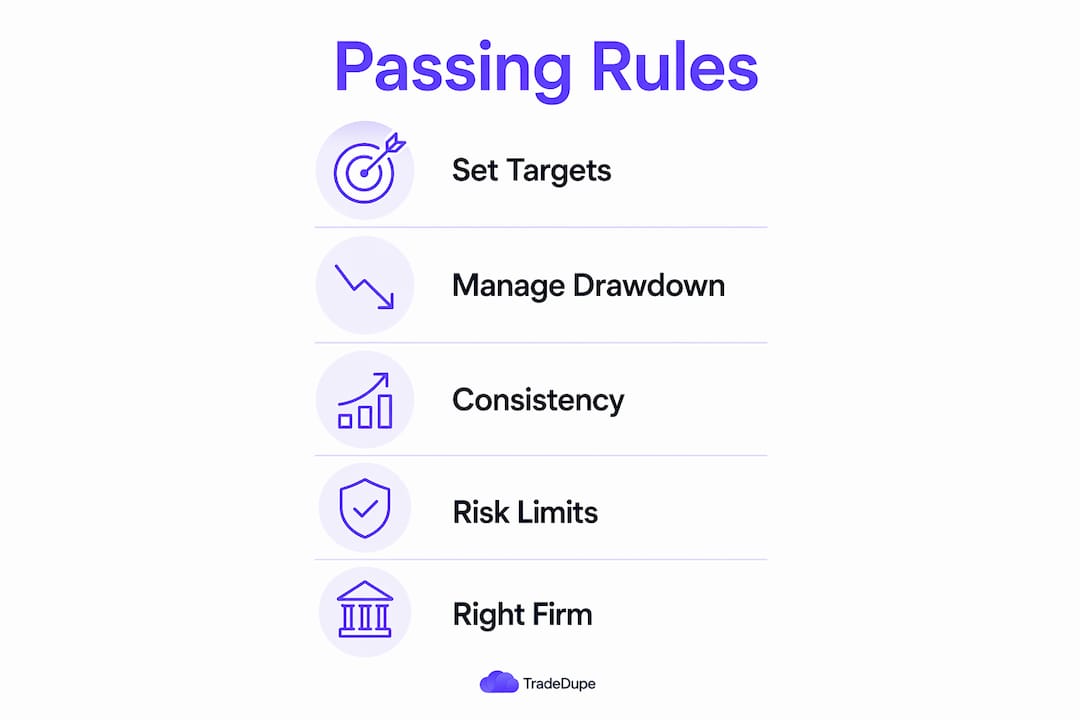
Every prop firm evaluation is a structured risk management test. Typical evaluation rules include a profit target of 6–10%, a maximum drawdown of 4–10% (fixed or trailing), and a daily loss limit of 2–5%. These rules filter for discipline and consistency, not raw profit-making ability.
When you manage multiple evaluation accounts, each account carries its own independent set of these rules. A breach on one account does not affect the others, but a behavioral pattern that causes one breach will likely repeat across all of them. That is the real danger.

Consistency rules add another layer of complexity. Many 2026 evaluations cap single-day profits at 30–40% of the total profit target. On a $9,000 target, that means no single day can produce more than roughly $2,700 in profit. Exceeding that cap triggers an automatic fail, even if your overall P&L looks healthy. You can read a detailed breakdown of how these constraints work in Tradedupe's prop firm consistency rule guide.
Trailing drawdown creates a tighter cushion as your account grows. Trailing drawdown limits tighten after profits increase, requiring you to recalculate your risk floor dynamically throughout the evaluation. Most traders ignore this until it is too late.
Key rules to track across every account:
- Profit target: 6–10% of account size, measured cumulatively
- Max drawdown: Fixed (static floor) or trailing (moves up with equity highs)
- Daily loss limit: 2–5%, resets each trading day
- Consistency cap: Single-day profit ceiling, typically 30–40% of total target
- Minimum trading days: Usually 5–15 days, depending on the firm
Pro Tip: Choosing the right firm for your trading style can shift your pass probability from 15% to 70%. Match the drawdown type and consistency rules to how you actually trade before paying an evaluation fee.
How to strategically manage multiple prop firm accounts at once
The core insight behind running multiple evaluation accounts is asymmetric ROI. One successful payout can cover the cost of roughly 10 evaluation attempts. That math turns prop trading from a gamble into a portfolio business, where individual failures are expected and priced in.
The practical execution requires structure. Here is a proven approach for managing multiple accounts without losing control:
- Start with 3–5 accounts, not 20. New multi-account traders consistently overestimate their capacity. Each account demands daily attention, rule tracking, and emotional bandwidth. Three to five accounts is enough to test your system without creating chaos.
- Batch accounts in groups of 2–3. Linking all accounts to one master trade is a costly mistake. One bad trade wipes every linked account simultaneously. Batching in small groups limits the "blast radius" of any single error.
- Stagger your entries across accounts. Multi-account traders should avoid large correlated exposures. If you enter the same trade at the same time on all accounts, you are not diversifying. You are multiplying a single position.
- Size positions conservatively at the start. Starting with minimal position sizing and maintaining a 20–30% buffer below drawdown limits gives you room to learn each platform's nuances before scaling up.
- Use a profit calculator before each session. Knowing exactly how much room you have before hitting a daily loss limit or consistency cap removes guesswork from every trade. Tradedupe's prop firm profit calculator lets you model this across multiple accounts simultaneously.
- Set a daily stop time. Overtrading is the single most common cause of late-stage evaluation failures. A hard stop time forces you to treat each trading day as a contained unit, not an open-ended session.
Pro Tip: Treat evaluation fees as a cost of doing business, not a loss. A trader running five accounts with a 25% pass rate expects to fund one or two. Budget accordingly and remove the emotional weight from each individual attempt.
What behavioral pitfalls cause failure in multi-account evaluations?
The behavioral patterns that kill evaluations are predictable. Prop firms specifically seek traders who demonstrate a repeatable, low-variance process over 15–20 days, not traders who post one exceptional week. Understanding what "patient grinding" actually looks like in practice separates funded traders from perpetual evaluation candidates.
The most common failure patterns include:
- Revenge trading after a losing session. A loss on one account triggers aggressive trading on another. The accounts are separate, but the psychology is shared.
- Overtrading near the profit target. Chasing the last few percent of the target is a documented failure mode. The correct approach is to wait for the next high-quality setup and stop trading once you are close to the target.
- Ignoring updated firm rules. Prop firms adjust their evaluation parameters regularly. A rule that applied in january may not apply in june. Traders who do not re-read the terms before each new evaluation cycle get caught off guard.
- Treating evaluations differently from live funded accounts. Traders who take risks they would never take with real capital fail at a higher rate. The evaluation is a live risk management test, not a simulation.
> Passing an evaluation is primarily a risk management proof, not a profit maximization task. The firms are not asking whether you can make money. They are asking whether you can protect capital under pressure. Every trade you take should answer that question.
Sound risk management strategies are the foundation of every successful evaluation run, especially when you are managing several accounts at once. The psychological load multiplies with each account, which makes pre-defined rules more important, not less.
Which tools and setups support scaling multiple funded accounts?
Technology reduces the operational burden of managing multiple evaluation accounts. Without the right setup, even a disciplined trader will make execution errors at scale.
The table below compares the main tool categories by function and relevance to multi-account evaluation management:
| Tool category | Primary function | Relevance to multi-account trading |
|---|---|---|
| Trade copier software | Mirrors trades from one lead account to multiple followers | Reduces manual entry errors across accounts |
| Risk analytics dashboards | Tracks drawdown, daily P&L, and rule compliance per account | Prevents accidental rule breaches |
| Profit calculators | Models target progress and daily limits | Keeps consistency rules visible before each session |
| VPS (Virtual Private Server) | Maintains stable, low-latency connections | Prevents missed fills or disconnections during live trades |
| Multi-account monitoring platforms | Displays all account statuses in one view | Reduces the cognitive load of tracking multiple evaluations |
Trade copier software is the most impactful tool for traders running more than three accounts. It eliminates the need to manually enter the same trade across multiple platforms, which is both time-consuming and error-prone. Tradedupe's trade copier software mirrors trades from a single lead account to multiple follower accounts with a median latency of 34ms, with rogue-trade detection and per-account toggle controls built in.
A VPS setup is non-negotiable for serious multi-account traders. A local machine that sleeps, restarts, or loses internet connection mid-session can cause partial fills or missed exits across every linked account. A dedicated VPS running 24 hours a day eliminates that risk entirely.
Key Takeaways
Passing multiple prop firm evaluations requires treating each account as a risk management proof, not a profit contest, and using systematic tools to manage execution at scale.
| Point | Details |
|---|---|
| Pass rates are behavioral, not skill-based | 85–90% of evaluation failures come from ignoring risk rules, not poor trading ability. |
| Consistency rules are the hidden trap | Daily profit caps of 30–40% of total target cause unexpected fails even when overall P&L is positive. |
| Batch accounts to limit blast radius | Linking all accounts to one master trade risks wiping every account on a single bad position. |
| Asymmetric ROI justifies multiple attempts | One funded payout covers roughly 10 evaluation fees, making multi-account trading a viable portfolio business. |
| Automation reduces execution errors | Trade copier software and risk dashboards prevent the manual mistakes that multiply with account count. |
Why I think most traders approach multi-account evaluations backwards
Most traders I have seen approach multi-account evaluations as a volume game. They buy five or ten evaluations at once, assume the law of averages will work in their favor, and then trade each account the same way they would trade one. That approach fails for a specific reason: it scales the behavior, not the system.
The traders who build sustainable funded accounts treat the evaluation phase as a proof-of-concept for a trading business. They define their edge, write down their rules, and then ask whether those rules can survive across five accounts simultaneously. If the answer is no, they fix the rules before scaling, not after.
The mindset shift that matters most is moving from "I need to pass this challenge" to "I need to demonstrate that my process is repeatable." Prop firms are not looking for one great month. They are looking for a trader who will not blow up their capital six months after funding. Your evaluation performance is the only evidence they have.
Realistic expectations matter here too. A 25% pass rate on the first attempt is not a failure. It is the industry baseline. The traders who build real income from prop firms are the ones who treat each failed evaluation as a data point, adjust one variable, and run the next batch. That is portfolio management, not gambling. Tradedupe's practical playbook for prop firm trading covers this process in detail for traders who want a repeatable framework.
> — Andres
Tradedupe makes scaling multiple prop firm accounts practical
Managing five or more evaluation accounts manually is operationally expensive. Every missed entry, mismatched position size, or delayed exit compounds across accounts and erodes the edge you worked to build.
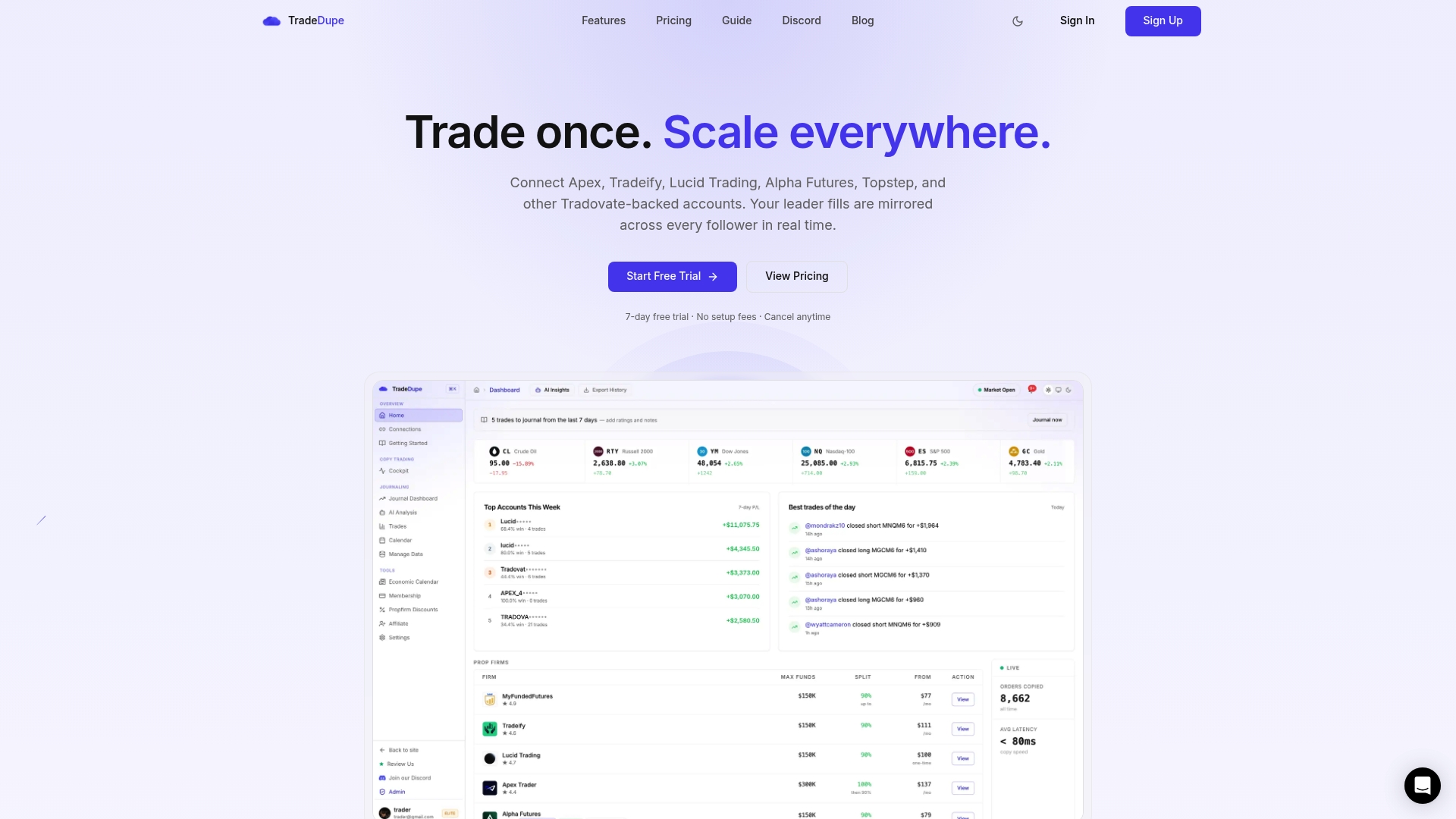
Tradedupe mirrors trades from a single lead account to multiple follower accounts in real time, with a median latency of 34ms. It integrates directly with Apex, Tradeify, Lucid Trading, and Alpha Futures accounts on Tradovate, covering the most widely used prop firm platforms in 2026. Per-account toggle controls let you pause or adjust individual accounts without affecting the rest of your portfolio. Traders who want to see how the platform handles multi-account setups can get started with Tradedupe in under 10 minutes, or explore the full Apex copy trading setup for firm-specific configuration.
FAQ
What is the average pass rate for prop firm evaluations?
Industry-wide first-attempt pass rates are 15–25%. The majority of failures come from behavioral rule violations, not a lack of trading skill.
Can you have multiple prop firm accounts at the same time?
Yes. Most prop firms allow traders to hold multiple evaluation and funded accounts simultaneously. The key constraint is that each account operates under its own independent set of rules.
How many evaluation accounts should a trader run at once?
Starting with 3–5 accounts is the standard recommendation for traders new to multi-account management. This range is large enough to benefit from asymmetric ROI without creating unmanageable operational complexity.
What is the biggest mistake traders make with multiple evaluation accounts?
Linking all accounts to one master trade is the most costly structural mistake. A single bad trade wipes every linked account at once. Batching accounts in groups of 2–3 limits that exposure.
How do consistency rules affect multi-account evaluation strategies?
Consistency rules cap single-day profits at 30–40% of the total profit target. Traders must track this limit per account daily to avoid automatic disqualification even when cumulative P&L is on track.
Recommended
- How to Trade Prop Firms (2026): A Practical Playbook to Pass and Keep a Funded Account | TradeDupe Blog
- What Happens After You Get Funded? Scaling a Prop Firm Account the Right Way | TradeDupe Blog
- Tradovate Trade Copier | Real-Time Account Sync | TradeDupe
- Prop Firm Consistency Rule Guide (2026): Topstep, Apex, Tradeify, MFFU Rules Explained | TradeDupe Blog