

How Tradeify Prop Accounts Work: 2026 Guide
TradeDupe
10 min read
Discover how Tradeify prop accounts work and unlock funding, profit splits, and tailored paths to enhance your trading strategy today.
Tradeify prop accounts are funded trading accounts that give traders access to firm capital through either an evaluation path or instant funding, with a 90/10 profit split in the trader's favor. Understanding how Tradeify prop accounts work is the first step toward using them effectively, because each account type carries distinct rules around consistency, drawdown, and payouts that directly shape your trading strategy. Tradeify offers three primary paths: Growth, Select, and Lightning. Each one targets a different trader profile, and choosing the wrong one creates friction from day one. This guide breaks down the mechanics of each account type, multi-account management, risk controls, and automated trade duplication so you can operate with full clarity.
What are the main Tradeify prop account types and their differences?
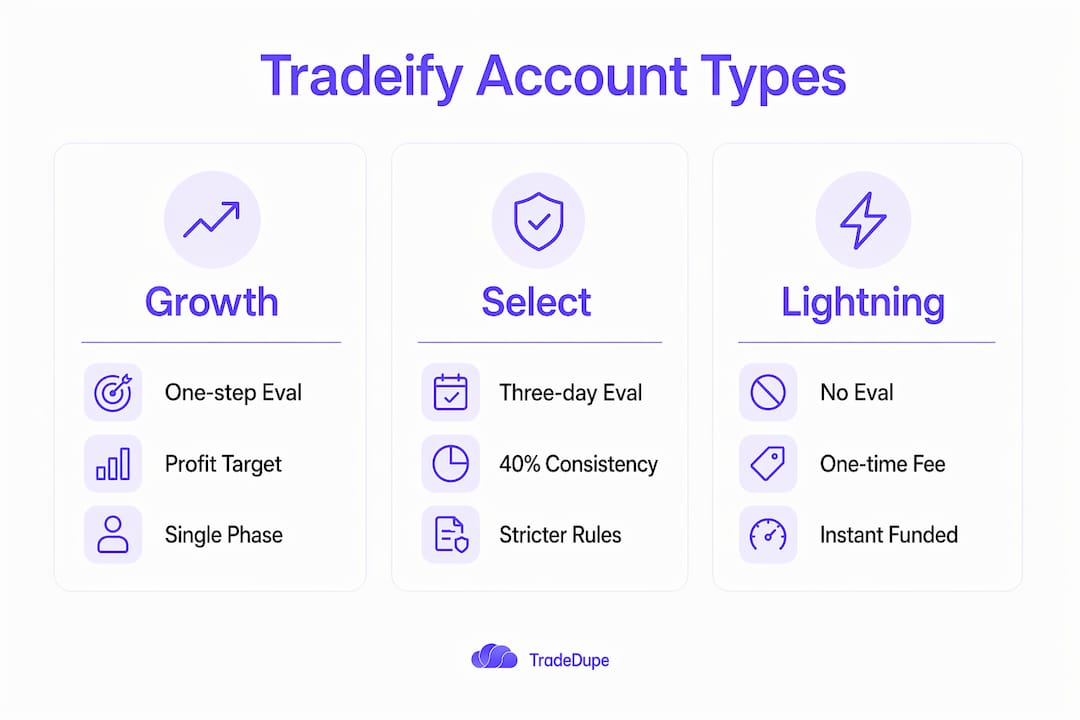
Tradeify's three account paths are Growth, Select, and Lightning, and they differ in evaluation structure, consistency requirements, and payout options. Picking the right one is not just a preference decision. It determines how much margin for error you have and how quickly you can access profits.
Growth accounts
Growth uses a one-step evaluation. You pass a single phase, meet the profit target, and move to funded status. The consistency rule is 35%, meaning no single trading day can account for more than 35% of your total profits. This rule prevents traders from passing on one lucky day and then struggling in funded accounts. Growth accounts also carry a daily loss limit, which acts as a hard stop on any given session.

Select accounts
Select runs a three-day minimum evaluation with a stricter 40% consistency rule during the evaluation phase. The extra friction is intentional. Once funded, Select traders choose between two payout structures: Flex or Daily. Select Flex requires 5 winning days before a payout request, while Select Daily allows smaller daily payouts with tighter loss controls. This choice is permanent, so traders should match it to their actual cash flow needs before deciding.
Pro Tip: If you trade intraday and want frequent access to profits, Select Daily fits better. If you run larger positions and can wait for a 5-day window, Select Flex typically delivers larger single payouts.
Lightning accounts
Lightning skips evaluation entirely. You pay a one-time fee ranging from $107 to $179 and receive instant funded status. The tradeoff is the strictest consistency rules in the Tradeify lineup. Lightning starts at a 20% consistency cap, which tightens to 30% after payouts. That means no single day can represent more than 20% of cumulative profits early on. Traders with a proven, disciplined strategy benefit most from Lightning. Traders still refining their edge will find the rules punishing.
| Feature | Growth | Select | Lightning |
|---|---|---|---|
| Evaluation steps | One-step | Three-day minimum | None (instant funded) |
| Consistency rule | 35% | 40% (evaluation) | 20% → 30% |
| Payout options | Standard | Flex or Daily | Standard |
| Fee structure | Subscription or one-time | Subscription or one-time | $107–$179 one-time |
| Daily loss limit | Yes | Yes (Daily payout version) | Yes |
How does multi-account management work on Tradeify?
Traders can hold up to five active accounts simultaneously on Tradeify, with a combined capital cap of $750,000 across all accounts. That cap exists to limit the firm's total exposure to any single trader. For you, it means the ceiling on your total funded capital is fixed regardless of how many accounts you hold.
Running multiple accounts serves two practical purposes: strategy segmentation and risk distribution. You might run a momentum strategy on one account and a mean-reversion approach on another. If one strategy hits a drawdown period, the other can continue generating profits. This separation protects your overall funded status better than concentrating everything into one account.
Managing five accounts manually creates real execution risk. Key practices for multi-account trading include:
- Track each account's drawdown floor separately. Each account has its own trailing drawdown, and a breach on one does not affect the others.
- Size positions relative to each account's specific rules. Growth and Select have different daily loss limits, so position sizing cannot be uniform across accounts.
- Log every trade by account. Mixing up which trade belongs to which account creates compliance errors that are hard to unwind.
- Monitor consistency ratios in real time. A strong day on one account can push you toward the consistency cap faster than expected.
Pro Tip: Treat each Tradeify account as a separate business unit with its own risk budget. Mentally separating them prevents the common mistake of over-trading one account to compensate for losses on another.
What risk control strategies and rules apply on Tradeify prop accounts?
The end-of-day trailing drawdown is the most misunderstood rule across all Tradeify account types. The drawdown floor trails your highest end-of-day balance, not your intraday high. That distinction matters because it means a strong morning session followed by an afternoon pullback does not move your floor intraday. The floor only adjusts at the close of each trading day.
During evaluation, the drawdown floor continues to trail, which creates a compounding risk. Every profitable day raises the floor, which means a subsequent losing day has less room before a breach. Once you reach funded status and your balance exceeds your starting capital plus max drawdown plus $100, the floor locks permanently. That locked floor is one of the most valuable features in funded trading. It means your risk floor stops moving against you.
Consistency rules interact with drawdown in a way that catches many traders off guard. Consider this scenario: you have a $10,000 funded account and you make $3,000 in one session. On a Growth account with a 35% consistency rule, that single day now represents a large portion of your cumulative profits. Any future losing days reduce total profits, which can retroactively push that single day above the 35% threshold.
Key risk rules by account type:
- Growth: 35% consistency, daily loss limit, end-of-day trailing drawdown
- Select (evaluation): 40% consistency, daily loss limit, trailing drawdown active throughout
- Select Daily (funded): Daily loss limit with profit buffer requirement before payouts
- Lightning: 20% consistency cap initially, tightening to 30% after first payout
Traders must manage the trailing drawdown actively during evaluation because it never locks until funded status is achieved. Swing traders face particular exposure here. Holding positions overnight during evaluation means open P&L does not protect you from the floor moving against you at the end of each session.
Pro Tip: Use a prop firm profit calculator to model your drawdown floor movement before each trading session. Knowing exactly where your floor sits prevents reactive decisions mid-session.
How does automated trade duplication work with Tradeify prop accounts?
Automated trade copying is permitted on Tradeify accounts provided the trader owns the strategy exclusively. You cannot copy another trader's signals or use a shared signal service. The strategy must originate from you. That rule exists to prevent traders from passing evaluations using someone else's edge and then failing in funded accounts.
Trade copiers work by mirroring orders from a lead account to one or more follower accounts in real time. For Tradeify traders running multiple funded accounts on Tradovate, this means a single trade decision executes across all accounts simultaneously. The practical benefit is eliminating manual entry errors across five separate accounts during fast-moving markets.
Common pitfalls in automated duplication include:
- Execution lag causing slippage differences across accounts. Even small delays can result in different fill prices, which affects consistency ratios differently per account.
- Position sizing mismatches. If your lead account uses a different contract size than your follower accounts, the copier must scale correctly or you risk breaching daily loss limits on smaller accounts.
- Risk rule conflicts. A trade that is safe on your lead account may push a follower account past its daily loss limit if that account has a different drawdown floor.
- Forgetting to toggle off accounts near their limits. Running automation without per-account controls is the fastest way to breach multiple accounts in a single session.
Trade copier users must monitor combined risk from all funded accounts against the $750,000 capital cap. Automation does not remove the compliance burden. It shifts it from execution to monitoring.
Pro Tip: Use a platform with per-account toggle controls so you can pause copying to any individual account that is approaching its daily loss limit without interrupting the others. This is the single most important feature for multi-account automation on Tradeify.
Key Takeaways
Tradeify prop accounts function through three distinct paths, each with specific consistency rules, drawdown mechanics, and payout structures that require active management across up to five simultaneous funded accounts.
| Point | Details |
|---|---|
| Three account types | Growth, Select, and Lightning each carry different evaluation steps and consistency rules. |
| Multi-account cap | Traders can hold up to five active accounts with a combined $750,000 capital limit. |
| Drawdown locks at funding | The trailing drawdown floor locks once funded status is reached, reducing ongoing risk. |
| Automation is permitted | Trade copying is allowed if the trader exclusively owns the strategy being copied. |
| Consistency rules are dynamic | Lightning starts at 20% and tightens to 30% after payouts; Select requires 40% during evaluation. |
My take on balancing funded accounts and automation
Running multiple Tradeify accounts simultaneously is genuinely one of the more demanding operational challenges in prop trading. The rules are not complicated in isolation. They become complicated when you are tracking five separate drawdown floors, five consistency ratios, and five daily loss limits in real time while also executing trades.
The Lightning account gets a lot of attention because instant funding sounds appealing. My experience is that it is only the right choice if your strategy is already proven and your intraday discipline is tight. The 20% consistency cap is unforgiving for traders who rely on one or two big days per week to carry their results. Growth is a better starting point for most traders because the 35% rule gives you more room to have a strong day without immediately hitting the cap.
The Select account's post-evaluation choice between Flex and Daily is underrated. Most traders pick Flex because larger payouts feel better. But if your cash flow depends on regular income from trading, Select Daily creates a more predictable structure. The smaller payouts add up, and the discipline of daily limits actually helps some traders avoid overtrading.
On automation, the biggest mistake I see is treating a trade copier as a set-and-forget tool. Prop firm rules require active oversight. A copier that mirrors trades without per-account risk controls will eventually breach an account during a volatile session. The technology should reduce your manual workload, not eliminate your judgment.
> — Andres
Tradedupe makes Tradeify multi-account trading manageable
Managing five Tradeify accounts manually during live market hours is where most traders lose discipline. Tradedupe is built specifically for prop traders on Tradovate who need real-time trade mirroring across multiple funded accounts with per-account controls.
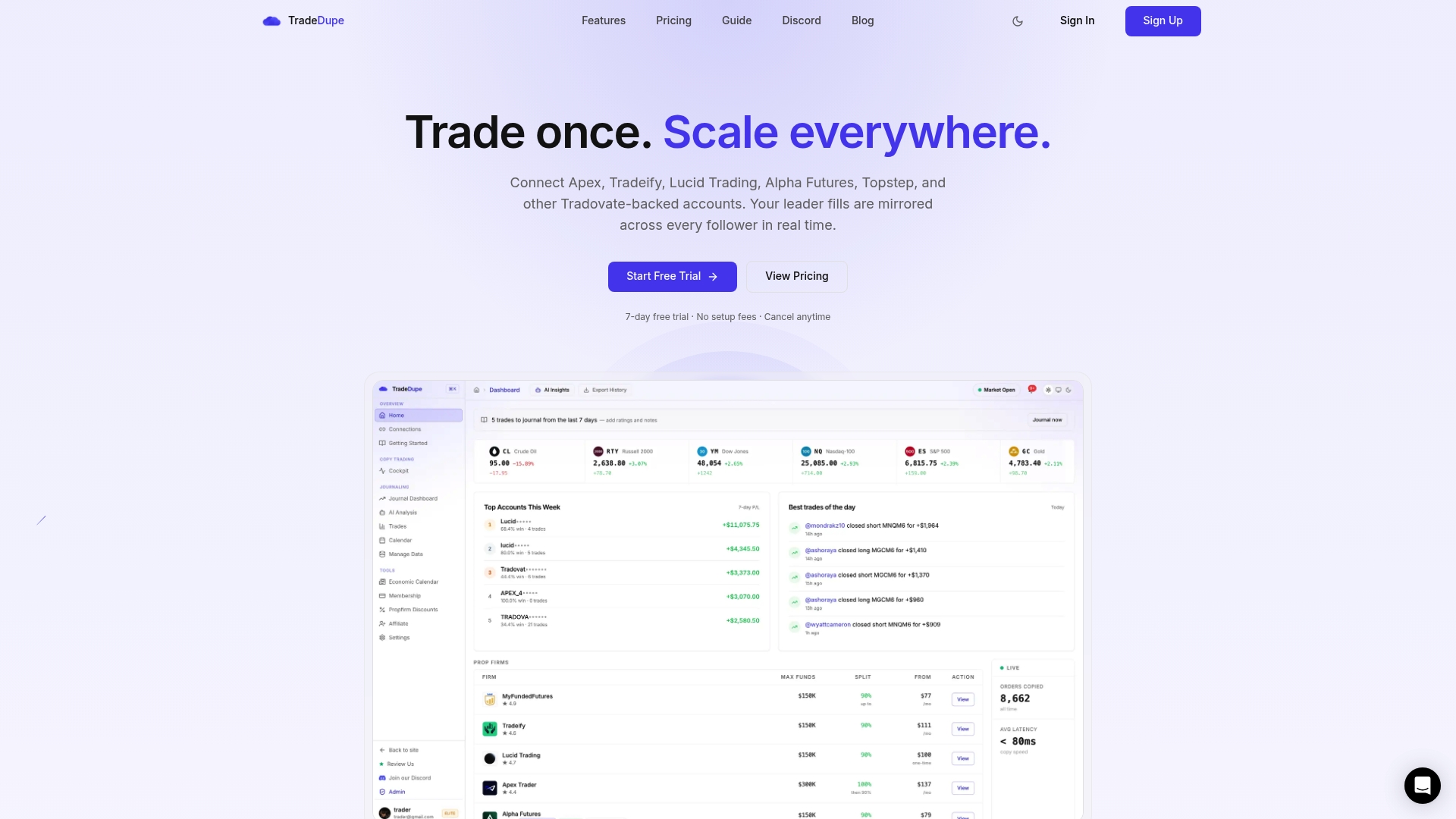
Tradedupe mirrors trades from your lead account to up to five follower accounts with a median latency of 34ms. Per-account toggle controls let you pause copying to any individual account without stopping the others, which is critical when one account is near its daily loss limit. The platform also includes rogue-trade detection and auto-recovery to catch execution errors before they become compliance problems. If you are running Tradeify accounts on Tradovate and want to get started with copy trading, Tradedupe is built for exactly this workflow.
FAQ
What is the profit split on Tradeify funded accounts?
Tradeify offers a 90/10 profit split, with 90% going to the trader. This applies across Growth, Select, and Lightning funded accounts.
How long does a Tradeify Select evaluation take?
Select requires a minimum of three trading days to complete the evaluation phase. The 40% consistency rule applies throughout this period.
Can I run automated bots on Tradeify accounts?
Automated bots are permitted on Tradeify accounts as long as the trader owns the strategy exclusively. Shared signal services or copying another trader's account violates Tradeify's rules.
When does the trailing drawdown floor lock on Tradeify?
The drawdown floor locks once your funded account balance exceeds your starting capital plus the max drawdown amount plus $100. Before that threshold, the floor continues to trail your end-of-day balance.
How quickly are Tradeify payouts processed?
Payouts are processed within 60 minutes after verification through the Rise payment platform. Select Flex requires five winning days before a payout request; Select Daily has its own daily profit buffer requirements.