

Multi-trader firm setups on Tradovate: Examples and pitfalls
TradeDupe
12 min read
Discover practical examples of multi-trader firm setups on Tradovate. Avoid pitfalls and streamline your trading operations for success.
Scaling a prop trading operation across multiple Tradovate accounts sounds straightforward until you're three accounts deep and a follower misses an exit because bracket orders didn't propagate. For prop firms looking to replicate trades cleanly across funded accounts at Apex, Tradeify, Topstep, or similar providers, the gap between "technically possible" and "operationally reliable" is where most setups break down. This guide cuts through the surface-level explainers and walks you through real setup examples, critical feature gaps to test before you scale, and the organizational decisions that separate firms running smooth multi-trader desks from those stuck firefighting manual exits.
Table of Contents
- Core ingredients for effective multi-trader setups
- Classic setup example: Lead-follower copy trading workflows
- Edge cases, operational hurdles, and what to watch out for
- Beyond copying: Pod shops and institutional multi-manager models
- A practitioner's take: What actually prevents multi-trader setups from failing
- Ready to optimize your multi-trader setup?
- Frequently asked questions
Key Takeaways
| Point | Details |
|---|---|
| Group trading essentials | Robust setups depend on group trading tools, risk alignment, and exit management features. |
| Lead-follower workflow | Most Tradovate firms use master-follower setups to duplicate positions efficiently. |
| Operational edge cases | Watch for order type, sync, and exit handling issues that can disrupt large-scale operations. |
| Scaling alternatives | Hedge fund pod shop models offer an alternative, focusing on team independence and strict risk limits. |
| Testing before rollout | Small-scale testing and process discipline are keys to sustainable multi-trader success. |
Core ingredients for effective multi-trader setups
With the challenge set, let's first define what makes a scalable, safe multi-trader setup on Tradovate.
Group trading is the foundational concept here. Tradovate Prop positions group trading as the core mechanism for managing multiple accounts from a single workflow, including both risk management and bracket-order support. In practice, group trading means one lead account drives entries and exits, while designated follower accounts mirror those actions automatically. The appeal is obvious: your best trader's decisions propagate instantly without requiring each account to be monitored or manually managed.
But the mechanism only holds if specific features are in place. Here's what a multi-trader setup actually requires to function reliably:
- Full bracket order support: Entries without exits are half a trade. Bracket orders, meaning attached stop loss (SL) and take profit (TP) levels, must be recognized and propagated by the group trading tool, not just the initial fill. Not all group trading tools propagate bracket exits automatically, which creates a dangerous gap where follower accounts hold open positions without protective exits.
- Proportional contract sizing: If the lead account trades 5 contracts and a follower is funded for fewer, the system must apply a scaling ratio, not a flat copy. Mismatched sizing relative to account equity is one of the most common causes of rule violations on prop firm accounts.
- Per-account toggle controls: Firms need the ability to pause or enable copying on specific follower accounts without disrupting the entire group. This matters enormously when a follower account is near a drawdown limit or is going through an evaluation phase.
- Exit propagation and order state management: What happens when the lead closes partially? Or reverses? Robust setups handle these scenarios with clear logic. Weak setups leave the firm manually closing residual follower positions.
Understanding the copy trading benefits of this architecture helps clarify why it's worth building carefully. When it works correctly, one skilled trader drives P&L across many accounts simultaneously, compressing overhead and eliminating the need to hire additional execution staff.
Pro Tip: Before committing to any group trading tool or copier setup, place a test trade with a bracket order on the lead account and verify that both the SL and TP appear automatically on every follower account. If you need to manually place exits, your risk controls are already compromised at scale.
Classic setup example: Lead-follower copy trading workflows
Once you know what to look for, here's how a standard lead-follower multi-trader workflow is built out, and where snags often occur.
A common lead-follower setup uses a master account to drive entries with follower accounts duplicating trades at proportional contract ratios, but bracket exit syncing is not always handled natively. The typical build-out follows this sequence:
- Designate the lead account: This account belongs to the trader whose decisions are replicated. All entries, exits, and order modifications originate here.
- Configure follower accounts with ratio mappings: Each follower is assigned a contract multiplier or ratio. A lead trading 3 contracts might map to a follower trading 1 contract, for example, based on account size and risk parameters.
- Define order type handling: Determine which order types the system will copy. Market orders are almost universally supported. Limit and stop orders, including bracket components, are where many tools fall short.
- Test with a single follower before expanding: Run the setup with one follower account for several sessions to verify fills, timing, and bracket handling before adding additional followers.
- Monitor fill quality and latency: Every millisecond of delay between lead fill and follower fill creates slippage risk, especially in fast-moving futures markets. Latency under 50ms is generally considered acceptable for most futures strategies.
- Establish a manual override protocol: Even the best automated systems need a human fallback. Define who closes follower positions manually in the event of a system outage or propagation failure.
Here's how the major workflow options compare in practice:
| Feature | Native group trading | Third-party copier | Manual relay |
|---|---|---|---|
| Entry order copying | Yes | Yes | Yes (with delay) |
| Bracket (SL/TP) propagation | Partial | Varies | No |
| Latency | Low | Very low (best tools) | High |
| Per-account controls | Limited | Full (best tools) | Manual |
| Rogue trade detection | No | Yes (best tools) | No |
| Scalability | Moderate | High | Very low |
| Prop firm compatibility | Varies | High (specialized tools) | High |
Some setups require manual exit handling because bracket orders may not propagate to follower accounts, meaning the risk controls the lead trader relies on simply don't exist for followers. This is not a minor inconvenience. It's a material operational gap that can result in follower accounts blowing through drawdown limits while the lead account is safely protected.

For firms evaluating purpose-built trade copier software, the key differentiator from native tools is often exactly this: bracket handling, rogue trade detection, and per-account toggle controls that native group trading doesn't provide. See the multi-account trading guide for a deeper look at how these choices compound over a full trading operation.
Pro Tip: Always map your contract ratios to maximum position size rules for each specific prop firm account, not just account equity. Apex, Tradeify, and Topstep each have distinct position size limits. A sizing error that violates a prop firm rule on a funded account can cost you the account entirely.
Edge cases, operational hurdles, and what to watch out for
Beyond basic setup, what separates robust firm operations from those prone to costly errors are the less-obvious operational hurdles that only surface once you're live.
Key friction points that frequently trip up even experienced multi-trader operations include:
- Pending order synchronization delays: When the lead places a limit order that isn't immediately filled, follower accounts may not receive the order until the lead fill occurs. This creates timing mismatches where followers enter at worse prices than the lead, especially during periods of fast order flow.
- Partial fills and position state divergence: If the lead fills partially, does the copier treat that as a full signal or a fractional one? Inconsistent handling creates position size mismatches that accumulate over a session.
- Reversed trades and flat-to-long transitions: Some tools struggle when the lead flips from long to short in a single order. The follower may close incorrectly or open a position in the wrong direction.
- Platform restarts and session handoffs: What happens to open follower positions if the copier software restarts mid-session? Without auto-recovery logic, positions can become orphaned.
> "Pending stop and limit orders may not sync instantly. Follower fills only occur after the master fills, and many copiers only handle market orders without propagating SL/TP." This is the core operational reality of most current Tradovate copy trading setups.
The risk dimension compounds when you factor in prop firm rules. While group trading is active, personal risk settings and bracket orders may be disabled on follower accounts, meaning the safety nets each account holder might configure individually are overridden by the group structure. For prop firm accounts with strict daily loss limits, this is a critical consideration. The lead trader's risk management becomes the only risk management.
For firms running Apex copy trading setups specifically, the interaction between Apex's trailing drawdown rules and propagation delays deserves extra scrutiny. A follower account that enters a few seconds after the lead during a news spike can fill at a materially different price, affecting both P&L and drawdown calculations independently of the lead.
Pro Tip: Run every new multi-trader configuration through at least five complete trade cycles on a test or sim account before activating it on funded accounts. Include at least one reversal scenario, one partial fill scenario, and one bracket-entry trade to verify full propagation behavior under realistic conditions.
Beyond copying: Pod shops and institutional multi-manager models
For organizations ready to scale even further, it's vital to consider what the largest institutions do, and why simple copy setups can't handle every scenario.
The pod shop structure involves many semi-independent teams operating within strict firm-level risk limits. Each pod runs its own strategy and manages its own book, rather than copying a single lead trader. Firms like Millennium have popularized this model precisely because it distributes both alpha generation and risk accountability rather than concentrating both in one lead account.
This contrasts sharply with the leader-follower copy model in fundamental ways:
| Dimension | Centralized copy trading | Pod shop model |
|---|---|---|
| Decision-making | Single lead trader | Multiple independent teams |
| Risk accountability | Concentrated at lead | Distributed per pod |
| Technology requirement | Low to moderate | High (governance systems) |
| Best for | Smaller multi-account firms | Large multi-manager platforms |
| Scalability ceiling | Limited by lead trader | High, scales with teams |
| Failure mode | Lead error affects all accounts | Pod failure is isolated |
Scaling multi-manager platforms places extra emphasis on technology and risk systems for governance and fund control. What this means in practice is that the technology stack for a pod shop isn't a copier, it's a risk aggregation and position monitoring system that ensures no individual pod breaches firm-level limits even as each operates independently.
For prop trading firms on Tradovate, understanding this distinction helps clarify which organizational model actually fits your scale. A five-account operation benefiting from one strong trader's decisions is a copy trading problem. A twenty-trader desk with distinct strategy mandates is a governance and technology problem that copy trading tools alone cannot solve. Recognizing the correct category prevents firms from applying the wrong solution and then wondering why it doesn't scale cleanly. Review the multi-account ecosystem framework to assess which model fits your current stage and near-term growth targets.
A practitioner's take: What actually prevents multi-trader setups from failing
Having explored both copy-based and organizational alternatives, here is a candid look at what truly sustains effective multi-trader firm setups in practice, and what most miss.
The uncomfortable reality is that most multi-trader setups don't fail because of technology. They fail because of process gaps that technology then exposes. Specifically, three patterns account for the vast majority of operational breakdowns.
First, unclear risk splits. Who owns the drawdown on each follower account? If the answer is "the lead trader's decisions," that's a governance gap, not a software issue. Firms that run successful group setups define in writing which accounts are active at any time, who monitors drawdown thresholds, and what the manual intervention protocol is when a threshold is approached.
Second, ambiguous order management responsibilities. When bracket orders don't propagate to a follower, who closes that position and when? If the answer isn't documented and drilled before going live, it gets improvised in real time during a volatile session. That's where mistakes compound quickly.
Third, over-reliance on published benchmarks. Empirical benchmarks are rarely published for multi-trader duplication success rates or slippage outcomes. Most available content covers setup mechanics, not measured outcomes. This matters because a tool that works cleanly in a demo or at low frequency may degrade under live conditions with multiple simultaneous fills during high-volume sessions.
The lesson drawn from watching prop desks build and rebuild these setups is simple: start with two accounts and one complete trade cycle before adding complexity. Verify every edge case manually. Document what the system does and does not handle automatically. Then scale. The real-world multi-account lessons that matter most aren't in manuals. They're earned by running controlled tests before trusting the system with funded accounts.
Process discipline, clear role definitions, and a culture of accountability around risk are what separate firms that run these setups successfully from those that lose funded accounts to preventable execution errors.
Ready to optimize your multi-trader setup?
Putting these strategies into practice requires the right foundation, and that means tools built specifically for the Tradovate and prop firm environment rather than generic solutions adapted after the fact.
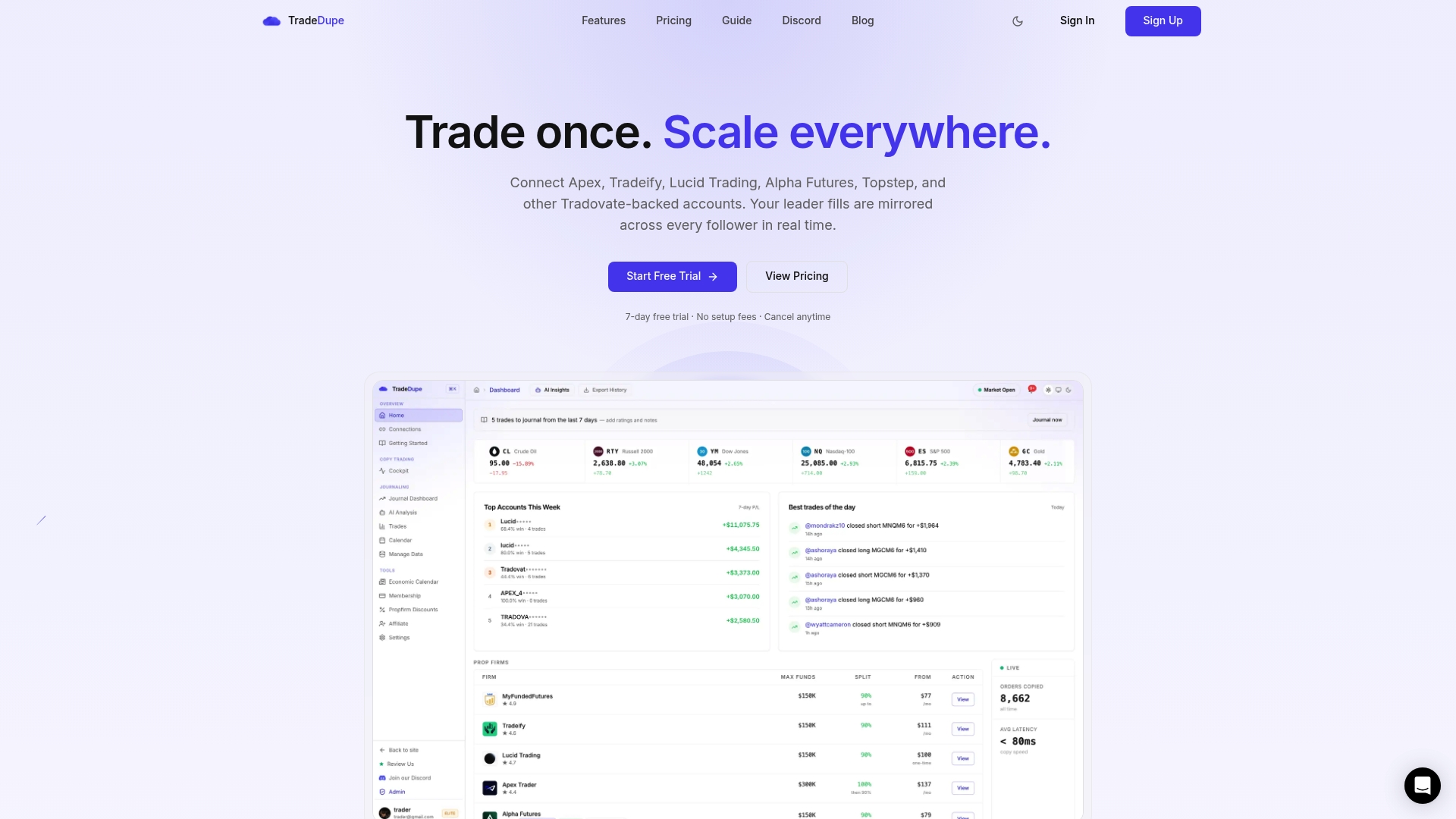
TradeDupe is purpose-built for exactly this operational context. With a median latency of 34ms, rogue-trade detection, auto-recovery on reconnection, and per-account toggle controls, it addresses the specific failure points covered throughout this guide. Whether you're managing Apex, Tradeify, Topstep, or Lucid Trading accounts, the platform handles bracket propagation and follower restrictions in ways that native group trading simply doesn't. For firms comparing options, the TradeDupe vs TradeCopia comparison breaks down feature-by-feature differences clearly. When you're ready to configure your first multi-trader setup or migrate an existing one, the Tradovate setup guide walks you through the full onboarding process with prop firm-specific configurations in mind.
Frequently asked questions
What is the main benefit of a lead-follower setup for prop trading firms?
A lead-follower setup allows firms to duplicate trades across accounts efficiently while centralizing risk decisions. Lead-follower setups duplicate trades with proportional sizing so one skilled trader drives performance across multiple funded accounts simultaneously.
Do all trade copier tools on Tradovate support bracket order (SL/TP) copying?
No, many native and third-party tools require you to manage exits manually since SL/TP orders may not propagate automatically. Bracket order sync is not universally provided, making manual exit handling a common operational requirement.
How do follower accounts differ from master accounts in group trading?
Follower accounts typically cannot place or modify trades independently, and their personal risk settings may be overridden during active group trading. Follower accounts are restricted in group setups, with risk parameters controlled at the lead or master level.
Are there industry benchmarks for success or slippage in multi-trader setups on Tradovate?
No, current sources describe setup mechanics but do not publish empirical benchmarks for duplication success rates or slippage. Most published content focuses on how to configure setups rather than measuring live performance outcomes.
When should a firm consider centralized copy trading versus a pod shop structure?
Centralized copy trading fits smaller teams needing efficient duplication from one lead trader. Pod shop models work better for large firms with multiple independent teams requiring governance infrastructure beyond trade copying.