
Prop Trading Multi-Account Management Explained for Pros
TradeDupe
12 min read
Discover how prop trading multi-account management explained can elevate your trading strategy. Master risk aggregation and enhance compliance.
Managing multiple funded prop accounts is not simply a matter of copying trades from one screen to another. Prop trading multi-account management explained properly reveals a system with interconnected layers: execution infrastructure, portfolio-level risk aggregation, compliance enforcement, and operational automation. Each funded account carries its own drawdown ceiling, daily loss limit, and payout structure. Miss any one of those variables at scale and a single losing trade can breach multiple accounts simultaneously. This guide walks you through the workflows, tools, and risk frameworks that professional prop traders and risk managers actually use.
Table of Contents
- Key takeaways
- Multi-account workflow and platform tools
- Portfolio-level risk management and aggregated compliance
- Reducing correlated risk and optimizing execution
- Advanced features: PAMM, API integrations, and automation
- Daily monitoring, performance tracking, and payout management
- My take on scaling multiple prop accounts
- How TradeDupe supports your multi-account setup
- FAQ
Key takeaways
| Point | Details |
|---|---|
| Two distinct execution modes exist | Copier Groups and Multi-Account Placement solve different problems; matching the right method to your setup matters. |
| Risk must be aggregated, not siloed | Monitoring each account independently creates blind spots; portfolio-level kill switches prevent compounding breaches. |
| Blast radius control is the real skill | Limiting how many accounts share one copier group caps the damage a single bad trade can do. |
| Daily check-ins should take five minutes | A structured morning routine covering drawdown, daily loss, and sync status catches problems before the market does. |
| Automation needs human guardrails | Automated copiers must enforce follower-specific sizing and timing variance to stay within each firm's individual rules. |
Multi-account workflow and platform tools
Understanding prop trading multi-account management starts with the execution layer. Two fundamentally different approaches exist, and confusing them is a common setup mistake.

Copier Groups create a leader-follower network where a single master account broadcasts trades to multiple follower accounts. The power here is in configurability. You can apply ratio-based sizing and instrument mapping per follower, meaning a $50K account and a $150K account receive proportionally scaled positions rather than identical lot sizes. This matters because prop firm evaluations often tie position limits directly to account size, and a flat copy that works on one account will violate the rules on another.
Multi-Account Placement takes a simpler path: the same order fires simultaneously across all selected accounts. No ratio logic, no mapping. This works cleanly when your accounts are identical in size and operating under the same firm's rule set, but it breaks down the moment account parameters diverge.
Combined setups are common among experienced operators. A trader might use Copier Groups for their core prop accounts with different funding tiers while using Multi-Account Placement for a batch of identical evaluation accounts running a uniform strategy.
A centralized dashboard for multi-account tracking is not optional at scale. You need per-account filtering for drawdown, P&L, and rule compliance, plus an aggregated portfolio view for combined income and total exposure. The alternative, a spreadsheet updated manually after each session, introduces transcription errors and latency that a live trading environment cannot tolerate.
- Per-account view: Monitor individual drawdown headroom, daily loss consumed, and open position status for each funded account.
- Portfolio view: See aggregate P&L, total notional exposure, and combined rule compliance across all active accounts.
- Trade assignment log: Confirm that each executed trade has been correctly attributed to the intended account and sizing tier.
- Sync status indicators: Real-time confirmation that follower accounts are active, connected, and receiving signals from the leader.
Pro Tip: Label each account with a naming convention that includes the firm name, account tier, and activation date (e.g., Apex-150K-PA-Mar26). Consistent naming eliminates the risk of routing a trade to the wrong account, especially when managing six or more accounts across multiple prop firms.
Portfolio-level risk management and aggregated compliance
The most dangerous assumption in multi-account prop trading is that managing risk per account equals managing risk overall. It does not.
Consider this failure mode: you run three accounts with independent expert advisors, each capped at 2% risk per trade. All three fire simultaneously on the same correlated futures instrument. Your per-account risk looks controlled. Your actual portfolio exposure just hit 6% of combined equity in a single directional bet. Risk management must be aggregated system-wide, not calculated in isolation, because independent strategies can unknowingly stack exposures into a combined loss that exceeds what any one account could absorb.
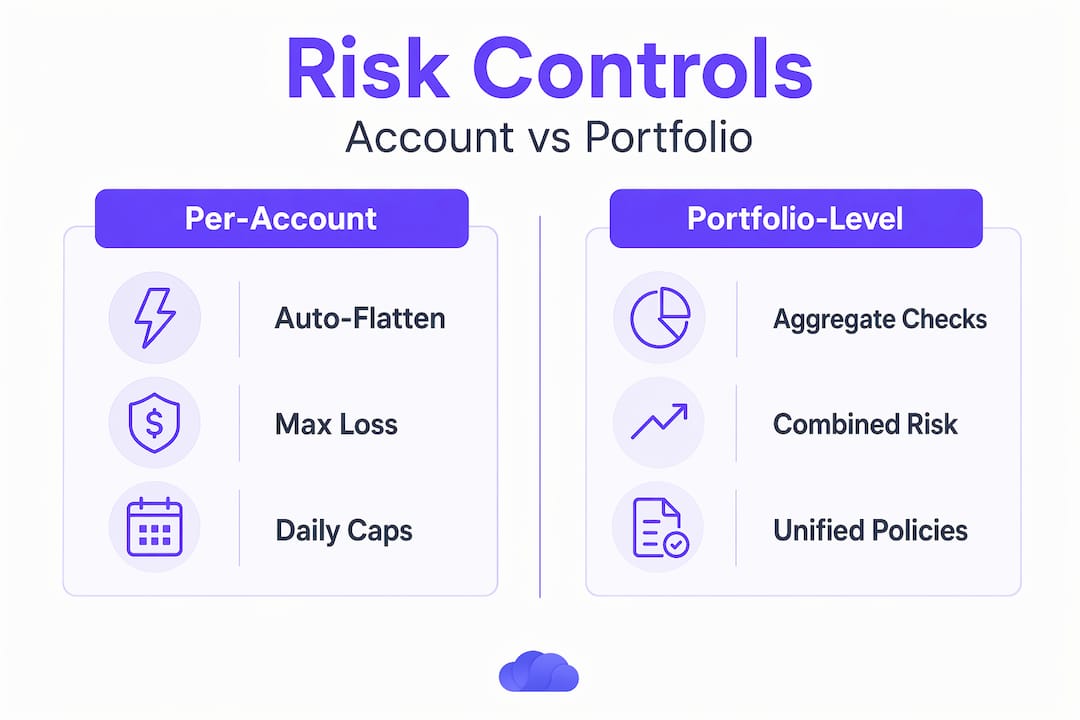
Automated risk monitors solve this by measuring equity drawdown from the start of each session across all active accounts and triggering a kill switch when a portfolio-level threshold is crossed. Auto-flattening, where open positions are closed automatically when a daily loss limit is approached, is the operational safety net that prevents a single bad session from cascading into multiple simultaneous account breaches.
Key components of an aggregated risk framework include:
- Portfolio equity baseline: Calculate combined starting equity at session open across all accounts to establish the daily loss reference point.
- Warning thresholds: Set alerts at 60-70% of maximum daily loss consumed so you have time to reduce exposure manually before automation takes over.
- Auto-flatten triggers: Configure per-account and portfolio-level auto-flatten rules that close all open positions when a defined equity level is breached.
- Correlation monitoring: Identify when multiple accounts hold positions in the same instrument or correlated instruments, flagging concentration risk before it becomes a compliance issue.
Pro Tip: Do not rely on your prop firm's risk desk to catch aggregated breaches before you do. By the time they act, you have already violated the rule. Build your own kill-switch layer on top of the copier, positioned between your leader account and the follower network.
Per-account configurable risk controls with auto-flatten and daily max loss policies give you the granular enforcement layer. The portfolio-level monitor sits above that to catch the combinations those per-account tools cannot see individually.
Reducing correlated risk and optimizing execution
Even when individual account risk looks clean, correlated execution across multiple accounts creates concentration exposure that standard per-account risk tools miss. Tactical diversification at the operational level addresses this directly.
- Stagger entry timing across accounts. Rather than firing all followers at the exact same millisecond, introduce deliberate timing offsets of 2 to 5 seconds between account executions. This distributes slippage more evenly across fills and avoids creating a single large footprint that can move the market against your position during high-frequency fills on illiquid instruments.
- Separate strategies or instruments by account cluster. Assign one group of accounts to an ES futures strategy during the New York open session and a second group to NQ during the London overlap. You preserve exposure diversity without requiring entirely separate trading systems, and a single strategy failure does not hammer every funded account at once.
- Cap copier group sizes deliberately. Limiting blast radius by batching accounts in groups of two to three per copier group prevents a single bad trade decision from breaching every account you hold. Split the remainder into independent clusters, each with its own leader or signal source.
- Use round-robin signal distribution for evaluation accounts. Rather than copying every signal to every evaluation account simultaneously, rotate which accounts receive each signal. This introduces natural variance in drawdown curves across accounts, reducing the probability that all evaluations breach on the same day for the same reason.
Pro Tip: Treat each copier group as its own risk entity with a defined maximum daily loss budget. When that group hits its budget, shut it down for the day regardless of what the strategy says. The accounts that are not copying keep trading. This is blast radius thinking applied at the operational level.
Compliance-safe copy trading requires follower-specific sizing, timing rotation, and drawdown state checks. Blindly copying master position sizes can violate follower account limits even when the strategy itself is sound.
Advanced features: PAMM, API integrations, and automation
For traders managing diverse account sizes or operating as a small prop desk, standard copier tools have a ceiling. That ceiling is where PAMM systems, API integrations, and scripted automation begin.
| Feature | Use case | Key benefit |
|---|---|---|
| PAMM allocation | Managing accounts of varied sizes under one strategy | Trades allocated proportionally by fixed ratios summing to 100% |
| Full API access | Programmatic order execution and monitoring | Automates order management and compliance checks at scale |
| Scripted workflows | Custom signal routing and multi-account logic | Handles complex instrument mapping and session-based rules |
| Dashboard APIs | Real-time data extraction for external reporting | Feeds performance data into custom risk dashboards or reporting tools |
PAMM systems handle the math of proportional allocation automatically. A trader managing accounts of $25K, $75K, and $150K under a single strategy does not need to manually calculate position sizes for each. The PAMM module scales each fill by the account's proportional weight within the total pool.
Full API access takes this further. When a prop trading platform exposes an API for order execution, modification, and streaming, you can build automated workflows that check drawdown state before routing a signal, modify position sizes based on current account equity, and log compliance data in real time to an external system. API-enabled programmatic control for multi-account trading allows traders to enforce firm risk limits automatically without manual intervention on every fill.
The critical caveat: automated environments require explicit compliance logic built into the code. Automation does not self-regulate. If you do not write a drawdown check into your order routing script, no drawdown check will run.
Daily monitoring, performance tracking, and payout management
A disciplined daily routine is what separates professional multi-account prop trading from reactive account management. The goal is a structured check-in that takes five minutes and surfaces anything that needs attention before the market opens.
| Check | Tool | What to look for |
|---|---|---|
| Drawdown status | Dashboard per-account view | Remaining headroom versus daily maximum |
| Daily loss consumed | Aggregated portfolio view | Percentage of session budget used |
| Sync status | Copier group indicators | All followers active and connected |
| Open positions | Position summary | Overnight holds, unintended residual exposure |
| Payout eligibility | Profit tracking module | Accounts approaching payout threshold |
Switching between per-account and portfolio scope is not just a monitoring habit. It directly affects how you interpret your trading day. An account that looks like it had a flat session may have absorbed losses offset by gains elsewhere in the portfolio. You need both views to understand what actually happened.
Payout tracking across multiple funded accounts has tax implications that compound quickly. Each funded account's profit split is typically reported separately, and the timing of payout requests affects which tax year that income falls into. Using a profit split calculator for each account keeps these figures current without end-of-month reconciliation surprises.
Naming conventions and folder structures for trade logs reduce human error when you are managing six or more accounts. A log named "trade-log" tells you nothing. A log named "Apex-150K-PA-2026-Q1" can be audited in seconds.
My take on scaling multiple prop accounts
I've seen traders celebrate passing five evaluations in a single month, then blow three of them in the same week because they treated the scaling challenge as purely a trading problem. It is not. It is a systems problem.
What I've found is that the traders who scale successfully spend more time on architecture than on charts. The copier configuration, the blast radius limits, the aggregated kill switch, the naming conventions. These are the decisions that determine whether your funded accounts survive the first difficult week, not your entry technique.
The counterintuitive lesson I keep returning to: fewer accounts, managed with tighter control, consistently outperform larger account sets running loose workflows. Ten accounts with no aggregated risk monitoring are not ten times better than one. They are ten ways to fail at once.
I've also watched traders automate everything and then stop watching. Automation handles execution, but it does not replace judgment about when a strategy should stop running. The best multi-account operators I know use automation for the repeatable mechanical tasks and retain human oversight for the contextual decisions: pausing a copier group during a Federal Reserve announcement, cutting exposure during low-liquidity sessions, rotating strategies when volatility regimes shift.
The operational skill in multi-account prop trading is knowing exactly how much damage one bad decision can cause and designing your system so that maximum damage is contained before it happens. Successful scaling comes from system architecture controlling risk blast radius, not from superior chart reading.
> — Andres
How TradeDupe supports your multi-account setup
Running multiple funded accounts across Apex, Topstep, Tradeify, Lucid Trading, and Alpha Futures from a single interface is exactly what TradeDupe was built for. The platform's leader-follower Copier Groups handle ratio-based sizing and instrument mapping across accounts with different funding tiers, while per-account toggle controls let you pause or exclude individual follower accounts without disrupting the rest of the network.
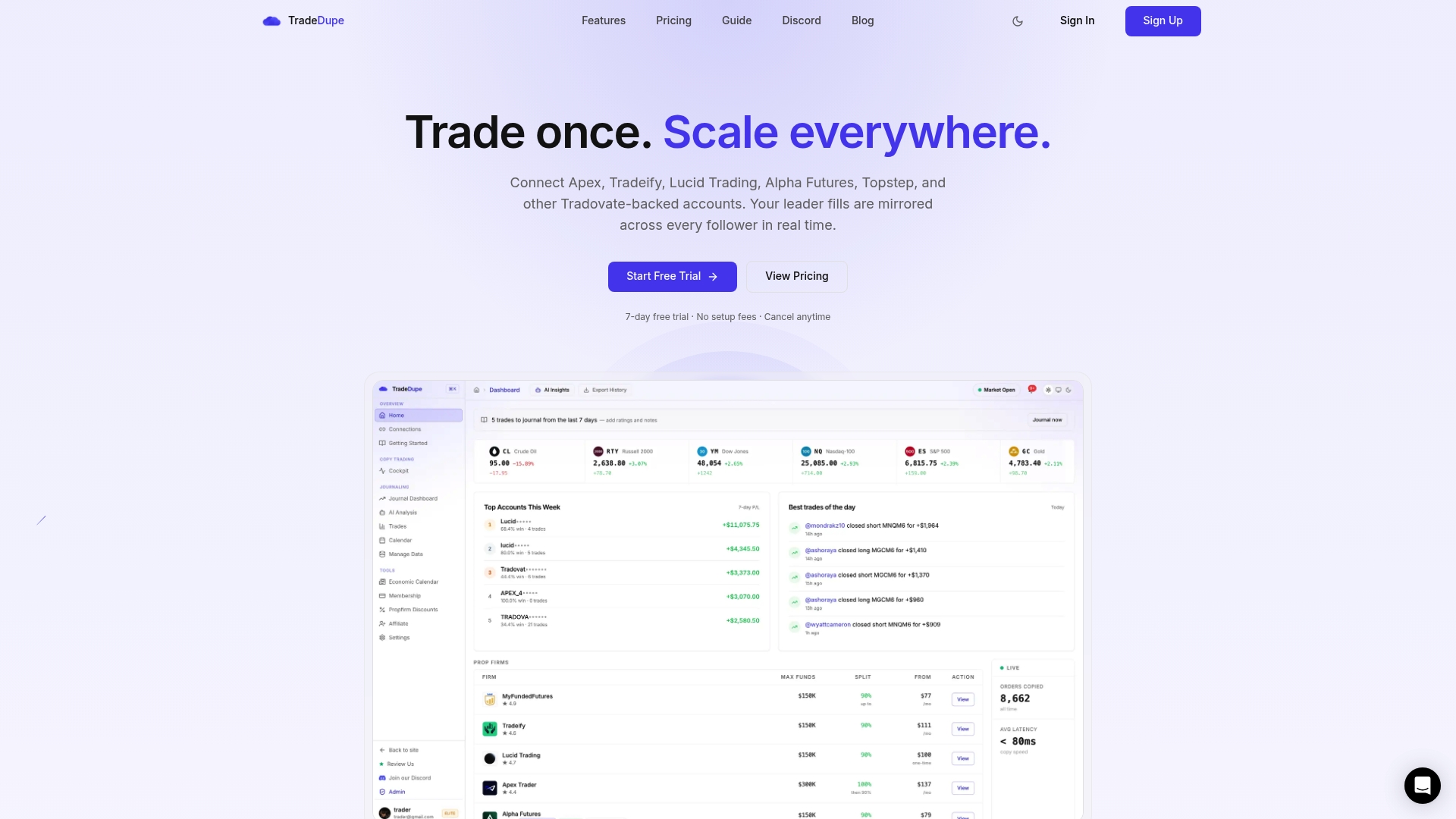
TradeDupe's median trade mirroring latency of 34ms keeps follower fills tight to the leader, and built-in rogue-trade detection with auto-recovery handles the edge cases that manual monitoring misses. Daily max loss enforcement and auto-flattening are configured per account, giving you the granular compliance layer that portfolio-level aggregation requires. For traders ready to move from spreadsheet management to a purpose-built Tradovate copy trading platform, TradeDupe offers tiered plans from individual setups to enterprise-level prop desks. You can also explore how TradeDupe compares to other copy trading tools before committing to a workflow change.
FAQ
What does prop trading multi-account management involve?
It involves coordinating trade execution, risk monitoring, and compliance enforcement across multiple funded prop firm accounts simultaneously. Effective management requires aggregated risk views, automated copier tools, and structured daily monitoring routines, not just trade replication.
What is the difference between Copier Groups and Multi-Account Placement?
Copier Groups build leader-follower networks with per-follower sizing ratios and instrument mapping, while Multi-Account Placement sends identical orders to all selected accounts at once. Use Copier Groups when account sizes differ; use Multi-Account Placement for uniform account batches.
How do you prevent one bad trade from breaching multiple accounts?
Cap each copier group at two to three accounts and split remaining accounts into independent clusters. This limits blast radius so a single losing trade damages only one group rather than every funded account you hold simultaneously.
Why is aggregated risk monitoring necessary?
Because independent per-account risk controls cannot detect when multiple accounts are simultaneously exposed to the same correlated instrument. Aggregated system-wide monitoring with portfolio-level kill switches catches combined exposure that per-account tools see as separate, compliant positions.
How should payouts be tracked across multiple prop accounts?
Use a dedicated profit tracking tool to log each account's profit split separately, noting payout request dates for accurate tax reporting. Consistent naming conventions and per-account trade logs prevent reconciliation errors when managing six or more funded accounts.