
Audit Trail for Multiple Trading Accounts: 2026 Guide
TradeDupe
10 min read
Discover how to maintain an effective audit trail for multiple trading accounts. Ensure compliance and enhance performance analysis today!
Maintaining a clean audit trail across multiple trading accounts is one of the most underestimated operational challenges in professional trading. Whether you are managing prop firm evaluations across Apex, Topstep, and Tradeify simultaneously, or running a multi-account futures desk, the complexity compounds fast. Poor trade history documentation does not just create headaches during regulatory reviews. It silently distorts your performance analysis, masks correlated risk exposure, and can cost you a funded account. This guide covers what you actually need to set up, maintain, and verify an audit trail that holds up under scrutiny.
Table of Contents
- Key takeaways
- Audit trail prerequisites for multiple trading accounts
- Setting up an effective multi-account audit trail
- Common pitfalls in tracking trades across multiple accounts
- Analyzing and verifying your audit trail data
- My take on audit trail practices across multiple accounts
- How Tradedupe keeps your audit trail clean
- FAQ
Key takeaways
| Point | Details |
|---|---|
| Consolidated exposure is mandatory | Failing to track aggregate positions across accounts risks invisible correlated risk that compounds without warning. |
| Automated ingestion beats manual filing | Auto-importing trade data with metadata tagging cuts regulator response time from days to minutes. |
| Timestamps at every stage matter | Capturing execution timing across leader and follower accounts is the only way to distinguish strategy failures from process errors. |
| Subaccounts isolate audit scope | Using subaccounts instead of shared API keys keeps per-strategy records clean and reduces audit ambiguity. |
| Daily dashboard reviews close gaps early | A five-minute consolidated dashboard check prevents small discrepancies from compounding into compliance problems. |
Audit trail prerequisites for multiple trading accounts
Before you touch a single configuration, you need to know what a proper audit trail actually contains. Most traders assume it is just a list of filled orders. It is not. A complete record reconstructs the entire decision-making pipeline: signal origin, order routing, execution fill, slippage deviation, and post-trade classification.
Core components every audit trail needs
- Account linkage: Each trade record must identify which specific account and sub-entity it belongs to, including broker ID and account number.
- Timestamps at every stage: Entry signal time, order submission time, and fill confirmation time must all be captured separately. The gaps between them are where execution drift hides.
- Order metadata: Side (long/short), instrument, quantity, fill price, commission, and routing path.
- Version history and modification logs: Any edit to a trade record must carry a timestamp and identity tag. Tamper-evident logs are compliance requirements, not optional features.
- Retention classification: Different jurisdictions require different retention periods. Your records must carry a classification tag so expired documents are not accidentally purged.
Choosing tools that support multi-account tracking
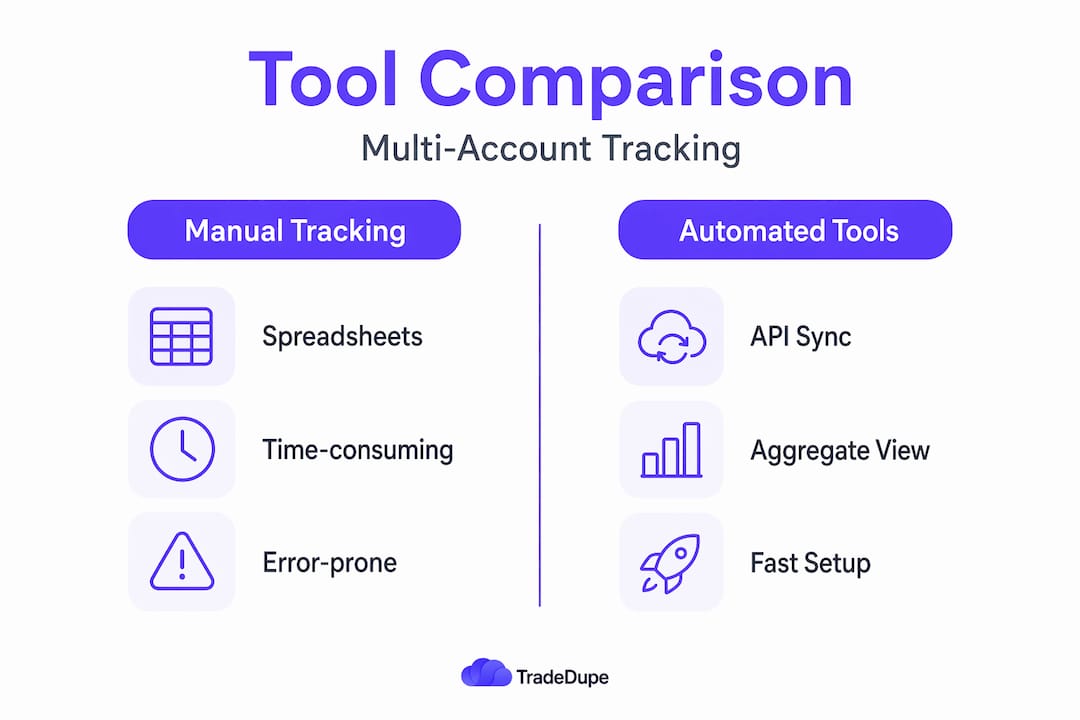
Leading trading trackers like TraderSync (700+ broker connections), Tradervue (80+ brokers), and TradesViz (200+ brokers) all support automated importing at the account level, with setup averaging about five minutes per account. The differences matter less than the multi-account architecture each tool uses.
| Platform | Broker connections | Aggregate view | API ingestion | Avg. setup time |
|---|---|---|---|---|
| TraderSync | 700+ | Yes | Yes | 5 min/account |
| Tradervue | 80+ | Yes | Manual/CSV | 5 min/account |
| TradesViz | 200+ | Yes | Yes | 5 min/account |
Pro Tip: Before committing to any trade journal platform, verify whether it supports scope switching, meaning the ability to toggle between a single-account view and a consolidated aggregate view without exporting data. This single feature determines whether your audit workflow scales.
One structural decision many traders overlook: the difference between API keys and subaccounts. API keys share margin and rate limits across strategies, while subaccounts isolate balances and position exposure. For clean audits per strategy or per prop firm, subaccounts are the right architecture.
Setting up an effective multi-account audit trail
With prerequisites in place, the actual setup is methodical. Rushing through it creates gaps you will not discover until a compliance request forces you to reconstruct records manually.
- Create individual account entries. Register each trading account separately in your journal platform. Label them by broker, account type (evaluation, funded, personal), and strategy. This labeling system becomes your filter taxonomy later.
- Configure automated imports. Use API-based ingestion wherever the broker supports it. For brokers that require CSV uploads, set a daily scheduled export from the broker portal and import immediately. Manual drag-and-drop filing introduces version errors and gaps that automated ingestion eliminates.
- Capture execution-level timestamps. Go beyond fill price. Log order submission time, fill time, and, in copy trading setups, leader signal time. The delta between leader fill and follower fill is where you identify latency-driven slippage. Professional copy trading systems must capture timing at each step to verify audit trail consistency.
- Link master signals to follower executions. If you are running a copy trading setup, each follower trade record must reference the originating leader trade by ID. This parent-child linkage is what lets you reconstruct the full pipeline and attribute deviations accurately.
- Configure consolidated and per-account views. Set up your dashboard to display both. Multi-account dashboards that support quick scope switching give you the daily oversight needed without exporting data to spreadsheets.
- Establish a daily check-in routine. A five-minute review at session close covers open position alignment across accounts, any fill discrepancies flagged by the system, and pending data imports. This is the habit that prevents small gaps from becoming audit liabilities.
Pro Tip: Tag each trade record with a strategy identifier and risk tier at import time. Retroactively categorizing hundreds of trades before a compliance review is a time sink. Front-loading the metadata work makes every future query instant.
| Audit element | Where to capture it | Why it matters |
|---|---|---|
| Leader signal timestamp | Copy trading platform log | Proves trade origin for follower attribution |
| Follower fill timestamp | Broker execution report | Measures latency and slippage per account |
| Account identifier | Journal platform metadata | Isolates per-account performance and compliance scope |
| Modification history | Audit log within journal | Demonstrates record integrity during examiner review |

Common pitfalls in tracking trades across multiple accounts
Most audit trail failures are not catastrophic. They are death by a thousand small omissions. Here is where traders consistently get it wrong.
Assuming broker statements are sufficient. Raw broker statements contain fills, but they do not contain strategy context, signal origin, or cross-account exposure. You cannot reconstruct your decision-making process from a brokerage PDF.
Underestimating execution drift in copy trading setups. Execution drift caused by timing, volume rounding, or broker constraints is normal. The problem is when traders do not capture it. Without timestamps at each stage, you cannot distinguish whether a follower account underperformed because of a bad strategy or a slow fill.
Overlooking partial fills. Many brokers split large orders across multiple fills with separate timestamps. If your import process logs only the first fill, your per-trade records are systematically incomplete. Verify that your journal platform aggregates partial fills correctly before trusting any performance metrics.
Neglecting metadata completeness. Rich metadata that captures uploader identity, account linkage, version history, and retention classification transforms a folder of files into a searchable record system. Missing even one field, such as account linkage, means a single examiner question can require hours of manual reconstruction.
> "Consolidated tracking is not a convenience feature. It is mandatory risk management. Failing to aggregate total exposure across accounts creates invisible correlated risk that single-account reviews cannot detect."
Building monitoring overhead that does not scale. Traders who rely on manual spreadsheet reconciliation across six or eight accounts spend more time on record-keeping than on trading. The solution is not to reduce accounts. It is to automate ingestion, consolidate views, and limit manual touchpoints to exception handling.
Analyzing and verifying your audit trail data
Having records and actually using them for compliance and performance analysis are two different disciplines. Here is how to bridge that gap.
Distinguishing strategy failures from process failures
This is the most analytically valuable thing your audit trail does. When a follower account underperforms the leader, you need to determine whether the gap came from market conditions (slippage, liquidity) or from a process issue (latency, partial fill, wrong lot sizing). Timestamps and execution metadata at every stage give you the evidence to make that distinction cleanly.
Comparing execution quality across accounts
Pull fill prices and commission data per instrument per account over a defined period. Look for systematic divergence. If one prop firm account consistently fills 1-2 ticks worse than another on the same signal, that is a broker execution issue, not a strategy issue. Without per-account transaction logs, that pattern stays invisible.
Preparing for regulatory reviews
Auto-ingestion and metadata tagging reduce regulator response time from days to minutes. When an examiner submits a Request for Information, the answer should be a filtered export, not a manual reconstruction. Organize records so you can query by date range, account, instrument, and strategy simultaneously.
Pro Tip: Run a quarterly internal audit before any external review is scheduled. Pull a sample of 20 to 30 trades across all accounts, verify that every record links to a broker confirmation, and check that timestamps are contiguous. This rehearsal surfaces gaps while you still have time to correct them.
Using audit data to refine risk management
Consolidated tracking reveals correlated exposure across accounts that per-account views hide. If your ES trades in three prop firm accounts all move in the same direction simultaneously, your actual risk is three times what any single account statement shows. Audit trail analysis is where that exposure becomes visible and manageable.
My take on audit trail practices across multiple accounts
I have watched traders spend thousands of hours on strategy refinement while running sloppy, fragmented record-keeping across their accounts. And when a compliance request arrives or a drawdown forces a post-mortem review, the absence of consolidated records turns what should be a two-hour analysis into a multi-day reconstruction project.
The part the industry does not discuss openly: current audit trail systems remain fragmented, with accountability gaps that create real risk for serious traders. Most of the tools exist but the discipline to connect them does not. Traders treat audit infrastructure as a box to check rather than as an analytical asset.
What I have found actually works is treating your audit trail as a live performance attribution system, not a static archive. Every week I am reviewing leader-to-follower execution deltas across accounts on the Tradovate multi-account setup and asking whether the gaps are within expected latency bounds or whether something in the pipeline needs adjustment.
The other shift worth making: stop thinking per-account and start thinking per-strategy. Your audit trail should let you reconstruct the performance of a specific strategy across all the accounts running it simultaneously. That is the view that reveals whether a strategy actually works or whether your best account happened to get lucky fills.
> — Andres
How Tradedupe keeps your audit trail clean
Managing a clean audit trail across prop firm accounts does not have to mean hours of manual reconciliation. Tradedupe was built specifically for Tradovate traders running multiple accounts simultaneously, and the platform captures the exact data points that make audit trails defensible.
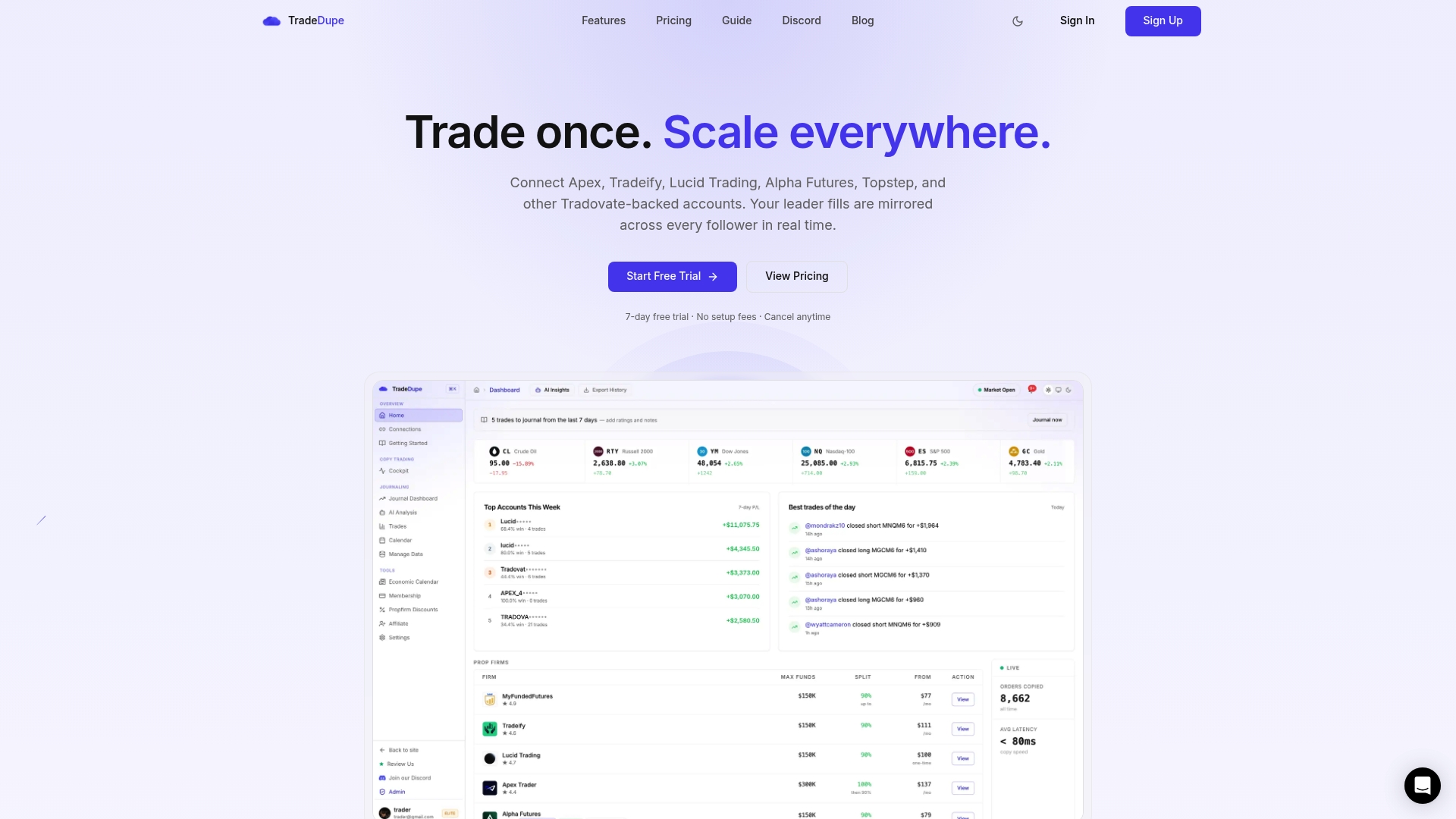
Every follower trade in Tradedupe carries a reference to the originating leader order, with timestamps captured at median 34ms latency. The dashboard gives you both per-account and aggregate views without any data export required. If you are managing Apex, Tradeify, or Topstep accounts alongside personal accounts, Tradedupe consolidates the entire picture in one place. For traders who want to see how it stacks up against alternatives, the prop firm trade copier comparison is worth reviewing before you commit to a setup. Ready to get started? The Tradedupe platform connects in under ten minutes.
FAQ
What should an audit trail include for multiple trading accounts?
A complete audit trail includes account identifiers, timestamps at each execution stage, fill prices, order metadata, and modification history. Each follower trade in a copy trading setup should reference the originating leader order by ID.
How do I consolidate trade history across multiple accounts?
Use a trading journal platform that supports API-based ingestion and scope switching between per-account and aggregate views. Platforms like TraderSync and TradesViz connect to hundreds of brokers and unify records in a single dashboard.
What causes execution drift in multi-account copy trading?
Execution drift results from timing delays, volume rounding at the broker level, or partial fill handling. Capturing timestamps at both the leader and follower stages lets you attribute deviations to process issues rather than strategy failures.
How often should I review my audit trail data?
A five-minute daily check at session close covers fill discrepancies and import gaps. Conduct a more thorough internal audit quarterly to verify record completeness and prepare for potential regulatory reviews.
Are subaccounts better than API keys for multi-account audit trails?
Yes. Subaccounts isolate balances and margin per strategy, producing cleaner per-account records. Shared API keys aggregate resources across strategies, which creates ambiguity in per-strategy attribution during an audit.