
Topstep trading accounts: Stages, rules, and scaling
TradeDupe
12 min read
Discover what a Topstep trading account really is! Learn about the stages, rules, and scaling to maximize your trading success.
Professional traders frequently refer to their "Topstep trading account" as if it were a single, static entity, but Topstep's model is stage-based, with rules and mechanics that change meaningfully from the simulated Trading Combine to the Express Funded stage to the Live Funded stage. Each stage carries its own risk parameters, payout eligibility, and operational restrictions. For traders managing multiple accounts simultaneously or deploying automated trade execution, treating these stages as interchangeable is a costly operational mistake that affects everything from compliance to profit splits.
Table of Contents
- What is a Topstep trading account? A definition for professionals
- Topstep's three account stages: Trading Combine, Express Funded, Live Funded
- Risk management and automation: Operating multiple Topstep accounts efficiently
- Real-world workflows: Trade mirroring and multi-stage account management
- A practitioner's perspective: Why Topstep's stages matter more than you think
- Automate and scale your Topstep and prop trading accounts with TradeDupe
- Frequently asked questions
Key Takeaways
| Point | Details |
|---|---|
| Three-stage model | Topstep accounts exist in Trading Combine, Express Funded, and Live Funded stages, each with different rules. |
| Risk controls are central | Topstep enforces account discipline through in-platform tools like loss limits and bracket orders. |
| Automation is native | Trade mirroring is integrated within TopstepX for efficient multi-account execution. |
| Stage matters in automation | Automation setups must adapt to rule differences between stages for effective scaling. |
| Optimize for profit | Best results come from synchronizing trade mirroring with each stage’s payout and restriction rules. |
What is a Topstep trading account? A definition for professionals
The term "Topstep trading account" is one of the most loosely used phrases in the prop trading community. Ask three funded traders what it means, and you'll likely get three different answers rooted in whichever stage they currently occupy. That ambiguity creates real problems at the operational level.
In the most precise sense, a Topstep Funded Account is the account where you trade firm capital under Topstep's rules, rather than your own money, and you split profits with the firm. But "funded" can technically describe both the Express Funded stage (simulated environment, real payouts) and the Live Funded stage (real capital, real markets). Neither is the same as the Trading Combine, which is purely evaluative and carries no payout eligibility at all.
For professionals operating across rule-based trading models, this definitional precision matters enormously. Automation scripts, position sizing logic, and risk controls all need to be calibrated to the specific stage you're operating in. Misidentifying a stage at the account-setup level can mean your trade copier software fires orders that violate stage-specific contract limits or daily loss rules you didn't account for.
Key characteristics that define a Topstep trading account across all stages:
- Firm capital involvement: Varies by stage, from purely simulated to real market execution
- Payout eligibility: Only available from Express Funded and Live Funded stages
- Risk rule enforcement: Automated platform controls govern maximum daily loss, drawdown, and position sizing at every stage
- Progression mechanics: Each stage has explicit pass/fail criteria that determine advancement or account reset
Understanding these distinctions isn't academic. It's operationally essential for any trader scaling across multiple accounts simultaneously.
Topstep's three account stages: Trading Combine, Express Funded, Live Funded
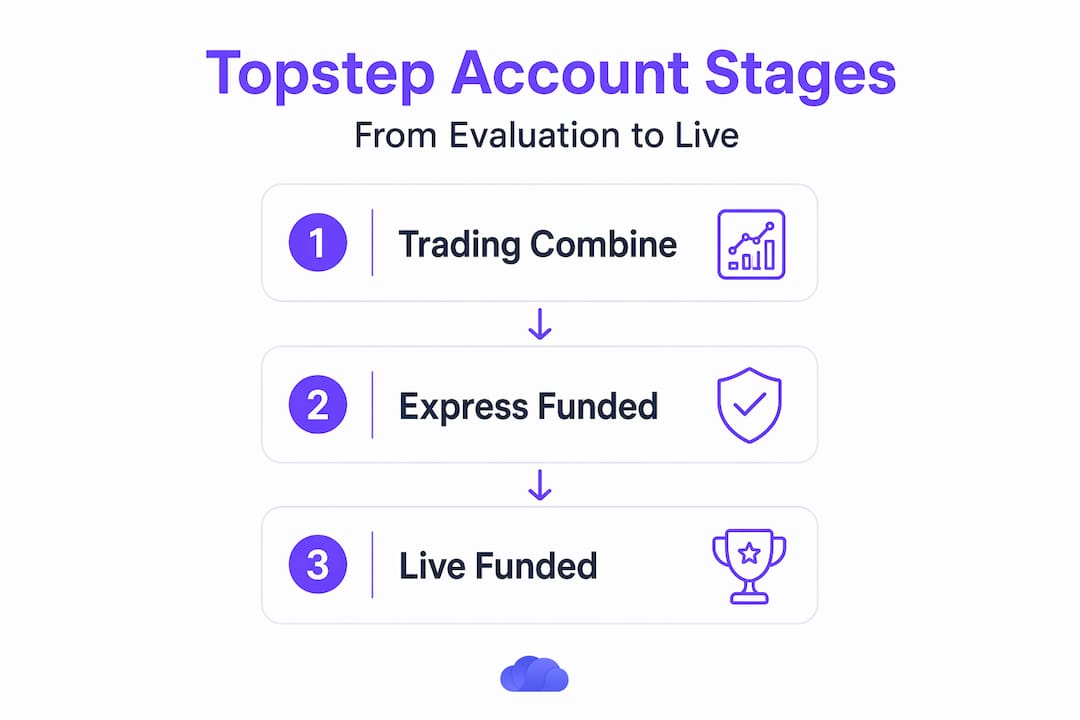
Topstep structures its evaluation and funding process as a three-stage pipeline. Many traders enter Stage 1 without fully understanding how different the rules become at Stages 2 and 3. That knowledge gap becomes most visible when traders start running multiple accounts at different stages and discover their automation setups need meaningful reconfiguration at each boundary.

Stage 1: The Trading Combine
The Trading Combine is a rules-based evaluation conducted in a simulated futures market that determines whether you can advance to a funded Topstep account. Think of it as the filter layer. Topstep isn't watching your P&L in isolation; it's evaluating your consistency, your adherence to risk parameters, and your ability to operate under live-like conditions without blowing up.
Key Trading Combine rules and mechanics:
- No payout eligibility: All gains are simulated and non-withdrawable
- Strict daily loss limits: Exceed the preset daily drawdown and the session is over
- Consistency requirements: Some account sizes require traders to demonstrate repeated profitable days rather than one outsized winner
- Time-limited evaluation: Accounts have defined periods to hit profit targets without violating loss rules
From an automation standpoint, the Trading Combine is where many traders first test their mirroring setups. It's also where configuration errors are cheapest to discover, since failing here costs you a reset fee rather than real capital.
Stage 2: Express Funded Account (XFA)
The Express Funded Account is an intermediate funded stage where you trade in a simulated environment but can earn real payouts based on performance. This is arguably the most misunderstood stage in the Topstep ecosystem. Traders sometimes assume that because the market environment is simulated, the account behaves like the Combine. It doesn't.
The XFA introduces real financial stakes through its payout mechanics. Performance thresholds must be met before withdrawals are processed, and the risk rules tighten relative to the Combine. Drawdown calculations, contract limits, and intraday position rules all require careful review before deploying any automation.
Stage 3: Live Funded Account
The Live Funded Account is the real-money stage, triggered after a call-up from the XFA, where you trade live markets using Topstep's capital. Rules govern capital release and balance unlocks, meaning your accessible trading size grows incrementally as you demonstrate consistent profitability. Profit sharing with Topstep applies here, and the operational stakes are at their highest.
| Account stage | Market environment | Payout eligible | Capital type | Risk ruleset |
|---|---|---|---|---|
| Trading Combine | Simulated | No | Simulated | Evaluation rules |
| Express Funded | Simulated | Yes | Simulated | Stricter limits |
| Live Funded | Live markets | Yes | Topstep capital | Full live ruleset |
For traders running accounts across multiple stages (a common setup for those managing Apex copy trading alongside Topstep accounts), this table illustrates why a single automation configuration rarely works cleanly across all three. Each stage demands its own rule profile.
Pro Tip: Before pushing any automation to a new stage, manually review that stage's specific contract limits and daily loss parameters in the TopstepX platform. A five-minute audit at stage transition prevents hours of troubleshooting later.
Moving through stages also changes how you should approach demo to live trading transitions, since the psychological and operational shift from XFA to Live Funded is substantial, even for experienced professionals. Your Tradovate trade copier configuration should reflect not just account differences, but also the behavioral adjustments that come with trading real capital.
Risk management and automation: Operating multiple Topstep accounts efficiently
With the stage architecture clear, the next operational challenge is scaling execution safely across multiple accounts. This is where the intersection of platform-native tooling and third-party automation becomes critical to understand.
TopstepX includes a built-in trade copier that lets you mirror trades from a lead account into follower accounts, enabling scale across multiple accounts while maintaining the platform's risk controls. This native integration matters because it ensures that mirrored orders still pass through Topstep's risk enforcement layer. A generic third-party copier that bypasses that layer can push orders that technically violate account rules, even if the originating trade was compliant.
Topstep's risk tooling includes personal daily loss limits, contract limits, and bracket orders as mechanisms to keep trading disciplined across all account types. These are not just guardrails. For professional traders, they function as structural inputs that should feed directly into your automation design.
> "Discipline at scale isn't about willpower. It's about building systems where the guardrails are structural, not behavioral."
Here's how experienced traders structure their risk management across multiple Topstep accounts:
- Map stage-specific rules to automation profiles: Each account stage gets a dedicated configuration that reflects its unique daily loss limits and contract ceilings
- Use bracket orders consistently: Bracket orders (preset stop-loss and take-profit levels attached to every position) ensure that even automated entries carry predefined exit logic
- Monitor daily loss thresholds in real time: TopstepX's dashboard surfaces real-time drawdown status; this data should feed into any external monitoring systems you're running
- Segregate lead account selection by stage: Don't use a Live Funded account as the lead if followers include Combine accounts with more restrictive position limits
For traders who also need to align setting risk parameters across a broader portfolio of prop accounts, the Tradovate trade copier and TradingView trade copier workflows available through platforms like TradeDupe provide the granular per-account control that native tools don't always offer at scale.
| Configuration element | Combine accounts | XFA accounts | Live Funded accounts |
|---|---|---|---|
| Max daily loss | Stage-specific cap | Stricter cap | Strictest cap |
| Contract limit | Moderate | Reduced | Staged unlock |
| Payout tracking | N/A | Required | Required |
| Bracket order use | Recommended | Required | Required |
Real-world workflows: Trade mirroring and multi-stage account management
With risk controls mapped and automation tools in place, the practical question becomes: how do professional traders structure their daily workflows across multiple Topstep accounts at different stages?
Topstep's native recommendation for multi-account scaling is to use the TopstepX trade copier rather than generic external tools. The copier mirrors your own trades across linked accounts while still relying on the platform's risk controls. This approach is sensible as a baseline, but many professional traders find that managing three, five, or ten accounts simultaneously requires more granular control than a single native tool provides.
Here's a practical workflow that experienced multi-account traders use:
- Designate a single lead account per session: Select the account operating in the environment with the most permissive (but compliant) rule set for that session. This minimizes the risk of the lead account generating signals that followers can't execute within their own restrictions.
- Audit follower account restrictions before market open: Each morning, check each follower account's remaining daily loss buffer and current drawdown status. Accounts close to their daily limits should be toggled off before trading begins.
- Run stage-segregated follower groups: Group your XFA accounts together and your Live Funded accounts separately within your copier configuration. Apply different position sizing multipliers to each group to reflect their distinct capital and risk environments.
- Log stage transitions immediately: When an account moves from XFA to Live Funded, update your automation configuration that same day. Stage transitions are the most common trigger for misconfigured copier setups.
- Review payout calendars against trading schedules: XFA and Live Funded payouts each have timing mechanics. Structure high-volatility sessions to ensure you're not approaching daily loss limits on payout-eligible days.
Pro Tip: Use the Lucid trade copier workflow as a reference when you need to coordinate accounts across multiple prop firm platforms alongside your Topstep accounts. The logic of segregating followers by rule environment translates directly to multi-firm setups.
Common mistakes that undermine otherwise solid automation setups include using the same position sizing multiplier across Combine and Live Funded followers (the contract limits differ significantly), failing to update automation profiles after a successful stage transition, and assuming that a profitable XFA configuration will transfer cleanly into a Live Funded environment without adjustment. It rarely does.
A practitioner's perspective: Why Topstep's stages matter more than you think
Here's an uncomfortable truth that most guides won't tell you: the majority of automation failures on Topstep accounts aren't caused by bad strategy. They're caused by stage confusion.
Traders who've been through the process multiple times consistently report the same pattern. They build a working configuration during the Trading Combine, advance to the XFA, and assume the setup carries forward. Then they hit an unexpected rule violation, a misfired position size, or an order rejection because the contract limits changed at the stage boundary and nobody updated the automation profile. The operational cost isn't just a reset fee. It's lost payout eligibility on an account that was performing well.
The more counterintuitive lesson is this: scaling across more Express Funded and Live Funded accounts doesn't automatically mean more profit. The relationship between account count and total payout is nonlinear. Each additional account adds compliance overhead, and if your automation isn't tuned to each account's specific payout mechanics, you can end up in a situation where you're generating gross profits across ten accounts but netting less than you would from three well-managed accounts because of rule violations, reset costs, and missed withdrawal windows.
Comparing TradeDupe vs TradeCopia in this context reveals something instructive about how professional automation tools should be evaluated. The question isn't just latency or feature count. It's whether the tool gives you per-account toggle control, rogue-trade detection, and the ability to apply distinct rule profiles to accounts at different stages. Those capabilities determine whether your automation scales cleanly or creates operational drag at every stage boundary.
The hard-won advice from practitioners is simple: map your account restrictions explicitly before you automate anything, review those maps every time an account transitions to a new stage, and never assume that a configuration that worked at one stage will work at the next.
Automate and scale your Topstep and prop trading accounts with TradeDupe
Managing multiple Topstep accounts across different stages demands automation that respects stage-specific rules, not just generic copy-trading logic.
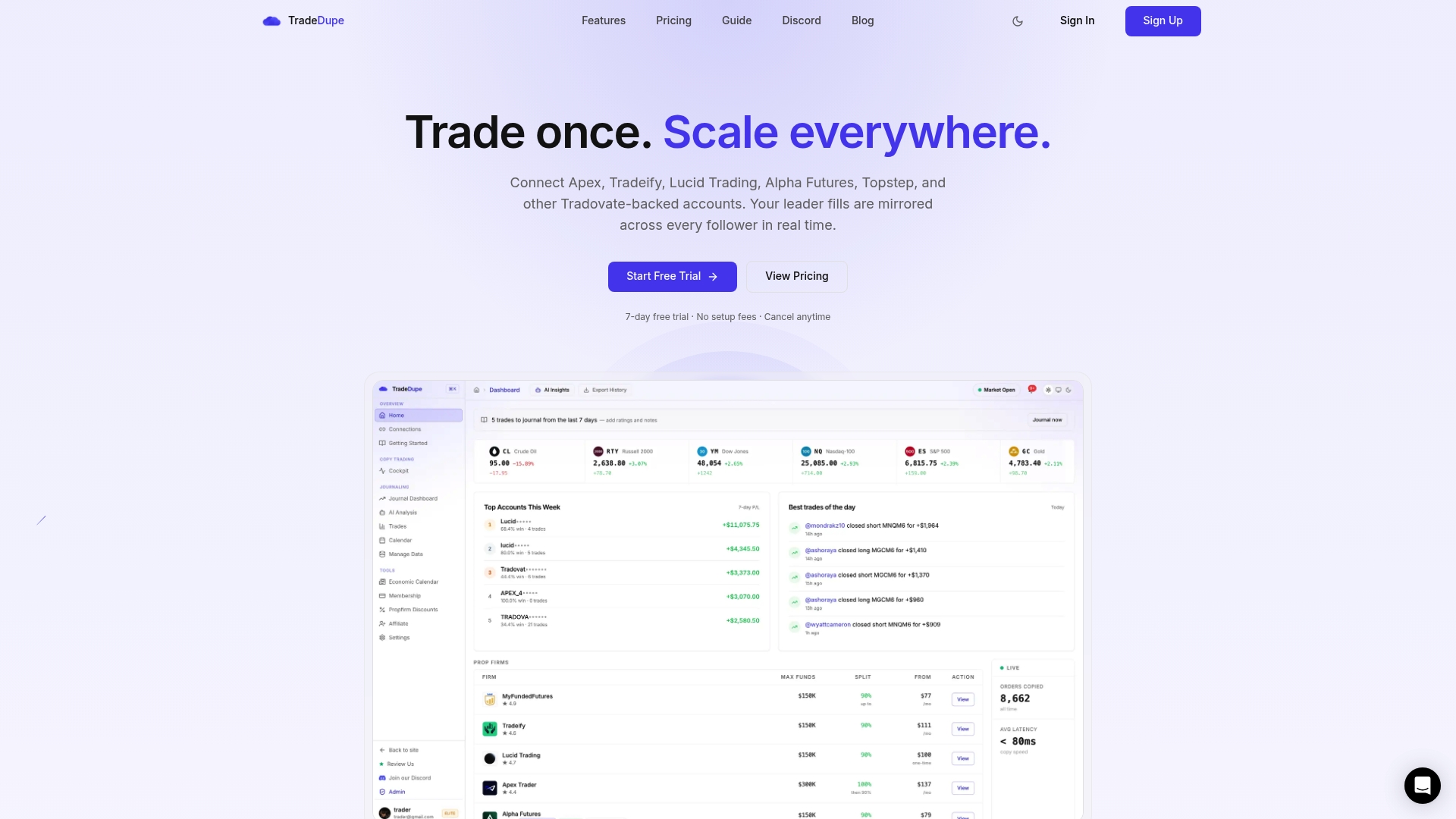
TradeDupe is purpose-built for professional prop traders managing multiple accounts through Tradovate, with direct support for Topstep, Apex, Lucid Trading, Tradeify, and Alpha Futures. The platform's futures trade copier solutions deliver trade mirroring at a median latency of 34ms, with per-account toggle controls, rogue-trade detection, and auto-recovery built in. Whether you're coordinating Express Funded accounts, Live Funded accounts, or a mix of both alongside accounts from other prop firms, TradeDupe gives you a unified dashboard for real-time sync monitoring and risk management. Explore the platform and see how it fits your current multi-account setup.
Frequently asked questions
What are the key rule differences between Trading Combine, Express Funded, and Live Funded Topstep accounts?
Each stage operates under distinct rules: the Trading Combine evaluates consistency and risk criteria in a simulated market, the Express Funded stage allows real payouts from simulated performance under stricter limits, and the Live Funded stage involves trading real capital with staged balance unlocks and profit sharing.
Can you automate trading across multiple Topstep accounts?
Yes. TopstepX includes a built-in trade copier that mirrors trades from a lead account into follower accounts while maintaining platform-enforced risk controls, making multi-account automation a core supported feature.
How are profits and payouts handled in a Topstep Funded Account?
In both Express Funded and Live Funded accounts, profits are split with Topstep under the firm's rules, with withdrawals processed once specific performance milestones and account conditions are satisfied.
What risk management tools does Topstep provide for funded accounts?
Topstep's platform risk tooling includes personal daily loss limits, contract limits, and bracket orders, all designed to enforce trading discipline across every account stage, from Combine through Live Funded.
Is Topstep's trade copier compatible with third-party copy trading software?
Topstep recommends its native TopstepX trade copier for scaling across linked accounts, as it keeps mirrored orders within the platform's risk control framework. Third-party tools can add value at scale but require careful configuration to ensure stage-specific rules remain intact.