
Trade Replicator: The 2026 Guide for Prop Traders
TradeDupe
10 min read
Discover how a trade replicator streamlines multi-account trading. Learn to enhance efficiency and execution for prop traders in our 2026 guide.
A trade replicator is a software system that automatically mirrors trades from one master account to multiple follower accounts in real time. For prop traders and trading firms managing several funded accounts simultaneously, this technology is the difference between manual chaos and disciplined, repeatable execution. Most specialized replicators support mirroring to up to 20 follower accounts with sub-second latency, making them a core tool for anyone running multi-account operations at scale. The industry term for this category is "trade copier" or "copy trading software," and understanding both terms helps you evaluate the right solution.
How does a trade replicator work in practice?
A trade replicator operates on a master and follower account relationship. The master account, also called the leader, places a trade. The replicator software detects that order and fires matching orders across all connected follower accounts within milliseconds.
Two primary replication modes define how this works in practice:
- Orders Mode: The follower account fires an order the moment the master places one, without waiting for a fill confirmation. This mode is faster but carries more risk of slippage mismatches between accounts.
- Executions Mode: The follower fires only after the master receives a confirmed fill. Executions Mode is recommended for prop firm evaluation accounts because it reduces replication errors and improves synchronization across accounts.
The underlying technology comes in two forms. Cloud-based systems run on remote servers, handling execution 24/7 without requiring your trading platform to stay open. Local software runs on your own machine or a VPS, communicating between accounts through a shared channel on the same device.
Synchronization relies on a unique identifier, often called a File identifier or synchronization token, that links the master to its followers. Every order event passes through this channel. If the identifier is misconfigured, the replication fails silently, which is one of the most common and costly beginner mistakes.

Pro Tip: Always test your replicator on a demo or simulation account before going live. Confirm that follower accounts receive and fill orders correctly before risking real capital or prop firm evaluation accounts.
What are the essential features of advanced trade replicators?
The gap between basic and advanced copy trading software comes down to risk controls and execution flexibility. A basic replicator copies trades. An advanced one lets you control exactly how those trades land on each follower account.
Core feature categories to evaluate
- Account capacity: Support for up to 20 follower accounts per master is the current standard. Firms running more than 20 accounts typically need enterprise-tier or multi-master configurations.
- Per-account risk management: Independent risk settings per follower are non-negotiable. Daily loss caps, drawdown limits, and maximum contract sizes should apply individually to each account, not globally.
- Position sizing controls: The ability to modify lot size or contract quantity per follower account lets you scale exposure proportionally across accounts with different funding levels.
- Symbol and instrument mapping: Useful when follower accounts trade on different brokers or contract specifications. The replicator translates the master's instrument to the correct equivalent on each follower.
- Replication toggle controls: Per-account ON/OFF switches let you pause copying on a specific account without disrupting others. A panic button that closes all positions across all accounts simultaneously is a critical safety feature.
- Order type compatibility: The replicator should handle market orders, limit orders, stop orders, and partial fills without breaking synchronization.
Pro Tip: When evaluating copy trading software for prop firm use, confirm that the platform supports the specific order types your prop firm allows. Some firms restrict certain order types during evaluations, and a replicator that fires incompatible orders can trigger rule violations.
The benefits of copying multiple accounts go beyond convenience. Properly configured risk controls on each follower account mean a single bad trade on one account does not cascade into losses across your entire portfolio. That isolation is what separates professional multi-account management from reckless duplication.
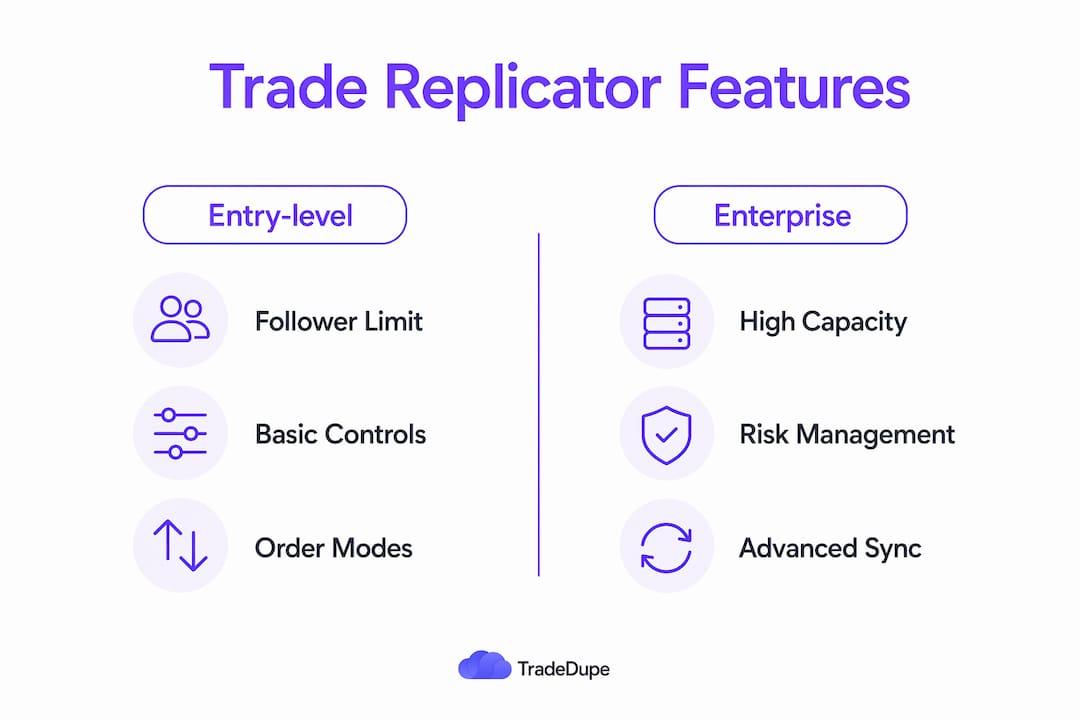
A comparison of feature tiers by deployment type:
| Feature | Entry-level replicators | Enterprise platforms |
|---|---|---|
| Follower account limit | 2–5 accounts | 10–20+ accounts |
| Per-account risk controls | Basic or none | Full: daily loss caps, drawdown limits |
| Replication mode options | Orders Mode only | Orders Mode and Executions Mode |
| Panic button / emergency close | Rarely included | Standard feature |
| Symbol mapping | Not available | Available |
What pricing models and deployment options are available?
Trade replicator pricing follows two dominant models, and the right choice depends on your scale and operational preferences.
- Monthly subscription (cloud-based): Cloud subscriptions typically start around $49 per month and scale up based on the number of follower accounts or advanced features. The key advantage is that execution runs 24/7 on remote servers. You do not need to keep your trading platform open. The trade-off is a dependency on the provider's uptime and a slight latency increase from internet relay.
- One-time lifetime license (local desktop software): Local replicators charge a single upfront fee and run entirely on your machine or VPS. Local trade copiers use a shared channel on the same computer for near-zero latency and enhanced privacy, with no cloud dependency. This model suits privacy-conscious traders or firms that want full control over their infrastructure.
- Tiered subscription plans: Many professional platforms offer tiered plans that scale from individual traders to prop desks. Lower tiers cover a handful of follower accounts. Enterprise tiers include unlimited broker connections, AI-powered analytics, and dedicated support.
- VPS-hosted local software: A hybrid approach where local software runs on a virtual private server. This combines the privacy and low latency of local software with the 24/7 uptime of cloud services. The added cost is the VPS rental, typically $20–$50 per month depending on specifications.
The decision between cloud and local is not purely technical. Prop firms with strict data policies often prefer local or VPS deployments. Individual traders who want a hands-off setup and do not want to manage a VPS typically favor cloud subscriptions.
What are best practices for setting up and managing trade replicators?
Configuration errors cause most trade replication failures. The software itself rarely fails. Most failures stem from synchronization identification mistakes rather than software bugs, making configuration validation the first priority before going live.
Follow these practices to keep your replication running cleanly:
- Validate your synchronization identifier first. The File identifier or sync token must match exactly between master and follower configurations. A single character mismatch causes silent failure with no error message.
- Use RESET or SYNC features regularly. Reset features that flatten and realign positions prevent drift caused by partial fills, disconnections, or manual position changes on follower accounts. Drift is the most common failure point in live multi-account operations.
- Set independent risk parameters per follower account. Applying a single global risk setting across all followers is the fastest way to amplify losses. Each account should have its own daily loss cap and drawdown limit.
- Monitor synchronization status in real time. A dashboard showing live sync status for each follower account lets you catch desynchronization before it becomes a costly problem.
- Test order modifications and partial fills. Many replicators handle clean fills correctly but break on partial fills or order modifications. Test these edge cases in simulation before running live.
Pro Tip: Schedule a weekly sync check where you compare open positions and P&L across all follower accounts against the master. Drift accumulates slowly and is easy to miss without a systematic review.
Prop firm rules directly affect how you configure your replicator. Firms like Apex and Tradeify have specific rules around maximum contracts, daily loss limits, and consistency requirements. Your replicator's per-account risk settings must mirror those rules exactly to stay compliant.
Key Takeaways
A trade replicator's reliability depends on correct synchronization configuration, per-account risk controls, and the right deployment model for your scale and privacy needs.
| Point | Details |
|---|---|
| Executions Mode reduces errors | Wait for confirmed master fills before firing follower orders, especially on prop firm accounts. |
| Per-account risk controls are mandatory | Apply daily loss caps and drawdown limits independently to each follower account. |
| Silent failures come from bad identifiers | Validate your sync token or File identifier before going live to avoid undetected replication failures. |
| Cloud vs. local is a privacy and latency decision | Local deployments offer near-zero latency and no cloud dependency; cloud offers 24/7 uptime without a VPS. |
| Drift requires active management | Use RESET or SYNC features regularly to realign follower accounts after partial fills or disconnections. |
The feature that separates good replicators from great ones
After working with multi-account setups across different platforms, the single most underrated feature in any automated trading system is the per-account panic button. Most traders evaluate replicators on latency and account capacity. Those matter. But when a news event moves the market 50 ticks in two seconds, the ability to close all positions across 15 accounts simultaneously is what protects your capital.
I have seen traders lose evaluation accounts not because their strategy failed, but because their replicator did not support independent risk controls. One account hit its daily loss limit and kept copying trades because the risk settings were global, not per-account. That is a configuration problem, not a market problem.
My honest recommendation: prioritize Executions Mode and per-account risk isolation above everything else when selecting a trading signal replicator. Latency matters less than you think at the retail and prop firm level. A 50ms difference in fill time is irrelevant compared to the cost of a cascading loss across 10 accounts.
Cloud versus local is a real decision, but it is often overthought. If you are running fewer than five accounts and value simplicity, a cloud subscription is the right call. If you are running a prop desk with 15 or more accounts and have data privacy requirements, a VPS-hosted local solution gives you control without sacrificing uptime. The security and reliability standards of your replication platform should be a non-negotiable checkpoint in your evaluation process.
> — Andres
Tradedupe: trade replication built for Tradovate prop firms
Tradedupe is a purpose-built platform for professional prop traders using Tradovate as their brokerage. It mirrors trades from a single leader account to multiple follower accounts with a median latency of 34ms, covering prop firm integrations including Apex, Tradeify, Lucid Trading, and Alpha Futures.
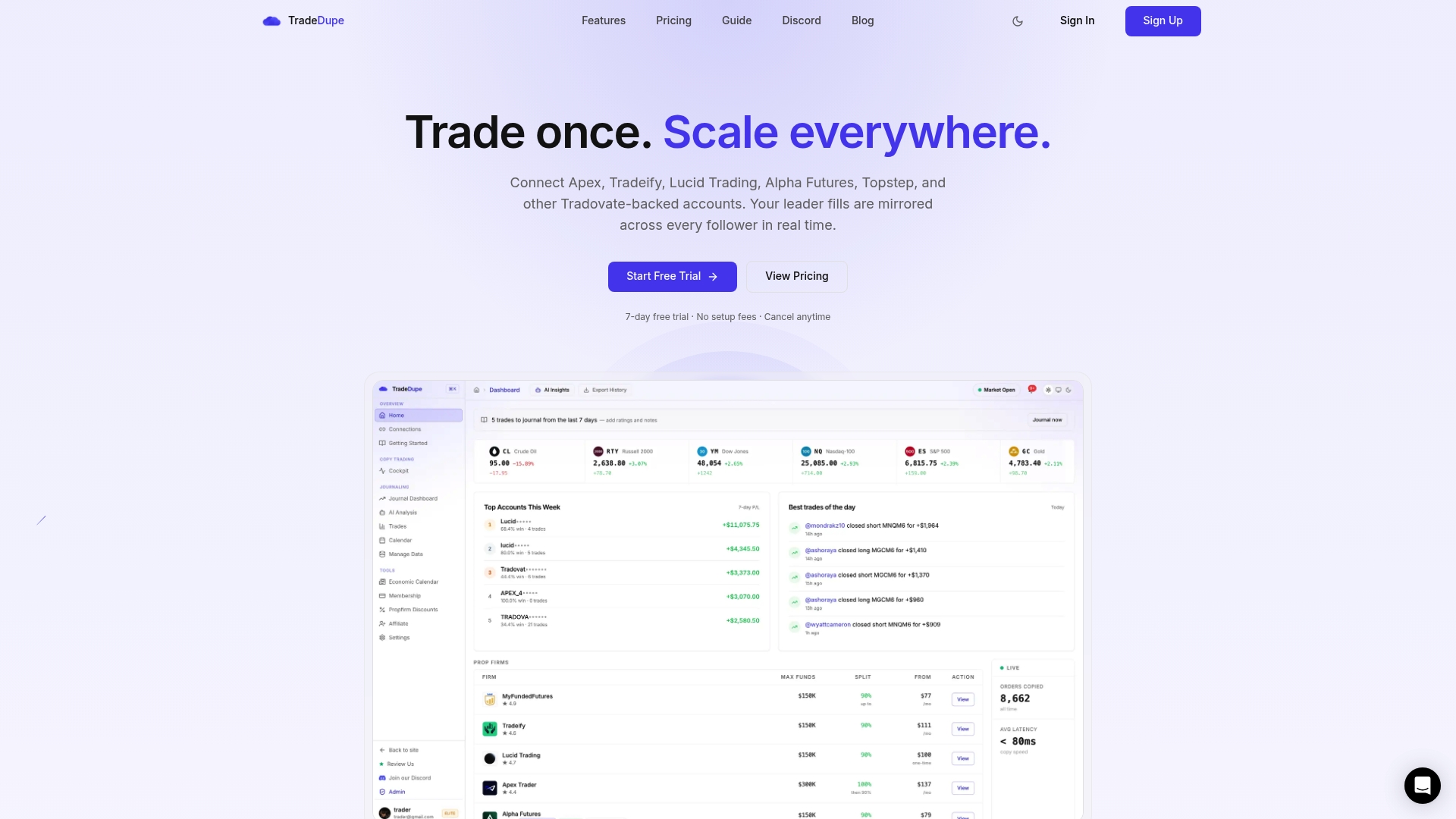
The platform includes rogue-trade detection, auto-recovery, and per-account toggle controls as standard features. Risk managers get a real-time dashboard showing sync status, leader and follower activity, and account-level P&L. Tradedupe offers tiered plans from individual traders to enterprise prop desks, with AI-powered trade analysis on higher tiers. If you are managing multiple funded accounts and need a futures trade copier built specifically for prop firm compliance, Tradedupe is worth a close look. You can also review the Apex copy trading setup to see how the platform handles multi-account prop firm operations in practice.
FAQ
What is a trade replicator?
A trade replicator is software that automatically copies trades from one master account to multiple follower accounts in real time. It is also called a trade copier or copy trading software.
How many accounts can a trade replicator support?
Most specialized replicators support up to 20 follower accounts per master with sub-second execution latency. Enterprise configurations can extend beyond that limit.
What is the difference between Orders Mode and Executions Mode?
Orders Mode fires follower orders immediately when the master places a trade. Executions Mode waits for a confirmed master fill before firing, which reduces errors and is the preferred setting for prop firm evaluation accounts.
Why do follower accounts fall out of sync?
Drift occurs when partial fills, disconnections, or manual position changes cause follower accounts to diverge from the master. Reset or Sync features that flatten and realign all positions are the standard fix.
Is cloud or local deployment better for trade replication?
Cloud deployment runs 24/7 without a VPS but adds slight latency and depends on external servers. Local deployment offers near-zero latency and full privacy but requires your machine or a VPS to stay online.