Futures Trading Desk Structures: A 2026 Guide for Managers
TradeDupe
10 min read
Discover the types of futures trading desk structures in our 2026 guide. Learn how to build and evaluate efficient trading operations now.
What are the main types of futures trading desk structures?
Futures trading desks fall into three primary categories: agency desks, proprietary desks, and programmatic desks. Each operates under a distinct capital model, risk profile, and execution philosophy. Understanding these desk structure types is the starting point for any manager building or evaluating a futures operation.
- Agency desks execute trades on behalf of clients, earning commissions without taking on directional market risk. The firm's capital is never at stake; the desk's performance is measured by execution quality and client volume.
- Proprietary desks trade the firm's own capital with the explicit goal of generating direct profit from market movements. Risk exposure is real and immediate, which demands tighter risk controls and more rigorous capital allocation frameworks.
- Programmatic desks (also called electronic or algorithmic desks) rely on automated execution systems, AI-driven order routing, and quantitative models to execute at speed and scale. Human traders shift from ticket entry to oversight and strategy refinement.
The differences between these models go beyond execution method. Agency desks carry minimal balance-sheet risk but depend on client relationships and order flow volume. Proprietary desks carry full market risk but retain all upside. Programmatic desks can operate across all three models, functioning as the execution layer beneath either agency or prop strategies. Most institutional futures operations blend elements of all three, particularly as buy-side desks evolve toward asset-agnostic, AI-augmented workflows.
How futures trading desks are organized internally

The internal futures desk organizational structure typically divides into three functional pillars: front office, middle office, and back office. According to the Futures Industry Association, a standard institutional futures firm structures these offices with distinct, non-overlapping responsibilities that collectively support trade execution, client service, and regulatory reporting.

Large U.S. dealer banks such as Bank of America, Citigroup, Goldman Sachs, JP Morgan, and Morgan Stanley operate roughly 86 trading desks per bank on average, organized by asset market and further subdivided by activity type and region. Futures desks within these institutions often carry sub-classifications for hedging, derivatives, and directional trading, each with its own P&L accountability.
Key roles within a futures desk include:
- Head trader: Sets strategic direction, approves risk parameters, and makes final calls on large or complex positions. Accountable for overall desk P&L.
- Desk traders: Execute the strategies defined by the head trader, managing individual positions and responding to intraday market conditions.
- Quantitative analysts (quants): Design and maintain the mathematical models driving execution algorithms, risk scoring, and performance attribution. On programmatic desks, quants are often the most operationally critical role.
- Sales traders: Serve as the interface between institutional clients and the desk on agency operations, translating client intent into executable orders while managing relationship expectations.
The front office covers sales, client onboarding, research, and execution. The middle office handles client services, trading platform support, and margin collection. The back office manages settlement, delivery, and reconciliation. Cross-functional teams in legal, compliance, risk management, and financial management advise and monitor all three layers.
Pro Tip: On smaller prop desks, one person often covers both quant and risk roles. Separating these functions as the desk scales is one of the highest-leverage structural decisions a manager can make.
Trading desk operations: execution, risk management, and compliance
Execution methods differ sharply across desk types. Agency desks prioritize best execution for clients, using algorithms like VWAP (volume-weighted average price) and implementation shortfall to minimize market impact. Proprietary desks focus on capturing directional alpha, often using limit orders, iceberg orders, and liquidity sweep strategies to build positions without telegraphing intent. Programmatic desks automate the entire workflow, from signal generation through order routing and post-trade analysis.
Risk management is the operational backbone of any futures desk. Real-time monitoring of margin exposure, position limits, and drawdown thresholds is non-negotiable. The Basel Framework's MAR/12 chapter requires proprietary desks to maintain documented risk controls, approved trading limits, and regular management reporting. Compliance with frameworks like Basel III and MiFID II shapes how desks monitor exposure and report to regulators.
Cross-department coordination is where many desks lose efficiency. The risk management function needs real-time position data from the front office, while compliance needs post-trade reports from the back office. Gaps between these flows create audit risk and operational drag.
Key operational priorities for any futures desk:
- Real-time margin monitoring and automated breach alerts
- Pre-trade and post-trade compliance checks aligned with CFTC and NFA requirements
- Daily P&L reconciliation between front-office systems and back-office records
- Documented escalation protocols for limit breaches or rogue trades
- Regular stress-testing of position books against historical volatility scenarios
How to set up a proprietary futures trading desk
Setting up a prop desk requires more than capital and a trading platform. The Basel Framework requires proprietary desks to maintain a formal documented business strategy, approved budgets, and regular management reporting to satisfy supervisory standards. Here is a practical sequence for getting it right.
- Register your legal entity. Choose between an LLC, LLP, or corporation depending on liability preferences and tax structure. In the U.S., the SEC and CFTC govern futures trading activity, and your entity type affects registration requirements with the NFA.
- Define capital allocation and risk appetite. Establish maximum drawdown limits, position size rules, and margin utilization thresholds before a single trade is placed. These parameters should be written into a formal risk policy document.
- Build your technology infrastructure. You need a reliable order management system (OMS), a data feed from a CME-approved provider, and a backtesting environment for strategy validation. For multi-account prop operations, a futures trade copier that mirrors trades across accounts with minimal latency is a core infrastructure component.
- Hire and define roles. At minimum, a prop desk needs a head trader with documented strategy authority and a risk officer with veto power over position limits. Quants can be added as the strategy library grows.
- Complete your regulatory compliance checklist. File for NFA membership if required, establish anti-money laundering (AML) procedures, and document your trading system's conformance with exchange requirements. Some exchanges require automated strategies to be pre-approved.
- Install a risk management system (RMS). The RMS should monitor data quality, network latency, position exposure, and scalability factors in real time. Automated kill switches for runaway positions are standard practice.
- Establish reporting protocols. Daily P&L reports, weekly risk summaries, and monthly strategy reviews should flow to senior management. Regulators expect this documentation to be audit-ready at all times.
Modern technology solutions for prop futures desks
The most consequential shift in futures desk technology over the past few years is the move toward agentic AI overlays. These systems accept natural language instructions from traders, interpret intent, and route orders into structured execution workflows without requiring manual ticket entry. Human traders focus on oversight, exception management, and complex strategy, while the AI handles routine execution.
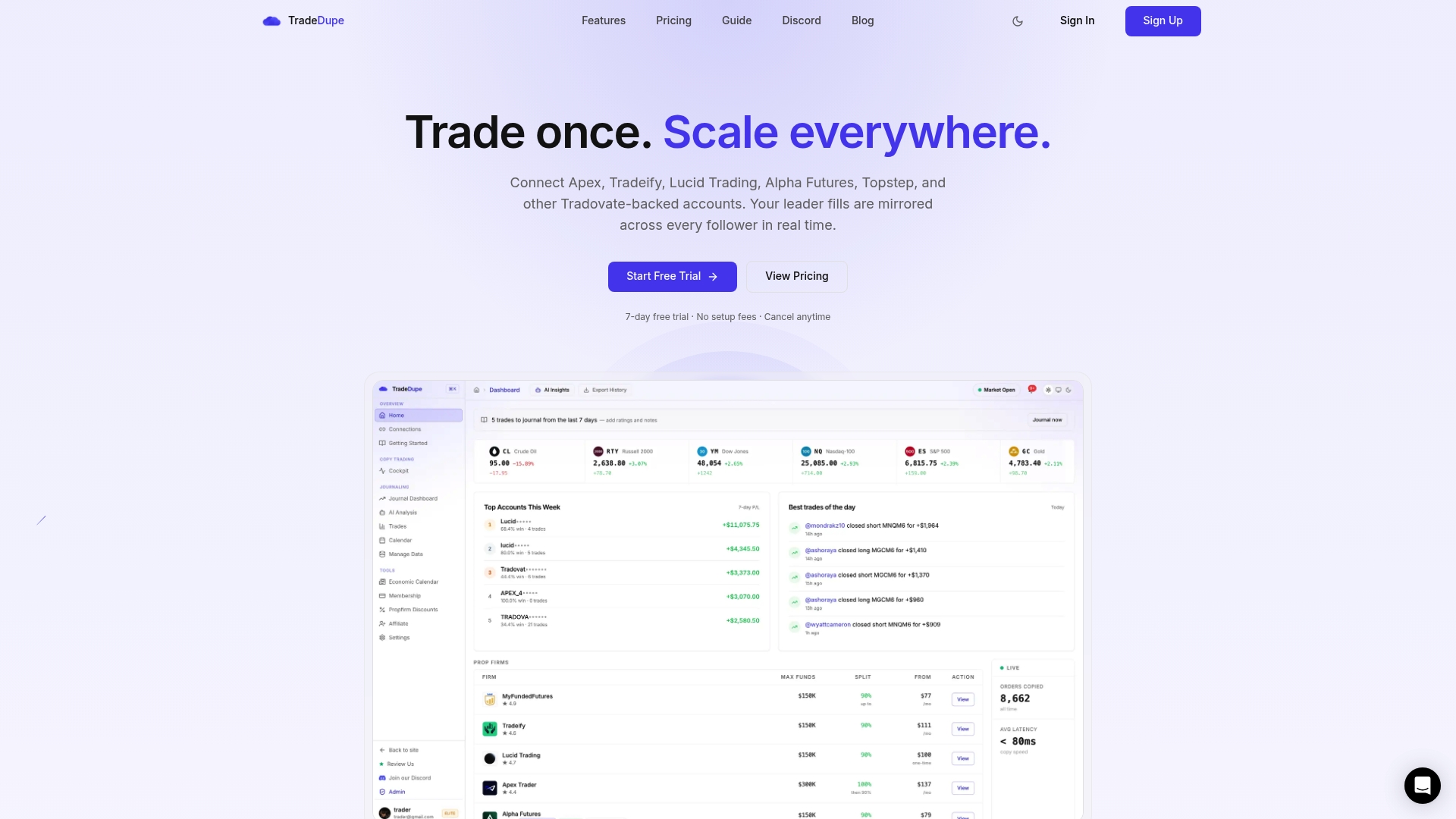
For prop desks running multiple accounts, real-time trade mirroring is the technology that separates scalable operations from manual bottlenecks. Tradedupe is built specifically for this use case, mirroring trades from a single lead account to multiple follower accounts on Tradovate with a median latency of 34ms. The platform includes rogue-trade detection, auto-recovery, and per-account toggle controls, with integrations covering prop firm accounts at Apex, Tradeify, Lucid Trading, and Alpha Futures.
| Technology Component | Function | Benefit for Prop Desks |
|---|---|---|
| Real-time trade mirroring | Replicates lead account trades to followers instantly | Scales execution across accounts without manual input |
| Agentic AI overlay | Converts natural language to structured order workflows | Reduces ticket errors, frees traders for strategy work |
| Risk management system (RMS) | Monitors margin, exposure, and data quality in real time | Prevents runaway positions and compliance breaches |
| OMS/EMS integration | Centralizes order routing and execution reporting | Supports straight-through processing and audit trails |
| AI-powered analytics | Attributes P&L, identifies execution inefficiencies | Improves strategy refinement and performance reporting |
Key technology advantages for futures prop trading:
- Sub-100ms trade replication across multiple accounts reduces execution drift
- AI analytics surface order flow patterns and execution cost attribution automatically
- Integrated security and reliability features protect against unauthorized access and system failures
- Unified dashboards give risk officers real-time visibility across all accounts simultaneously
Pro Tip: When evaluating trade mirroring platforms, test latency under peak market conditions, not just idle benchmarks. Execution drift during high-volatility opens is where most copy systems fail.
How risk exposure and capital requirements differ across desk types
The three desk models carry fundamentally different risk and capital profiles, and choosing the wrong structure for your firm's balance sheet is a costly mistake.
Agency desks carry near-zero market risk. Capital requirements are minimal because the desk never holds a directional position. Revenue depends entirely on client volume and the quality of execution, making this model sensitive to client concentration risk rather than market risk. Margins are thin, and the desk lives or dies on operational efficiency and relationship depth.
Proprietary desks sit at the opposite end of the spectrum. Every position represents direct capital at risk, and drawdowns come straight off the firm's balance sheet. Capital requirements are substantial, and regulators expect formal risk governance frameworks. The upside is uncapped relative to the agency model, but so is the downside. Effective risk management practices are what separate sustainable prop operations from those that blow up in the first volatile quarter.
Programmatic desks can amplify either profile. An algorithmic agency desk can process far more client volume than a manual one, scaling revenue without proportionally scaling headcount. An algorithmic prop desk can execute higher-frequency strategies that would be impossible manually, but also accumulate risk faster if controls fail. The speed advantage cuts both ways.
| Desk Type | Market Risk | Capital Requirement | Primary Revenue Source |
|---|---|---|---|
| Agency | Minimal | Low | Client commissions and volume |
| Proprietary | Full directional exposure | High | Direct trading profits |
| Programmatic | Depends on underlying model | Variable | Volume efficiency or directional alpha |
Key performance metrics for each futures trading desk type
Measuring desk performance requires metrics tailored to the desk's actual business model. Applying agency metrics to a prop desk, or vice versa, produces misleading conclusions.
Agency desk metrics center on execution quality and client retention. The primary measures are implementation shortfall (the gap between decision price and execution price), fill rate, and client-reported satisfaction with execution. Market impact analysis, which quantifies how much the desk's own order flow moves the price against the client, is a standard evaluation tool.
Proprietary desk metrics focus on risk-adjusted returns. Sharpe ratio, Sortino ratio, and maximum drawdown are the standard measures. P&L per unit of risk taken, measured against the desk's approved risk budget, tells managers whether the desk is generating alpha or simply taking on more exposure. Win rate and average profit per trade matter less than the ratio of average winner to average loser, particularly in futures where leverage amplifies both.
Programmatic desk metrics add a layer of operational performance measurement. Latency (order-to-fill time), slippage versus theoretical execution, system uptime, and strategy decay rate (how quickly a model's edge erodes over time) are all tracked alongside financial returns. For multi-account prop operations, copy trading efficiency metrics such as replication accuracy and per-account P&L variance become critical evaluation tools.
A well-run desk reviews these metrics on three time horizons: daily for operational anomalies, weekly for strategy performance trends, and monthly for structural risk and capital efficiency reviews.
Key Takeaways
The most effective futures trading desk structure aligns desk type, capital model, risk governance, and technology infrastructure before the first trade is placed.
| Point | Details |
|---|---|
| Three core desk types | Agency, proprietary, and programmatic desks differ in capital use, risk exposure, and execution method. |
| Three-office structure | Front, middle, and back office functions must be clearly separated to support execution, compliance, and settlement. |
| Regulatory documentation | Proprietary desks must maintain a formal business strategy, approved budgets, and management reporting under Basel Framework standards. |
| Technology drives scale | Real-time trade mirroring with sub-100ms latency enables prop desks to scale across multiple accounts without proportional headcount increases. |
| Metrics must match the model | Agency desks measure implementation shortfall; prop desks measure risk-adjusted returns; programmatic desks track latency, slippage, and strategy decay. |
*
Running a prop futures desk on Tradovate and managing multiple accounts manually? Tradedupe mirrors trades from a single lead account to unlimited followers at 34ms median latency, with built-in rogue-trade detection and real-time risk dashboards built for professional prop operations.