

Types of Trade Mirroring Strategies: A 2026 Guide
TradeDupe
10 min read
Discover the three main types of trade mirroring strategies in our 2026 guide. Learn how to choose the right method for your trading needs.
Trade mirroring is defined as the automated replication of trades from one lead account to one or more follower accounts in real time. The three principal types of trade mirroring strategies are PAMM (Percentage Allocation Management Module), MAM (Multi-Account Manager), and copy trading. Each operates on a different capital structure, allocation method, and risk control model. Choosing the wrong one for your setup costs you either flexibility, compliance headroom, or execution speed. This guide breaks down each method with the operational detail you need to make the right call.
1. What are the main types of trade mirroring strategies?
Trade mirroring methods fall into three distinct categories, and the differences between them are not cosmetic. PAMM pools investor capital into one master account. MAM replicates trades into separate investor accounts using lot allocation. Copy trading mirrors trades independently per subscriber with no pooled capital at all. Each category carries different implications for risk control, regulatory exposure, and operational overhead. Understanding these distinctions is the starting point for building any multi-account trading operation.

2. What is PAMM trading and when is it ideal?
PAMM pools all investor money into a single master trading account and allocates profits or losses proportionally by each investor's capital share. The manager trades the master account, and gains or losses flow down to investors automatically based on their percentage stake. This structure is administratively clean because reporting, fee calculations, and performance tracking happen at the master level.
Key advantages of PAMM:
- Simple administration with centralized reporting
- Consistent strategy execution across all investor shares
- Lower operational overhead for the manager
Key disadvantages of PAMM:
- No per-investor leverage or risk customization
- Pooling client funds often triggers regulatory requirements under MiFID II and ESMA in EU jurisdictions
- Investors cannot set individual stop-outs or withdrawal schedules independently
PAMM works best for fund-style managers running a single strategy with a homogeneous investor base. If your investors all share the same risk tolerance and you want minimal administrative complexity, PAMM is the right fit.
Pro Tip: If you operate in a regulated jurisdiction, confirm whether pooling client funds under PAMM triggers discretionary portfolio management licensing requirements before you launch.
3. How does MAM trading differ, and who benefits most?
MAM mirrors the manager's trades into each investor's own separate account using lot allocation methods, which preserves individual account integrity. Each follower account can carry its own leverage setting, stop-out level, and withdrawal schedule. This separation gives both the manager and the investor far more control than PAMM allows.
MAM supports several lot allocation methods:
- Lot allocation: Fixed lot sizes per account regardless of balance
- Equity allocation: Lots scaled proportionally to account equity
- Balance allocation: Lots scaled proportionally to account balance
Key advantages of MAM:
- Per-account customization of leverage and risk parameters
- Investors can withdraw funds without disrupting the master trade
- More per-account flexibility suits investors with varied risk profiles
- Generally lighter compliance burden than PAMM because capital is not pooled
Key disadvantages of MAM:
- Higher reporting complexity and operational overhead
- Lot allocation mismatches can create unintended exposure if not configured carefully
MAM is the right choice when you manage investors with different account sizes, risk appetites, or leverage preferences. The tradeoff is operational complexity. You need solid systems to track per-account performance and fee calculations accurately.
Pro Tip: Use equity-based lot allocation as your default in MAM setups. It scales trade size naturally as accounts grow or shrink, reducing the risk of oversizing positions in smaller follower accounts.
4. What is copy trading, and how does it compare to PAMM and MAM?
Copy trading operates by subscribers independently mirroring trades from a chosen trader or strategy with no pooled capital involved. Each follower account replicates the leader's trades as separate, independent orders. The follower retains full ownership and control of their account at all times.
Key advantages of copy trading:
- Greatest individual control over position sizing and risk caps
- No pooled capital means lighter regulatory compliance in most jurisdictions
- Social features such as trader profiles and real-time performance stats attract retail followers
- Highly scalable because adding followers does not change the leader's account structure
Key disadvantages of copy trading:
- The manager has the least allocation control of the three methods
- Execution latency per follower account can compound across large follower pools
- Slippage risk increases when many accounts execute simultaneously on the same signal
Copy trading is best suited for retail-facing operations and lower-ticket investors who want transparency and individual account control. Prop traders managing multiple funded accounts also use copy trading structures to replicate a single strategy across Apex, Tradeify, Lucid Trading, and Alpha Futures accounts simultaneously.
5. What technical and latency factors impact mirroring strategy performance?
Latency is the single most underestimated variable in trade mirroring. Latency over 100ms in mirror trade copying signals local machine or network issues and degrades execution reliability. The target threshold for professional mirroring setups is approximately 50ms. Anything above 100ms requires diagnosis before you attribute poor fills to your strategy.
| Factor | Acceptable Range | Impact if Exceeded |
|---|---|---|
| End-to-end latency | Under 100ms | Missed fills, slippage |
| Latency variance | Low and consistent | Unreliable replication |
| CPU/disk load | Under 80% sustained | Order processing delays |
| Network jitter | Minimal | Inconsistent order timing |
High latency variance causes more mirroring unreliability than high average latency. A setup that averages 60ms but spikes to 300ms during peak load will produce worse outcomes than one that holds steady at 90ms. Validate performance under peak load conditions, not just during quiet market hours.
PAMM and MAM systems process allocation calculations server-side, which insulates them somewhat from local machine latency. Copy trading systems that run on local machines or desktop apps are more exposed to CPU and disk contention. Traders switching automation platforms often cite latency inconsistency as the primary driver, a pattern well documented in platform migration analysis.
Pro Tip: Run your mirroring setup during a high-volume session like the New York open before going live. Latency spikes during peak order flow reveal infrastructure weaknesses that quiet-session testing will never catch.
6. Which trade mirroring strategy should you choose based on your needs?
Selecting the pooled vehicle type is a strategy decision that shapes investor risk controls and the entire investor experience. The right choice depends on four dimensions: capital structure, investor customization needs, regulatory environment, and operational capacity.
| Dimension | PAMM | MAM | Copy Trading |
|---|---|---|---|
| Capital structure | Pooled | Separate accounts | Separate accounts |
| Investor customization | Low | High | Highest |
| Regulatory burden | High (pooled funds) | Medium | Low |
| Operational complexity | Low | High | Medium |
| Best use case | Fund-style managers | Diverse risk profiles | Retail and prop traders |
For traders managing prop firm copy trading across multiple funded accounts, copy trading is almost always the correct structure. You retain individual account control, avoid pooled-fund compliance issues, and can set per-account risk caps independently.
For professional money managers serving institutional or high-net-worth clients with varied mandates, MAM provides the per-account control those clients expect. PAMM suits managers who want simplicity and serve a uniform investor base with a single strategy.
Running multiple mirroring types in parallel is also viable. A manager might use MAM for institutional clients while running a copy trading channel for retail followers on the same underlying strategy. The key is defining clear trade allocation rules upfront. Selective replication using instrument filters and lot-size rules prevents overexposure when follower accounts have margin or leverage constraints.
Consider these factors when making your final selection:
- Regulatory jurisdiction: PAMM triggers heavier compliance in most regulated markets
- Investor homogeneity: Uniform risk profiles favor PAMM; diverse profiles favor MAM
- Operational capacity: Small teams should weigh MAM's reporting overhead carefully
- Scalability target: Copy trading scales the fastest with the least structural change
Key Takeaways
The most effective trade mirroring strategy is the one that matches your capital structure, investor base, and operational capacity, not the one with the most features.
| Point | Details |
|---|---|
| PAMM suits uniform investor bases | Pooled capital simplifies reporting but limits per-investor customization and increases regulatory burden. |
| MAM enables per-account control | Separate accounts allow custom leverage and stop-outs, but require heavier operational management. |
| Copy trading scales fastest | No pooled capital means lighter compliance and easy follower expansion, ideal for prop traders. |
| Latency under 100ms is non-negotiable | Latency variance matters more than average latency; validate under peak load before going live. |
| Selective replication prevents overexposure | Combining instrument filters and lot-size rules protects follower accounts with margin constraints. |
The tradeoff most traders get wrong
Most traders I see pick their mirroring structure based on what sounds most sophisticated, not what fits their actual operation. MAM looks impressive on paper, but if you are running a lean prop desk with three to five funded accounts, the reporting overhead will eat into time you should spend on execution. Copy trading is often dismissed as "retail," but for prop traders managing Apex, Tradeify, or Lucid Trading accounts, it is the cleanest structure available.
The latency conversation is where I see the most costly mistakes. Traders spend hours debating PAMM versus MAM allocation methods, then run their mirroring software on a shared desktop with a consumer internet connection. Your allocation method is irrelevant if your fills are arriving 200ms late during the New York open. Test your infrastructure first. Strategy selection is a distant second priority.
The other overlooked factor is transparency with your followers or investors. Clear allocation rules, documented filter logic, and real-time reporting are not just compliance tools. They are the foundation of trust. Platforms that surface this data clearly give managers a structural advantage over those that obscure it. If your mirroring platform cannot show you per-account sync status and execution latency in real time, you are operating blind.
Diversifying across mirroring types is underrated for complex operations. Running MAM for institutional clients and copy trading for retail followers on the same strategy is not redundant. It is risk segmentation. Each channel has its own failure modes, and separating them protects your operation if one channel encounters a technical or regulatory issue.
> — Andres
How Tradedupe supports multi-account trade mirroring
Tradedupe is built specifically for prop traders and trading firms operating on Tradovate who need reliable, real-time trade replication across multiple accounts.
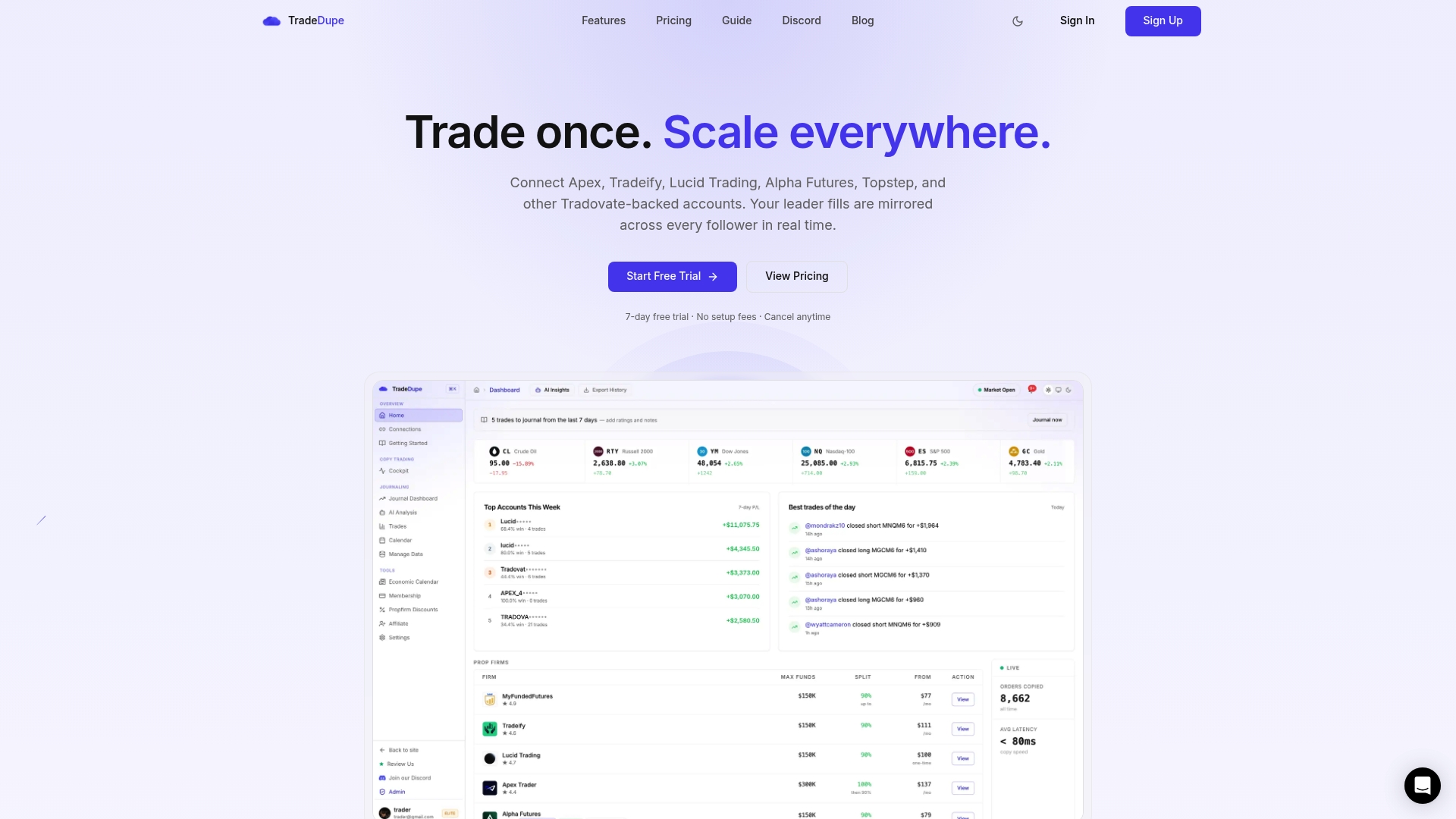
Tradedupe's futures trade copier delivers a median execution latency of 34ms, well inside the 100ms threshold that separates reliable mirroring from degraded execution. The platform supports per-account toggle controls, rogue-trade detection, and auto-recovery, giving you the risk management layer that copy trading structures require. Native integrations with Apex, Tradeify, Lucid Trading, and Alpha Futures mean you can start mirroring accounts across your entire prop portfolio without custom development. For traders who want to run a professional multi-account operation on Tradovate, Tradedupe provides the infrastructure to do it at scale.
FAQ
What is trade mirroring in simple terms?
Trade mirroring is the automatic replication of trades from one lead account to one or more follower accounts in real time. The follower accounts execute the same trades as the leader, scaled by the chosen allocation method.
What is the difference between PAMM and MAM?
PAMM pools all investor capital into one master account and allocates profits by share percentage. MAM keeps investor accounts separate and mirrors trades using lot allocation, giving each investor individual leverage and risk settings.
Is copy trading the same as trade mirroring?
Copy trading is one type of trade mirroring. It mirrors a leader's trades into each follower's independent account with no pooled capital, making it the most flexible and compliance-light of the three main mirroring structures.
What latency is acceptable for trade mirroring?
A target latency of approximately 50ms is standard for professional mirroring setups, with 100ms as the maximum before execution reliability degrades. Latency variance matters more than average latency for consistent performance.
How do I prevent overexposure in multi-account mirroring?
Selective replication using instrument filters and custom lot-size rules prevents accidental overexposure when follower accounts have different margin or leverage constraints. Define these rules before going live, not after a problem appears.