
What Is Futures Copy Trading? A 2026 Guide
TradeDupe
11 min read
Discover what is futures copy trading and how it allows traders to efficiently manage multiple accounts, enhancing your trading strategy today!
Futures copy trading is defined as software that automatically duplicates trades from one lead futures account to multiple follower accounts, letting a single trader manage 5 to 50 accounts simultaneously without manual order entry. The industry standard term for this technology is a futures trade copier, and it differs sharply from social copy trading platforms like eToro, where you follow a stranger's signals. Here, you control every account being copied. Platforms built on Tradovate, NinjaTrader, and Rithmic have made this workflow accessible to prop traders running multiple evaluation accounts across firms like Apex Trader Funding, Topstep, and Tradeify. The core value is precision at scale: one decision, executed across your entire account stack in near real time.
What is futures copy trading and how does it differ from social trading?
Futures copy trading is standalone software that replicates your own trades across multiple futures accounts you control, eliminating manual repetition. This is the critical distinction most beginner resources miss. Social copy trading, as offered by retail platforms, routes your capital into another trader's strategy. A futures trade copier routes your own strategy into your own accounts simultaneously.
The practical implication is significant. You remain the decision maker, the risk manager, and the account holder across every position. The copier is purely an execution layer. Prop traders use this setup to pass multiple evaluations at once, scale funded accounts, or run the same strategy across different prop firms without re-entering every order by hand.
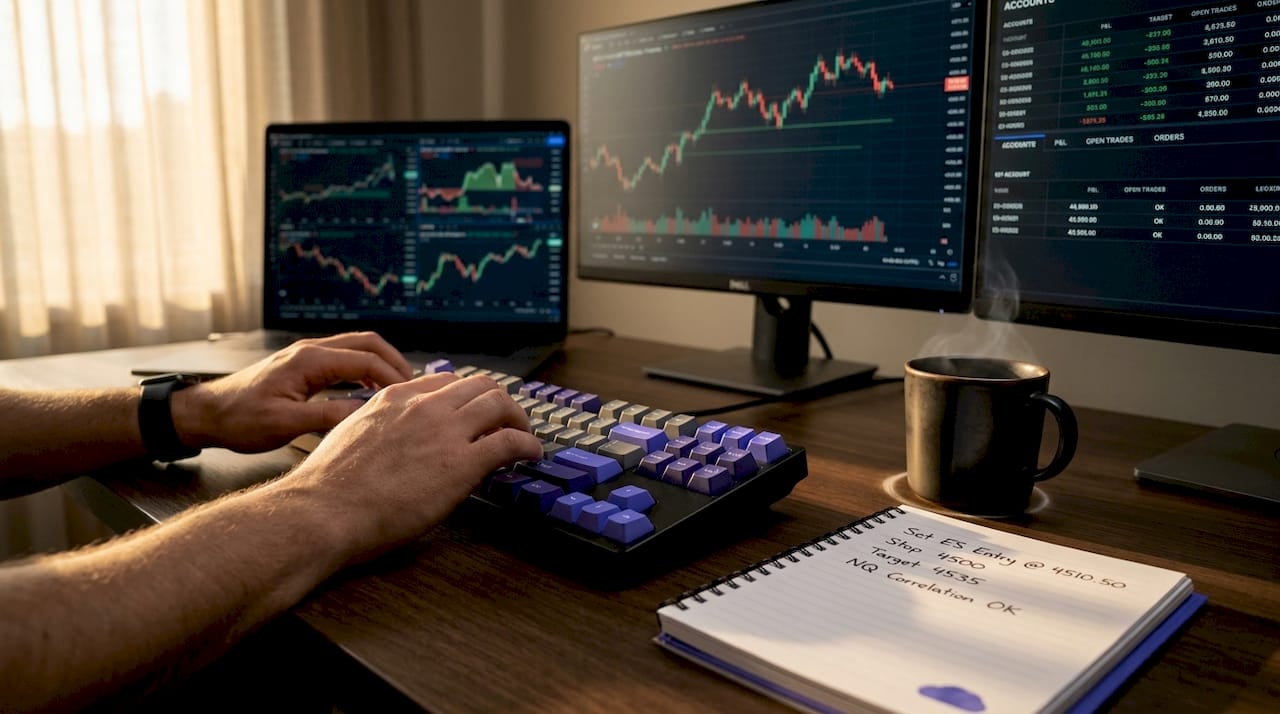
Binance's 2026 TradFi Futures Copy Trading launch illustrates how the concept is expanding beyond pure prop trading into retail futures markets, with lead traders earning up to 2,000 USDT in incentives. That expansion signals growing mainstream adoption, but the mechanics for professional multi-account traders remain fundamentally different from consumer-facing copy products.
How does futures copy trading software work?
The engine behind any futures trade copier is a process that watches a designated lead account and replicates every order event to a list of follower accounts. Two synchronization modes define how that replication happens, and choosing the wrong one for your setup creates real execution problems.
Executions mode copies filled trades almost instantly after the lead account receives a fill. The copier detects the fill, calculates the proportional size for each follower, and submits market orders to replicate the position. This mode is straightforward and works well when speed matters more than order type precision.
Orders mode mirrors live order placement, modifications, and cancellations in real time. Orders mode enables account-specific automation strategies to maintain alignment as market conditions change. If you modify a stop on the lead account, the copier propagates that modification to every follower. This is the preferred mode for traders who use limit entries, bracket orders, or dynamic stop management.
Beyond mode selection, three technical features separate functional copiers from unreliable ones:
- Contract type mapping: ES on the lead account maps correctly to MES on a follower, or NQ maps to MNQ, allowing mixed contract sizes across accounts without manual adjustment.
- Size scaling: Each follower account can be configured to trade a fixed number of contracts or a percentage of the lead account's position, accommodating different account sizes and risk tolerances.
- Order synchronization: The copier tracks open positions across all accounts and detects drift, where a follower holds a position the lead has already closed, and corrects it automatically.
Technical challenges are real. Partial fills on the lead account create ambiguity about how many contracts to copy. Order rejections on a follower account, often triggered by margin limits or daily loss caps, require the copier to handle gracefully rather than leaving the account in a mismatched state. Continuous monitoring is necessary because trade replication is imperfect by nature.
Pro Tip: Configure your copier to alert you immediately on any order rejection from a follower account. A silent failure means one account is out of sync while you assume everything is running correctly.
What are the key benefits and risks of futures copy trading?
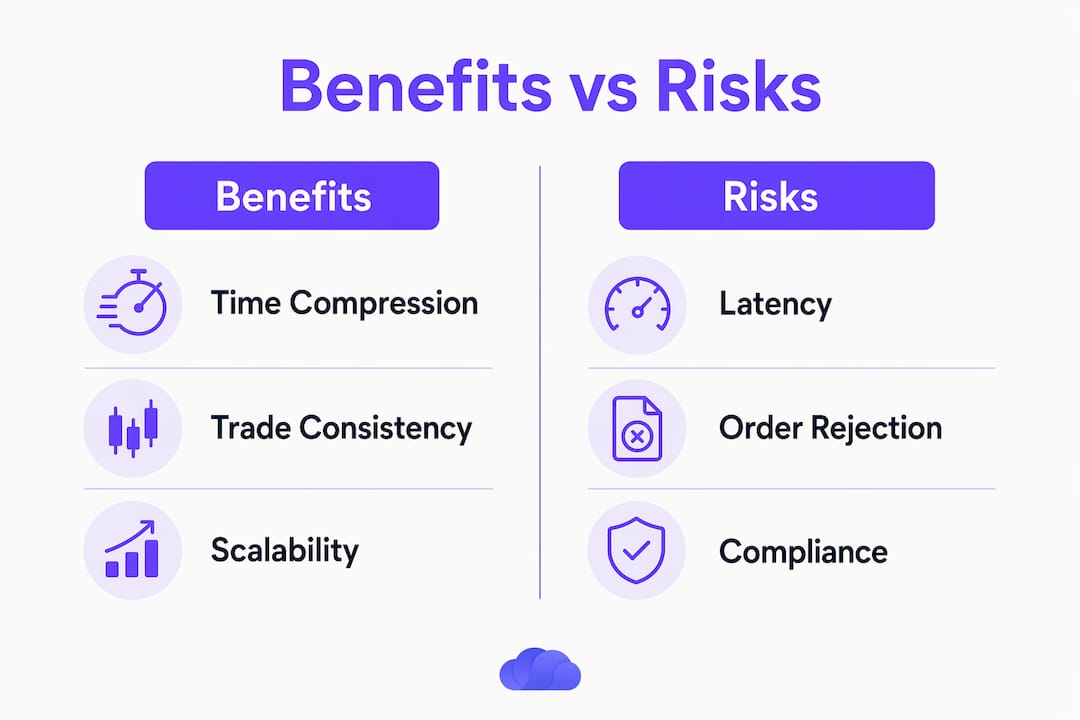
The primary benefit is time compression. During a fast-moving market, manually entering the same trade across six accounts introduces both delay and error. A copier eliminates that gap. Risk controls include per-trade portfolio caps, slippage protection, and stop/target consistency enforcement across follower accounts, which are features that manual trading cannot replicate at speed.
For prop traders specifically, the risk management layer is where copy trading earns its place. Effective risk control for prop firms includes daily loss caps, drawdown limits, symbol whitelists, and controls on stop and target adjustments. These parameters prevent any follower account from inadvertently breaching the firm's rules, even if the lead account is trading aggressively.
The risks, however, are not trivial:
- Slippage amplification: A one-tick slippage on the lead account becomes one-tick slippage on every follower simultaneously, compounding the cost across your account stack.
- Synchronization failures: Connection drops, API timeouts, or broker-side delays can leave follower accounts in positions that the lead has already exited.
- Prop firm compliance violations: Some firms prohibit trade copiers outright. Others permit them under specific conditions or flag accounts that show identical order patterns.
> The biggest hidden challenge in futures copy trading is ensuring compliance with proprietary firm policies and brokerage rules, not just achieving clean technical execution. Traders who focus only on the technology and ignore the compliance layer often discover the problem after an account has been flagged or terminated.
Latency is the other underappreciated risk. Sub-2ms execution speeds are achievable with desktop or VPS-based setups, compared to roughly 100ms typical of cloud-based copiers. In liquid futures markets, that gap rarely causes catastrophic fills, but in thin liquidity or during news events, 100ms is enough to miss a price level entirely.
How to choose and compare futures copy trading tools
Selecting a futures trade copier requires matching the tool's architecture to your specific trading environment. The four criteria that matter most are platform compatibility, execution latency, risk management depth, and multi-account scaling capacity.
| Tool | Platform | Architecture | Key Strength |
|---|---|---|---|
| Replikanto | NinjaTrader | Local/VPS | Deep NinjaTrader integration, strategy-level copying |
| Affordable Indicators Copier | NinjaTrader | Local | Orders mode with full bracket support |
| TradeSyncer | Cloud | Cloud | Browser-based, no local install required |
| TradeCopia | Cloud | Cloud | Multi-broker support, simple UI |
| Tickblaze IgniteCopier | Tickblaze | Local | Tight Rithmic integration |
| TradeDupe | Tradovate | Cloud/Local | Prop firm focused, 34ms median latency |
Platform compatibility is non-negotiable. A copier built for NinjaTrader will not connect to Tradovate accounts, and vice versa. Traders running Apex, Topstep, or Tradeify accounts on Tradovate need a copier that speaks Tradovate's API natively. For a detailed head-to-head evaluation of cloud-based options, the TradeSyncer vs TradeCopia comparison breaks down feature gaps that are not obvious from marketing pages.
Cloud-based copiers offer convenience: no local machine required, accessible from any browser, and no software updates to manage manually. The tradeoff is latency. Local or VPS-based copiers sit closer to the broker's execution infrastructure, which is why local VPS-based execution consistently outperforms cloud alternatives on raw speed.
One advanced feature worth prioritizing is randomized order submission. Advanced copiers randomize the sequence in which follower accounts receive orders, preventing any single account from consistently being last in the queue during thin liquidity. This detail matters when you are running ten or more accounts simultaneously.
Pro Tip: Before committing to any copier, run it in paper trading mode for at least one full trading week. Watch specifically for order rejections, position drift, and how the system handles a fast-moving market during a major economic release.
Pricing models vary widely. Some tools charge per account connected, which makes scaling expensive. Others offer flat-rate subscriptions with unlimited account connections, which is the better model for traders managing large account stacks. Always calculate the per-account cost at your expected scale before signing up.
What compliance considerations should futures traders know in 2026?
Compliance in futures copy trading operates on two levels: regulatory oversight from bodies like the CFTC and NFA, and firm-level policies from individual prop companies. Both layers carry real consequences for traders who ignore them.
- Understand CFTC and NFA requirements. According to CFTC and NFA guidance, marketing of copy trading products must include clear risk disclosures. If you are operating a copy trading service for others, not just your own accounts, you may trigger registration requirements.
- Read every prop firm's terms before deploying a copier. Prop firm rules vary widely: Apex Trader Funding permits copy trading, while Take Profit Trader prohibits automated execution during both evaluation and funded stages. Assuming your firm's policy matches another firm's is a common and costly mistake.
- Monitor for pattern detection. Firms that allow copy trading still watch for accounts that show statistically identical order timing. Submitting the same trade to ten accounts within milliseconds of each other creates a detectable signature. Some copiers address this with randomized submission delays.
- Maintain emergency stop controls. Every serious copy trading setup needs a kill switch that halts all follower activity instantly. Connection issues, rogue fills, or a sudden change in market conditions require the ability to stop replication across all accounts in a single action.
- Keep software current. Broker API changes, prop firm platform updates, and copier software patches all affect synchronization reliability. A copier running on an outdated API version may silently fail to replicate orders without throwing an obvious error.
For a detailed breakdown of how specific prop firm rules interact with copy trading software in 2026, the prop firm rules guide covers the most common compliance scenarios traders encounter.
Key takeaways
Futures copy trading works because it separates trade decision-making from trade execution, letting one strategy run across multiple accounts with speed and consistency that manual entry cannot match.
| Point | Details |
|---|---|
| Core definition | A futures trade copier replicates your own trades across accounts you control, not a stranger's signals. |
| Synchronization modes | Orders mode preserves full bracket and modification logic; executions mode prioritizes raw fill speed. |
| Latency matters | VPS or local setups achieve sub-2ms speeds versus roughly 100ms for cloud copiers, affecting fill quality. |
| Compliance is non-negotiable | Prop firm policies vary sharply; always verify your firm's stance before deploying any copier. |
| Risk controls are built-in | Daily loss caps, drawdown limits, and symbol whitelists prevent follower accounts from breaching firm rules. |
Why I think most traders underestimate the compliance layer
After working closely with prop traders running multi-account setups, the pattern I see most often is this: traders spend weeks selecting the right copier, configuring contract mapping, and testing latency, then deploy to live accounts without ever reading their prop firm's terms of service past the first page.
The technical side of futures copy trading is genuinely solvable. Latency, order synchronization, and contract mapping are engineering problems with known solutions. Compliance is a relationship problem, and it requires a different kind of attention. I have seen funded accounts terminated not because the copier malfunctioned, but because the trader assumed that "automation is allowed" meant "copy trading is allowed." Those are not the same thing at many firms.
My practical advice: contact your prop firm's support team directly and ask, in writing, whether trade copiers are permitted and under what conditions. Get a specific answer, not a vague reference to the terms. Firms that support copy trading, like Apex, are generally forthcoming about it. Firms that prohibit it will tell you clearly. Either answer is useful. The dangerous position is assuming without asking.
The other underrated practice is configuring per-account risk limits independently of the lead account. Your lead account may be able to absorb a five-contract loss. A follower account in a smaller evaluation may not. Treat each follower's risk parameters as its own configuration problem, not a scaled copy of the lead.
> — Andres
Scale your futures accounts with TradeDupe
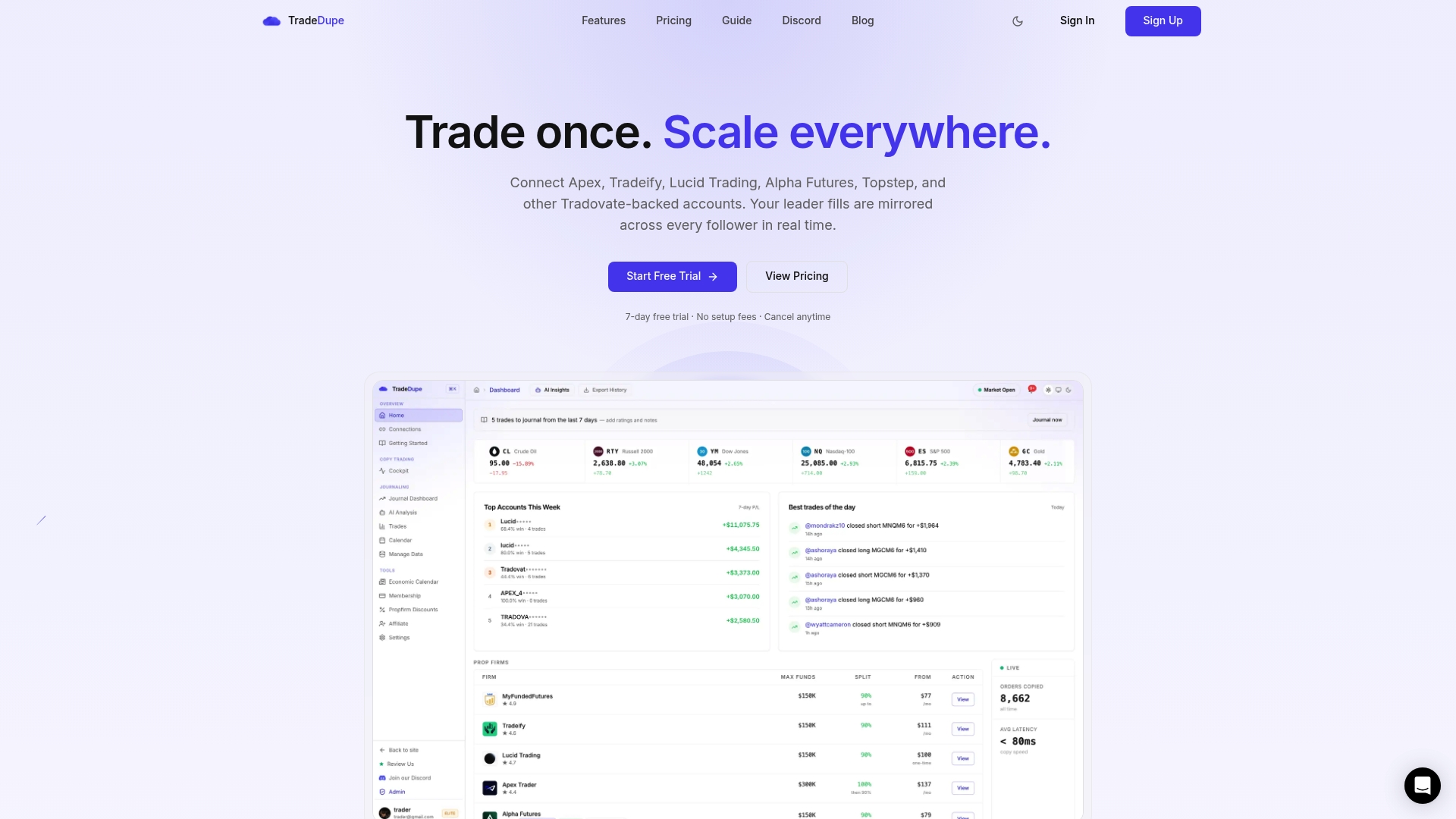
TradeDupe is built specifically for prop traders running multiple Tradovate accounts across firms like Apex Trader Funding, Tradeify, Topstep, Alpha Futures, and Lucid Trading. Its median execution latency of 34ms, rogue-trade detection, and per-account toggle controls address the exact operational and compliance challenges covered in this article. The platform's dashboard gives you real-time visibility into sync status, leader and follower activity, and risk exposure across your entire account stack. Whether you are managing two evaluation accounts or scaling a funded prop desk, TradeDupe's copy trading platform is designed to handle the complexity without adding operational overhead. Getting set up takes under ten minutes with the step-by-step onboarding guide.
FAQ
What is the difference between futures copy trading and social copy trading?
Futures copy trading replicates your own trades across multiple accounts you control, while social copy trading mirrors another trader's signals into your account. The key distinction is account ownership and decision authority.
Can you use a trade copier with prop firm accounts?
Some prop firms like Apex Trader Funding permit trade copiers, while others like Take Profit Trader prohibit automated execution entirely. Always verify your specific firm's policy in writing before deploying any copier software.
How fast does a futures trade copier execute?
Local or VPS-based copiers can achieve sub-2ms execution speeds, while cloud-based copiers typically operate around 100ms. The latency difference affects fill quality most during fast markets and thin liquidity conditions.
What synchronization mode should I use for futures copy trading?
Orders mode is the better choice for traders using limit entries, bracket orders, or dynamic stop management, because it propagates modifications and cancellations in real time. Executions mode suits traders who prioritize raw fill speed over order type precision.
Does futures copy trading require CFTC registration?
If you are copying trades across your own accounts, registration is generally not triggered. Operating a copy trading service for other people's accounts may require CFTC or NFA registration, depending on the structure and compensation involved.