

What Is Institutional Copy Trading for Prop Traders
TradeDupe
12 min read
Discover what is institutional copy trading and how it enables prop traders to manage multiple accounts efficiently for optimal returns.
Most traders encounter copy trading as a retail concept: follow a successful trader, mirror their positions, and collect returns passively. That framing is incomplete. What is institutional copy trading, properly defined, is a structured, technology-driven approach where a single master account executes trades that are automatically replicated across dozens or hundreds of sub-accounts simultaneously, each with independent risk parameters and allocation logic. This is not passive income by another name. It is a scalable execution infrastructure that asset managers, prop firms, and professional traders use to manage multi-account operations with precision and compliance-grade controls.
Table of Contents
- Key Takeaways
- What institutional copy trading actually means
- Managing multiple accounts with MAM and PAMM models
- Risk management and regulatory considerations
- Execution details and common misconceptions
- Practical applications for traders and investors
- My honest take on institutional copy trading
- Build your institutional copy trading setup with Tradedupe
- FAQ
Key Takeaways
| Point | Details |
|---|---|
| Institutional vs. retail copy trading | Institutional setups use master accounts with separate client sub-accounts, not simple social following. |
| Allocation methods matter | Percentage-based, fixed lot, and balance-scaled formulas each produce different follower outcomes. |
| MAM/PAMM are the core models | These platforms centralize execution while keeping individual account risk controls independent. |
| Regulatory classification is not fixed | EU frameworks under MiFID II and MiCA classify copy trading differently based on execution discretion. |
| Results are never guaranteed | Slippage, fees, and execution timing all affect follower P&L independent of the leader's performance. |
What institutional copy trading actually means
At its core, copy trading automates proportional replication of a leader's trades with real-time scaled execution. When the master account buys two contracts of ES futures, each follower account receives a proportional order based on its allocated capital and configured allocation method. The follower never manually approves the trade. The platform handles the entire execution chain.
The distinction between retail and institutional copy trading comes down to account architecture, execution precision, and risk control depth. Retail social copy trading, the kind popularized by forex platforms, typically links a follower's entire account to a signal provider with minimal customization. Institutional copy trading, by contrast, operates on a one-to-many execution model where a master trader's desk manages multiple client or proprietary accounts under a centralized but highly configurable system.
Three primary allocation methods define how trades scale from leader to follower:
- Percentage-based allocation: Each follower receives a position sized as a percentage of their account balance relative to the leader's balance. A follower with 50% of the leader's capital receives 50% of the leader's position size.
- Fixed lot allocation: Every follower receives the same absolute position size regardless of account balance. This works for uniform prop firm accounts but creates disproportionate risk exposure across accounts of different sizes.
- Balance-based scaling: The platform calculates position size dynamically based on real-time balance ratios, accounting for open positions and margin usage at the time of execution.
MAM-style institutional platforms execute trades across multiple client accounts using these allocation formulas, enabling a master trader to execute once while the platform propagates the order independently to each sub-account. The technology supporting this includes dedicated trade routing engines, latency optimization layers, and per-account risk engines that operate in parallel. Platforms like Tradedupe, built specifically for Tradovate prop traders, achieve a median execution latency of 34 milliseconds from master to follower, which matters significantly in fast-moving futures markets where order flow can shift within seconds.
Managing multiple accounts with MAM and PAMM models
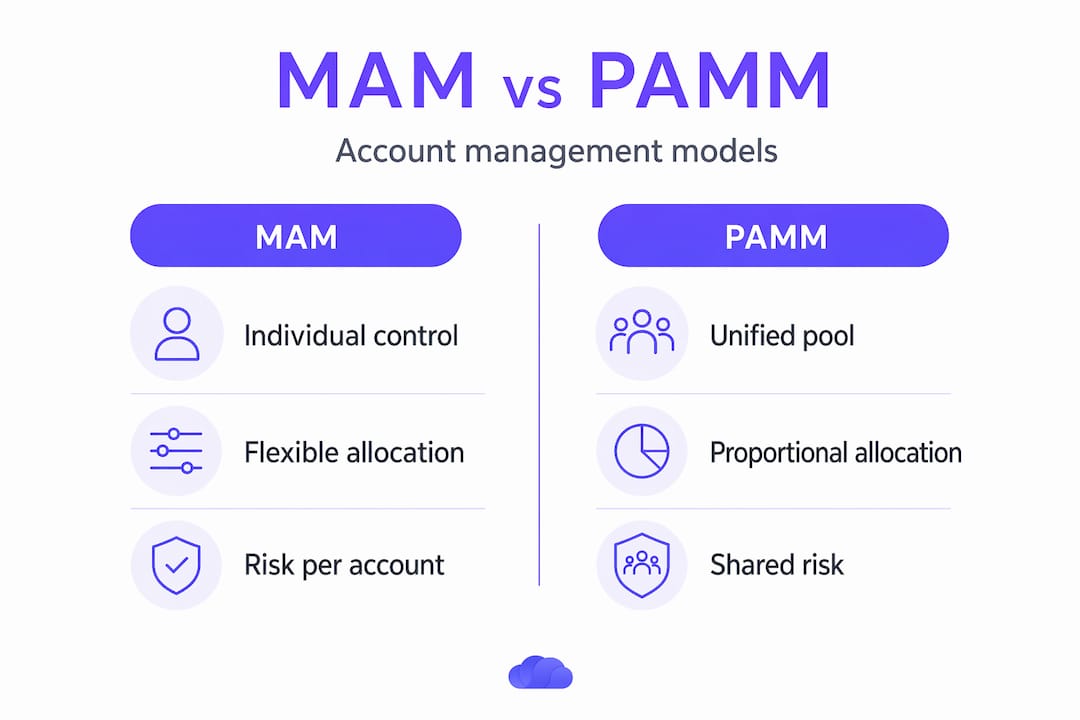
The two most recognized structural models in institutional copy trading are MAM (Multi-Account Manager) and PAMM (Percentage Allocation Money Management). Understanding the operational difference between them shapes how you set up and oversee a multi-account trading operation.
| Feature | MAM | PAMM |
|---|---|---|
| Trade execution | Master places trades; platform allocates per sub-account | Pool-based; trades executed as a single block then allocated |
| Account ownership | Each client retains their own account with independent balance | Client funds pooled under master's account |
| Risk customization | Per-account stop-loss, drawdown limits, and leverage settings | Risk applied at pool level; less per-client granularity |
| Transparency | Full visibility per sub-account in real time | Aggregate performance reported; per-trade detail varies |
| Best suited for | Prop firms, managed accounts, institutional desks | Fund-style pooled management structures |
In practice, MAM is the dominant model for prop trading firms because it preserves individual account integrity while centralizing execution. Each funded trader account maintains its own balance, daily loss limit, and trailing drawdown threshold. The master executes a trade, and the platform's allocation logic sizes each follower's position according to pre-configured parameters. If one follower hits a daily drawdown limit, their account pauses automatically while others continue trading unaffected.

Platform risk engines modify master strategy effects based on per-account risk parameters to safeguard each client independently. This is a critical operational feature that separates institutional-grade platforms from basic copy tools. A risk manager can configure account-level stop-out thresholds, maximum position sizes, and auto-pause triggers without altering the master strategy itself.
Pro Tip: When evaluating any MAM platform for multi-account management, check whether risk controls apply at the individual account level or only at the master level. Account-level controls are non-negotiable for managing multiple prop firm accounts with different drawdown rules.
Scaling a MAM setup introduces real operational challenges. Execution timing across 20 accounts differs from timing across 200. Slippage accumulates differently per account depending on liquidity depth at the moment of order propagation. These operational failures in multi-account copy trading often stem from workflow and execution mismatches rather than from flaws in the underlying strategy itself.
Risk management and regulatory considerations
Institutional copy trading platforms layer risk controls at multiple points in the execution chain. The most operationally significant features include:
- Drawdown limits: Configurable per sub-account; trading pauses or terminates when cumulative loss exceeds the defined threshold.
- Stop-out levels: Automatic position closure triggered when margin falls below a set floor, protecting both client capital and broker exposure.
- Auto-pause and termination: When a copy relationship breaches predefined performance thresholds, the platform can halt new trade replication without closing existing positions.
- Rogue-trade detection: Advanced systems flag trades that deviate from the master's established order flow patterns, catching entry errors or unauthorized positions before they propagate to all follower accounts.
> "Regulatory compliance in copy trading hinges not just on performance metrics, but on execution discretion and the degree of client intervention the model permits." — Skadden, 2025 MiCA Implementation Update
The regulatory picture is genuinely complex. EU regulation classifies copy trading services under portfolio management if trades are automatically executed without client intervention. When human discretion or client approval is involved before execution, the service may instead qualify as investment advice under MiFID II. The Markets in Crypto-Assets Regulation (MiCA) extends similar classification logic to digital asset copy trading services, creating new compliance requirements for firms operating in that space.
This distinction matters practically. A firm running a fully automated MAM setup where clients have no ability to reject individual trades needs portfolio management authorization in most EU jurisdictions. A model where clients receive signals and choose whether to act falls under a different regulatory category with different disclosure obligations. If you operate across prop firm accounts in multiple jurisdictions, understanding this classification before you scale is not optional.
Execution details and common misconceptions
The gap between what traders expect from institutional copy trading and what they actually experience often comes down to four misunderstood mechanics.
- Copy trading is not mirror trading. Copy trading is proportional to follower capital, causing position sizes and absolute dollar returns to differ from the leader's account. Mirror trading duplicates strategy logic; copy trading scales positions. A leader making $500 on a 4-contract trade does not mean a follower allocated at 25% of the leader's capital makes $125. Slippage, fee structures, and fill timing all affect the final figure.
- Proportional position sizing creates divergent P&L. If your account is 10% of the master's capital, you receive 10% of the position size. But your percentage return on capital should theoretically match the leader's. In practice, fees and minimum contract sizes can distort this relationship, especially in futures where the smallest tradable unit is one contract.
- Follower controls are more powerful than most traders use. You can disconnect specific trades, set a maximum drawdown on the copy relationship itself, adjust allocation size mid-strategy, and close copied positions independently. Follower control over allocation and stop-loss settings is crucial to managing risk within copy trading portfolios, yet most followers set parameters once and forget them.
- Leaders with strong track records can still produce losing outcomes for followers. Fees, execution latency, and market conditions at the moment of order propagation all affect follower results independent of the leader's raw performance.
Pro Tip: Always evaluate a master trader's risk-adjusted returns, not just raw profit figures. A 30% drawdown with a 40% return is a very different risk profile than a 10% drawdown with a 25% return. Your copy relationship inherits the risk profile, not just the upside.
Practical applications for traders and investors
How you engage with institutional copy trading depends significantly on your role and operational goals. Different trader profiles extract different value from the same infrastructure.
- Prop firm traders managing multiple funded accounts: The primary use case for platforms like Tradedupe. One trader executes on a lead account and mirrors those trades across every funded evaluation or payout account simultaneously. This eliminates manual execution errors and lets the trader focus on strategy rather than order entry across multiple terminals.
- Asset managers overseeing client portfolios: MAM structures allow centralized trade execution with per-client risk parameters. A manager running 50 client accounts does not enter 50 separate orders. One execution propagates to all, each sized according to the client's capital and risk tolerance.
- Active investors seeking systematic exposure: Rather than manually following a trader's published positions, a copy relationship automates execution with configurable limits. The investor retains control through allocation caps and drawdown stops while accessing professional-grade strategy execution.
When selecting a copy trading platform for institutional use, evaluate five factors in this order: execution latency (sub-100ms is the functional threshold for futures), per-account risk controls, allocation method flexibility, integration with your brokerage infrastructure, and reporting depth. A platform that shows you aggregate performance but cannot break down per-account slippage and fill quality is not built for institutional operations.
The technology curve in this space is moving fast. AI-powered trade analysis now surfaces execution anomalies across follower accounts that would take hours to identify manually. Real-time sync dashboards let risk managers see every open position across every sub-account at a glance, flag outliers, and intervene before a single rogue trade compounds across the entire book.
My honest take on institutional copy trading
I've spent considerable time reviewing how professional traders actually implement copy trading at scale, and the pattern I keep seeing is this: traders invest heavily in selecting the right leader or building the right strategy, then underinvest in the operational infrastructure that connects that strategy to their accounts.
The leader's edge is only as effective as the execution chain delivering it. I've seen setups where a disciplined futures trader was generating consistent edge on a master account, but follower accounts were underperforming by 15 to 20% due to latency, fill slippage, and allocation rounding errors. The strategy was sound. The infrastructure was not.
Risk managers rely on copy trade systems precisely because manual multi-account management introduces too many failure points. But selecting any system is not sufficient. You need to scrutinize execution semantics, per-account risk control depth, and how the platform behaves under high-volatility conditions when order flow is fastest and most consequential.
Treat institutional copy trading as an active operational discipline, not a passive setup. The traders who extract real value from it are the ones who monitor sync status, audit fill quality, and adjust allocation parameters as account sizes change. Copy trading done well is a professional workflow, not a hands-off income source.
> — Andres
Build your institutional copy trading setup with Tradedupe
Tradedupe is built specifically for professional prop traders and trading firms running multiple Tradovate accounts. If the mechanics covered in this article describe your operational goals, the platform delivers what actually matters: a median 34ms execution latency, per-account risk controls including rogue-trade detection and auto-recovery, and native integration with Apex, Tradeify, Lucid Trading, Alpha Futures, and Topstep.
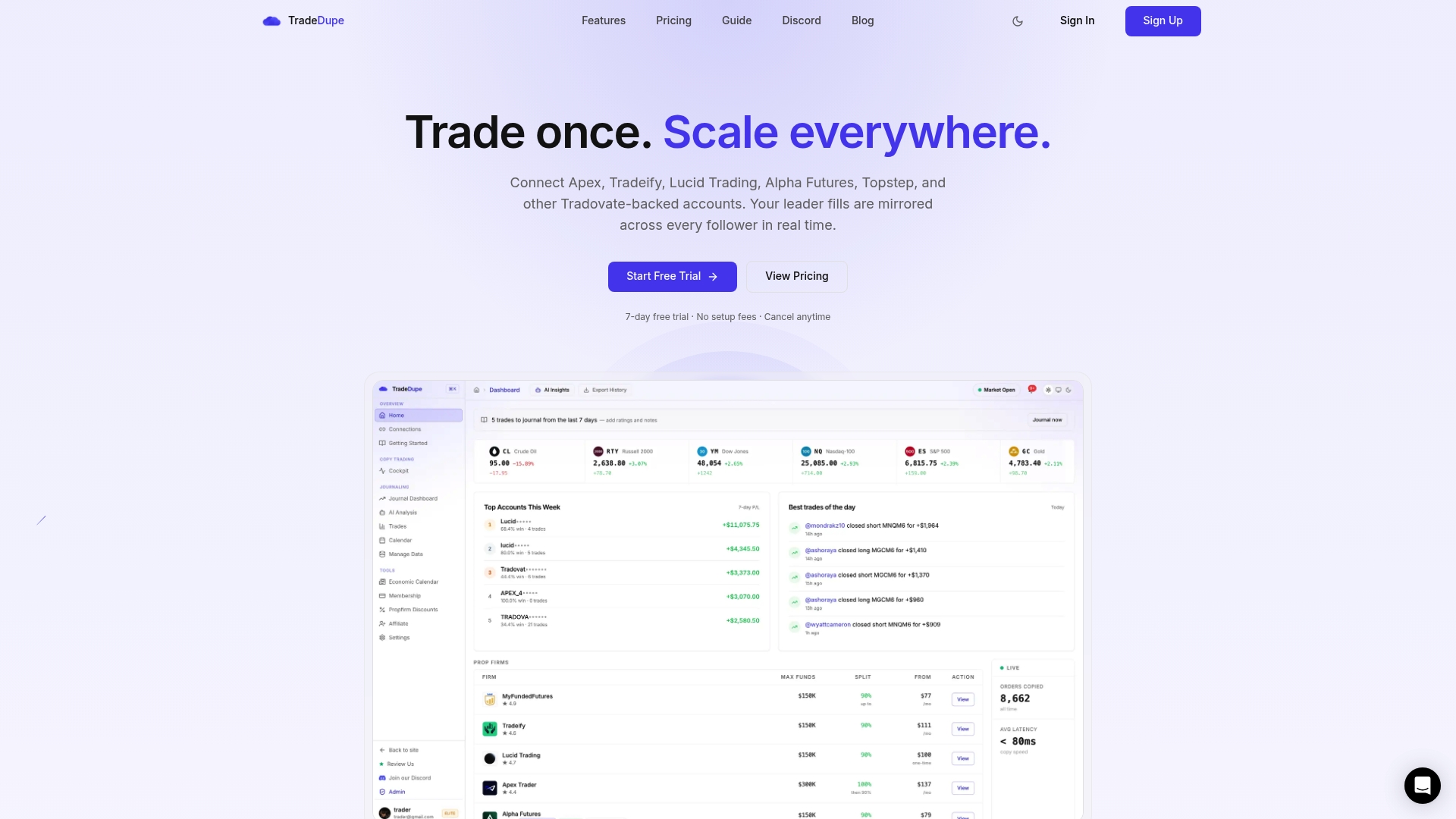
You can mirror trades across unlimited follower accounts from a single leader, monitor every account's sync status in real time, and configure independent drawdown and stop-out rules per account. The platform comparison available on the Tradedupe site gives you a direct breakdown of how it stacks up against alternatives for futures prop trading. If you are managing two funded accounts today and plan to scale to ten, this is the infrastructure designed for that trajectory.
FAQ
What is institutional copy trading?
Institutional copy trading is a structured system where a single master account automatically replicates trades across multiple client or proprietary sub-accounts using configurable allocation logic, per-account risk controls, and real-time execution technology. It differs from retail copy trading in its account architecture, execution precision, and compliance requirements.
How does copy trading work in a MAM setup?
In a MAM setup, the master trader executes a single trade and the platform applies a configured allocation formula, such as percentage-based or balance-scaled, to size and route that trade independently to each sub-account. Each account maintains its own balance, risk limits, and drawdown thresholds.
Is copy trading profitable for followers?
Follower profitability depends on the leader's risk-adjusted performance, the allocation method used, platform execution quality, fees, and slippage. Follower outcomes are never guaranteed to match the leader's returns due to these variables, making due diligence on the master and the platform equally important.
What are the main risks of institutional copy trading?
The primary risks include execution latency across multiple accounts, slippage at order propagation, insufficient per-account risk controls, and regulatory misclassification if you operate in EU-regulated jurisdictions. Platform failure or misconfigured allocation can also cause outsized losses across an entire book of follower accounts simultaneously.
How is copy trading regulated under EU law?
Under MiFID II and MiCA, fully automated copy trading with no client intervention is typically classified as portfolio management, requiring the relevant authorization. Models involving client signals and discretionary execution may qualify as investment advice instead, each carrying different disclosure and licensing obligations.