

Capital Efficiency in Prop Trading: 2026 Guide
TradeDupe
10 min read
Discover what is capital efficiency in prop trading. Learn how to maximize profits and manage risks for sustainable trading success.
Capital efficiency in prop trading is defined as the ratio of profits or position value generated relative to the capital allocated or margin required. It measures how effectively a trader or firm deploys available capital to produce risk-adjusted returns within firm-imposed limits. Understanding what is capital efficiency in prop trading separates traders who scale sustainably from those who blow accounts chasing raw returns. Market-making desks achieve capital efficiency ratios between 15% and 30%, while traditional prop desks see 5% to 12% due to larger risk buffers. That gap reflects structural differences in how each desk type manages margin, position sizing, and risk exposure.
What is capital efficiency in prop trading and how is it measured?
Capital efficiency in prop trading is calculated by dividing gross revenue or total position value by the capital allocated or margin required to hold those positions. The higher the ratio, the more productive each dollar of allocated capital becomes. Two metrics dominate this calculation in professional prop environments.
The first is the gross revenue to allocated capital ratio, which shows how much profit a desk generates per dollar of risk capital. The second is the total position value to required margin ratio, which measures how much market exposure a trader controls relative to the margin posted. Capital efficiency in derivatives trading is measured as total position value maintained against required margin, with portfolio margining improving efficiency by recognizing offsetting risks across correlated positions.

Portfolio margining and cross-margining are the two primary tools for improving these ratios. Portfolio margining calculates margin requirements based on the net risk of a combined book rather than summing each position's margin independently. Cross-margining allows gains in one account or asset class to offset margin requirements in another. Both techniques reduce the capital locked up as collateral, freeing it for additional positions.
| Desk type | Typical capital efficiency ratio | Primary driver |
|---|---|---|
| Market-making desk | 15%–30% | High turnover, tight spreads, low risk buffers |
| Traditional prop desk | 5%–12% | Larger directional risk buffers |
| Retail-funded prop account | 3%–8% | Conservative drawdown rules, fixed leverage caps |
Pro Tip: Measure capital efficiency at both the individual strategy level and the firm level separately. A strategy that looks efficient in isolation may consume disproportionate margin when combined with correlated positions across the book.
How do leverage, risk controls, and drawdown rules affect capital efficiency?
Leverage amplifies capital efficiency when trades perform, but it destroys accounts when drawdown rules are violated. Prop firms enforce strict parameters that directly constrain how much efficiency a trader can extract from allocated capital.
The most common risk controls in funded prop accounts include:
- Per-trade risk limits. Successful prop traders cap risk at 0.5% to 1% per trade to comply with firm drawdown rules. Staying within this band preserves the account long enough to compound returns.
- Risk-to-reward requirements. Firms and experienced traders require a minimum 1:2 or 1:3 risk-to-reward ratio on every trade. A 1:3 ratio means a single winning trade recovers three losing trades, keeping the capital base intact.
- Trailing drawdown rules. Many prop firms apply trailing maximum drawdown limits that follow the account's peak equity. This forces traders to reduce position size as the account grows, directly capping how aggressively capital can be deployed.
- Consistency requirements. Some firms require that no single trading day account for more than a set percentage of total profits. This prevents traders from taking outsized bets to hit targets quickly, which would otherwise inflate short-term efficiency at the cost of long-term survival.
Drawdown regulations directly affect capital preservation strategies within prop trading firms, and ignoring them is the fastest path to account termination. Volatility targeting, where position size is adjusted based on recent market volatility, is another technique firms use to keep risk consistent across changing market conditions.
Pro Tip: Use Micro contracts, such as Micro E-mini futures, to scale into positions incrementally. This lets you test a trade idea with minimal capital at risk before committing full size, preserving your drawdown buffer while still participating in the move.
What limits capital efficiency: capacity, market impact, and risk creep
Three forces cap how far capital efficiency can scale in any prop trading operation: market impact costs, alpha decay, and soft risk creep. Each one erodes returns in a different way, and professionals who ignore them eventually hit a ceiling.
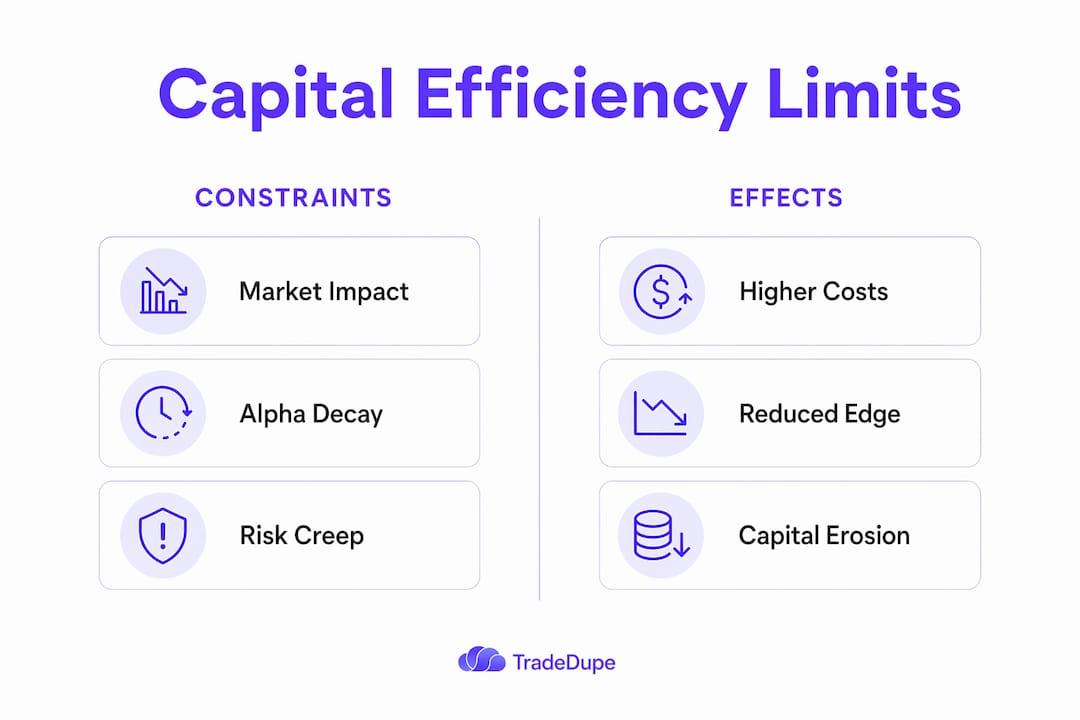
Market impact is the price movement caused by a trader's own order flow. Market impact costs rise disproportionately with order size, following the square-root law. This means doubling position size more than doubles the cost of execution, compressing net returns and capping strategy capacity. A strategy that works at $100,000 in notional size may become unprofitable at $1,000,000 because the act of entering and exiting positions moves the market against you.
Alpha decay compounds this problem. As more capital chases the same edge, or as other participants identify the same pattern, the profitability of a strategy shrinks over time. Strategy value depends on capacity, edge, and lifetime. Scalability and longevity often matter more than raw backtest performance. A strategy with a modest Sharpe ratio but a long viable lifespan generates more total capital than a high-Sharpe strategy that burns out in six months.
| Risk management pitfall | Best practice |
|---|---|
| Increasing size without verifying edge at new scale | Scale only after confirming edge holds across larger sample sizes |
| Ignoring market impact at higher position sizes | Monitor slippage per unit as size grows; reduce size when slippage rises |
| Treating all strategies as equally scalable | Segment capital by strategy type and capacity ceiling |
| Allowing winning streaks to inflate position size | Use fixed fractional sizing tied to verified risk parameters |
Soft risk creep is the most dangerous of the three because it is invisible until the damage is done. Increasing position sizes beyond verified edge leads to catastrophic drawdowns. Professionals counter this by maintaining a strict risk budget, reviewed weekly, and by treating any deviation from the plan as a process failure rather than a market problem.
Pro Tip: Track your average slippage per contract over rolling 20-trade windows. A rising slippage trend at constant position size signals that your strategy is approaching its capacity ceiling before your P&L shows it.
Practical strategies to improve capital allocation and scale trading performance
Improving capital allocation requires a structured approach that addresses position sizing, strategy diversification, and execution technology simultaneously. The following framework applies directly to prop traders managing single or multiple funded accounts.
- Build a portfolio allocation framework. Divide allocated capital across uncorrelated strategies and asset classes. A futures trader might split capital between trend-following strategies on equity index futures and mean-reversion setups on energy contracts. Correlation below 0.3 between strategy returns is the practical target for meaningful diversification benefit.
- Apply data-driven performance filtering. Capital efficiency determines long-term viability more than initial capital size. Firms that track per-strategy metrics, including profit factor, maximum adverse excursion, and win rate by market session, can reallocate capital away from underperforming strategies before drawdowns compound. Review top prop trading performance metrics regularly to identify which strategies deserve more capital and which should be reduced.
- Optimize margin usage through position sizing tools. A futures position size calculator removes guesswork from sizing decisions. Entering account size, risk percentage, and stop distance produces a precise contract count that keeps each trade within firm-mandated risk limits. This is the mechanical foundation of capital management in trading.
- Build a verifiable track record. A consistent trading record is the most capital-efficient approach to accessing larger capital tiers. Firms increase allocations to traders who demonstrate controlled drawdowns and consistent returns over 60 to 90 trading days. Chasing short-term profits to hit evaluation targets faster typically produces erratic equity curves that disqualify traders from capital increases.
- Use copy trading technology to scale verified strategies. Once a strategy proves efficient on a single account, replicating it across multiple funded accounts multiplies capital deployment without multiplying research or execution effort. Tradedupe mirrors trades from a single lead account to multiple follower accounts with a median latency of 34ms, preserving execution quality across Apex, Tradeify, Lucid Trading, and Alpha Futures accounts simultaneously. Automated trading strategies optimized for long-term profitability benefit directly from this kind of execution consistency at scale.
Capital allocation in prop trading balances return on risk-adjusted capital with risk budgets like VaR to prevent risk creep as strategies scale. Applying Value at Risk (VaR) limits at the strategy level, not just the account level, gives traders a forward-looking constraint that stops concentration before it becomes a problem.
Key Takeaways
Capital efficiency in prop trading is the single most important determinant of long-term viability, outweighing initial capital size, raw returns, or strategy complexity.
| Point | Details |
|---|---|
| Core definition | Capital efficiency measures profits or position value generated per dollar of allocated capital or margin required. |
| Desk type benchmarks | Market-making desks reach 15%–30% efficiency; traditional prop desks operate at 5%–12%. |
| Risk controls are structural | Capping risk at 0.5%–1% per trade and maintaining 1:2 to 1:3 R:R ratios preserves the capital base for compounding. |
| Capacity limits are real | Market impact follows the square-root law, capping strategy capacity before P&L signals the problem. |
| Scale through replication | Copy trading technology multiplies capital deployment across funded accounts without multiplying execution risk. |
Why capital preservation beats aggressive scaling every time
My view on capital efficiency runs counter to what most traders chase when they first enter prop trading. The instinct is to maximize returns on every trade, to push position size when a setup looks strong, and to treat drawdown limits as obstacles rather than guardrails. That instinct is expensive.
The traders I have seen sustain funded accounts over multiple years share one habit: they treat their risk budget as a fixed resource, not a flexible one. They do not increase size because they are on a winning streak. They do not reduce size because they are nervous. They follow a pre-defined allocation framework and adjust it only when new data justifies the change.
The capacity ceiling is the concept most traders underestimate. A strategy that works beautifully at small size often degrades quietly as size grows, not because the edge disappears, but because market impact erodes it. Monitoring slippage per contract, not just total P&L, is the diagnostic that catches this early. Most traders never look at it until the damage is visible in their equity curve.
The practical takeaway is this: build your track record first, scale second. Passing and keeping a funded account requires demonstrating controlled risk management over time, not a single spectacular month. Firms allocate more capital to traders who prove they can protect what they already have. That is capital efficiency in its most practical form.
> — Andres
How Tradedupe supports capital efficiency for prop traders
Prop traders who have verified a strategy on one funded account face a specific problem: scaling that strategy to additional accounts without degrading execution quality or violating firm risk rules.
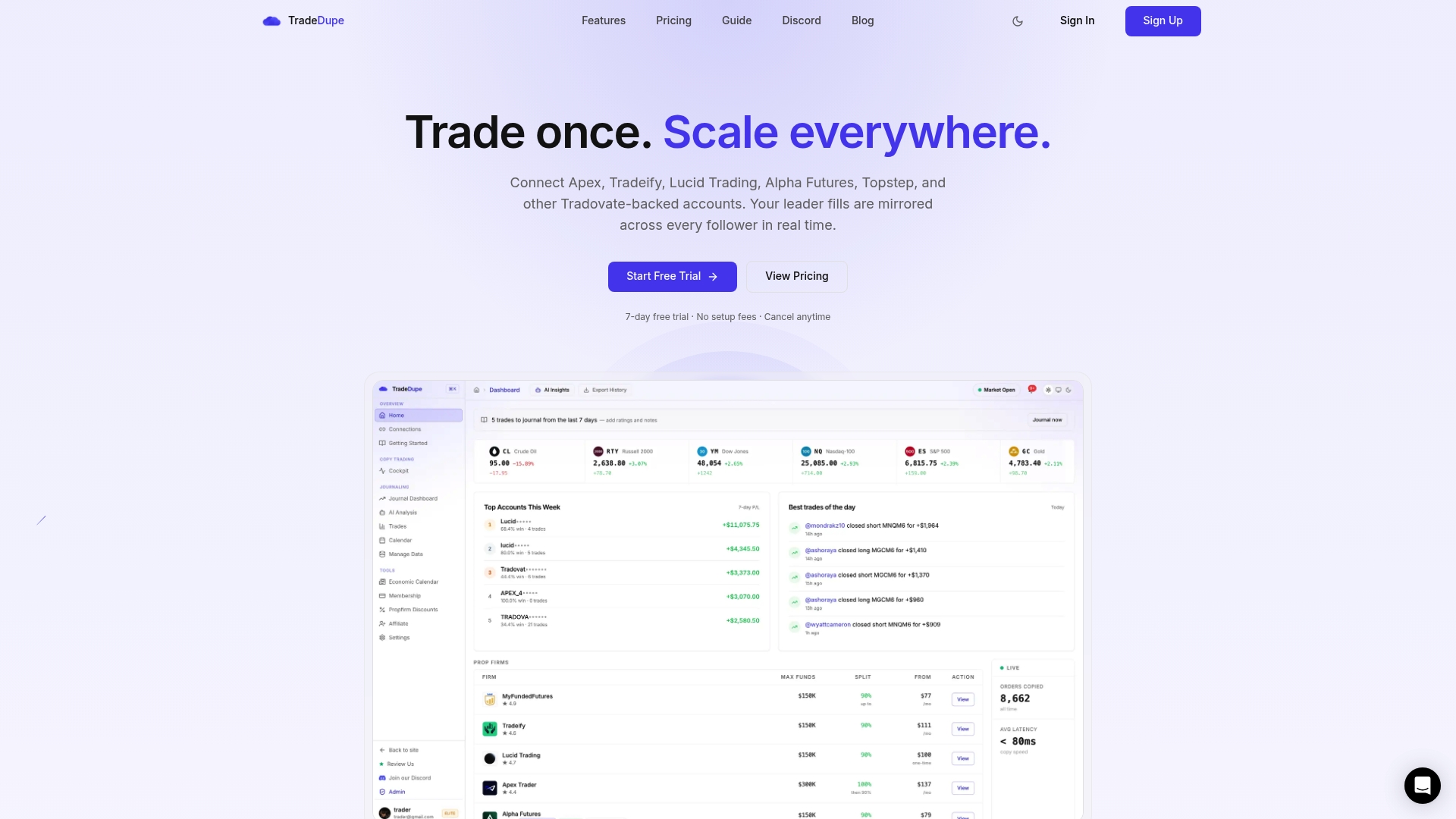
Tradedupe addresses this directly. The platform mirrors trades from a single lead account to multiple follower accounts across Apex, Tradeify, Lucid Trading, and Alpha Futures with a median latency of 34ms. Rogue-trade detection and per-account toggle controls keep each follower account within its individual drawdown limits. AI-powered trade analysis surfaces performance data across the entire account group, supporting the data-driven capital allocation decisions that separate sustainable prop operations from short-lived ones. Traders ready to scale can get started with Tradedupe and replicate their edge across multiple funded accounts without adding execution overhead.
FAQ
What is capital efficiency in prop trading?
Capital efficiency in prop trading is the ratio of profits or position value generated relative to the capital allocated or margin required. It measures how productively a trader deploys each dollar of risk capital within firm-imposed drawdown and leverage limits.
How do prop firms measure capital efficiency?
Prop firms track gross revenue to allocated capital ratios and total position value to required margin ratios. Portfolio margining improves these ratios by netting offsetting risks across correlated positions rather than summing margin requirements independently.
What risk limits support capital efficiency in funded accounts?
Capping risk at 0.5% to 1% per trade and maintaining a minimum 1:2 risk-to-reward ratio are the standard parameters. These limits preserve the capital base long enough for compounding to produce meaningful growth.
What is soft risk creep and why does it matter?
Soft risk creep is the gradual increase of position sizes beyond what a trader's verified edge supports. It produces catastrophic drawdowns because the larger size amplifies losses without a corresponding increase in edge, destroying capital that took months to build.
How does copy trading improve capital efficiency?
Copy trading replicates a verified strategy across multiple funded accounts simultaneously, multiplying capital deployment without multiplying research or execution effort. Tradedupe achieves this with a median trade replication latency of 34ms, preserving execution quality at scale.