
Common Multi-Account Trading Mistakes to Avoid in 2026
TradeDupe
11 min read
Avoid common multi-account trading mistakes in 2026 and boost your profits. Discover key strategies to sidestep costly errors today!
Managing multiple trading accounts sounds like a direct path to scaling profits. But the traders who treat it that way, assuming they can simply copy one working strategy across five funded accounts, are setting themselves up for a particularly painful kind of failure. Common multi-account trading mistakes are rarely about bad market reads. They are almost always operational, technical, or psychological errors that compound quickly when accounts multiply. This article breaks down the specific mistakes that cost prop firm traders payouts, evaluations, and real capital, along with the exact fixes that prevent them.
Table of Contents
- Key takeaways
- 1. Common multi-account trading mistakes begin with execution timing errors
- 2. Manual interference during auto-sync
- 3. Risk management mistakes unique to multi-account strategies
- 4. Technical and API integration pitfalls
- 5. Strategy and sizing logic errors in multi-position trading algorithms
- 6. Psychological and behavioral mistakes amplified by scale
- My take: why these mistakes keep happening despite better tools
- How Tradedupe addresses the errors that cost traders payouts
- FAQ
Key takeaways
| Point | Details |
|---|---|
| Timing errors violate firm rules | Copier latency can push follower holds under minimum thresholds, triggering payout denials. |
| Per-account risk is non-negotiable | Daily loss limits scale with account count, but that does not allow aggregating exposure into larger positions. |
| API and connection isolation matter | Reusing API keys or connecting one account to multiple instances creates duplicate orders and cascading errors. |
| Equity-based sizing prevents overexposure | Using account balance instead of equity in multi-position EAs masks real drawdown and inflates lot sizes. |
| Automation discipline reduces emotional load | Scheduled rules, auto-sync controls, and predefined stops protect against psychology-driven errors at scale. |
1. Common multi-account trading mistakes begin with execution timing errors
Execution timing is the single most misunderstood challenge when copying trades across multiple accounts. Most traders assume their copy setup is "close enough" to real-time. The reality is that even minor latency becomes a rule violation when prop firms set hard time thresholds.

Tradeify's rules are a clear example. Copier latency violations occur when the master account holds a trade for 11 seconds but the follower closes after only 9.5 seconds, breaching the firm's 10-second minimum hold rule and voiding the payout. The firm does not care about your intent. The log shows a violation, and the payout is denied.
Key execution mistakes traders make:
- Not accounting for round-trip latency when calculating minimum hold times. A 1.5-second delay is invisible in normal trading but decisive in compliance terms.
- Using limit orders for synchronized entries across follower accounts. Partial fills from limit orders cause follower accounts to miss entries entirely or execute at divergent prices, creating inconsistencies that show up as rule violations or risk mismatches.
- Ignoring platform-native order routing in favor of custom scripts that introduce additional latency layers.
The fix is straightforward: use market orders for copied entries whenever synchronization across accounts is the priority, accepting the marginally worse fill price as the cost of compliance certainty. For hold-time rules, treat the firm's minimum as a floor, not a target.
Pro Tip: If a prop firm requires a 10-second minimum hold, set your system's internal rule at 20 seconds or more. That buffer absorbs copier latency, network variability, and order processing time without requiring constant monitoring.
2. Manual interference during auto-sync
Automated copy trading only works cleanly when you leave it alone. One of the most disruptive multi-account trading errors comes from traders who manually close, modify, or add positions while auto-sync is actively running.
When you manually change a trade while the automation is live, the system often interprets the change as an unintended state. Connecting the same account to multiple platform instances causes the system to fire duplicate order update events, meaning a single manual close can trigger re-entries across all follower accounts. That feedback loop can multiply an unwanted position before you react.
The operational rule is simple: disable auto-sync before any manual intervention. Manual changes during auto-sync cause the system to re-enter closed trades, directly undermining what you intended. Re-enable sync only after the manual action is fully settled and confirmed. Building this pause-and-resume discipline into your daily workflow is not optional. It is the difference between a controlled operation and a cascade of unintended entries.
3. Risk management mistakes unique to multi-account strategies
Scaling to five funded accounts does not mean you have five times the capital to risk in one idea. That is a common trading pitfall that wipes out multi-account traders faster than single-account errors ever could.
Here is where traders go wrong with risk management across accounts:
- Treating accounts as an aggregate position. Daily loss limits scale with account count but do not permit you to combine them into a single oversized exposure. Each account must be managed independently against its own drawdown ceiling.
- Increasing position sizes to "justify" running multiple accounts. This behavior comes from the pressure to show returns commensurate with the operational effort. The result is inflated risk per trade and faster evaluation failures.
- Ignoring drawdown creep across accounts. You might be within limits on each individual account while your aggregate P&L is moving in a direction that signals a strategy breakdown. Review total equity exposure daily, not just per-account metrics.
Emotional pressure multiplies with account count according to traders who have managed five or more funded accounts simultaneously. Fear of giving back profits on any single account often drives premature exits that violate your own system rules.
Pro Tip: Set internal daily loss limits at 70% of the firm's stated maximum. That 30% margin gives you room to take a final exit without breaching the hard rule under the pressure of live trading.
4. Technical and API integration pitfalls
Most copy trading setups that fail at scale fail because of something invisible: a misconfigured connection, a shared credential, or a software instance overlap that nobody checked during setup.
Common technical mistakes in multi-account environments:
- Reusing one API key across multiple processes. Reusing a single API key causes nonce sequencing errors, where requests arrive out of order and the exchange rejects them. The fix is one API key per process, per account, with subaccount isolation where the platform supports it.
- Running duplicate platform instances on the same account. As noted with NinjaTrader configurations, connecting the same account to two software instances simultaneously fires duplicate order events. A single entry signal becomes two live orders before you can intervene.
- Failing to update contract symbols to continuous references. When a futures contract rolls, hardcoded symbols in your copy configuration stop resolving correctly. Trades either fail silently or execute on the wrong instrument. Use continuous contract references in your platform settings to eliminate this rollover risk.
Clear strategy isolation, as Kraken's guidance on subaccount API management emphasizes, is not just a technical best practice. It is the foundation of a multi-account setup that you can actually troubleshoot when something goes wrong.
5. Strategy and sizing logic errors in multi-position trading algorithms
If you run an expert advisor or algorithmic system across multiple accounts or open positions simultaneously, the way the EA calculates lot sizes will determine whether your risk exposure is what you think it is.
The most common error here is using "AccountBalance()` instead of `AccountEquity()` in sizing calculations. Using AccountBalance() in multi-position EAs causes lot sizes to remain static while your floating drawdown grows, because balance does not reflect unrealized losses. Equity does. The practical result is that during a drawdown phase, your EA opens new positions sized as if the account is healthy, increasing exposure precisely when you are most vulnerable.
Fixes for algorithm-level sizing mistakes:
- Switch all lot-size calculations to `AccountEquity()` so position sizing contracts automatically during open drawdowns.
- For grid or martingale strategies that compound exposure across multiple positions, pre-allocate a fixed budget per strategy run and calculate sizing against that budget, not total account equity.
- Test your EA in Strategy Tester under multi-position scenarios explicitly. Single-position backtests hide the exposure accumulation that only appears when multiple trades are open simultaneously.
Pro Tip: Before deploying any multi-position EA on live funded accounts, run a week of forward testing on a demo with identical account equity. Watch how lot sizes respond to a simulated 5% drawdown. If sizes do not contract, the EA is using balance, not equity.
6. Psychological and behavioral mistakes amplified by scale
The cognitive load of watching five accounts simultaneously is qualitatively different from watching one. More accounts do not just multiply your potential returns. They multiply every psychological pressure you have ever experienced in a single account.
Here are the behavioral patterns that break multi-account traders:
- Overmonitoring individual accounts. Watching tick-by-tick P&L across five dashboards keeps you in a state of reactive decision-making. Your system never gets clean execution because you are always tempted to intervene.
- Chasing payout thresholds across accounts. When three accounts are near target and two are near the daily loss limit, the temptation to "balance" by taking extra risk on the lagging accounts is nearly universal. This is also how traders blow multiple evaluations in a single session.
- Making inconsistent strategy adjustments mid-session. Modifying entry criteria on one account because of what you are seeing on another contaminates your edge data and creates results that are impossible to analyze or replicate.
- Failing to stop after a rule breach. Treating multiple funded accounts as an aggregate leads traders to continue trading on surviving accounts after violating rules on one, trying to offset the loss. This compounds the damage.
- Skipping scheduled breaks. Professional multi-account management requires fixed session windows and mandatory rest periods. Trading exhaustion at hour four produces decisions that contradict your own rules.
The structural fix is to treat each account as operationally independent with its own session limits, and to build hard-stop rules into your copy setup that prevent trading beyond predefined thresholds, regardless of what other accounts are doing.
My take: why these mistakes keep happening despite better tools
I've worked closely enough with prop firm traders to see a clear pattern. The common multi-account trading mistakes outlined in this article are not about ignorance. Most traders running three or more funded accounts know the rules. They understand latency. They have read the prop firm documentation.
What I've consistently observed is that the gap is operational. Traders spend enormous energy on market analysis and almost none on system testing under real multi-account conditions. They launch a new account, plug it into an existing copy setup, and assume it will behave identically to the first one. It rarely does.
The false belief that more accounts automatically means more income is the root cause of most psychological mistakes I've seen. More accounts mean more operational surface area for errors to hide. The traders who manage five or more funded accounts successfully are not smarter traders. They are more disciplined operators. They test every connection before going live. They treat each account as its own risk unit. They automate what can be automated and stay out of the way while automation runs.
My recommendation: add accounts one at a time. Validate each new connection with a week of mirrored demo trading before funding. Learn what your specific setup does under drawdown before scaling further.
> — Andres
How Tradedupe addresses the errors that cost traders payouts
Every mistake covered in this article, from latency violations to API duplication to manual interference feedback loops, has a technical layer that proper copy trading infrastructure either eliminates or reduces to a manageable exception.
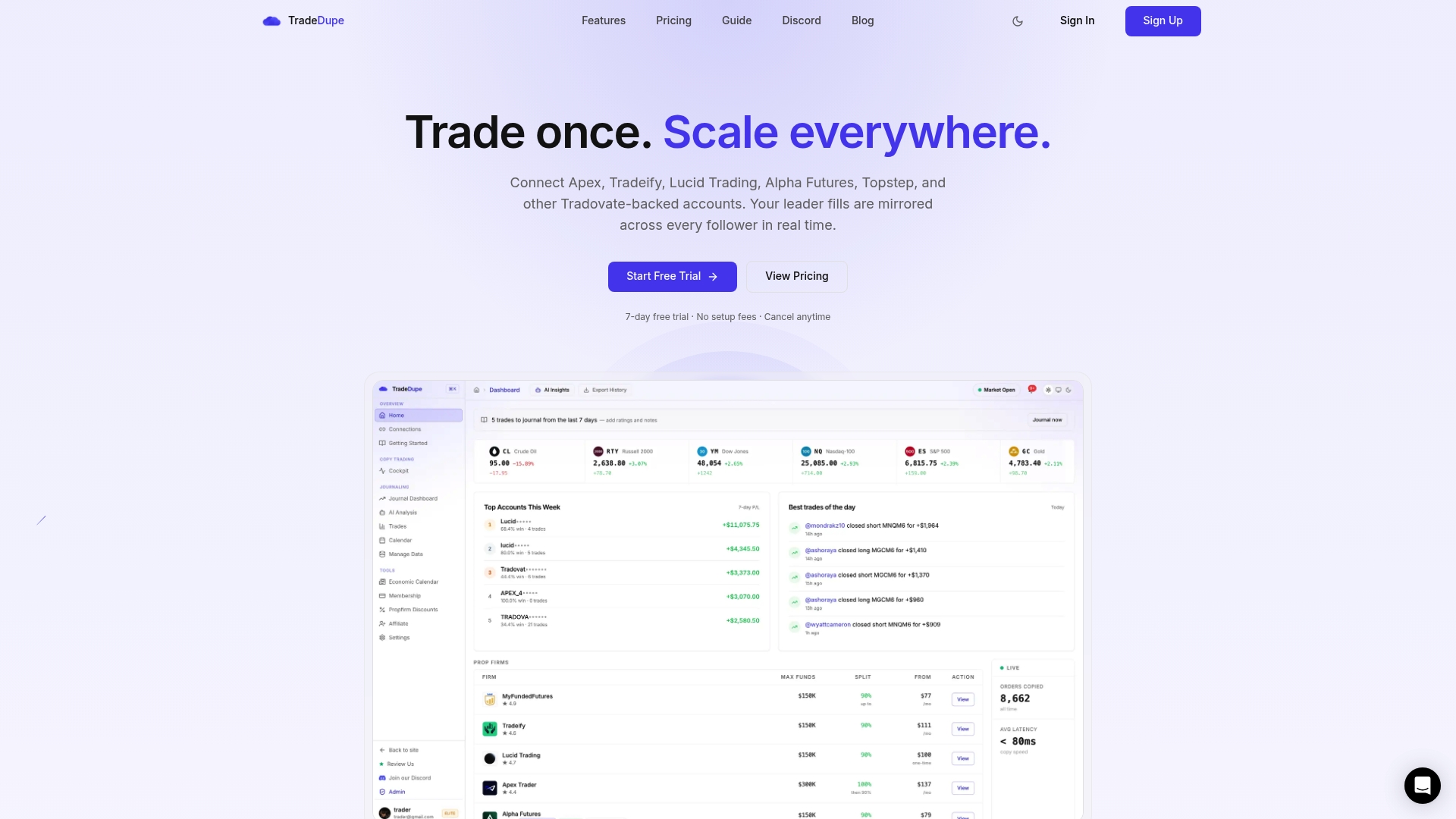
Tradedupe was built specifically for prop firm traders on Tradovate who need real-time trade mirroring that stays within firm compliance thresholds. With a median 34ms execution latency, the platform gives follower accounts enough execution speed to reliably clear minimum hold-time rules like Tradeify's 10-second requirement. The per-account toggle controls let you pause individual followers before manual interventions, eliminating the feedback loop problem. Rogue-trade detection and auto-recovery mean that connection disruptions do not silently desync your accounts for an entire session.
For traders evaluating their copy trading setup against other options, the Tradedupe vs TradeCopia comparison breaks down exactly how execution speed, synchronization reliability, and prop firm rule handling differ between platforms. The Apex copy trading integration page covers compliance-specific configuration for Apex Trader Funding accounts in detail.
FAQ
What causes the most common multi-account trading mistakes?
Most multi-account trading errors stem from operational timing issues and misconfigured technical setups rather than flawed market strategies. Latency, API mismanagement, and manual interference during auto-sync are the leading causes.
How do I avoid violating prop firm hold-time rules with a copier?
Set your internal hold-time rule well above the firm's stated minimum to absorb copier latency. If the firm requires 10 seconds, target 20 seconds as your system floor to account for network and processing delays.
Why is `AccountBalance()` dangerous in multi-position EAs?
`AccountBalance()` excludes floating profit and loss, so lot sizes do not shrink during open drawdowns. Switching to `AccountEquity()` ensures position sizing reflects actual account health in real time.
Can I connect the same account to multiple copy trading instances?
No. Connecting one account to multiple platform instances causes duplicate order events and feedback loops. Each account should connect to exactly one active instance, with API keys isolated per process.
How many accounts can I realistically manage without execution errors?
There is no universal number, but traders using automated copy trading tools with per-account controls and low-latency execution can manage five or more funded accounts reliably. The key is validating each connection individually before scaling further.