

Futures Trade Mirroring Solutions for Prop Trading Firms
TradeDupe
17 min read
Discover top futures trade mirroring solutions firms like Tradedupe. Fast, reliable, and designed for prop traders, avoid costly mistakes.
For professional prop traders managing multiple funded accounts, the right futures trade mirroring solution is Tradedupe: a Tradovate-native, prop-firm-safe platform built specifically for real-time fan-out replication across evaluation and performance accounts. Generic copy tools and DIY scripts introduce latency, orphaned positions, and audit gaps that get accounts flagged or closed. Tradedupe eliminates those failure points at the architecture level.
Three facts that matter most when evaluating any futures trade mirroring solutions firm:
- Median latency of 34 ms on Tradovate routes in production, per Tradedupe's benchmark, which keeps fills tight enough to avoid meaningful slippage across follower accounts.
- Fail-closed behavior by default: if a connection drops or an order cannot be verified, execution freezes rather than sending uncontrolled orders into follower accounts.
- Per-account multipliers and a full audit trail at the order and fill level, so every follower account carries its own sizing logic and every trade is reconcilable against prop-firm records.
> The core requirement for any production-ready mirroring stack: confirm that your platform supports Tradovate write access, a recognized datafeed such as Rithmic or ProjectX, and fail-closed behavior before signing any subscription. Everything else is a secondary feature.
*
Table of Contents
- What core features must a futures trade mirroring solution provide?
- Which broker and platform integrations should you verify before buying?
- How does the leader-to-follower replication workflow actually work?
- How do prop-firm rules affect your mirroring setup?
- What reliability benchmarks should you demand from any vendor?
- What does pricing look like for multi-account mirroring setups?
- Deployment checklist: from purchase to live production
- Key Takeaways
- The real cost of getting mirroring wrong
- Tradedupe: built for the prop desk, not the retail copier
- Useful sources for procurement and technical evaluation
What core features must a futures trade mirroring solution provide?
Production-ready trade mirroring is not the same as consumer copy trading. The gap between a SaaS platform built for prop desks and a retail signal copier shows up the moment you hit a partial fill, a rollover date, or a connection interruption. Before any RFP or vendor demo, confirm the following functional baseline.
Sizing, multipliers, and tick-aware conversion
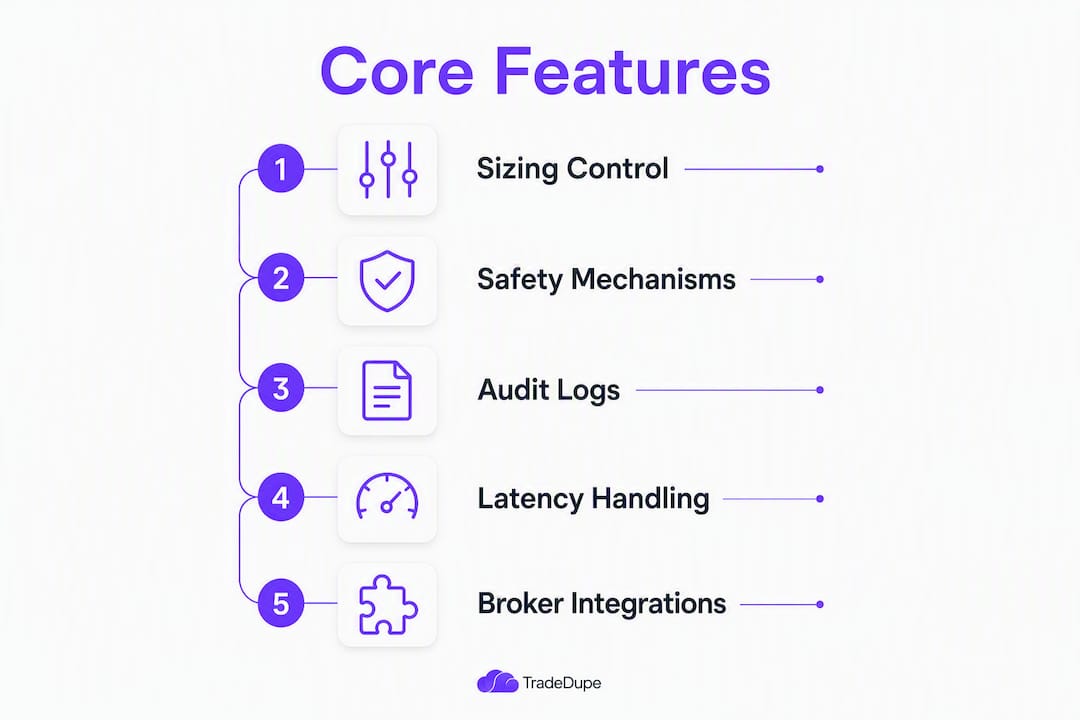
Every follower account needs its own sizing multiplier, an independent max-size cap, and tick-size-aware conversion logic. A leader trading ES at one contract must be able to fan out to followers trading MES at ten contracts, with the platform handling the 10:1 conversion automatically. Without this, a single misconfigured multiplier creates a position mismatch that violates per-account drawdown limits.

Symbol mapping and contract rollover handling are non-negotiable for futures. Quarterly expiries on ES, NQ, CL, and other liquid contracts require the platform to resolve new symbol names per follower account automatically during the transition window. Platforms built for futures include automated mapping and rollover resolution as a production feature, not an afterthought.
Safety controls and order integrity
- Fail-closed behavior: freeze execution on connection loss rather than allowing unverified orders to propagate.
- Rogue-trade detection: flag or quarantine orders that fall outside pre-set size or price parameters before they reach follower accounts.
- Duplicate protection: prevent the same signal from being executed twice during reconnection events.
- Reject quarantine: hold rejected orders in a reviewable queue rather than silently dropping them.
Tradedupe's safety architecture covers all four controls, with per-account toggle switches that let a desk operator enable or disable individual follower accounts without touching the leader.
Journaling, audit logs, and reconciliation
Order-level and fill-level journaling is what separates a compliant prop-desk tool from a retail copier. Every entry, exit, partial fill, and rejection must be logged with timestamps and account identifiers. Reconciliation against the broker's own records should be possible at any point, not just at end of day.

Deployment model and latency implications
Cloud and server-side execution eliminates the maintenance overhead of a local executable or a self-managed VPS. For a prop desk running 10 or more follower accounts, server-side deployment also removes the single point of failure that a local machine represents. The tradeoff is that you are trusting the vendor's infrastructure, which makes uptime SLAs and security controls a procurement requirement, not a nice-to-have.
| Feature | Minimum Requirement | Production Standard |
|---|---|---|
| Per-account multipliers | Independent per follower | Configurable caps + tick-aware sizing |
| Symbol mapping | Manual mapping table | Automated with rollover resolution |
| Fail-closed behavior | On connection loss | On any unverifiable order |
| Journaling | Trade-level logs | Order + fill level, exportable |
| Deployment | Cloud or VPS | Server-side with SLA |
| Scalability | 5+ followers | Unlimited broker connections |
Pro Tip: Request a sample journal export during the vendor demo. If the export does not include order IDs, fill timestamps, and per-account identifiers, it will not satisfy a prop firm's documentation request.
*
Which broker and platform integrations should you verify before buying?
Integration coverage is where most POC failures originate. A platform that mirrors trades beautifully within one broker's ecosystem may have no write access to a prop firm's evaluation accounts on a different route. Verify every link in the chain before committing.
Platforms and brokers to confirm
| Platform / Broker | Role in the Stack | Key Verification Question |
|---|---|---|
| Tradovate | Primary brokerage and API layer | Does the platform have write access to evaluation and PA accounts? |
| Rithmic | Datafeed and order routing | Is the Rithmic connection used for data, execution, or both? |
| NinjaTrader | Charting and signal source | Can NinjaTrader act as the leader signal layer? |
| TopstepX | Prop firm evaluation platform | Are TopstepX evaluation accounts supported as followers? |
| TradingView | Signal and alert source | Does the platform accept TradingView webhook alerts as leader signals? |
| ProjectX | Order routing and execution | Is ProjectX supported as an execution route for follower accounts? |
| Quantower | Charting and order management | Can Quantower connect as a leader or follower interface? |
| Sierra Chart | Advanced charting and data | Is Sierra Chart supported for signal generation? |
Tradedupe's native integration is Tradovate, which covers the majority of prop firm evaluation and performance accounts at firms like Apex, Tradeify, Lucid Trading, and Alpha Futures. For TradingView users, Tradedupe's TradingView integration allows TradingView alerts to act as the leader signal layer, routing fills into Tradovate follower accounts.
- Confirm write access for prop firm evaluation accounts specifically. Some brokers restrict API write access on evaluation tiers.
- Ask support whether symbol mapping is automatic or manual for the contracts you trade.
- Verify that the platform handles cross-broker fan-out if your desk consolidates personal, funded, and firm accounts on different routes. Cross-broker capability is critical for desks that cannot standardize on a single API.
*
How does the leader-to-follower replication workflow actually work?
The mirroring workflow has five distinct phases. Understanding each phase helps ops teams allocate setup time accurately and identify where failures are most likely to occur.
Step-by-step setup
- Connect the leader account. Authenticate the leader account with the platform using broker API credentials. Confirm that the leader account has live market access and that the platform can read open positions and pending orders.
- Add follower accounts in small batches. Start with two or three followers rather than the full account set. Authenticate each follower account and confirm write access before adding more.
- Configure per-follower multipliers and caps. Set the sizing multiplier, maximum contract size, and daily loss cap for each follower independently. For ES-to-MES conversion, set the multiplier to 10 and confirm tick-size mapping is active.
- Enable symbol mapping and rollover rules. Map leader symbols to follower symbols for every contract you trade. Confirm that rollover resolution is automatic or schedule manual updates around quarterly expiry dates.
- Run a dry-run test window. Execute test trades on the leader account with follower execution disabled or in paper mode. Verify that the platform logs the intended follower orders correctly before enabling live execution.
- Enable live execution and monitor the first 24–72 hours. Go live with the small follower batch first. Review the journal every few hours for rejects, latency outliers, and position mismatches before expanding to the full account set.
The Tradedupe getting-started guide covers this sequence in detail, including authentication steps for Tradovate accounts.
What to verify in the first 72 hours
- Latency consistency: check that median fill latency stays within the expected range across multiple sessions, not just at open.
- Reject and quarantine queue: review every rejected order to understand whether it was a sizing violation, a connectivity issue, or a symbol mismatch.
- Rollover behavior: if a contract rolls during the test window, confirm that the platform resolved the new symbol automatically on all follower accounts.
- Partial fill handling: place a test order that is likely to fill partially and verify that the platform handles the partial correctly rather than sending a duplicate for the remainder.
- P&L reconciliation: compare the leader's P&L against each follower's P&L adjusted for the multiplier. Any discrepancy beyond expected slippage indicates a fill or sizing error.
*
How do prop-firm rules affect your mirroring setup?
Prop firms enforce rules at the account level, not the strategy level. A mirroring setup that works perfectly in a personal account can trigger a violation in an evaluation account if the sizing, timing, or position handling does not match the firm's specific constraints.
Behaviors that commonly trigger violations
- Orphaned positions: a follower account holds an open position after the leader has closed, usually caused by a connection drop without fail-closed behavior. This is the most common cause of trailing drawdown violations.
- Mismatched sizing: a multiplier error or a missing tick-size conversion sends an oversized order into a follower account, breaching the per-account position limit.
- Good Faith Violations: in cash-margined accounts, trading before start-of-day buying power is settled can trigger a GFV. Prop-firm-safe platforms enforce start-of-day buying power caps to prevent this.
- Simultaneous account copying: some prop firms prohibit copying trades between their own evaluation accounts. Confirm the firm's policy before configuring internal fan-out.
Best practices for a compliant setup
- Enable fail-closed behavior as the default, not an optional setting.
- Set per-account daily loss caps in the platform that are tighter than the prop firm's stated limit, giving a buffer for slippage and fees.
- Use manual override controls to pause individual follower accounts during high-impact news events without stopping the leader.
- Keep a complete audit trail at the order and fill level. Prop firms that investigate a drawdown event will ask for timestamped order records, not just a P&L summary.
Pro Tip: Before going live, request your prop firm's written policy on automated copying and API-based execution. Some firms require disclosure; others prohibit specific configurations. A written confirmation protects you if a dispute arises.
When the prop firm requires trades to originate from its native platform, run the leader through that platform and use the mirroring tool only for fan-out to personal or firm accounts. This keeps the evaluation account's order flow clean while still automating replication across the rest of the desk.
*
What reliability benchmarks should you demand from any vendor?
Latency and failover behavior are the two reliability dimensions that matter most in production futures mirroring. Everything else, including uptime percentages and support response times, is secondary to these two.
Latency expectations for production futures mirroring
Tradedupe reports a median end-to-end copy latency of 34 ms on Tradovate routes in its production benchmark. For liquid futures contracts like ES and NQ, where a one-tick move on ES equals $12.50 per contract, 34 ms is tight enough that follower fills are functionally equivalent to the leader fill in most market conditions. Latency above 200 ms starts to introduce meaningful fill divergence during fast-moving sessions.
| Metric | Acceptable Range | Production Standard |
|---|---|---|
| Median copy latency | — | 34 ms median latency |
Tradedupe reports a median end-to-end copy latency of 34 ms on Tradovate routes in its production benchmark. | Auto-recovery time | — | Under 10 seconds | | Reject/quarantine rate | Under 2% of orders | — | | Journal completeness | Trade-level | Order + fill level |
Failover and fail-closed in practice
When a connection drops mid-session, a platform without fail-closed behavior will either attempt to re-send the last signal or leave follower accounts in whatever state they were in at the moment of disconnection. Both outcomes are dangerous. The correct behavior is to freeze execution immediately, log the disconnection event with a timestamp, and attempt auto-recovery without re-sending any unacknowledged orders.
For synthetic testing before go-live, run fan-out tests that simulate partial fills, latency spikes, and connection loss to validate reject and quarantine behavior under conditions that resemble real market stress. A vendor that cannot demonstrate this in a controlled test environment should not be trusted in production.
Acceptance criteria to request during any vendor demo:
- Measured median latency with methodology disclosed (not a theoretical minimum)
- Reject and quarantine rate from a recent production period
- Auto-recovery time from a simulated connection drop
- Sample journal export showing order IDs, fill timestamps, and per-account identifiers
Using market replay tools alongside synthetic fan-out tests gives ops teams a more complete picture of how the platform behaves across different session conditions, including gap opens and high-volatility periods.
*
What does pricing look like for multi-account mirroring setups?
SaaS pricing for futures trade mirroring solutions firms follows three common shapes. Understanding which shape a vendor uses tells you immediately how costs scale as you add accounts.
- Per-broker-connection pricing: cost scales with the number of broker API connections, regardless of how many follower accounts sit behind each connection. This model favors desks that consolidate many accounts under a single broker.
- Per-follower-account pricing: cost scales directly with the number of follower accounts. Predictable at small scale, but can become expensive for desks running 20 or more funded accounts.
- Flat-tier subscription: a fixed monthly or annual fee for a defined feature set and account ceiling. Enterprise tiers typically add SLA guarantees, priority support, audit log exports, and custom integrations.
Features that typically sit behind higher tiers include unlimited broker connections, AI-powered trade analysis, priority support with defined response times, and exportable audit logs formatted for compliance review. Trial access is standard across the industry, but confirm whether the trial includes live execution or is limited to paper trading, since paper-mode behavior does not always replicate production latency accurately.
> Budget for onboarding time, not just subscription cost. A desk migrating 15 or more funded accounts to a new mirroring platform should plan for at least one week of parallel testing before full cutover. Professional services or white-glove onboarding, available on enterprise tiers, can compress that timeline significantly — but the cost should be factored into the total first-year budget.
For enterprise buyers, the total cost of ownership includes the subscription, any professional services for initial configuration, and the internal ops time required for the first-week monitoring period. Platforms that offer server-side deployment with automated rollover handling reduce ongoing ops overhead enough to offset a higher subscription cost at scale.
*
Deployment checklist: from purchase to live production
Pre-deployment
- Inventory all accounts: list every leader and follower account with broker, account type (evaluation, performance, personal), and contract symbols traded.
- Confirm broker write access for every follower account, specifically for API-based order submission on evaluation tiers.
- Document contract symbol mappings and tick sizes for every instrument the leader trades, including the rollover schedule for the next 90 days.
- Review the prop firm's policy on automated execution and API-based copying for each funded account.
Deployment steps
- Connect the leader account and verify read access to open positions and order history.
- Add follower accounts in batches of two or three, confirming write access and symbol mapping for each batch before proceeding.
- Set per-account multipliers, max-size caps, and daily loss caps for every follower account before enabling live execution.
- Run a live-test window of at least 24 hours with a small follower batch before expanding to the full account set.
First-week monitoring
- Review the journal every session for rejects, latency outliers, and position mismatches.
- Check the quarantine queue daily and resolve any flagged orders before the next session opens.
- Confirm rollover resolution if any contracts expire during the first week.
- Define rollback criteria in advance: if reject rate exceeds a threshold or a position mismatch is detected, have a documented procedure for pausing follower execution and reconciling manually.
*
Key Takeaways
For any prop desk evaluating real-time trade mirroring, the decision comes down to three non-negotiable requirements: fail-closed behavior, per-account risk controls, and order-level auditability — and Tradedupe delivers all three natively on Tradovate.
| Point | Details |
|---|---|
| Fail-closed is non-negotiable | Any platform that does not freeze execution on connection loss will eventually create orphaned positions and drawdown violations. |
| Median latency benchmark | Tradedupe reports a median copy latency of 34 ms on Tradovate routes — this is the reference figure to compare against other vendors. |
| Symbol mapping and rollovers | Automated ES-to-MES conversion and quarterly rollover resolution must be confirmed before go-live, not discovered during a live session. |
| Audit trail depth | Order-level and fill-level journaling with exportable logs is the minimum standard for prop-firm compliance documentation. |
| Tradedupe recommendation | For Tradovate-first prop desks, Tradedupe is the production-ready choice: native integration, per-account controls, and server-side execution with SLA tiers. |
> When to choose Tradedupe: if your desk runs Tradovate accounts at Apex, Tradeify, Lucid Trading, or Alpha Futures and needs fail-closed, per-account risk controls, and a full audit trail, Tradedupe is the direct answer. If your stack is not Tradovate-based, run a POC to confirm integration coverage before committing.
*
The real cost of getting mirroring wrong
The conventional wisdom in prop trading circles is that trade mirroring is a scaling tool, something you bolt on after you have a profitable strategy. That framing misses the actual risk. Mirroring is a risk amplification mechanism first. Every orphaned position, every sizing error, every missed rollover is multiplied across every follower account simultaneously.
The desks that get into trouble are not the ones that chose the wrong multiplier on day one. They are the ones that chose a platform without fail-closed behavior because it was cheaper or easier to set up, and then discovered what "no fail-closed" means during a fast market when a connection dropped. By the time the session ended, three evaluation accounts had breached their trailing drawdown limits on positions the trader never intended to hold.
The right way to think about a futures mirroring platform is as infrastructure, not software. You would not run a trading desk on an exchange connection with no failover. The same standard applies here. Latency, fail-closed behavior, and audit depth are not premium features. They are the baseline. Any platform that treats them as upsells is telling you something important about its design priorities.
For desks that are genuinely Tradovate-first, the evaluation process is shorter than it looks. Confirm fail-closed, confirm per-account multipliers, request a sample journal export, and run a 48-hour live test with a small follower batch. If all four pass, you have your answer.
*
Tradedupe: built for the prop desk, not the retail copier
Prop traders running multiple funded accounts at Apex, Tradeify, Lucid Trading, or Alpha Futures need a mirroring platform that understands the difference between a performance account and a personal account. Tradedupe is that platform.
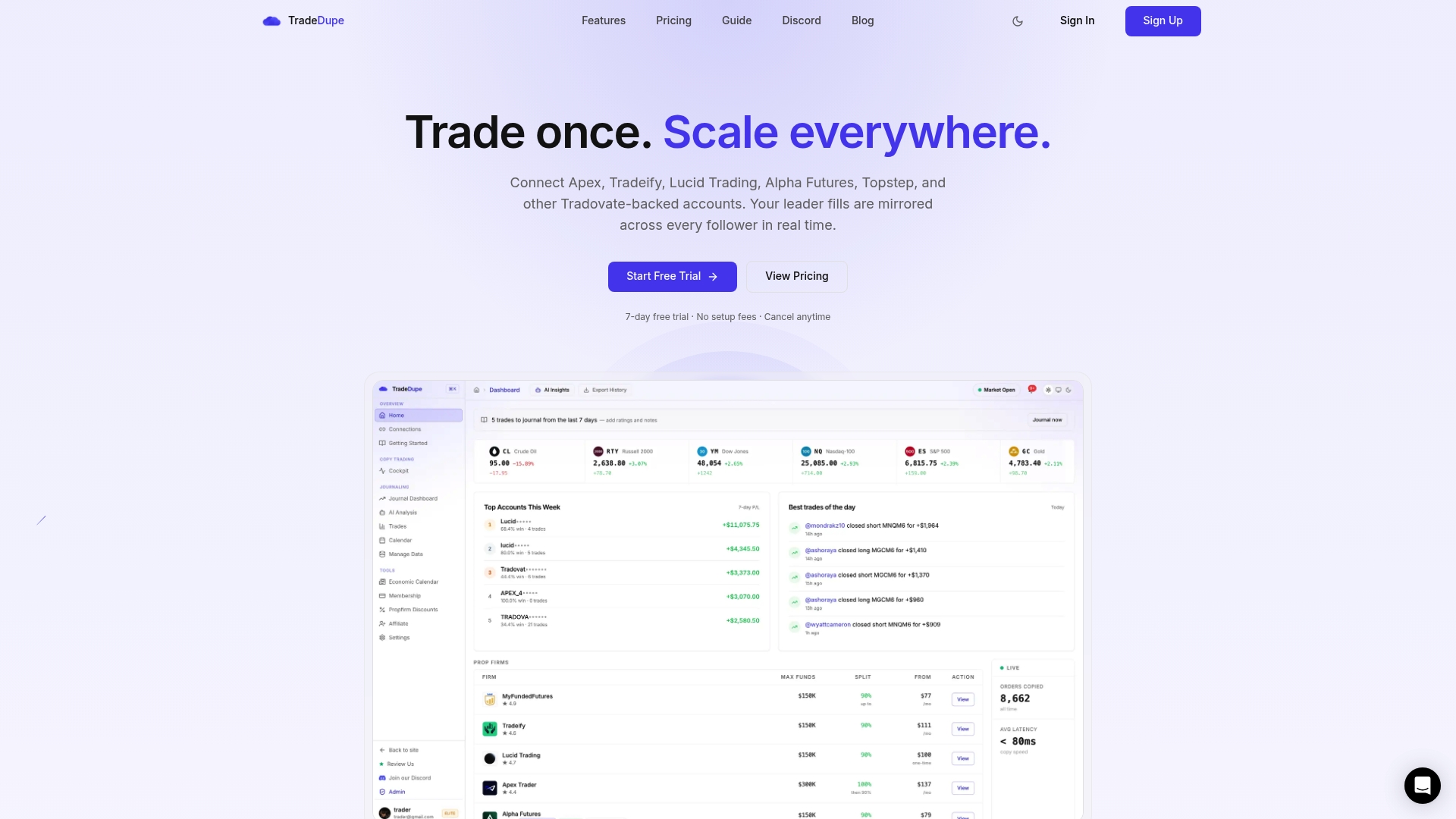
Where generic copy tools treat all accounts the same, Tradedupe gives every follower account its own multiplier, its own daily loss cap, and its own toggle control. The platform runs server-side on Tradovate, which means no VPS to maintain and no local executable to restart after a power cycle. Rogue-trade detection and auto-recovery are built into the core, not added as optional modules.
For enterprise prop desks, Tradedupe offers unlimited broker connections, AI-powered trade analysis, and priority support with defined SLA tiers. Onboarding is structured: connect accounts, configure followers, run a live-test window, and go live with a documented audit trail from day one.
The fastest path to production is a free trial through the Tradedupe platform. For larger desks, request a demo and ask specifically for latency logs, a reject-rate report from a recent production period, and a sample journal export. Those three documents will tell you everything you need to know before signing.
*
Useful sources for procurement and technical evaluation
Tradedupe internal resources:
- Futures trade copier product page and feature overview — primary reference for Tradovate integration, latency benchmarks, and trial access.
- Trade copier software technical specifications — architecture, security controls, and enterprise feature matrix.
- Getting started guide: set up Tradovate copy trading in 10 minutes — step-by-step onboarding for new accounts.
- TradingView trade copier integration — how TradingView alerts connect to Tradovate follower accounts.
- Futures trading glossary — definitions for fail-closed, fan-out, contract rollover, and other technical terms used in this article.
- Security and reliability documentation — encryption, access controls, and uptime claims.
- Best trade copier buyer's guide — comparative procurement checklist for prop desk operators.
Partner and general references:
- Mirror trading overview and risks (Investopedia) — neutral definition of mirror trading and its principal risks, useful for RFP background sections.
- NFA security futures disclosure — regulatory reference for US futures trading disclosures relevant to compliance documentation.
- Market replay for execution analysis — partner resource on replay-based testing methodology for acceptance testing.
- Long/short signal clarity guide — partner resource on leader signal validation and journal analysis.
This article provides general information about trade mirroring platforms and prop-firm workflows. It is not legal, financial, or compliance advice. Confirm current prop-firm rules, broker API terms, and regulatory requirements with the relevant firms and a qualified professional before deploying any automated trading system.