
Minimize Errors Copying Trades Manually: 2026 Guide
TradeDupe
9 min read
Discover how to minimize errors copying trades manually in 2026. This guide offers essential techniques and insights to enhance your trading accuracy.
Manual trade replication is defined as the process of duplicating positions from a lead account into one or more follower accounts by hand or with partial automation. The core challenge is that every second of delay and every procedural gap compounds into measurable capital loss. To minimize errors copying trades manually, you need three things working together: tight process controls, behavioral safeguards, and the right automation layer. This guide covers all three, with specific techniques drawn from on-chain trade data, futures process control research, and real-world prop firm workflows.
What are the main causes of errors when copying trades manually?
Execution latency is the single largest technical cause of manual copy trading errors. Analysis of 25.3 million trades shows that latency of 5–10 seconds causes 5%–15% worse entry prices on volatile assets. That price degradation directly erodes strategy edge before a single behavioral mistake enters the picture.
Beyond latency, human behavioral slips drive a second category of errors. These include:
- Impulsivity. Traders override their own rules during fast-moving sessions, entering positions outside the defined setup criteria.
- Fatigue. Cognitive load builds across a multi-account session. Missed fills, wrong contract sizes, and skipped stop placements increase as the session extends.
- Rule drift. Gradual loosening of entry criteria happens without conscious awareness, especially during drawdown periods.
- Confirmation bias. Traders evaluate signals selectively, favoring data that supports a position they already want to take.
Data quality is a third, often overlooked, cause of copy trading errors. Signal providers with fewer than 381 trades lack the statistical confidence to distinguish skill from luck. Copying a statistically insufficient signal set introduces structural error into the process from the start. Procedural gaps close the list: traders who do not log errors, track fill quality, or review execution debriefs have no feedback mechanism to catch recurring mistakes before they become costly patterns.
What process controls reduce human error in manual trade copying?
Structured process controls are the most direct way to reduce behavioral errors in manual trade duplication. The goal is to build external constraints that catch mistakes before they reach the market, rather than relying on willpower after the fact.

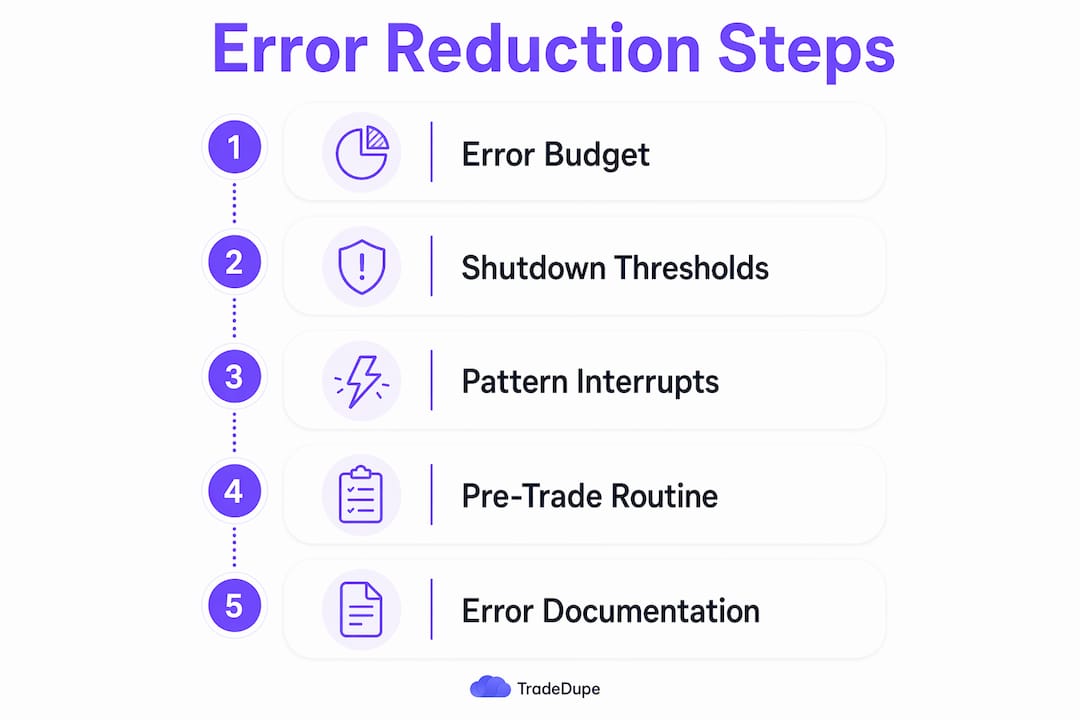
1. Implement a daily error budget.
An error budget caps the number of preventable mistakes allowed per session. Futures drawdowns are typically chains of small, avoidable errors rather than single catastrophic events. Treating error control as a budget shifts your attention from P&L to execution quality, which is the variable you can actually control in real time.
2. Set hard shutdown thresholds.
Define a specific error count or drawdown level that triggers a mandatory session stop. When you hit the threshold, you close all positions and stop trading for the day. This removes the decision from the moment of peak emotional pressure, where judgment is least reliable.
3. Use pattern interrupts throughout the session.
Repeating alarms set at regular intervals pull traders out of trance-like, impulsive states during high-volume sessions. Each alarm is a prompt to check: Am I following my rules? Am I in the right mental state to copy the next trade? This technique is particularly effective across multi-account workflows where attention splits across several positions simultaneously.
4. Run a pre-trade routine before each copy action.
A pre-trade routine is a short, repeatable checklist completed before entering any copied position. It should confirm contract size, account selection, stop placement, and signal validity. Written checklists outperform mental ones because they create a physical record of the decision.
5. Document every error explicitly.
Traders who rely on willpower alone repeat the same mistakes. Explicit capture means writing down the error type, the market condition, and the rule that was broken within minutes of the event. This raw data feeds the weekly review process described later.
Pro Tip: Set your session alarm to fire every 20 minutes. When it sounds, pause, read your top three rules aloud, and confirm your current positions match your plan before continuing.
How can automation tools aid in minimizing errors copying trades manually?
Automation removes the latency and attention gaps that make manual trade duplication error-prone at scale. Trade copier software replicates positions from a lead account to follower accounts in milliseconds, eliminating the 5–10 second manual delay that degrades entry prices on volatile instruments. The reduction in slippage alone justifies the tooling cost for any trader running more than two accounts.
Risk monitoring must operate independently from the trading engine itself. Independent watchdog processes that poll the broker API on a separate machine can flatten all positions if the primary trading engine crashes. This out-of-band architecture prevents a technical failure from becoming an uncontrolled risk event. Running risk logic on the same machine as the trading engine creates a single point of failure that no manual response can reliably cover.
Broker and exchange controls add a final protective layer. Daily loss limits at the broker level automatically flatten accounts when a defined threshold is breached, stopping error escalation without requiring trader intervention. These controls are last-resort protections, not primary risk management, but they catch the scenarios that process controls and automation miss.
The table below maps control categories to their function and failure mode:
| Control category | Primary function | Failure mode if absent |
|---|---|---|
| Pre-trade checklists | Confirm setup validity before entry | Rule drift, wrong size, missed stops |
| Trade copier software | Eliminate latency and manual fill errors | 5%–15% price degradation on volatile fills |
| Independent risk monitor | Flatten positions on engine crash | Uncontrolled exposure during technical failure |
| Broker daily loss limits | Hard stop on account drawdown | Uncapped loss during behavioral breakdown |
Pro Tip: Run your risk monitor on a separate machine or cloud instance from your trading terminal. If your primary machine freezes during a fast market, the monitor still closes positions automatically.
What steps should traders and risk managers take to audit manual trade duplication accuracy?
Auditing is the feedback mechanism that turns error data into process improvement. Without a structured review cycle, corrections are guesses rather than verified fixes.
- Weekly error pattern analysis. Review your error log every week and segment mistakes by type: latency errors, sizing errors, rule violations, and signal quality failures. Segmentation reveals which category is driving the most damage, so corrections target the right problem.
- Test one correction at a time. Change a single variable per week, then measure its impact on error frequency and fill quality. Changing multiple controls simultaneously makes it impossible to identify which adjustment produced the improvement.
- Maintain detailed execution debriefs. After each session, log entry price versus signal price, fill time, account selection accuracy, and stop placement. This granular data surfaces patterns that aggregate P&L figures hide entirely.
- Review signal provider statistics monthly. Position sizing between 2%–5% per trade, combined with a 30% stop loss threshold and monthly signal rotation, reduces the structural risk of copying an underperforming provider. Rotate providers whose performance degrades below your defined threshold rather than waiting for a full drawdown to force the decision.
- Tighten pre-entry gates based on audit findings. If the weekly review shows that 60% of errors occur in the first 30 minutes of a session, add a mandatory 30-minute observation window before copying any trades. Let the audit data reshape the process, not intuition.
The risk management benefits of systematic copy trade oversight compound over time. Each audit cycle produces a tighter process, and tighter processes produce fewer errors per session. The compounding effect on execution quality is as real as compounding returns.
Key takeaways
Minimizing manual trade copying errors requires layered controls: behavioral safeguards, independent risk monitoring, and a structured weekly audit cycle working together.
| Point | Details |
|---|---|
| Latency is the top technical error source | A 5–10 second delay causes 5%–15% worse entry prices on volatile instruments. |
| Error budgets outperform willpower | Capping preventable mistakes per session stops behavioral deterioration before capital loss escalates. |
| Risk monitors must run independently | Out-of-band watchdog processes flatten positions even when the trading engine crashes. |
| Audit one variable at a time | Testing a single correction per week reveals which change actually reduced error frequency. |
| Signal data volume matters | Providers with fewer than 381 trades lack statistical confidence, introducing structural error from the start. |
What I've learned about process discipline in multi-account trading
The most common mistake I see traders make is treating automation as a substitute for process discipline rather than a complement to it. A trade copier running at 34ms median latency eliminates the fill delay problem completely. But it does nothing for the trader who copies a position at the wrong size because they skipped the pre-trade checklist during a fast session.
The error budget concept changed how I think about session management. Counting errors instead of dollars removes the emotional charge from the review. When you hit your error cap, you stop. Not because you lost money, but because the process broke down. That reframe is harder to internalize than it sounds, and it takes deliberate practice to hold during a live session.
The other lesson that took me longer than it should have: independent risk monitoring is not optional for multi-account operations. Running your risk logic on the same machine as your trading terminal is a structural vulnerability. The day your terminal freezes during a high-volatility open is the day you find out how expensive that decision was. Separate the systems before that day arrives.
Pattern interrupts feel awkward at first. Setting an alarm every 20 minutes during a trading session seems disruptive. In practice, the alarm catches the exact moments when rule drift is happening, which is when you are most likely to copy a trade that does not meet your criteria. The discomfort is the point.
> — Andres
Tradedupe's approach to error-free trade replication
Traders managing multiple prop firm accounts across Apex, Tradeify, Lucid Trading, and Alpha Futures face the exact error sources covered in this article: latency, behavioral slips, and inadequate risk monitoring.
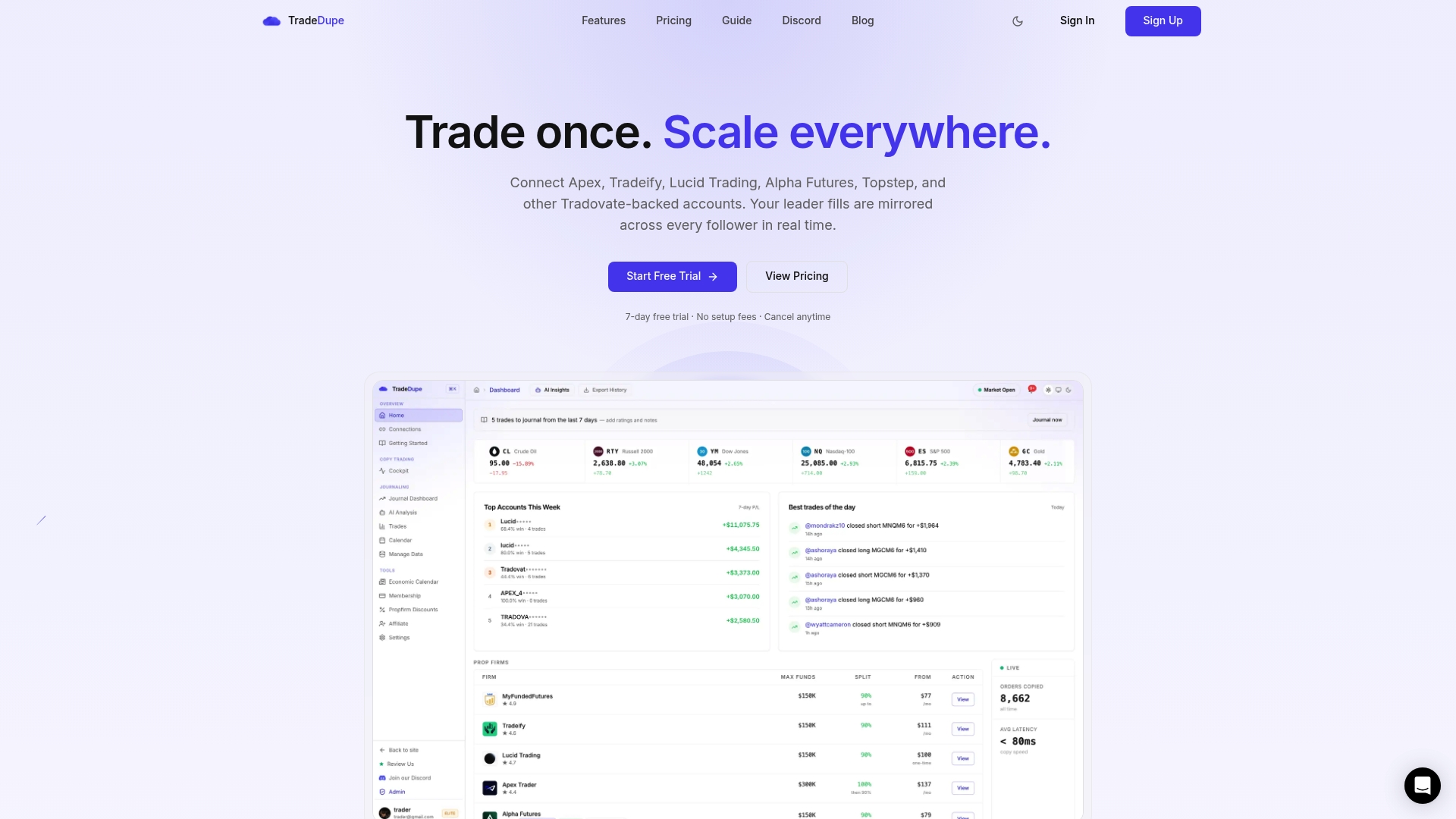
Tradedupe addresses all three at the platform level. Its desktop auth setup connects prop firm accounts directly to Tradovate with a median replication latency of 34ms, eliminating the fill degradation that manual copying produces. Rogue-trade detection and per-account toggle controls enforce risk limits without requiring manual intervention. The real-time dashboard gives risk managers a live view of sync status, leader activity, and follower positions across every account simultaneously. For traders ready to move from manual duplication to automated mirroring, the getting started guide walks through full setup in under 10 minutes.
FAQ
What is the biggest source of error when copying trades manually?
Execution latency is the primary technical error source. Analysis of 25.3 million trades shows that a 5–10 second delay produces 5%–15% worse entry prices on volatile instruments, directly eroding strategy edge.
How does an error budget reduce trading mistakes?
An error budget caps the number of preventable mistakes per session and triggers a hard shutdown when the limit is reached. This stops behavioral deterioration before it escalates into significant capital loss.
How many trades does a signal provider need before copying them is statistically valid?
Signal providers need at least 381 trades to demonstrate skill at 95% statistical confidence. Providers with fewer trades cannot reliably distinguish consistent skill from short-term luck.
Why should risk monitoring run on a separate machine from the trading engine?
If the trading engine crashes, an independent risk monitor can still poll the broker API and flatten all open positions automatically. Running both on the same machine creates a single point of failure with no recovery path.
How often should traders audit their manual trade duplication process?
Weekly error pattern analysis is the minimum effective frequency. Segmenting errors by type each week and testing one correction at a time produces measurable, verifiable improvements in copy trading accuracy.