Prop Firm Operator Scaling Best Practices (2026)
TradeDupe
10 min read
Discover prop firm operator scaling best practices to automate operations, enhance control, and drive growth without losing trader trust.
The most effective prop firm operator scaling best practice is to build automation-first operations combined with layered risk controls before you hit 500 active accounts. Manual workflows scale linearly with trader volume, which means your margins erode at exactly the moment growth should reward you. Prop trading firm strategies that survive year two share one trait: they treat operational infrastructure as a product, not an afterthought. This guide covers the core scaling methods operators need to grow trading operations without losing control of capital, compliance, or trader trust.
1. Why automation is the foundation of scaling trading operations
Automation is the single most important lever for scaling a prop firm without proportionally increasing headcount. Manual operations scale linearly with traders, meaning 1,000 active accounts require roughly five operations staff managing KYCs, provisioning, and payouts. That headcount cost destroys the margin model that makes prop firms viable.

The fix is end-to-end automation across every repeatable workflow. Top platforms deliver onboarding in under 60 seconds from payment clearing to credential delivery. That speed reduces churn from frustrated traders who abandon slow sign-up flows.
Key workflows to automate before you scale:
- KYC verification with configurable policy rules per jurisdiction
- Account provisioning triggered automatically on payment confirmation
- Rule enforcement for daily loss limits, max drawdown, and profit targets
- Payout processing with automated approval thresholds and reserve deductions
- Dispute flagging to route chargebacks before they become operational fires
Pro Tip: Choose automation solutions that allow flexible KYC policies and multiple payment integrations. Locking into a single provider creates a single point of failure at exactly the wrong time.
Operators who automate these five workflows before reaching 500 active accounts can grow to 10,000 traders with minimal additional ops headcount. Those who don't will hire their way into unprofitability.
2. How layered risk management controls protect your capital at scale
A real-time risk engine is the most operationally critical layer in any prop firm's tech stack. The risk engine evaluates drawdowns on every tick, enforces rules automatically, and escalates exposures before they become realized losses. Any lag in that enforcement converts controlled risk into a solvency threat.
Effective risk management at scale uses a hybrid A-book and B-book routing model. New accounts default to a B-book simulated environment. After a trader demonstrates sustained performance above defined thresholds, the system promotes them to A-book hedging with a live liquidity provider. This approach limits your real capital exposure to a small subset of your total trader base.
Exposure caps must be layered across multiple dimensions to keep open payout risk at manageable, budgeted levels:
| Risk Layer | What It Controls |
|---|---|
| Per-account daily loss | Caps individual trader drawdown each session |
| Per-symbol exposure | Limits concentration in single instruments |
| Cohort-level cap | Aggregates risk across similar account groups |
| Payout reserve | Reserves 20–30% of fee revenue for funded liabilities |
| Anomaly detection | Flags coordinated abuse, copy clusters, and account fleets |
Treating evaluation fees as immediate revenue is one of the most common and costly operator mistakes. Best practice is to book payout reserves of 20–30% against future funded account liabilities. That reserve accounting gives you an accurate picture of actual profitability, not an inflated one.
3. Best practices for operational runway and payment redundancy
Financial runway is not a nice-to-have. Operators need 3–6 months of runway to cover support costs, payouts, marketing, and dispute resolution before consistent net cash flow arrives. Launching with less than that forces reactive decisions under pressure, which is where operational mistakes compound.
Payment processing is the most fragile part of a prop firm's infrastructure. Chargeback rates of 5–15% on challenge fees are realistic. That range needs to be modeled into your fee revenue assumptions from day one, not discovered after the fact.
Build payment redundancy before you need it:
- Maintain at least two active payment service providers with different acquiring banks
- Activate crypto payout channels as a backup to mitigate sudden processor terminations
- Negotiate separate merchant accounts for challenge fees and funded account payouts
- Model dispute costs into your unit economics before setting challenge fee prices
Pro Tip: Write clear, non-refundable terms into your challenge agreements and display them prominently at checkout. Operators who do this consistently report lower chargeback volume because the terms remove ambiguity that drives disputes.
Payment processor termination is not a hypothetical risk. Prop firms have lost access to processing overnight with no warning. Operators who treat redundancy as optional find out the hard way that it isn't.
4. Scaling trader onboarding and multi-account management
Trader onboarding speed directly affects conversion rates and first-impression trust. Automated account provisioning integrated with your trading platform removes the manual bottleneck between payment and first login. For operators running accounts on Tradovate, multi-account trading management becomes a core operational competency as account volume grows.
Performance threshold gating is the right model for promoting traders from evaluation to funded status. The system should enforce this automatically, without human review, using defined criteria: profit target hit, daily loss never breached, consistency rule met. Manual review at this stage creates delays and inconsistent decisions.
Effective multi-account management at scale requires:
- Real-time dashboards showing each account's sync status, rule compliance, and payout eligibility
- Trade copying and account mirroring to replicate a verified strategy across multiple funded accounts simultaneously
- Per-account toggle controls to pause, resume, or restrict individual accounts without affecting the broader pool
- Analytics reporting to identify consistent traders, flag rule violations, and review enforcement patterns over time
Automated workflows that detect account fleets, copy trading clusters, and coordinated abuse protect your capital and enforce fair play at scale. Without these controls, bad actors exploit multi-account structures to extract payouts that your risk model never priced in.
Trader transparency also matters for retention. Operators who give traders clear dashboards showing their progress, rule status, and payout timeline see better engagement and fewer support tickets. Transparency reduces friction and builds the trust that keeps funded traders active on your platform. You can review prop firm consistency rules to understand how rule clarity affects trader behavior at scale.
For operators evaluating the broader prop firm market, comparing top prop firms in 2026 reveals how leading operators structure their evaluation tiers and payout models, which informs your own competitive positioning.
5. Infrastructure investment: build for year two, not year one
A lean white-label prop firm setup costs $5,000–$15,000 with a 2–4 week deployment timeline. A custom main-label build runs $50,000 or more and takes six months or longer. The cost difference is significant, but the more important variable is whether the infrastructure you choose can handle the scale you plan to reach.
Build your tech stack for the account volume you expect in 18 months, not the volume you have today. Operators who build for current size hit operational breakpoints at 500 active accounts and face expensive mid-flight rebuilds. That disruption affects trader experience, payout reliability, and firm reputation simultaneously.
The infrastructure checklist for year-two readiness:
- Risk engine capable of real-time enforcement across 10,000+ concurrent accounts
- Automated KYC with configurable rules for multiple jurisdictions
- Payout system with reserve accounting built into the ledger
- Payment processing with at least two active providers and crypto backup
- Monitoring and alerting for anomaly detection, rule violations, and exposure spikes
Successful firms build infrastructure to match their year-two scale goals, not their current size. That forward-looking approach is what separates operators who grow sustainably from those who scale marketing into an operational collapse.
Key takeaways
Prop firm operators who build automation-first infrastructure and layered risk controls before reaching 500 active accounts are the ones who scale without losing margin, capital, or trader trust.
| Point | Details |
|---|---|
| Automate before 500 accounts | Manual workflows erode margins; automate KYC, provisioning, and payouts early. |
| Layer risk controls | Use per-account, per-symbol, cohort, and reserve caps enforced in real time. |
| Plan 3–6 months runway | Cover support, payouts, and disputes before consistent cash flow arrives. |
| Build payment redundancy | Maintain two PSPs with different acquiring banks plus crypto backup channels. |
| Build for year two | Size your infrastructure for 18-month scale goals, not current account volume. |
What I've learned watching prop firms scale and stall
The operators I've seen fail in year two almost always made the same mistake: they scaled their marketing before they scaled their operations. They had great challenge products, strong trader communities, and real revenue. Then they hit 600 active accounts and the wheels came off. Support queues backed up. Payouts got delayed. Traders posted about it publicly. The firm spent the next six months in damage control instead of growth mode.
The uncomfortable truth is that prop firm growth is an operational problem disguised as a marketing problem. Most operators focus on acquisition because it's visible and measurable. Infrastructure work is invisible until it fails.
The firms that scale well treat their risk engine like a trading system: they test it, stress it, and monitor it continuously. They don't assume it works because it worked yesterday. They run payout stress tests quarterly. They review chargeback patterns monthly. They audit rule enforcement logs to catch edge cases before traders find them.
Automation is not just about efficiency. It's about consistency. A human reviewing 200 payout requests will make different decisions on request 1 and request 180. An automated system applies the same rule every time. That consistency is what builds trader trust, and trader trust is what drives referrals and retention.
My strongest advice: build the infrastructure you need for the firm you want to run in two years. The cost of building it early is a fraction of the cost of rebuilding it mid-scale under pressure.
> — Andres
How Tradedupe supports prop firm operators managing multiple accounts
Prop firm operators running accounts on Tradovate need a futures trade copier that works at the speed and reliability that scaling demands. Tradedupe mirrors trades from a single leader account to multiple follower accounts with a median latency of 34ms, which means your funded traders execute in near-lockstep with your lead strategy.
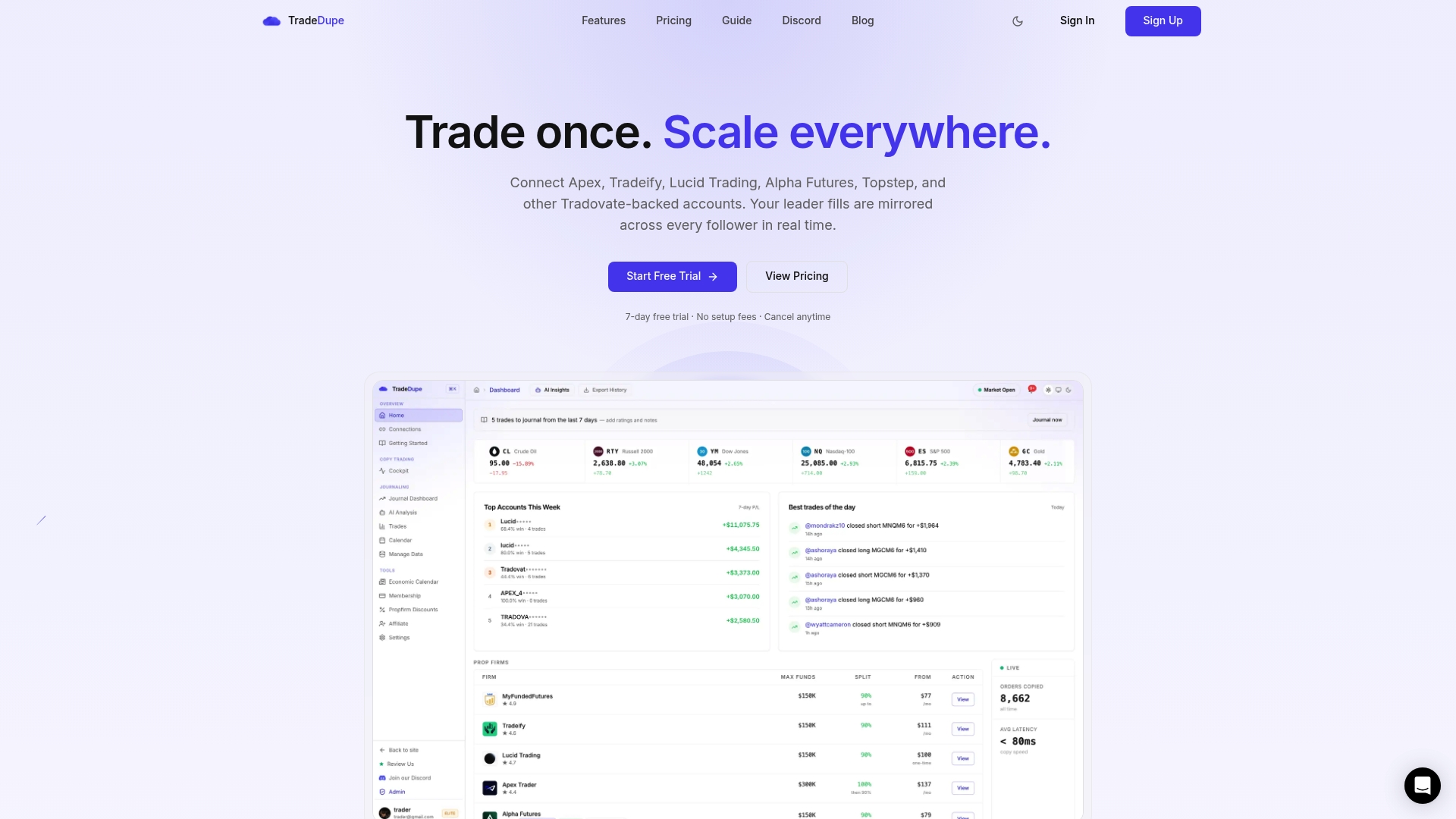
Tradedupe integrates directly with Apex, Tradeify, Lucid Trading, and Alpha Futures accounts, covering the major prop firm ecosystems where operators run multi-account setups. The platform includes rogue-trade detection, auto-recovery, and per-account toggle controls so you maintain precise control over every account in your pool. For operators ready to put these scaling practices into action, Tradedupe's copy trading platform is built specifically for the Tradovate ecosystem and the operational demands of running accounts at scale.
FAQ
What is the most important prop firm operator scaling best practice?
Automating KYC, account provisioning, rule enforcement, and payout processing before reaching 500 active accounts is the single most critical practice. Manual operations scale linearly with trader volume and destroy margins at growth stage.
How much financial runway does a prop firm operator need?
Operators need 3–6 months of runway to cover support, payouts, marketing, and dispute costs before consistent net cash flow arrives. Launching with less forces reactive decisions that compound operational risk.
What is the A-book vs B-book approach for prop firm risk management?
New accounts default to a B-book simulated environment, and the system promotes traders to A-book live hedging only after they meet sustained performance thresholds. This limits real capital exposure to a small, proven subset of your trader base.
How many payment providers should a prop firm maintain?
Operators should maintain at least two active payment service providers with different acquiring banks, plus crypto payout channels as a backup. Sudden processor termination is a real operational risk, and redundancy prevents it from stopping payouts entirely.
How do prop firms detect and prevent multi-account abuse at scale?
Automated workflows that flag account fleets, copy trading clusters, and coordinated payout extraction are the standard defense. Without these controls, bad actors exploit multi-account structures to extract payouts that the firm's risk model never priced in.