
Prop Firm Trader Onboarding Checklist for 2026
TradeDupe
11 min read
Streamline your success with this prop firm trader onboarding checklist. Follow essential steps for a smooth trading experience in 2026.
A prop firm trader onboarding checklist is a structured sequence of steps designed to verify identity, establish compliance, set risk parameters, and prepare traders for funded account operations. Skipping or rushing any step creates downstream problems: failed evaluations, frozen accounts, or disqualification for rule violations. This guide covers every critical stage of the trading firm onboarding process, from KYC document submission to platform readiness and daily rule review. Whether you are completing your first prop firm challenge or managing multiple funded accounts, this checklist gives you a clear, repeatable framework to follow.
1. Complete identity verification before anything else
Identity verification is the first gating step in every prop firm onboarding process. Without it, no credentials are issued and no trading begins. Automated KYC typically completes within 24 hours when documents are high quality. Manual review adds 1–3 business days when documents fail quality checks.
The most common causes of delay are avoidable:
- Government-issued ID: Submit a passport or national ID with all four corners visible, no glare, and no cropping.
- Proof of address: Provide a bank statement or utility bill dated within the last 90 days. The name and address must match your registration exactly.
- Document file size: Keep files under 5MB and submit unedited originals. Compressed or filtered images trigger manual review flags.
- Selfie verification: Some firms require a live selfie matched against your ID photo. Use good lighting and a plain background.
Sanctions and Politically Exposed Person (PEP) screening runs automatically alongside document review. This check compares your identity against global watchlists maintained by bodies like OFAC and the Financial Action Task Force (FATF). Firms with ongoing monitoring repeat this check periodically, not just at onboarding.
Pro Tip: Avoid logging in through a public or free VPN during onboarding. IP mismatches between your registration location and your access point trigger compliance alerts and can freeze your account before you place a single trade.

2. Document firm-specific risk parameters before trading
Every prop firm publishes its own risk rules. Reading them once is not enough. You need to document them and build your personal limits around them before your first trade.
Typical prop firm evaluation targets run 8–10% profit over 30–60 days, with a maximum drawdown of 10–12%. These are firm maximums, not personal targets. Set your own daily stop loss at roughly 60% of the firm's maximum to create a buffer against bad days.
Work through this list before funding your account:
- Write down the firm's exact daily loss limit and max drawdown in dollar terms, not percentages.
- Calculate your personal daily stop at 60% of the firm's daily loss limit.
- Confirm whether drawdown is calculated on the starting balance, peak balance, or end-of-day balance.
- Note the minimum and maximum number of trading days required.
- Record the profit target in dollar terms for each phase.
Pro Tip: Treat your first funded trade as a live execution, not a platform test. All platform testing belongs on a demo account before funding. The moment real capital is involved, every trade counts toward your evaluation metrics.
3. Set up position sizing with fixed equity percentages
Position sizing is the mechanical link between your risk rules and your actual trade execution. Position size should be a fixed percentage of current equity, typically 0.5–1%, recalculated after each session. This keeps risk consistent as your account balance changes during the evaluation.
A trader running a $100,000 funded account at 1% risk per trade exposes $1,000 per position. If the account grows to $105,000, the next trade risks $1,050. This automatic adjustment prevents overexposure after a winning streak and underexposure after a drawdown. Build a simple spreadsheet or use your trading journal to recalculate this number every morning before the session opens.
For a practical framework on building these calculations into your daily workflow, the risk management workflow guide from Funding Optimal covers the step-by-step process in detail.
4. Test platform parameters before the first live session
Platform errors during a funded evaluation are not excused. A stop-loss that does not trigger at the right level, or a symbol suffix mismatch, can cause a rule violation that ends your challenge. Test every parameter on a demo account that mirrors your funded account settings exactly.
Check these platform elements before going live:
- Server time: Confirm the broker's server time zone and align your session filters to it, not your local time.
- Symbol suffixes: Some brokers append suffixes to instrument names (e.g., "NQ" vs. "NQU26"). Verify the exact symbol your firm uses.
- Stop-loss and take-profit behavior: Test that orders trigger at the correct price, including during fast markets.
- Order types: Confirm whether the firm allows market orders, limit orders, or both.
- Slippage tolerance: Understand typical slippage on your instruments during high-volume periods.
News filters blocking high-impact economic events reduce drawdown risk from unexpected volatility. Apply a daily economic calendar filter and mark out events like Non-Farm Payrolls, FOMC decisions, and CPI releases. Many firms prohibit trading within a defined window around these events.
5. Build and maintain a detailed trading journal
A trading journal is not optional for prop firm traders. It is a compliance and performance tool. Journaling tracks risk usage, drawdown status, and rule adherence in real time, giving you evidence of disciplined trading during any firm review.
Your journal should record the following for every session:
- Opening account balance and current drawdown status
- Trades taken, including entry, exit, size, and outcome
- Daily profit or loss in dollar terms and as a percentage of the account
- Rule checks completed before and after the session
- Notes on any deviations from your trading plan
Journals also reveal patterns that raw P&L data hides. A trader who wins 60% of trades but consistently overrides their stop-loss on losing trades will see that pattern in a journal before it causes a catastrophic drawdown. For practical risk management examples that translate directly into journal entries, Funding Optimal's resource covers common scenarios prop traders face.
6. Review and internalize all firm trading rules
Rule violations are the leading cause of evaluation failure. Traders must document all firm rules, including consistency requirements, profit caps, and prohibited strategies, before placing a single trade. Reading the rulebook once is not sufficient. Daily pre-session review is the standard practice among traders who pass consistently.
Key rules to verify and document:
- Consistency rule: Many firms cap the maximum profit from any single trading day as a percentage of total profits. Exceeding this cap can void your payout even if you hit the profit target.
- Prohibited strategies: Confirm whether the firm bans news trading, martingale strategies, grid trading, or copy trading from external signals.
- Re-entry rules: Some firms restrict how quickly you can re-enter a position after closing it.
- Scaling conditions: Understand exactly what triggers an account size increase and what compliance steps accompany it.
- Payout structure: Verify the profit split percentage, payout frequency, and any minimum balance requirements before requesting a withdrawal.
Pro Tip: Keep a printed or pinned digital copy of the firm's current rulebook as your daily reference. Firms update rules periodically. Prop firm rules can change between evaluation phases, so verify you are reading the most current version before each new phase begins.
7. Automate compliance gating to prevent process gaps
Manual compliance processes do not scale. Manual compliance fails above 100 traders monthly, creating regulatory gaps that automated systems prevent. For individual traders, the equivalent risk is relying on memory to track rule adherence instead of using structured tools.
Automated workflows that combine KYC verification, AML screening, and compliance reporting remove human error from the process. Automated platforms integrating KYC, AML screening, and compliance reporting maintain regulatory adherence without manual intervention at each step. Traders benefit from this at the firm level when credentials are issued automatically after payment clears, and at the personal level when their own tracking tools flag rule proximity before a violation occurs.
> Delays in credential delivery cause high trader abandonment. Immediate credentialing after payment builds trust and keeps traders engaged. When delays are unavoidable, clear status communication prevents frustration and drop-off.
The same principle applies to your personal onboarding setup. Use calendar reminders, rule-check templates, and automated journal prompts rather than relying on manual memory. The traders who complete evaluations consistently are the ones who systematize their compliance, not the ones who rely on discipline alone.
8. Verify account scaling and post-funding compliance steps
Passing the evaluation is not the end of the onboarding process. It is the beginning of a new compliance phase. Scaling a prop firm account requires meeting specific performance benchmarks while maintaining the same rule adherence standards from the evaluation.
Confirm these items before and after funding:
- Scaling triggers: Know the exact profit percentage and consistency metrics required to qualify for an account increase.
- Payout request process: Understand the steps, timing, and documentation required to request your first payout.
- Rule continuity: Confirm whether funded account rules differ from evaluation rules. Some firms apply stricter drawdown limits post-funding.
- Multi-account policies: If you plan to run multiple funded accounts, verify the firm's policy on simultaneous positions and correlated trades.
For traders managing multiple funded accounts across platforms like Apex, Tradeify, or Lucid Trading, prop firm consistency rules vary significantly between firms. Document each firm's rules separately and never assume they match.
Key Takeaways
A complete prop firm trader onboarding checklist covers identity verification, risk documentation, platform testing, rule internalization, and compliance automation before the first trade is placed.
| Point | Details |
|---|---|
| Identity verification first | Submit unedited documents under 5MB with all four corners visible to avoid manual review delays. |
| Set personal risk buffers | Cap your personal daily stop at 60% of the firm's maximum to protect against rule violations on bad days. |
| Test the platform on demo | Verify symbol suffixes, stop-loss behavior, and server time before any live execution. |
| Journal every session | Track drawdown status, rule checks, and trade outcomes daily to maintain compliance evidence. |
| Automate compliance tracking | Use structured tools and templates instead of memory to prevent rule violations as accounts scale. |
Why most traders fail onboarding before they ever trade
The traders I see struggle most with prop firm onboarding are not the ones who lack trading skill. They are the ones who treat onboarding as a formality rather than a discipline. They skim the rulebook, skip the platform test, and assume their instincts will catch compliance issues in real time. They do not.
The consistency rule is the most underestimated trap in prop trading. A trader can hit the profit target and still fail the evaluation because one exceptional day exceeded the firm's single-day profit cap. That rule is buried in the fine print of most firm agreements, and traders who do not document it before trading discover it only after the damage is done.
My honest view is that the onboarding checklist is where your trading discipline is actually tested, not the market. Anyone can follow a setup in a trending market. The traders who build durable prop trading careers are the ones who treat every compliance step with the same rigor they apply to their entries and exits. The checklist is not bureaucracy. It is the foundation your funded account stands on.
Rules also change. Firms update their policies between evaluation phases, and traders who rely on a rulebook they read six months ago get caught by amendments they never saw. Build a habit of verifying the current rulebook at the start of every new phase. That single habit prevents more evaluation failures than any trading strategy adjustment.
> — Andres
Tradedupe makes multi-account compliance manageable
Managing compliance across multiple funded accounts multiplies the complexity of every checklist item. Tradedupe is built for exactly this scenario.
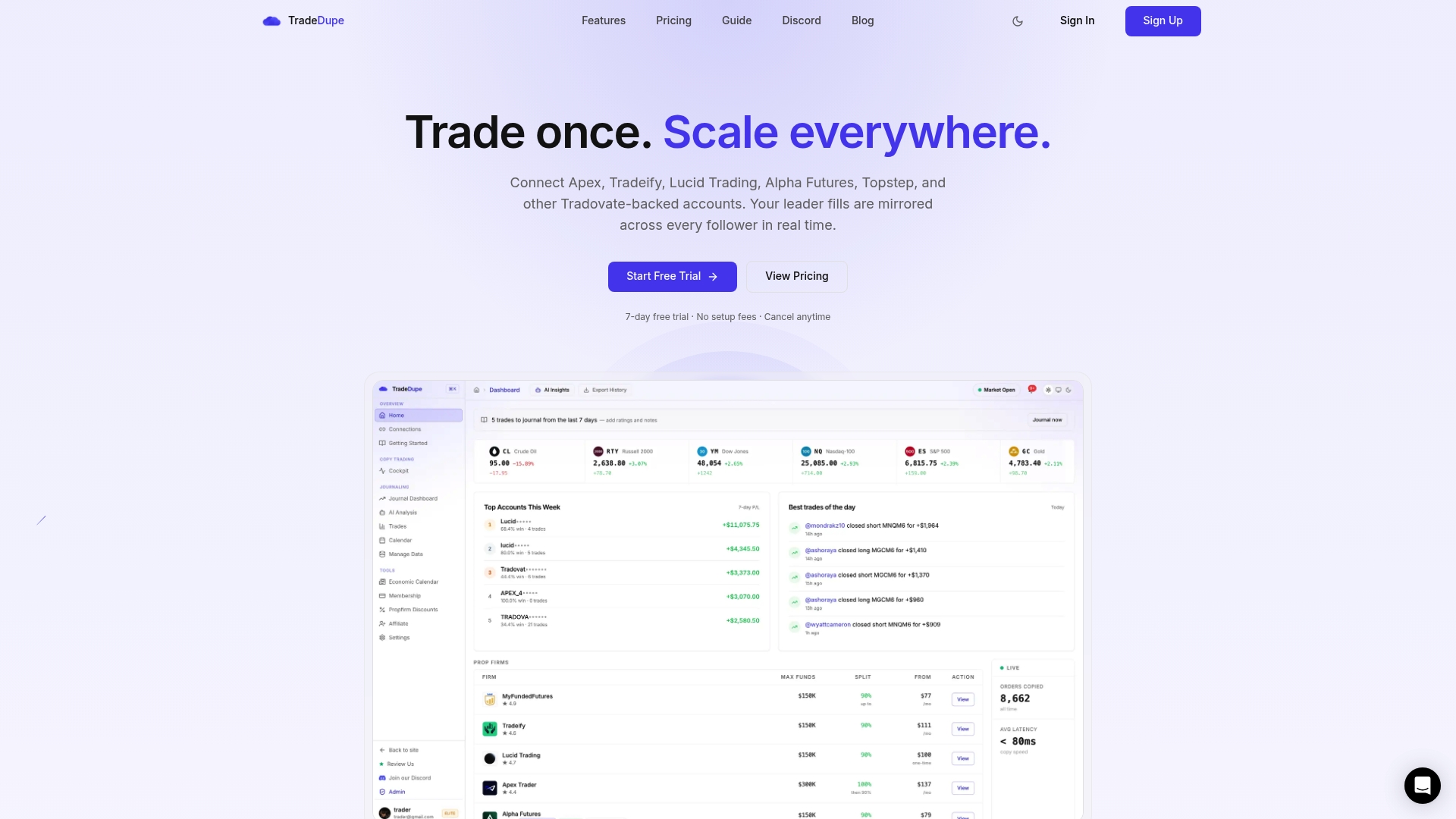
Tradedupe's platform mirrors trades from a single lead account to multiple follower accounts on Tradovate with a median latency of 34ms. It supports funded accounts from Apex, Tradeify, Lucid Trading, and Alpha Futures, with rogue-trade detection and per-account toggle controls that keep each account within its specific rule boundaries. The futures trade copier handles real-time sync so you can focus on execution rather than manual account management. For traders ready to set up their first mirrored workflow, the getting started guide walks through the full configuration in under 10 minutes.
FAQ
What documents does prop firm KYC require?
Most prop firms require a government-issued photo ID and a proof-of-address document dated within 90 days. Both must be unedited originals with all four corners visible and file sizes under 5MB.
How long does prop firm onboarding verification take?
Automated KYC completes within 24 hours for high-quality document submissions. Manual review adds 1–3 business days when documents fail initial quality checks.
What is the consistency rule in prop trading?
The consistency rule caps the maximum profit a trader can earn in a single day as a percentage of total profits. Exceeding this cap can void a payout even when the overall profit target is met.
Why does VPN use cause compliance issues during onboarding?
Prop firms monitor IP addresses during onboarding and trading. A mismatch between your registered location and your access IP triggers a compliance alert and can result in an account freeze.
How should traders track rule adherence during an evaluation?
A daily trading journal recording drawdown status, rule checks, and session outcomes provides both a compliance record and a performance reference. Structured templates work better than memory-based tracking for multi-account traders.
Recommended
- How to Trade Prop Firms (2026): A Practical Playbook to Pass and Keep a Funded Account | TradeDupe Blog
- What Happens After You Get Funded? Scaling a Prop Firm Account the Right Way | TradeDupe Blog
- Prop Firms With No Consistency Rule (2026): The Honest List
- Prop Firm Consistency Rule Guide (2026): Topstep, Apex, Tradeify, MFFU Rules Explained | TradeDupe Blog