
Reverse Copy Trading: A Practical 2026 Strategy Guide
TradeDupe
11 min read
Discover how reverse copy trading can turn losing strategies into profits. Our practical guide for 2026 reveals key techniques and risks.
Reverse copy trading is defined as automatically executing trades in the exact opposite direction of a lead account, turning a consistently losing signal source into a potential profit engine. Also called fade trading or inverse copy trading, this approach flips the standard copy trading model on its head. Instead of following a winning trader, you systematically bet against a losing one. The logic is mathematically sound in theory, but the execution demands far more discipline than most traders expect. This guide covers the mechanics, the real risks, and the portfolio practices that separate profitable application from costly mistakes.
What is reverse copy trading and how does it work?
Reverse copy trading involves automatically executing trades opposite to a lead account's trades, exploiting consistent negative expectancy from losing traders or bots. When the lead account goes long, your account goes short. When the lead closes, you close. The entire process runs through a trade copier configured for inversion, with no manual intervention required.
The mathematical premise is straightforward. If a signal source loses on 60% of its trades, inverting every trade should theoretically produce a 60% win rate on your end. That edge sounds compelling. The problem is that raw win rate inversion ignores the actual dollar amounts at stake. A losing trader might win small and lose big, which means inverting their trades gives you the opposite: small wins and large losses.

Net expectancy after costs is the real metric. Spreads, commissions, and slippage apply to every trade regardless of direction. A signal source must show consistent negative expectancy across multiple market cycles, not just a bad month, before inversion becomes viable. The ideal candidate is a bot or trader with a structurally flawed strategy that loses predictably in both trending and ranging markets.
Identifying a valid signal source for inversion
Not every losing trader qualifies as a good inversion target. The signal source must meet specific criteria:
- Consistent losses across market cycles, not just a single regime or drawdown period
- Low variability in loss size, meaning the losing trades are relatively uniform rather than occasional catastrophic blowups
- High trade frequency, so the statistical edge has enough samples to express itself
- Losses that survive cost analysis, meaning the negative expectancy remains negative even after you subtract your own trading costs
A trader who loses because of poor timing in trending markets may become profitable when volatility shifts. That regime change would flip your inverse edge into a loss. Selectivity at the source identification stage is the single most important filter in this entire strategy.
Pro Tip: Run at least 200 trades of historical data through a cost-adjusted expectancy calculation before committing capital to any inversion signal. A sample size below 100 trades is statistically unreliable.
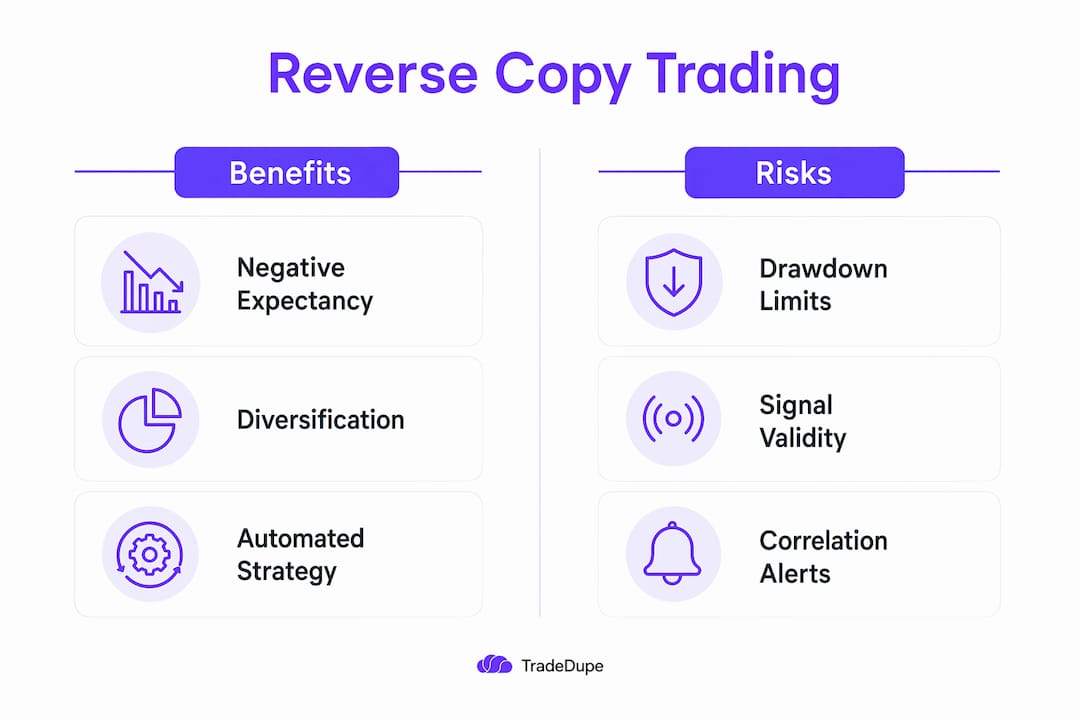
What are the risks and limitations of reverse copy trading?
The biggest misconception about inverse copy trading is that it is a free lunch. High win-loss ratios alone do not guarantee reverse copy profitability. Total net profitability after costs determines success, and those costs are relentless.
The core risks break down into six categories:
- Trading costs: Every inverted trade carries spreads, commissions, and slippage. These costs reduce or eliminate the theoretical edge, especially on high-frequency signal sources with thin margins.
- Market regime shifts: Reverse copy trading requires constant re-evaluation because a consistent loser in one market regime can become a winner when conditions change, negating your inverse edge entirely.
- Rarity of valid targets: Truly consistent losing strategies are uncommon. Most losing traders lose erratically, which makes inversion unreliable.
- Prop firm compliance: Trading firms monitor negative correlation between accounts, and a Pearson correlation coefficient of -0.95 or lower triggers the same risk flags as +0.95. Prop firms treat strong inverse trade repetition as group trading violations. If you run reverse strategies inside a prop firm account, review the copy trading compliance rules for your specific firm before proceeding.
- Overfitting risk: Identifying a losing strategy from historical data and then trading it live is a form of curve fitting. Past losses do not guarantee future losses.
- Monitoring burden: This is not a set-and-forget system. Dynamic evaluation is mandatory, and failure to adapt when conditions change can reverse expected profitability.
Understanding why trading strategies fail at a structural level helps you identify which losing signals are genuinely exploitable versus which ones are just going through a rough patch.
Pro Tip: Set a hard unfollow rule before you start. If the inverted signal produces a drawdown exceeding 10% of allocated capital, stop copying immediately and re-evaluate the source.
How to implement reverse copy trading with portfolio and risk management
Practical implementation requires a structured approach to capital allocation, position sizing, and ongoing oversight. Winging it with a single inverted signal and full account exposure is how traders blow up.
Follow these steps to build a disciplined inverse copy trading setup:
- Allocate 8%–15% of your portfolio per signal source. Professional traders in copy trading portfolios allocate 8% to 15% per trader across 6 to 8 signal sources. That diversification prevents any single bad signal from causing serious damage.
- Cap maximum exposure at 25% per trader. Even if a signal looks exceptional, hard-cap your exposure. Concentration risk in inverse strategies is especially dangerous because regime shifts can happen without warning.
- Use Kelly-adjusted position sizing. Kelly-adjusted math and mechanical stop conditions improve copy trading performance and preserve capital. A fractional Kelly approach (typically 25%–50% of full Kelly) reduces variance while maintaining the edge.
- Combine inverse and standard copy trading signals. Running both directions across different signal sources creates a natural hedge. When one regime favors standard copying, the other may favor inversion.
- Configure your copier with custom lot sizing and symbol mapping. These features let you scale position sizes independently of the lead account and remap instruments when the inverse trade requires a different symbol.
- Set mechanical stop conditions. Define drawdown limits, strategy drift thresholds, and unfollow triggers before you go live. Document them. Follow them without exception.
The table below summarizes recommended allocation parameters for a reverse copy trading portfolio:
| Parameter | Recommended range |
|---|---|
| Allocation per signal source | 8%–15% of total portfolio |
| Maximum exposure per trader | 25% of total portfolio |
| Number of signal sources | 6–8 diversified sources |
| Position sizing model | Fractional Kelly (25%–50%) |
| Drawdown stop condition | 10% of allocated capital per source |
For a deeper look at multi-account copy trading benefits, including how diversification across accounts reduces overall drawdown, the principles apply directly to inverse portfolio construction.
What technology and tools support effective reverse copy trading?
Execution quality determines whether your theoretical edge survives contact with live markets. A slow or unreliable copier introduces slippage that can erase the entire inverse edge on high-frequency signals.
The key features to look for in a reverse trading platform include:
- Instant trade inversion: The copier must execute the opposite trade in milliseconds. Latency above a few hundred milliseconds on fast-moving instruments creates fill-price divergence that compounds over time.
- Symbol mapping: Some inverse trades require remapping instruments. For example, a copier supporting symbol mapping like XAUUSD to USDXAU handles this automatically, along with custom lot sizing, smart hedging, and analytic dashboards.
- Custom lot sizing: Your position size should be independent of the lead account's size. A copier that only mirrors lot sizes 1:1 removes your ability to apply Kelly-adjusted sizing.
- Analytics and reporting: You need trade-level data to monitor whether the inverted signal's expectancy remains negative after costs. Aggregate P&L is not enough.
- Low-latency infrastructure: For futures traders on Tradovate, Tradedupe delivers a median latency of 34ms for trade mirroring, which is critical for preserving fill quality on inverted signals.
- Per-account toggle controls: The ability to enable or disable inversion on individual accounts without affecting others gives you surgical control over your portfolio.
Open-source frameworks exist for building custom reverse trading bots, but they require significant development resources and ongoing maintenance. For most prop traders, a purpose-built platform with native inversion support is the more reliable path.
When should you reverse copy trade vs build your own inverse strategy?
Blindly reversing a losing trader's actions often fails after costs. The better practice is building proprietary inverse or mean-reversion systems that target identified flaws in strategies. This distinction matters more than most traders realize.
Reverse copy trading makes sense when:
- You have identified a signal source with a verified, cost-adjusted negative expectancy across multiple market cycles
- You lack the development resources to build a custom system from scratch
- The signal source trades instruments and timeframes where your copier can execute with minimal slippage
- You have the monitoring infrastructure to detect regime changes quickly
Building your own inverse strategy makes sense when:
- You understand the structural flaw in the losing strategy well enough to model it
- You want full transparency into the logic driving your trades
- You plan to backtest and forward-test the system independently before going live
- You need to avoid the compliance risks that come with mirroring another account's trades
The common trading mistakes that make losing traders predictable, such as overtrading, ignoring stop losses, and chasing momentum, are the same flaws that a well-designed mean-reversion system can exploit directly. A proprietary system targeting those flaws gives you more control and better transparency than raw inversion copying.
Pro Tip: If you decide to build a custom inverse system, validate it on at least 12 months of out-of-sample data before allocating real capital. In-sample backtests on losing strategies are notoriously prone to overfitting.
Key Takeaways
Reverse copy trading works only when the signal source shows verified negative expectancy after all trading costs, monitored continuously across changing market conditions.
| Point | Details |
|---|---|
| Net expectancy is the only metric that matters | Win rate inversion means nothing without confirming the edge survives spreads, commissions, and slippage. |
| Diversify across 6–8 signal sources | Allocate 8%–15% per source and cap any single trader at 25% to limit drawdown exposure. |
| Prop firm compliance is a real risk | A Pearson correlation of -0.95 or lower triggers group-trading flags at most prop firms. |
| Regime changes require active monitoring | A consistent loser can become a winner when market conditions shift, reversing your edge without warning. |
| Custom inverse systems often outperform raw copying | Building a proprietary mean-reversion system targeting identified flaws gives you more control and transparency. |
My honest assessment of reverse copy trading
Reverse copy trading is one of those strategies that sounds elegant in theory and punishing in practice. I have watched traders get excited about inverting a losing bot, run it for two weeks, and then watch the signal source suddenly start winning right when they went live. That is not bad luck. That is the regime-change problem playing out in real time.
The traders who make this work treat it like a quantitative research project, not a passive income setup. They verify negative expectancy with cost-adjusted data, they size positions conservatively, and they monitor performance weekly. They also maintain hard stop conditions and follow them without negotiation. The moment you start making exceptions because "the signal will turn around," you have lost the discipline that makes the strategy viable.
My recommendation is to use inverse copying as one component of a diversified copy trading portfolio, not as a standalone approach. Pair it with standard copy trading signals across different instruments and timeframes. That combination reduces your dependence on any single signal's behavior and gives your portfolio more ways to generate returns regardless of market regime. Treat every inverted signal as a hypothesis under continuous testing, not a confirmed edge.
> — Andres
Tradedupe's platform for serious copy trading setups
Tradedupe is built for prop traders who need precise, low-latency trade mirroring across multiple Tradovate accounts, and its feature set maps directly onto the requirements of a disciplined copy trading operation.
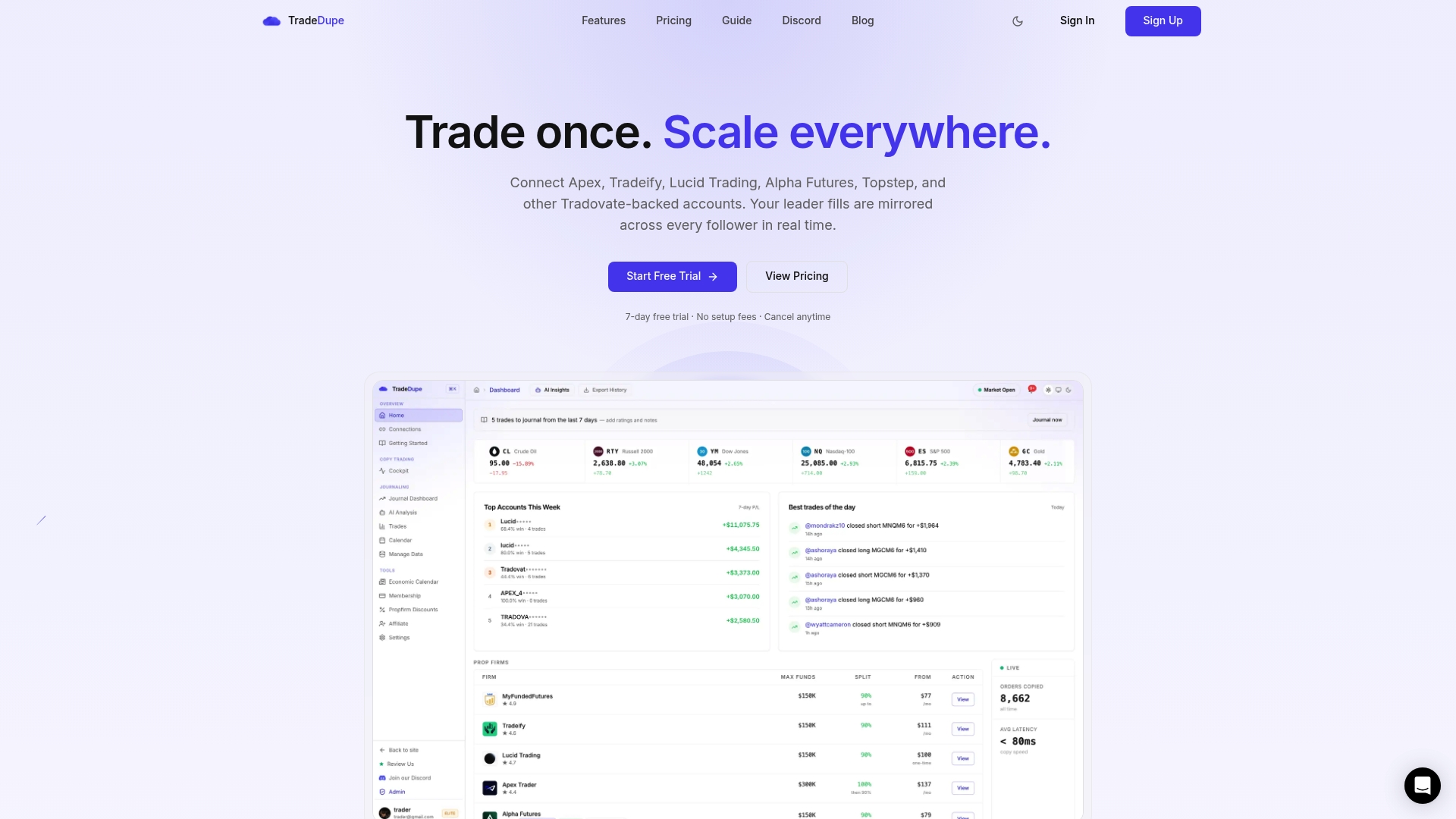
The platform's futures trade copier delivers a median latency of 34ms, supports custom lot sizing, and includes per-account toggle controls that let you manage inverse and standard signals independently. Rogue-trade detection and auto-recovery protect your accounts from runaway positions. Native integrations with Apex, Tradeify, Lucid Trading, and Alpha Futures make it a practical choice for multi-account prop desk operations. If you are ready to put a structured copy trading setup into practice, get started with Tradedupe and configure your first mirroring workflow in under 10 minutes.
FAQ
What is reverse copy trading?
Reverse copy trading automatically executes trades in the opposite direction of a lead account, aiming to profit from a signal source with consistent negative expectancy. It is also called fade trading or inverse copy trading.
Is reverse copy trading profitable?
Profitability depends entirely on net expectancy after trading costs, not just win rate inversion. A signal source must show verified, cost-adjusted losses across multiple market cycles for the strategy to work.
Does reverse copy trading violate prop firm rules?
It can. Prop firms monitor account correlations, and a Pearson correlation coefficient of -0.95 or lower triggers the same compliance flags as coordinated group trading. Always review your firm's specific rules before running inverse strategies.
How much capital should I allocate to a reverse copy trading signal?
Professional copy trading portfolios allocate 8%–15% per signal source across 6–8 sources, with a hard cap of 25% maximum exposure per trader to limit drawdown risk.
When should I stop following an inverted signal?
Stop immediately if the inverted signal produces a drawdown exceeding your predefined threshold, typically 10% of allocated capital, or if the source's win rate improves significantly, indicating a market regime change.
Recommended
- What Is Copy Trading? A Real Guide to Social and Automated Trading | TradeDupe Blog
- Best Futures Trading Strategy for Copy Trading (2026): Order Flow vs ICT Concepts | TradeDupe Blog
- Apex Trader Funding Copy Trading (2026): Mirror Every Eval & PA Account | TradeDupe
- TradeSyncer vs TradeCopia: Honest 2026 Comparison for Futures Traders