

Take Profit Trader Copy Trading: Strategies That Work
TradeDupe
10 min read
Discover effective strategies in take profit trader copy trading. Maximize returns and minimize emotional decision-making with proven techniques.
Take profit trader copy trading is defined as the practice of automatically mirroring a lead trader's positions across follower accounts while applying preset profit targets and exit rules to each replicated trade. The industry standard term for this practice is trade mirroring with profit controls, though "take profit trader copy trading" captures how most active prop traders search for and discuss it. Done correctly, it removes emotional decision-making from exits, protects capital during drawdowns, and gives multi-account operators a repeatable edge. Disciplined copy trading portfolios target 15–35% annual net returns with drawdowns of 10–25%. That range is not accidental. It reflects the math behind position sizing, daily loss caps, and calibrated profit targets working together.
What are the best take profit strategies in copy trading?
Profit target selection is the most consequential decision a copy trader makes. Set targets too tight and you exit winners early. Set them too wide and you give back gains waiting for levels that never fill.
Three core methods dominate professional copy trading setups:
- Fixed target levels set a specific price or tick distance as the exit. They work best with high-frequency scalping leaders whose edge depends on consistent, small wins.
- Trailing stops move the exit point as price advances, locking in gains without capping the upside. They suit trend-following leaders who hold positions through pullbacks.
- Scaled exits close portions of the position at multiple targets. A trader might exit 50% at the first target and let the remainder run with a trailing stop. This method balances profit capture with upside participation.
How to evaluate a master trader before copying
Selecting the right leader determines whether your profit targets are realistic. Consistent performance evaluation over 30–90 days is the minimum window for meaningful assessment. A 10-day hot streak tells you nothing about edge durability.
Key metrics to review before copying any leader:
- Win rate vs. average reward-to-risk ratio. A 40% win rate with a 2:1 reward-to-risk ratio outperforms a 65% win rate with a 0.8:1 ratio over time.
- Maximum drawdown. If a leader's historical drawdown exceeds your personal loss tolerance, their profit targets are misaligned with your risk profile.
- Trade frequency and holding time. A scalper's profit targets are measured in ticks. A swing trader's targets span days and hundreds of dollars per contract.
Pro Tip: Align your profit target settings with the leader's average holding time. If the leader holds trades for 4 hours on average, a tight 5-tick target will close your position before the trade has time to develop.
Market volatility also affects target selection. During high-volatility sessions like NFP releases or FOMC announcements, wider targets and reduced position sizes protect against erratic price action. During low-volatility consolidation, tighter targets capture the available range without overstaying.

Which risk management rules complement take profit settings?
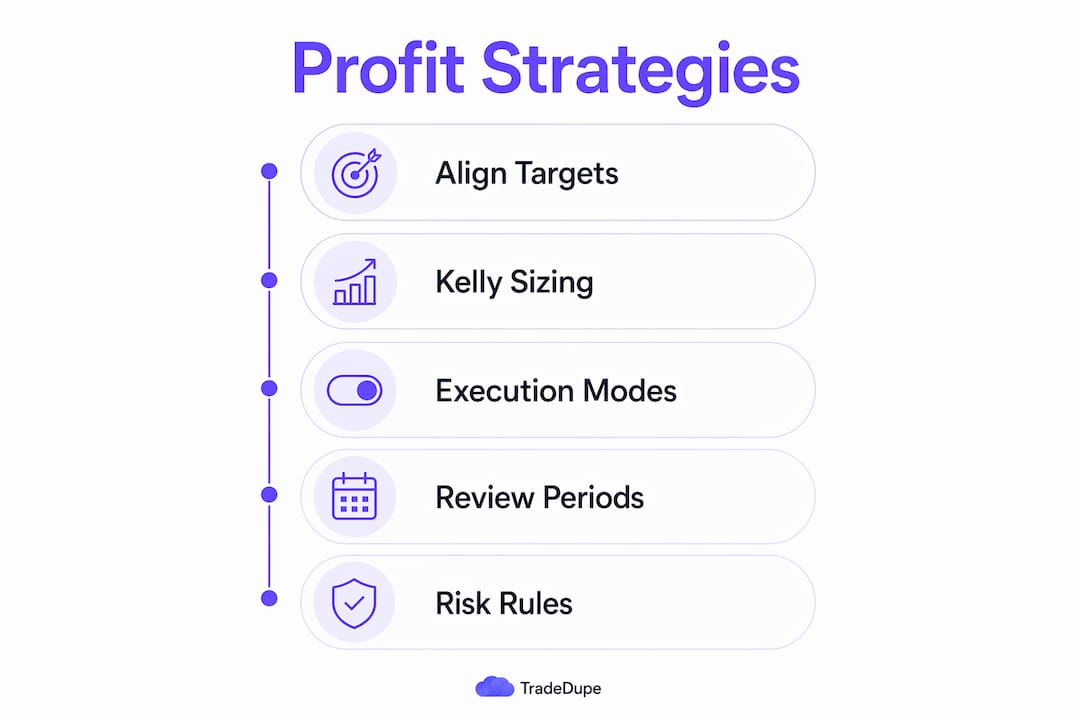
Profit targets only protect the upside. Risk controls protect the downside. Both must work together for copy trading automation to succeed.
The three pillars of risk management in copy trading are:
- Daily loss caps. A common standard sets the daily loss limit at approximately 20% of the account's daily risk budget. When the cap hits, the system stops copying new trades for the session. This prevents a single bad day from compounding into an account-ending drawdown.
- Per-trade exposure caps. Each copied trade should risk no more than a fixed percentage of total capital. This prevents an oversized position from the leader from destroying a follower account that operates at a different capital level.
- Drawdown pauses. When cumulative drawdown reaches a preset threshold, the system pauses copying entirely. The pause forces a review before additional capital is exposed.
Position sizing with Kelly-adjusted math
Kelly-adjusted math recommends allocating 8–15% of copy capital per master trader to avoid fat-tail risks. Full Kelly is mathematically optimal but practically dangerous. Half Kelly or quarter Kelly is the standard for retail and prop copy traders because it absorbs losing streaks without wiping the account.
Spreading capital across 6–8 leaders at 8–15% each creates a diversified copy portfolio. No single leader's bad month destroys the whole account. The benefits of copying multiple accounts extend beyond diversification. They also allow you to test different profit target strategies simultaneously across different market conditions.
Pro Tip: Never allocate more than 15% to any single leader, regardless of their track record. Past performance does not guarantee future results, and fat-tail events hit even the best traders.
Execution modes and their risk profiles
Trade execution modes create meaningfully different risk profiles. Orders Mode replicates a filled trade instantly, giving the follower the same entry as the leader. Executions Mode manages live order placement, which can introduce slight timing differences but gives more control over fill quality. Orders Mode suits traders who prioritize speed and synchronization. Executions Mode suits traders who prioritize fill control and want to manage slippage on exits.
How to set up take profit trader copy trading step by step
Setup quality determines whether your profit targets execute as designed or fail at the worst possible moment. Follow this sequence:
- Select a compatible platform. Choose a trade copier that supports per-account profit targets, daily loss limits, and automatic order syncing. Tradedupe operates on Tradovate and supports prop firm accounts including Apex, Tradeify, Lucid Trading, and Alpha Futures.
- Connect follower accounts to the leader. Link each follower account through the platform dashboard. Tradedupe's getting started guide walks through Tradovate account connection in under 10 minutes.
- Configure profit targets and loss limits per account. Per-account funded goal tracking allows each follower to have unique daily loss caps and profit targets. Set these based on each account's funding rules and your personal risk tolerance.
- Choose your execution mode. Select Orders Mode for maximum synchronization speed or Executions Mode for fill control. Tradedupe reports a median execution latency of 34ms, which minimizes slippage on exits.
- Monitor sync status in real time. Use the platform dashboard to track leader and follower activity. Confirm that profit target exits are firing correctly on the follower accounts.
- Adjust targets as conditions change. Review performance weekly. If a leader's average win is shrinking or drawdown is expanding, tighten profit targets or reduce allocation.
The table below summarizes the key configuration decisions and their trade-offs:
| Configuration | Conservative setting | Aggressive setting |
|---|---|---|
| Profit target per trade | 5–10 ticks | 20–40 ticks |
| Daily loss cap | 10% of session budget | 20% of session budget |
| Capital per leader | 8% | 15% |
| Execution mode | Executions Mode | Orders Mode |
| Leaders copied | 6–8 | 2–3 |
Pro Tip: Start with conservative settings for the first 30 days. This gives you a clean baseline for evaluating whether the leader's actual performance matches their historical metrics before you increase allocation.
What common mistakes do copy traders make with profit targets?
Most copy trading failures stem from picking leaders based on short-term streaks and emotional sizing. The pattern repeats constantly: a trader posts three exceptional weeks, attracts followers, then reverts to mean performance while followers hold positions sized for the hot streak.
The most damaging mistakes fall into four categories:
- Emotional sizing. Increasing allocation after a winning streak violates Kelly math and concentrates risk at exactly the wrong moment.
- Ignoring slippage and latency. A leader's published profit target may be 20 ticks, but if your copier adds 3–5 ticks of latency, your effective target shrinks. High-latency platforms erode edge on every exit.
- Style mismatch. Copying a scalper's profit targets onto a swing trader's positions, or vice versa, produces exits that are either too early or too late for the actual trade setup.
- Skipping regular reviews. Market regimes change. A leader who performed well in trending conditions may underperform in choppy markets. Profit targets calibrated for one regime fail in another.
> Copy trading is not guaranteed profit. Social style analysis is as important as technical analysis when matching a leader's strategy to your risk tolerance. Risk evaluation is not optional. It is the foundation of every profitable copy trading operation.
The fix for all four mistakes is the same: treat copy trading like portfolio management, not social following. Repeatable rule-based strategies for entry, sizing, exit, and stop-copy decisions separate disciplined copy traders from those who chase performance. Reviewing trading strategy alignment with your risk profile before committing capital is a step most traders skip and later regret.
Key Takeaways
Effective take profit trader copy trading requires calibrated profit targets, Kelly-adjusted position sizing, daily loss caps, and real-time execution monitoring working together as a single risk system.
| Point | Details |
|---|---|
| Align targets with leader style | Match profit target width to the leader's average holding time and trade frequency. |
| Apply Kelly-adjusted sizing | Allocate 8–15% per leader across 6–8 traders to limit fat-tail exposure. |
| Use daily loss caps | Set session loss limits at approximately 20% of the daily risk budget to prevent compounding losses. |
| Evaluate leaders over 30–90 days | Short-term streaks are noise; consistent metrics over 30–90 days reveal real edge. |
| Monitor and adjust regularly | Review performance weekly and update profit targets as market conditions shift. |
Why I treat profit targets as the most underrated variable in copy trading
Most traders obsess over which leader to copy. I obsess over how the exit is configured. After watching dozens of copy portfolios perform, the pattern is clear: two traders copying the same leader with different profit target settings produce dramatically different results over a quarter.
The traders who set targets based on the leader's actual average win, adjusted for their own platform's latency, consistently outperform those who copy default settings. Default settings are designed for the average follower. You are not the average follower. You have a specific account size, a specific prop firm's daily loss rules, and a specific tolerance for drawdown.
The other insight that took me longer to internalize: profit targets need to change as market volatility changes. A 15-tick target that works beautifully during a trending week becomes a liability during a choppy consolidation week. Automation helps here. Platforms like Tradedupe that support per-account profit and loss controls let you adjust targets without touching the leader's setup. That separation of leader logic from follower risk parameters is the structural advantage that most traders overlook when they first start copying.
Treat your copy portfolio like a fund. Rebalance it. Review it. Adjust the exits. The leaders are just the signal source. You control the risk.
> — Andres
Tradedupe's copy trading tools for prop firm traders
Prop firm traders managing multiple Tradovate accounts need more than basic trade mirroring. They need per-account profit targets, daily loss caps that respect each firm's funded rules, and execution fast enough to match the leader's fills.
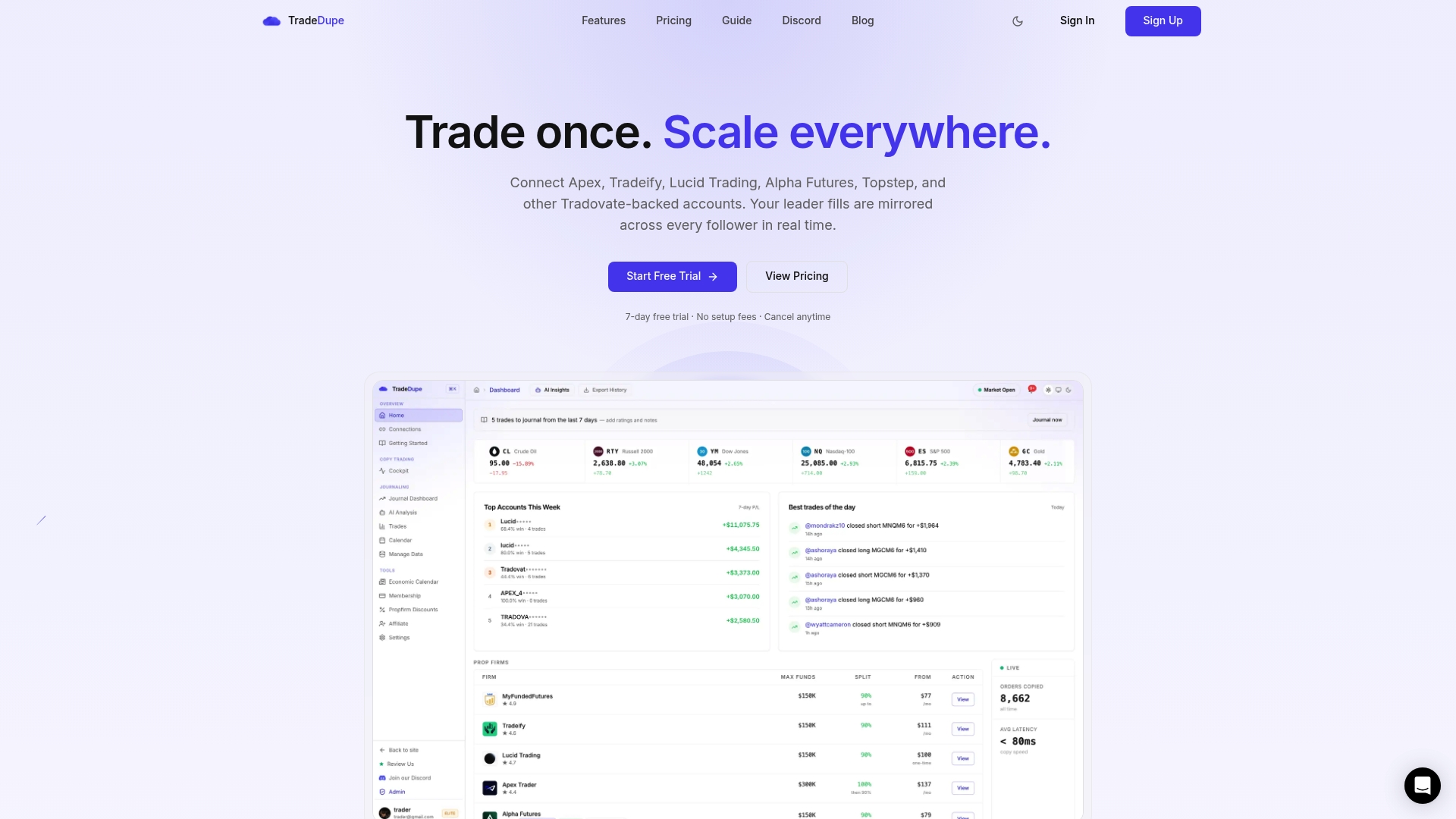
Tradedupe is built specifically for this workflow. The platform mirrors trades from a single leader account to unlimited follower accounts with a median latency of 34ms. Per-account risk controls let you set unique profit targets and loss limits for each funded account without touching the leader's configuration. Rogue-trade detection and auto-recovery keep the system running even when connectivity drops. For traders running Apex, Tradeify, Lucid Trading, or Alpha Futures accounts, Tradedupe's futures trade copier handles the synchronization while you focus on the strategy.
FAQ
What is take profit trader copy trading?
Take profit trader copy trading is the practice of mirroring a lead trader's positions across follower accounts while applying preset profit targets and exit rules to each replicated trade. It combines automated trade mirroring with per-account risk controls to produce consistent, rule-based exits.
How do I set the right profit target when copy trading?
Match your profit target to the leader's average winning trade size and holding time, then adjust for your platform's execution latency. A target that is too tight relative to the leader's style will close positions before the trade develops.
What is the recommended capital allocation per leader in copy trading?
Kelly-adjusted position sizing recommends 8–15% of total copy capital per master trader, spread across 6–8 leaders. This limits the damage any single leader's drawdown can cause to the overall portfolio.
How does execution mode affect profit target performance?
Orders Mode replicates filled trades instantly for maximum synchronization, while Executions Mode manages live order placement for better fill control. The choice affects how closely your follower account's exits match the leader's published profit targets.
How often should I review my copy trading profit targets?
Review profit targets at least weekly. Market volatility regimes shift, and targets calibrated for trending conditions underperform in choppy markets. Consistent performance evaluation over 30–90 days also helps confirm whether a leader's edge remains intact before you adjust allocation.
Recommended
- Take Profit Trader (TPT) Copy Trading (2026): Mirror Every Account | TradeDupe
- What Is Copy Trading? A Real Guide to Social and Automated Trading | TradeDupe Blog
- Best Futures Trading Strategy for Copy Trading (2026): Order Flow vs ICT Concepts | TradeDupe Blog
- Why risk managers rely on copy trade systems for efficiency | TradeDupe Blog