

What Is a Lead Account in Copy Trading?
TradeDupe
9 min read
Discover what a lead account in copy trading is and how it enables automated, real-time trading strategies for maximum profits.
A lead account in copy trading is defined as the primary trading account managed by an experienced trader whose live positions are automatically replicated across one or more follower accounts in real time. Understanding this structure is the foundation of every copy trading strategy, whether you are running prop firm evaluations across Apex or Tradeify accounts, or managing a multi-account futures desk on Tradovate. The lead account sits at the center of the entire system. Every trade it opens, modifies, or closes becomes an instruction that follower accounts execute proportionally and instantly.
What is a lead account in copy trading and how does it work?
A lead account, also called a leader account or master account in some platforms, is the single source of truth for all trade signals in a copy trading setup. The trader who controls it executes positions normally, using their own analysis, order flow reading, or systematic strategy. The platform then mirrors those positions into every connected follower account without any manual input from the followers.
Trade replication works proportionally. If the lead account holds $100,000 in capital and opens a 10-contract position in the ES futures market, a follower account with $10,000 receives a 1-contract mirror of that same trade. The ratio of follower capital to lead capital determines the position size. This proportional scaling keeps risk exposure consistent across all accounts regardless of account size.

The platform handles synchronization automatically. When the lead closes the trade, all follower accounts close their mirrored positions at the same moment. Tradedupe, for example, reports a median latency of 34ms between the lead account action and follower execution. That speed matters in fast-moving futures markets where a 1-second delay can mean a different fill price.
Here is how the replication sequence works step by step:
- Lead trader opens a position. The platform detects the new order in real time.
- The system calculates proportional size. Each follower's position size is scaled to their allocated capital relative to the lead account.
- Follower accounts receive the mirrored order. Execution happens within milliseconds across all connected accounts.
- The lead modifies or closes the trade. All follower accounts reflect the same change simultaneously.
- The platform logs the full sequence. Analytics and reporting tools record every action for review.
Pro Tip: Set your follower capital allocation before the lead account takes its first trade. Changing allocation mid-session can cause size mismatches and unintended exposure in open positions.
How do profit-sharing and fee structures work for lead accounts?
Lead traders earn compensation through performance fees paid by followers. The most common model is the High-Watermark (HWM) fee structure. Under HWM, the lead trader earns a percentage of net profits only when the follower's account reaches a new peak value above its previous high. This prevents lead traders from collecting fees during recovery periods after a drawdown.
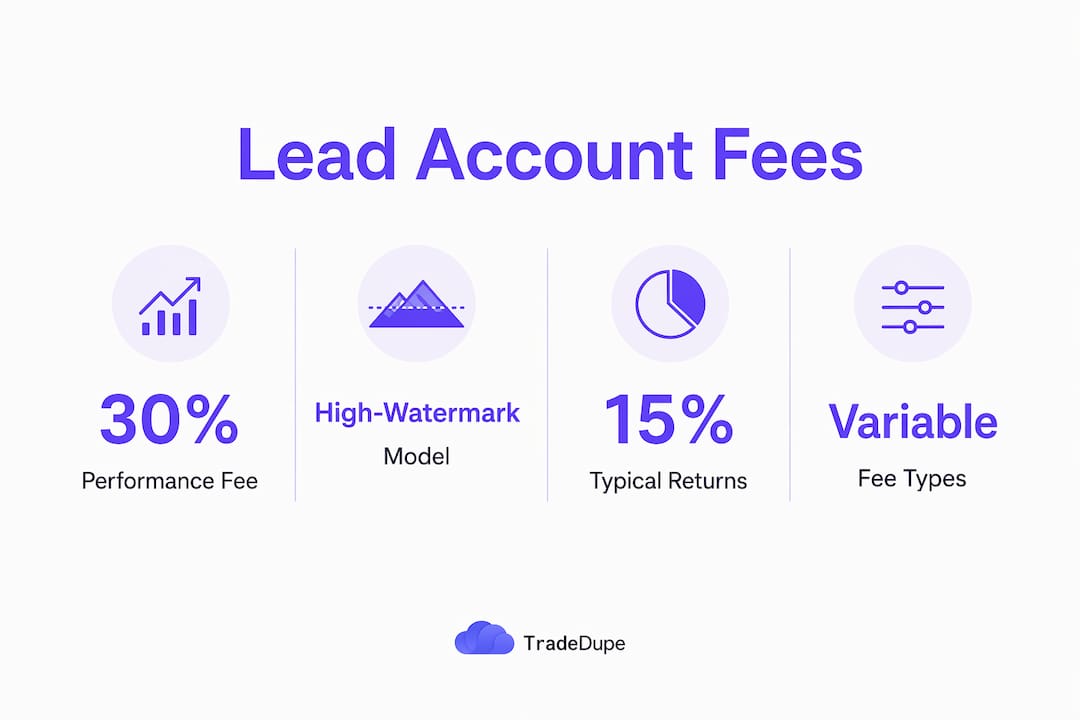
The HWM model aligns incentives. Lead traders earn fees only when they generate genuine new profits for followers, not simply when they recover from losses they caused. That structure rewards consistent performance rather than volatility.
Key fee-related facts every follower should know:
- Performance fees typically range from 10% to 30% of net profits, though the exact percentage varies by platform and lead trader.
- Management fees are less common in copy trading but appear on some broker-integrated social trading platforms as a flat monthly charge.
- Fee transparency is a legal and competitive requirement on regulated platforms. Followers should always verify fee terms before allocating capital.
- Lead traders can set their own fees on many platforms, creating a marketplace where followers choose based on performance and fee structure.
The fee model directly affects your net return as a follower. A lead account generating 15% gross returns with a 30% performance fee delivers 10.5% net to the follower before any platform subscription costs. Run those numbers before you commit capital.
What risks come with copying a lead account?
Copy trading is not passive income. It is delegated active risk. The follower transfers decision-making to the lead trader, but the financial exposure remains entirely the follower's own. Most beginners underestimate this distinction and suffer losses when a lead account enters a drawdown period.
The core risks every follower must evaluate:
- Drawdown risk. A lead account can lose a significant portion of its capital before triggering any automatic stop. Without a defined max drawdown limit, followers can absorb the full loss.
- Strategy drift. Lead traders sometimes change their approach without notifying followers. A momentum trader who shifts to mean reversion during a trend market can produce unexpected losses.
- Execution slippage. Even with low-latency platforms, follower fills may differ from lead fills during high-volatility events like economic data releases.
- Concentration risk. Following a single lead account concentrates all copied exposure in one trader's decisions and one strategy's weaknesses.
Professional-grade platforms provide dashboards where followers can set maximum drawdown limits and stop-copy thresholds. These controls automatically halt copying when losses reach a defined level. Using them is not optional for serious traders. It is the minimum standard for responsible capital allocation.
Pro Tip: Review a lead account's risk management metrics before allocating capital. Specifically check maximum drawdown, Sharpe ratio, and the ratio of winning months to losing months over at least 6 months of verified history.
Lead traders' performance metrics including ROI, follower count, and drawdown history are publicly visible on broker-integrated social trading platforms. That transparency exists specifically so followers can make informed decisions. Use it. A lead account with a high ROI but a 40% max drawdown is a very different risk profile than one with a lower ROI and a 10% max drawdown.
What are the benefits of lead accounts for traders and investors?
Lead accounts serve two distinct groups with different goals. Understanding which profile fits your situation determines how you should use copy trading accounts.
| Trader Profile | Primary Benefit | Best Use Case |
|---|---|---|
| Experienced lead trader | Earn performance fees from followers | Scale income without adding personal capital |
| Prop firm trader | Mirror one strategy across multiple eval accounts | Pass multiple evaluations simultaneously |
| Time-limited investor | Access expert strategies without manual trading | Portfolio diversification with reduced time cost |
| Developing trader | Study lead account decisions in real time | Learn by observing live execution patterns |
For prop firm traders, the lead account model solves a specific operational problem. Running five Apex or Tradeify evaluation accounts manually requires five separate trading sessions, five separate risk monitors, and five times the mental load. A single lead account connected to all five follower accounts through a platform like Tradedupe collapses that workload into one trading session. The lead executes once. All follower accounts mirror the same trades within milliseconds.
Followers benefit by saving time and accessing strategies they could not develop independently. Copy trading allows portfolio diversification without managing every trade manually. That suits investors with limited time, limited experience, or both. The key is selecting lead accounts with verified track records rather than relying on short-term performance windows.
Copying multiple accounts from a single lead also creates consistency. Every follower account holds the same positions at the same time, which simplifies risk monitoring and reporting. For prop firm traders managing funded accounts with strict drawdown rules, that consistency is not just convenient. It is a compliance requirement.
Key Takeaways
A lead account is the operational core of any copy trading setup, and its effectiveness depends entirely on the quality of the trader controlling it and the risk controls the follower puts in place.
| Point | Details |
|---|---|
| Lead account definition | The primary account whose live trades are mirrored proportionally across all connected follower accounts. |
| Proportional replication | Follower position sizes scale to their capital relative to the lead account, keeping risk ratios consistent. |
| HWM fee model | Lead traders earn performance fees only on new profits above the previous peak, aligning their incentives with follower returns. |
| Delegated active risk | Copy trading transfers decision-making but not financial exposure. Followers must set drawdown limits and monitor performance. |
| Prop firm application | A single lead account can mirror trades across multiple evaluation accounts simultaneously, reducing operational workload. |
Why I think most traders misuse lead accounts
The most common mistake I see is treating lead account selection like picking a stock. Traders look at a 30-day ROI number, allocate capital, and walk away. That approach fails almost every time.
A lead account's recent performance tells you almost nothing about its future behavior under different market conditions. What matters is how the lead trader manages losing periods. A lead account that recovers from a 15% drawdown in two weeks using disciplined position sizing is a fundamentally different risk than one that recovers by doubling down on losing trades. The outcome may look similar on a chart. The process is completely different.
The second mistake is skipping the risk control dashboard entirely. Platforms provide stop-copy thresholds and max drawdown controls for a reason. Not using them is the equivalent of driving without a seatbelt because you trust the other driver. The lead trader's skill does not protect your capital. Your own risk settings do.
My practical advice: treat copy trading as active portfolio management with a subcontracted execution layer. Review your lead accounts weekly. Check whether the strategy is behaving consistently with its historical pattern. If something changes, act on it. The traders who do well with copy trading are the ones who stay engaged, not the ones who set it and forget it.
> — Andres
Tradedupe and real-time lead account mirroring for prop traders
Prop firm traders managing multiple Tradovate accounts need more than basic copy trading. They need latency under 100ms, per-account toggle controls, and rogue-trade detection that catches errors before they breach funded account rules.
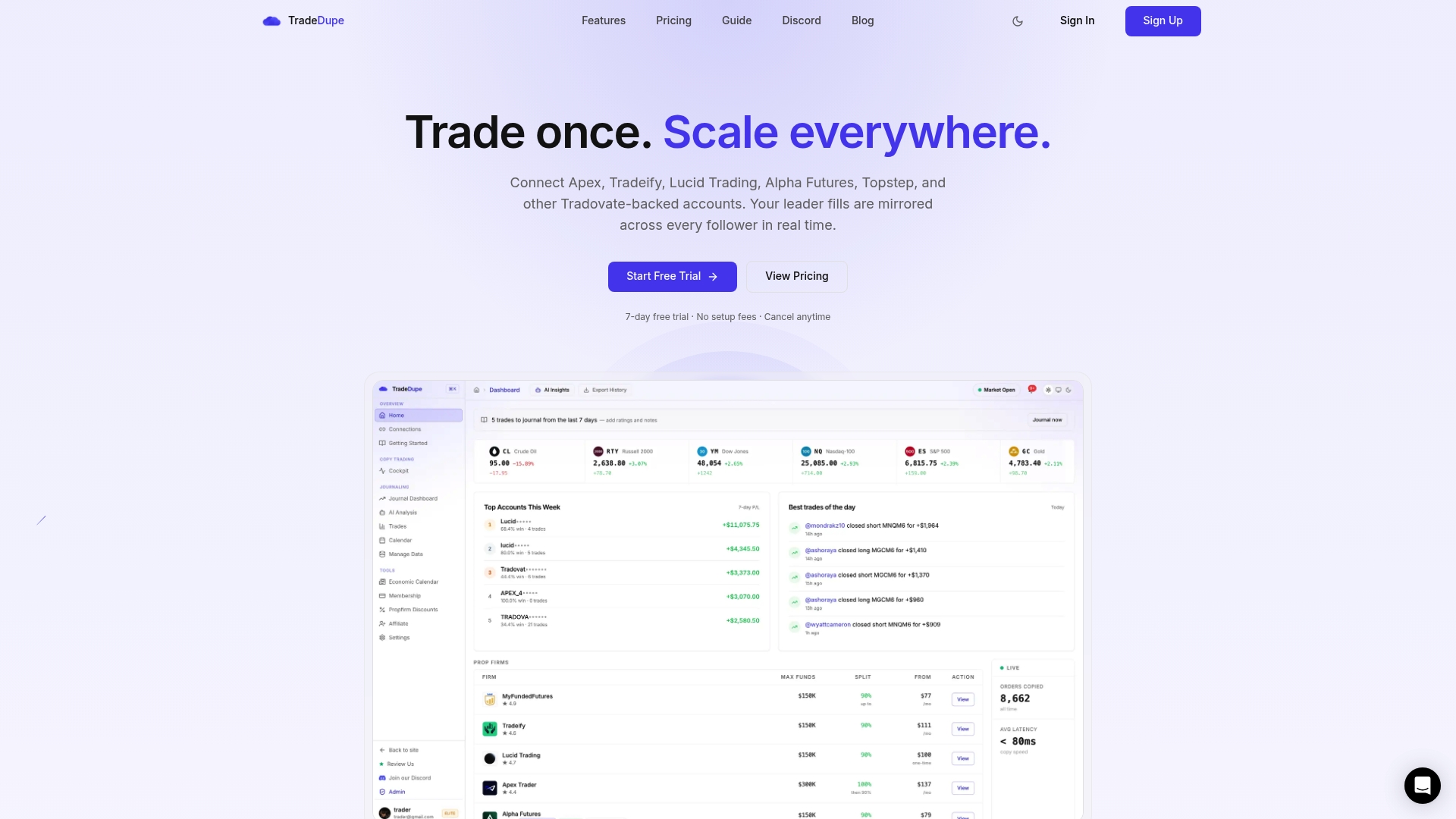
Tradedupe is built specifically for that environment. The platform connects a single lead account to multiple follower accounts across Apex, Tradeify, Lucid Trading, and Alpha Futures, syncing every trade in real time with a median latency of 34ms. Features like auto-recovery and per-account controls let you manage risk at the individual account level without interrupting the lead account's session. If you are running prop firm evaluations and want to mirror your strategy across every account without manual duplication, getting started with Tradedupe takes under 10 minutes.
FAQ
What is the difference between a lead account and a follower account?
A lead account is controlled by the trader who executes positions. A follower account automatically mirrors those positions proportionally based on allocated capital.
How are trades replicated from a lead account to followers?
The copy trading platform detects each trade the lead account opens or closes and instantly sends proportional orders to all connected follower accounts, typically within milliseconds.
Can a follower stop copying a lead account at any time?
Yes. Most platforms allow followers to pause or stop copying a lead account at any time using per-account toggle controls or stop-copy thresholds set in the risk dashboard.
What fees do followers pay to copy a lead account?
Followers typically pay a performance fee, often calculated using the High-Watermark model, where the lead trader earns a percentage of net profits only above the follower's previous peak account value.
Is copy trading from a lead account suitable for prop firm evaluations?
Yes. Platforms like Tradedupe allow a single lead account to mirror trades across Apex and other prop firm evaluation accounts simultaneously, reducing manual workload while maintaining compliance with prop firm risk rules.
Recommended
- What Is Copy Trading? A Real Guide to Social and Automated Trading | TradeDupe Blog
- Tradovate Trade Copier | Real-Time Account Sync | TradeDupe
- Apex Trader Funding Copy Trading (2026): Mirror Every Eval & PA Account | TradeDupe
- Take Profit Trader (TPT) Copy Trading (2026): Mirror Every Account | TradeDupe