
What is a trading leader account for prop firms
TradeDupe
12 min read
Discover what a trading leader account is and how it impacts your copy trading strategy in prop firms. Improve your trading with clarity!
Many traders hitting the Tradovate copy trading setup for the first time assume that a trading leader account is some elevated account tier, a special designation granted by the broker, or a separate account type requiring unique approval. It is none of those things. A leader account is a functional role in a copy trading system, and confusing it with a special account type causes real operational mistakes in multi-account prop firm environments. This guide cuts through that confusion, explains exactly how leader accounts work, and details what that means for risk control, contract sizing, and follower synchronization across Tradovate prop firm accounts.
Table of Contents
- Defining the trading leader account in copy trading
- How Tradovate implements leader accounts with Trade Copier
- Nuances and operational challenges in leader account trade replication
- Aligning leader account replication with prop firm risk parameters
- Practical trade mirroring strategies for prop firm leader accounts
- Rethinking the leader account role: insights from prop firm operations
- Explore TradeDupe for advanced Tradovate copy trading solutions
- Frequently asked questions
Key Takeaways
| Point | Details |
|---|---|
| Leader account role | A trading leader account is a role in copy trading triggering trade replication, not a special account type. |
| Trade Copier basics | Tradovate’s Trade Copier uses grouped accounts and contract ratios to mirror trades across multiple follower accounts. |
| Order limitations | Bracket orders like stop-loss and take-profit are not natively replicated and must be managed on follower accounts. |
| Risk compliance | Follower accounts must enforce prop firm risk parameters independently to prevent breaches during trade replication. |
| Scaling accuracy | Proper contract sizing and execution mode settings are critical to avoid operational failures and API rate-limit issues. |
Defining the trading leader account in copy trading
A leader account is not a separate product or a privileged account tier. It is a role assigned within a copy trading framework, designating which account's executed trades will be mirrored to one or more follower accounts. The leader acts as the signal source. Every filled order on the leader side triggers a proportional replication event on each follower account linked to the same group.
The mechanics behind what is a leader account are straightforward in theory. When the leader executes a buy order for, say, 4 contracts of NQ futures, the copy trading system calculates the proportional allocation for each follower based on pre-configured ratios and fires corresponding market orders. Trade replication from master accounts to follower accounts happens in real time with proportional sizing, meaning a follower configured at a 0.5x ratio receives a 2-contract order while a follower at 1x receives a 4-contract order.
Key characteristics of the leader account role:
- Role, not account type: Any standard Tradovate account can be designated as a leader within a copy trading group.
- Real-time replication: Follower orders are triggered immediately upon leader fill, not on a delayed or periodic basis.
- Proportional scaling: Trade size on follower accounts is determined by the allocation ratio configured for each follower, not by copying the exact contract count.
- No manual execution required: Followers do not need to be watching the screen or clicking buttons; the copy system handles execution automatically.
Understanding this distinction matters immediately when you are managing five or ten funded Apex or Topstep accounts simultaneously. The leader is simply the account where your primary trading decisions are executed. Everything else is system configuration.
How Tradovate implements leader accounts with Trade Copier
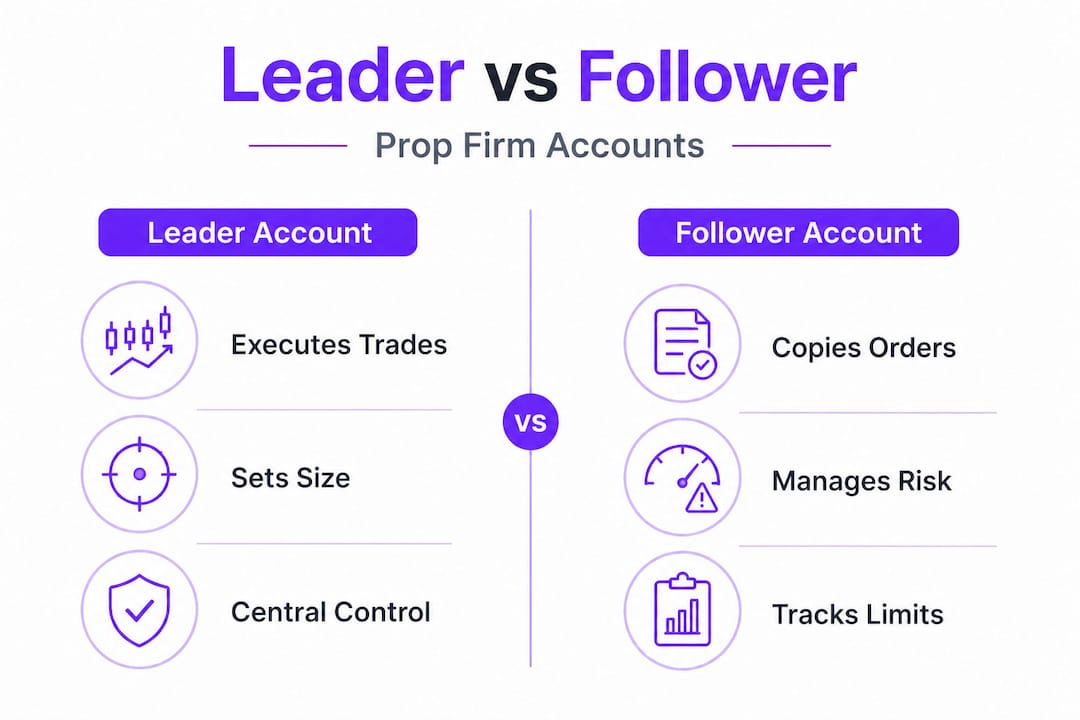
Tradovate's native Trade Copier feature operates on a group-based model rather than a direct point-to-point link between two specific accounts. You configure a trading group, assign one account as the leader, add follower accounts to the group, and define the contract quantity scaling for each follower. Tradovate's Trade Copier scales trades from a master account to multiple followers using grouping and contract-size scaling, though with notable order type limitations.
Operational mechanics in Tradovate's implementation:
- Group-based architecture: The leader is defined at the group level, not the account level. You can reorganize groups without creating new accounts.
- Market order execution: The system replicates filled market orders. It does not track pending order states across follower accounts.
- Contract quantity divisibility: Leader contract quantities must be divisible by the follower ratio. If your leader trades 3 contracts but a follower is set to 0.5x, the math produces 1.5 contracts, which is not executable. The trade either fails or rounds in ways that misrepresent your intended allocation.
- Bracket order limitations: Stop-loss and take-profit bracket orders placed on the leader side are not automatically replicated to follower accounts. Followers receive market orders only.
Pro Tip: Before you go live with any leader-follower group, test your contract quantity math on paper first. Map out every follower's configured ratio against your minimum and maximum intended trade sizes on the leader account. A single indivisible quantity during a fast-moving trade can leave followers flat while your leader is positioned.
When comparing copy trading platforms, the bracket order limitation is one of the most practically significant differences between Tradovate's native solution and dedicated third-party copy trading infrastructure.

Nuances and operational challenges in leader account trade replication
The gap between understanding what a trading leader account does conceptually and running it in a live prop firm environment is where most operational problems surface. Four issues consistently cause disruptions.
- Contract sizing errors. Follower contract sizes must be correctly scaled and divisible to avoid operational failure during copying. If you add a new follower mid-session without recalculating the group's scaling math, you create misallocation risk across every subsequent trade.
- Stop-loss and take-profit gaps. Because bracket orders are not replicated, follower accounts have no automatic exit mechanism tied to the leader's risk controls. Each follower must have its own independent stop and target management, either via manual monitoring or a separate automation layer.
- Execution mode selection. Running in execution mode converts follower entries into market orders rather than attempting to replicate the pending order state. Execution mode reduces API load by using market orders instead of tracking pending orders, which prevents rate-limit penalties and synchronization failures.
- API rate limit violations. Tradovate's API enforces rate limits on order submissions. When you are copying one leader to ten or fifteen followers, each fill event generates ten to fifteen simultaneous API calls. Exceeding those limits causes missed orders, partial fills on the follower side, and desynchronization that can be difficult to detect in real time.
> "Follower accounts must have their contract sizes correctly scaled and divisible to avoid operational failure during trade copying." This is not a configuration footnote. It is the single most common source of live trading errors in multi-account prop firm setups.
Pro Tip: Set your leader's minimum trade size as a multiple that remains cleanly divisible across every follower ratio in your group. For example, if followers run at ratios of 0.5x, 1x, and 2x, trading in even-number contract increments on the leader eliminates rounding failures entirely.
Good risk management in copy trading requires treating these technical constraints as risk factors, not just setup preferences.
Aligning leader account replication with prop firm risk parameters
Prop firms impose firm-level risk parameters that govern every account in their ecosystem, including accounts operating as followers in a copy trading group. Prop firm risk parameters regulate trader behavior through daily loss limits, trailing drawdowns, and maximum position sizes, all of which leader and follower setups must independently respect.
The critical insight here is that trade replication does not transfer risk compliance automatically. When the leader enters a position, each follower account is entering its own position, measured against its own account-level drawdown and loss limits. A position that is well within the leader account's drawdown tolerance can simultaneously push a follower account with a smaller funded balance past its trailing drawdown threshold.
Key benefits of copy trading for prop firms are only realized when follower-side risk controls are configured independently:
- Daily loss limits: Each follower account must be monitored against its own daily loss ceiling, not the leader's.
- Trailing drawdowns: Funded accounts at firms like Apex and Topstep have trailing drawdown thresholds that move with peak equity. A copied trade that is profitable on the leader can still breach a follower's trailing drawdown if that follower is already near its high-water mark.
- Maximum position sizes: Follower allocation ratios must be calibrated so that scaled trade sizes never exceed the position limit the prop firm enforces per account.
- Profit targets: Some prop firm evaluation accounts have profit targets that, once hit, should trigger a pause on replication to protect the achieved milestone.
| Risk parameter | Leader account responsibility | Follower account responsibility |
|---|---|---|
| Daily loss limit | Trade within leader account limit | Independent monitoring per follower |
| Trailing drawdown | Manage leader equity curve | Separate follower drawdown tracking |
| Max position size | Execute within leader's limit | Scale ratios to stay within follower cap |
| Profit target protection | Pause trading when target hit | Toggle off follower replication independently |
Practical trade mirroring strategies for prop firm leader accounts
There are two primary allocation approaches when configuring leader account replication across a prop firm desk, and each carries distinct tradeoffs in flexibility versus simplicity.
Proportional allocation assigns each follower a multiplier relative to the leader's trade size. The precise allocation math combined with follower-side risk controls is what makes multi-account management operationally sound. This approach allows you to give larger-balance followers bigger exposure without separate trading decisions, but it requires careful divisibility math at every contract size.
Fixed contract sizing assigns each follower a flat contract count per trade regardless of leader size. It is simpler to manage and avoids rounding errors, but it does not scale naturally when you want to vary position size on the leader.
Recommended configuration sequence for prop firm leader accounts:
- Define your leader account's minimum and maximum trade sizes before touching any follower configuration. These boundaries constrain every ratio calculation downstream.
- Map follower ratios against the leader's size range to confirm no rounding failures across the full trading spectrum.
- Configure follower stop-loss and take-profit independently using the prop firm's risk parameter guidelines as your floor, not a ceiling.
- Set execution mode to market order replication on all followers to reduce API call volume and minimize latency.
- Test the group with minimal contract sizes before scaling up to full allocation, confirming synchronization and fill quality.
Using the right trade copier infrastructure makes this configuration process faster and reduces the margin for human error in setup. For prop firms running Apex accounts specifically, Apex copy trading setups require attention to that firm's specific trailing drawdown mechanics when calibrating follower ratios.
| Allocation approach | Best for | Main risk |
|---|---|---|
| Proportional allocation | Variable position sizing, scaling desks | Rounding errors at non-divisible sizes |
| Fixed contract sizing | Consistent position sizing, simpler management | Does not scale with leader trade size changes |
Rethinking the leader account role: insights from prop firm operations
Here is the perspective that most copy trading guides miss entirely: the best trading leader accounts at prop firm operations are not the ones with the most sophisticated entry signals. They are the ones built around the most precisely configured downstream infrastructure.
The leader account executes the trade. Full stop. That is the extent of its elevated role. What determines whether that trade becomes a scalable, risk-compliant event across ten funded accounts or a fragmented disaster is entirely a function of how the follower group is configured. A leader account is a role, not a special account type; operational success depends entirely on how automation and risk limits interact across the full leader-follower chain.
Experienced prop firm operations managers recognize this intuitively. They spend more time auditing follower configuration, testing API rate behavior under peak concurrency, and stress-testing their contract sizing math than they spend tweaking the leader's entry criteria. The leader's trade quality matters, but a well-configured follower group can protect that quality from degrading at scale.
The more interesting challenge is latency-aware risk control. When your leader enters a position during a volatile news event and all fifteen followers are firing market orders simultaneously, the question is not whether replication will happen. It is whether each follower's risk parameters will engage fast enough to prevent a drawdown breach before the next price tick. That is a system design problem, not a trading problem.
If you think of risk managers' operational approach to copy trading, the focus is always on the follower layer. Leadership in copy trading is a system architecture challenge. The account labeled "leader" is just where the signal originates.
Explore TradeDupe for advanced Tradovate copy trading solutions
If you are managing multiple funded accounts across Apex, Topstep, Tradeify, or other Tradovate-supported prop firms, the native Trade Copier's limitations in bracket order support, API rate management, and follower-side risk enforcement become real constraints at scale. TradeDupe is built specifically to address those gaps for professional prop traders operating in the Tradovate ecosystem.
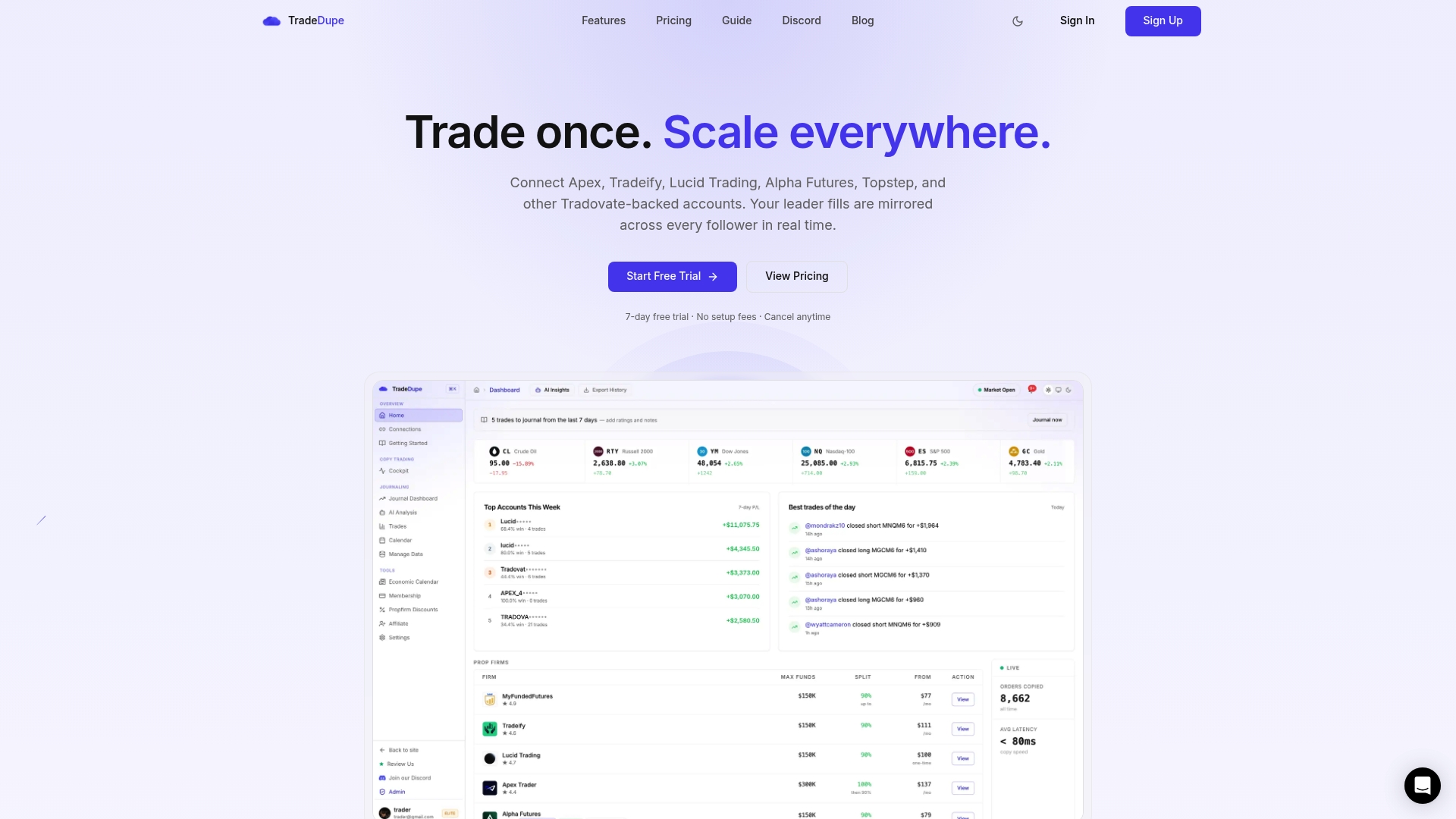
TradeDupe delivers real-time trade mirroring with a median latency of 34ms, rogue-trade detection, per-account toggle controls, and auto-recovery features that keep your follower group synchronized even during volatile market conditions. The platform supports precise contract sizing, flexible group management, and AI-powered trade analysis across unlimited broker connections. Getting started with TradeDupe takes minutes, with guided setup flows and expert support available when you are configuring complex multi-account groups. If you want trade copier software designed for prop firm realities rather than retail copy trading use cases, TradeDupe is worth evaluating directly.
Frequently asked questions
Is a trading leader account a special type of account?
No. A leader account is a role within a copy trading system responsible for executing trades that follower accounts replicate. It carries no special platform privileges or account-type distinction at the broker level.
Can a Tradovate leader account's stop-loss and take-profit orders be copied automatically?
No. Bracket orders are not natively replicated to follower accounts in Tradovate's Trade Copier. Followers receive market orders only, requiring independent stop-loss and take-profit management on each follower account.
Why is contract sizing important in leader-follower trade copying?
Contract quantity math is critical because leader trade sizes must be evenly divisible among follower allocation ratios. Indivisible quantities cause rounding failures or skipped fills that misrepresent intended position sizing across the follower group.
How do prop firm risk parameters affect leader account setups?
Prop firm risk parameters such as daily loss limits and trailing drawdowns apply independently to each follower account, meaning a replicated trade that stays within the leader's limits can still breach a follower account's separate threshold, requiring per-account monitoring.
What is a common solution to prevent API rate-limit issues in leader-follower trade copying?
Execution mode reduces API request volume by converting follower replication events into market orders rather than tracking pending order states, which prevents synchronization failures caused by hitting Tradovate's API rate limits during multi-follower concurrent execution.