Trade Execution Across Prop Accounts: Tradovate Desk Guide
TradeDupe
14 min read
Discover what is trade execution across prop accounts and how to ensure consistent fills and compliance with our comprehensive Tradovate desk guide.
Trade execution across prop accounts means routing a single trading decision from a master account to multiple funded follower accounts simultaneously, with each follower receiving a comparable fill while staying within its individual drawdown and rule constraints. When the process works correctly, fills are consistent, rule status stays intact, and P&L tracks closely across the entire account pool. When it fails, even a 50-millisecond delay can push later accounts into worse fills, triggering drawdown breaches or payout denials. The SEC and FINRA both require firms to seek best execution and maintain supervisory systems that document and review order-handling quality. Tradedupe is purpose-built for exactly this workflow on Tradovate, with a reported median sync latency of 34ms and per-account controls designed to protect funded-account status.
Table of Contents
- How does multi-account execution actually work on a Tradovate stack?
- What are the primary risks when running one strategy across multiple prop accounts?
- What U.S. regulatory expectations apply to multi-account execution quality?
- Which execution-quality KPIs should you track across a multi-account copier?
- How do you configure and test multi-account execution on Tradovate?
- What are the most effective mitigations for large or volatile orders?
- What should a production-grade Tradovate copier actually deliver?
- Key Takeaways
- Execution quality belongs in your desk risk policy
- Tradedupe gives Tradovate prop desks a production-ready copier
- Useful sources and further reading
How does multi-account execution actually work on a Tradovate stack?
The canonical flow is straightforward: a decision fires on the master terminal, the copier intercepts the order signal, scales and maps it to each follower's parameters, transmits it to the Tradovate API for each account, and confirms fills back to the dashboard.
Step-by-step execution flow:
- Master account generates a market or limit order based on the active strategy.
- The copier software intercepts the order event in real time.
- Scaling logic applies per-account multipliers (equity-based or fixed-ratio).
- The copier broadcasts the transformed order to all follower endpoints.
- Each follower's Tradovate API session submits the order independently.
- Fill confirmations return to the copier dashboard for reconciliation.
The infrastructure choice at step 4 determines most of your latency profile. VPS-based setups reduce network hops and median sync latency compared to third-party cloud hubs, making them the preferred architecture for margin-sensitive funded accounts. A cloud hub adds an extra routing layer that can add additional latency under load.
Order type mapping also matters more than most desks realize. Platform and account-type differences change how an order is recorded and filled; spread settings, swap configurations, and contract sizing on Tradovate all alter the effective break-even distance and drawdown impact for each follower. A market order on the master may arrive as a marketable limit on a follower with different symbol settings, producing a different fill behavior entirely.

Pro Tip: Use a demo or small personal account as the master rather than a funded account. This removes emotional hesitation at the point of entry and lets the copier replicate cleanly into funded followers without the psychological drag of trading firm capital directly.
What are the primary risks when running one strategy across multiple prop accounts?
The top failure modes are latency-driven sequential slippage, identical-trade fingerprinting, inconsistent scaling, and platform mismatches. Each one can independently cause performance divergence or trigger a funded-account rule violation.
Sequential broadcast is the most common structural flaw. Standard copiers send orders to Account A, then B, then C. During a news release, the third or fourth account in the chain consistently receives the worst fills. Over dozens of trades, that slippage compounds into a measurable P&L gap between the master and the trailing followers, and in a prop account capped at a 0.5%–1% risk per trade, even small fill degradation can push a position past its daily loss limit.
Fingerprinting is the second major threat. Prop firm risk engines can flag multiple accounts opening identical lot sizes at the exact same millisecond. Automated detection triggers an immediate review or termination, regardless of whether the trader is aware of the rule.
Additional failure scenarios to map before going live:
- Partial fills across followers: one account fills fully while another receives a partial, creating unequal exposure and mismatched stop distances.
- Stop/TP mismatch: order type mapping errors place stops at different price levels across accounts.
- Symbol or contract sizing discrepancy: a micro-contract on one follower versus a standard contract on another inflates risk relative to account equity.
- Aggregated drawdown blindspot: a 2% drawdown on the master across five $100k accounts equals $10,000 in aggregate loss, which may breach the collective risk threshold even if each individual account stays within its limit.
> Execution errors in rule-bound prop accounts often require immediate remediation. Rule-bound prop accounts have tight daily and maximum loss limits; execution failures can cause immediate account termination or payout denial.
Pro Tip: Introduce controlled variance intentionally. Inject a randomized delay of 100–500 milliseconds across followers and apply fractional lot multipliers (e.g., 0.98x on one account, 1.02x on another). This prevents a synchronized millisecond footprint that triggers fingerprinting flags.
What U.S. regulatory expectations apply to multi-account execution quality?
U.S. rules require firms to seek best execution and maintain supervisory systems that measure and review order-handling performance. FINRA Rule 5310 requires "regular and rigorous" execution-quality reviews, at minimum quarterly, with more frequent reviews depending on the firm's business model. The SEC reinforces this: brokers must evaluate orders in aggregate and periodically assess which markets or venues offer the most favorable execution terms.
For a multi-account desk, these obligations translate into documented procedures, periodic reviews, and audit-ready records of every copier action.
Supervisory controls checklist:
- Written procedures describing how orders are routed, scaled, and monitored across accounts.
- Quarterly (or more frequent) execution-quality reviews comparing fills across master and followers.
- Escalation rules defining who is notified when slippage or fill-rate thresholds are breached.
- Trade error handling procedures covering mis-sized orders, partial fills, and rogue trades.
- Audit trail for every copier event: timestamps, order IDs, scaling settings, and fill confirmations.
The SEC's best-execution framework also requires brokers to disclose order-routing practices quarterly and respond to customer inquiries about where individual orders were routed. For a prop desk running automated copiers, this means the copier's logs must be complete enough to reconstruct any order's lifecycle on demand.
Which execution-quality KPIs should you track across a multi-account copier?
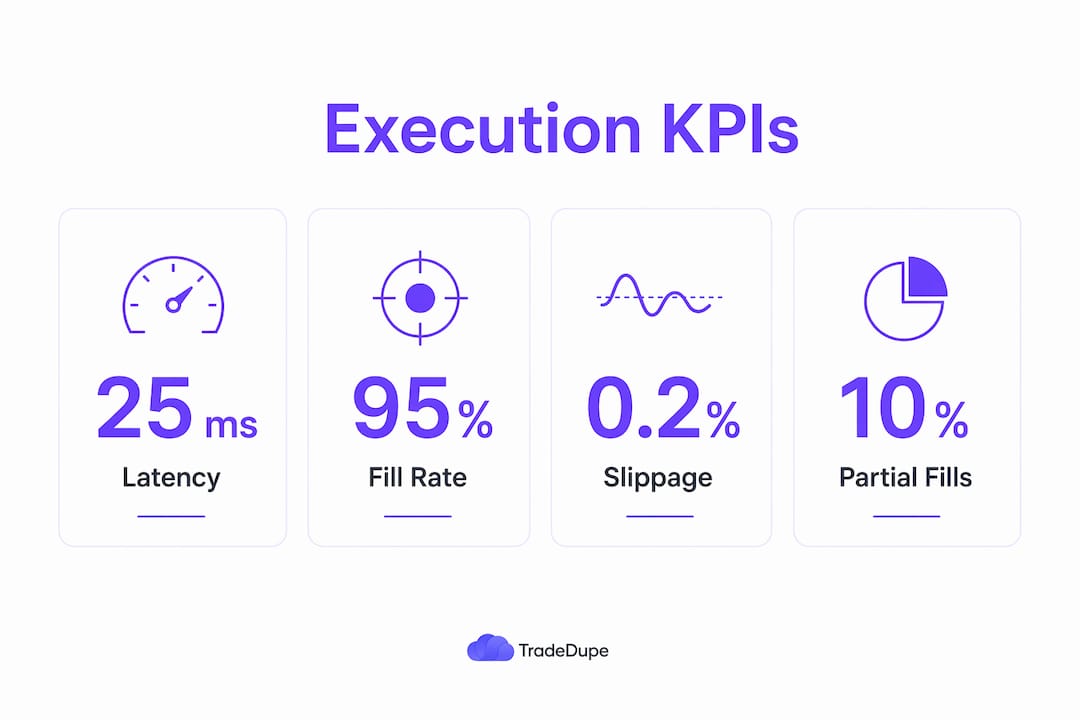
The primary metrics are execution latency, slippage per leg, fill rate, partial-fill frequency, implementation shortfall, and realized P&L divergence. Together they give a complete picture of where execution cost is accumulating and which accounts are drifting from the master.
Implementation shortfall is the standard for measuring total trade cost. It decomposes into delay cost (the gap between decision and order submission), execution cost (market impact from the order itself), and opportunity cost (unfilled shares due to adverse price movement or insufficient liquidity).
| KPI | Definition | Data Source | Monitoring Frequency |
|---|---|---|---|
| Execution latency | Time from master order event to follower fill confirmation | Copier dashboard logs | Real-time |
| Slippage per leg | Executed price minus master decision price | Fill reports vs. master journal | Per trade |
| Fill rate | Percentage of orders filled in full vs. partial | Broker API fill data | Daily |
| Partial-fill frequency | Count of orders receiving less than full fill | Copier reconciliation log | Daily |
| Implementation shortfall | Total trade cost vs. paper return at decision price | Portfolio analytics | Weekly/quarterly |
| Realized P&L divergence | Difference in net P&L between master and each follower | Account statements | Daily |
Monitoring and alert thresholds:
- Page the desk lead when execution latency exceeds 100ms on any follower.
- Flag any trade where follower slippage exceeds 1.5x the master's slippage.
- Trigger a compliance review when fill rate drops below 95% over a rolling five-day window.
- Escalate to compliance when realized P&L divergence between master and any follower exceeds 3% over a calendar month.
For portfolio-level transparency and cost control, building these thresholds into a structured dashboard review process is the difference between catching a drift early and discovering it during a payout audit.
How do you configure and test multi-account execution on Tradovate?
The goal is to verify consistent fills and protected rule status across all linked accounts before any funded capital is at risk.
Pre-deployment checks:
- Map each follower's account rules (daily loss limit, max drawdown, contract limits) before writing scaling logic.
- Isolate each follower on a dedicated IP or VPS to prevent IP-matching flags.
- Segregate credentials and API tokens per account; never share a session across followers.
- Confirm symbol contract specifications match across all accounts (tick size, point value, margin).
Configuration steps:
- Set scaling logic to equity-based or risk-percentage-based multipliers, not fixed lot sizes.
- Configure slippage filters to reject fills beyond an acceptable deviation from the master price.
- Enable queue or stagger settings only where fingerprinting risk outweighs latency cost.
- Assign per-account multipliers and verify them against each account's current equity.
- Set a global daily loss limit that triggers a hard close across all followers before any single account breaches its individual limit.
- Enable rogue-trade detection and auto-recovery on the copier.
Testing plan:
- Run 10–15 demo master trades and reconcile fills across all followers.
- Step up to micro-trades on live followers and measure latency and slippage per leg.
- Profile cross-account latency under simulated high-volatility conditions.
- Execute a forced-failover drill: disconnect the master mid-trade and confirm auto-recovery behavior.
- Reconcile all fills against the master journal before declaring the setup production-ready.
What are the most effective mitigations for large or volatile orders?
Order slicing, limit orders, staggered execution, randomized latency, fractional lot variance, and a global kill-switch are the core mitigations. Each addresses a different failure mode.
- Order slicing: Break large orders into smaller tranches to reduce market impact and prevent a single large fill from moving price against later followers.
- Limit orders: Use limit orders instead of market orders when price control matters more than fill certainty. This is the default best practice for large trades in institutional contexts.
- Staggered execution: Introduce a deliberate time gap between tranches during high-volatility events to avoid sweeping liquidity at a single price level.
- Randomized latency: Inject 100–500ms of randomized delay across followers to prevent fingerprinting flags.
- Fractional lot variance: Apply 0.98x–1.02x multipliers across accounts to produce unique volume signatures on each order ticket.
- Global kill-switch: Set an aggregated floating-loss threshold (e.g., 3.5% across all accounts) that triggers a hard close on every open position simultaneously.
Consider a desk running five funded accounts during a high-impact CPI release. By slicing the intended position into three tranches and staggering entries by 200ms each, the desk avoids sweeping the entire available liquidity at one price. The global kill-switch, set at 3.5% aggregate loss, fires before any individual account reaches its 5% daily limit, preserving all five accounts through the volatility event.
Pro Tip: Combine risk-based scaling with the global emergency brake so the copier cannot blow multiple funded accounts during a single adverse event. The brake should trigger at 70%–80% of the most restrictive individual account's daily loss limit, giving you a buffer before any single account is at risk.
> Prop-firm scaling is as much an operational engineering challenge as a trading one. The infrastructure — latency controls, monitoring systems, and kill-switches — defines whether a strategy survives at scale across multiple funded accounts.
What should a production-grade Tradovate copier actually deliver?
A production copier for Tradovate prop desks should provide low median sync latency, per-account toggle controls, rogue-trade detection with auto-recovery, and full analytics covering latency, fill rate, and P&L divergence. Tradedupe's Tradovate-specific integration is built around these requirements, with a reported median latency that meets these needs and a dashboard that surfaces sync status, leader and follower activity, and risk metrics in real time.
| Capability | Desk Value | Acceptance Test |
|---|---|---|
| Low median sync latency | Minimizes sequential slippage across followers | Measure p50 latency over 50 live micro-trades |
| Per-account toggle controls | Disable a single follower without stopping the master | Toggle one follower off mid-session; confirm others continue |
| Rogue-trade detection | Catches mis-sized or unauthorized orders before they fill | Inject an out-of-range order on the master; confirm rejection |
| Auto-recovery | Reconnects dropped followers without manual intervention | Simulate a network drop; confirm reconnection within 60 seconds |
| Global kill-switch | Closes all positions across all accounts simultaneously | Trigger the kill; confirm all accounts flat within one bar |
| AI-powered analytics | Surfaces P&L divergence and latency trends over time | Review weekly report for fill-rate and slippage trends |
A desk managing multiple Apex and Lucid Trading funded accounts, for example, can use Tradedupe's per-account toggles to isolate a follower showing anomalous fills while the master and remaining followers continue trading. The rogue-trade detection layer flags a mis-sized order before it reaches the broker API, preventing a single configuration error from triggering a payout review across the entire account pool.
Run your own latency and fill tests before onboarding funded accounts. Vendor-reported figures are a starting point, not a guarantee. Your VPS location, network path to Tradovate's servers, and order volume all affect real-world performance.
Pro Tip: Before scaling to funded accounts, run a 30–60 minute acceptance test using micro-trades on the live copier. Log every fill, measure p50 and p95 latency, and confirm the kill-switch fires correctly. Only promote the setup to full funded use after passing all five checklist items above.
> Execution quality is an element of governance, not an operational afterthought. Trade execution should be fully integrated into portfolio and desk risk processes, with documented procedures and periodic reviews that meet the firm's fiduciary obligations.
Key Takeaways
Multi-account trade execution on Tradovate requires simultaneous broadcast, risk-based scaling, documented supervisory controls, and a tested global kill-switch to protect funded-account status across every follower.
| Point | Details |
|---|---|
| Latency drives slippage | A 50ms delay can push later followers into worse fills; use simultaneous broadcast and a VPS close to Tradovate's servers. |
| Fingerprinting is a termination risk | Inject 100–500ms randomized latency and fractional lot variance (0.98x–1.02x) to prevent identical-trade flags. |
| FINRA requires quarterly reviews | Document execution-quality procedures and conduct "regular and rigorous" reviews at least quarterly per FINRA Rule 5310. |
| Measure six KPIs consistently | Track latency, slippage, fill rate, partial-fill frequency, implementation shortfall, and realized P&L divergence per account. |
| Tradedupe for Tradovate desks | Tradedupe's 34ms median sync, per-account toggles, and rogue-trade detection map directly to the controls described in this guide. |
Execution quality belongs in your desk risk policy
Most prop desks treat execution quality as a technical problem to solve once during setup and then forget. That framing is the source of most payout disputes and account terminations. Execution KPIs — latency, slippage per leg, fill rate, P&L divergence — belong in the same weekly desk report that tracks drawdown and win rate. They are not IT metrics; they are risk metrics.
The governance change worth making immediately is mandatory demo-master testing before any funded scaling. No funded account should be added to a copier configuration that has not completed the five-step test plan above. That single policy change eliminates the most common class of execution failures: configuration errors that only surface under live market conditions.
Quarterly compliance sign-offs should include a review of copier logs, fill reconciliation reports, and any threshold breaches from the monitoring system. This is not bureaucratic overhead. It is the audit trail that protects the desk when a prop firm questions a payout or flags an account for review.
Tradedupe gives Tradovate prop desks a production-ready copier
Running multiple funded accounts on Tradovate without a purpose-built copier means accepting manual errors, unmonitored latency, and no automated protection when a trade goes wrong. Tradedupe delivers real-time mirroring with a 34ms median sync, per-account toggle controls, rogue-trade detection, and a live dashboard covering every follower's sync status and P&L.
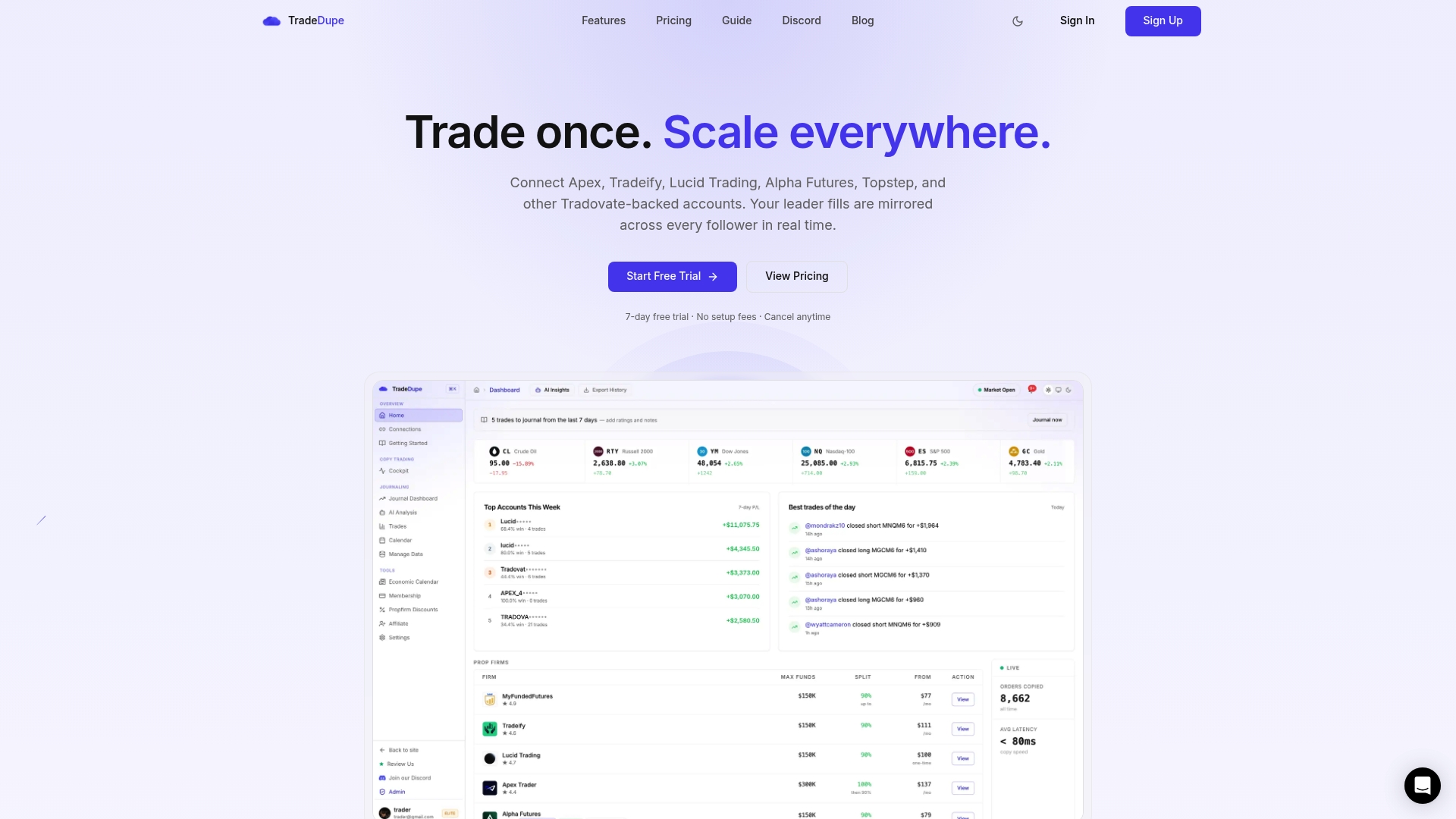
The recommended first step is a 30–60 minute demo test: run micro-trades through the Tradedupe futures copier, measure p50 latency, confirm the kill-switch fires, and reconcile fills against the master journal before onboarding any funded account. For teams ready to move to production, start your setup or contact the Tradedupe team for a production trial tailored to your account pool size and prop firm mix.
Useful sources and further reading
The sources below are the primary references for the regulatory guidance, execution-quality frameworks, and operational design covered in this guide.
- FINRA Rule 5310 — Best Execution: The governing rule for best-execution supervisory obligations in the U.S. Consult this first for audit preparation and when drafting written supervisory procedures.
- SEC — Trade Execution: The SEC's public guidance on order routing, price improvement, and broker disclosure obligations. Use this to understand the disclosure requirements that apply to automated order-handling systems.
- CFA Institute — Trade Strategy and Execution: The authoritative framework for implementation shortfall decomposition and execution-quality evaluation. Reference this when building your KPI measurement methodology.
- Prop Firm Consistency Blueprint: Operational detail on multi-account routing, fingerprinting mitigations, and aggregated drawdown management. Use for technical implementation guidance.
- Tradedupe — Tradovate Trade Copier: Platform-specific configuration notes, telemetry features, and acceptance-testing guidance for Tradovate desks.
- VPS and copier architecture best practices: Infrastructure recommendations for latency reduction and network isolation in funded-account environments.
This article is general information for professional traders and does not constitute legal, financial, or compliance advice. Confirm current regulatory requirements with FINRA, the SEC, or a qualified compliance professional for your specific situation.