
Why Prop Firms Offer Funded Accounts: Trader's Guide
TradeDupe
10 min read
Discover why prop firms offer funded accounts and how this impacts your trading success. Get insights on profit splits and evaluation strategies!
If you've explored prop trading, you've likely asked yourself why prop firms offer funded accounts rather than simply trading their own capital in-house. The answer reveals a business model that is more calculated than charitable. Prop firms use funded accounts to filter for edge, limit their own downside, and capture a share of skilled trader output at scale. Understanding this dynamic changes how you approach every evaluation, every drawdown rule, and every payout conversation.
Table of Contents
- Key takeaways
- Why prop firms offer funded accounts: the business model explained
- Benefits of funded accounts for traders
- Funded account models compared: evaluation vs. instant
- How prop firms attract and retain quality traders
- My take on funded accounts after years of watching traders get this wrong
- Scale your funded accounts with Tradedupe
- FAQ
Key takeaways
| Point | Details |
|---|---|
| Funded accounts serve the firm too | Prop firms limit real risk exposure to drawdown parameters, not the headline account size. |
| Evaluation fees generate initial revenue | Firms earn from evaluation fees while screening for traders who can generate long-term profit. |
| Profit splits favor disciplined traders | Most firms offer 70% to 90% profit splits, but strict rules protect the firm from reckless behavior. |
| Model type changes your risk profile | Evaluation-based accounts tend to offer better terms and lower breach rates than instant funding programs. |
| Community drives retention | Active trader communities and transparent payouts keep profitable traders engaged long-term. |
Why prop firms offer funded accounts: the business model explained
The surface-level answer is capital access. The real answer is risk-adjusted profit extraction. Prop firms are not running charities for undercapitalized traders. They have built a model where they benefit from every outcome.
Here is how the structure works in practice:
- Evaluation fees as revenue. Before a trader ever touches a funded account, they pay to attempt an evaluation challenge. These fees typically range from $10 to $1,600 depending on account size. A firm running thousands of evaluations per month generates substantial income before a single payout is made.
- Drawdown as the real risk cap. The headline account balance is misleading. A $100,000 funded account with a 10% maximum drawdown means the firm's actual exposure is $10,000. The funded amount is a position sizing base, not capital at genuine risk. This distinction matters enormously when you understand why firms can afford to offer large nominal account sizes.
- Profit-sharing aligns incentives asymmetrically. When a trader profits, the firm collects its share automatically. When a trader loses, the drawdown limit terminates the account before losses exceed the pre-set cap. The firm wins on fees, wins on profitable traders, and limits losses through hard rules.
- Scale through technology. The prop sector is valued at $20 billion, and the leading firms operate as technology businesses running global evaluation funnels, not traditional trading desks. The funded account product is the monetized output of that tech infrastructure.
Pro Tip: Read the drawdown rules before calculating your potential earnings. The drawdown type, whether trailing intraday or end-of-day static, determines how much real buffer you have and can be the difference between a successful pass and a breach on a normal trading day.
Evaluation-based models screen traders under precise drawdown limits and profit targets, which filters out undisciplined participants before any real capital is at risk. The firms that survive long-term are the ones treating this as a volume funnel, not a one-time fee collection.
Benefits of funded accounts for traders
Understanding the prop firm's motivation does not diminish the genuine advantages available to you as a trader. The structure creates real opportunity when approached correctly.
- Access to institutional-scale capital. Most retail traders operate with accounts too small to generate meaningful income from a consistent 1-2% monthly edge. A funded account of $50,000 to $200,000 transforms that same edge into real income. Skilled traders gain access to leverage and order routing they could not replicate personally.
- Personal financial risk is capped at the evaluation fee. You are not risking the funded capital out of your own pocket. A failed evaluation costs you the entry fee, which is a defined, small loss. This is a structurally favorable risk profile compared to trading your own account where losses come directly from your savings.
- Profit splits are trader-favorable at the top tier. Most funded accounts offer 70% to 90% profit splits to the trader, sometimes increasing through tiered scaling programs as your track record grows.
- Institutional-grade data and execution tools. Many prop firms provide access to professional order flow tools, depth-of-market data, and fast execution infrastructure that retail accounts cannot access without significant monthly costs.
- Scaling paths reward consistency. Firms that offer scaling programs increase your account size when you hit performance milestones. A trader who passes at $50,000 and demonstrates consistent results can eventually manage $200,000 or more, compounding their earning potential without adding personal risk.
The trade-offs are real, though. You operate under strict rules covering drawdown limits of 3% to 10% of account balance, position size restrictions, consistency requirements, and sometimes daily loss limits that can cut a trading session short. Visit the prop firm consistency rule guide to understand how firms like Topstep, Apex, and Tradeify structure their behavioral requirements.
Pro Tip: Use a profit split calculator before committing to an evaluation. The difference between an 80% and 70% split on a $100,000 account generating $3,000 per month is $300 monthly compounded over a year. Those numbers matter.

Funded account models compared: evaluation vs. instant
Not all funded accounts are built the same way, and the model type shapes your actual trading experience more than the headline numbers suggest.
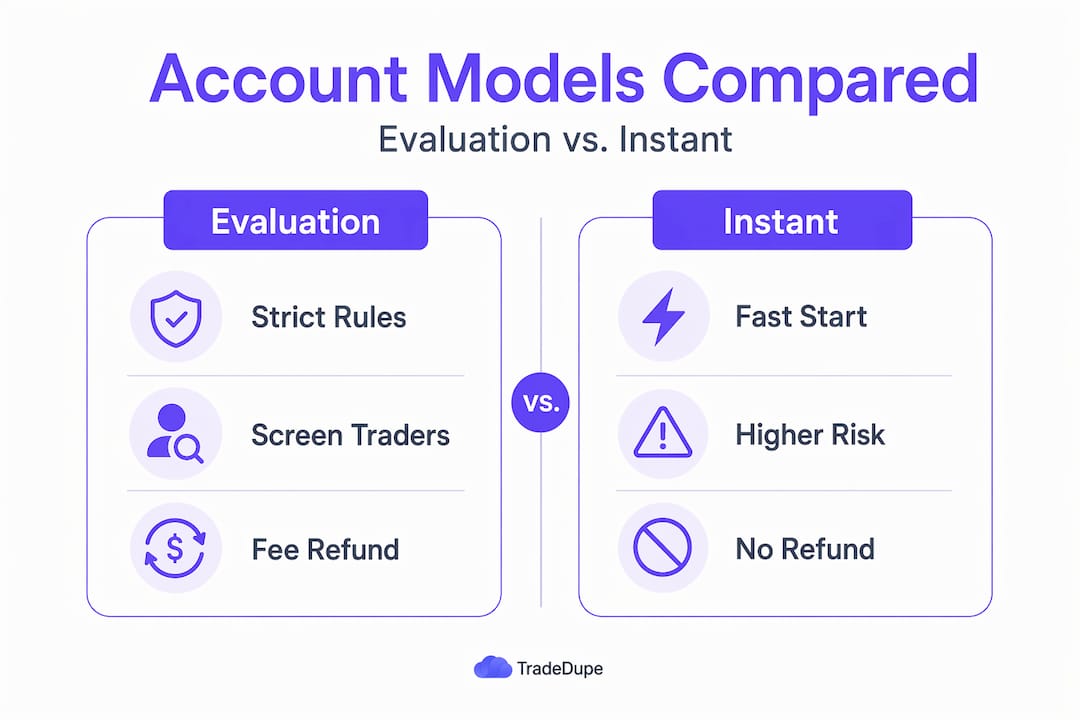
| Feature | Evaluation-based | Instant funding |
|---|---|---|
| Onboarding speed | 1 to 4 weeks (evaluation period) | Immediate access |
| Profit split | 70% to 90% | Often 50% to 75% |
| Breach risk | Lower with structured vetting | 4x higher breach risk than evaluation |
| Drawdown type | End-of-day or trailing (firm-specific) | Often stricter trailing intraday |
| Fee structure | Evaluation fee, sometimes refundable | Higher upfront or subscription cost |
| Simulated vs. live | Usually simulated, real payouts from firm | Typically simulated as well |
| Sustainability for trader | Higher with clear rules and scaling | Riskier due to tight constraints |
The evaluation model exists because it filters out traders who cannot maintain discipline across a multi-stage test. Instant funding shortcuts that process, but the firm compensates for increased exposure through tighter trailing drawdowns and lower profit splits. Instant funding carries significantly higher breach risk compared to evaluation-based counterparts.
One structural reality worth internalizing: most funded accounts, regardless of model, operate on simulated account infrastructure. Your trades are not being routed directly to live markets. Payouts are real and come from the firm's balance sheet, but you are operating within a mirrored environment. This has execution implications for latency-sensitive strategies and is a regulatory consideration firms navigate differently across jurisdictions.
Evaluation-based firms that offer evaluation fee refunds upon passing signal something meaningful about their business model. It tells you they are confident in earning revenue from your funded trading performance, not just from your failed attempts.
How prop firms attract and retain quality traders
Acquiring a trader is expensive. Keeping a profitable one is the actual business. The cost of acquiring a funded trader through paid channels averages $4 to $7 per click, and conversion rates through multi-stage evaluations are low. This is why the best prop firms invest heavily in retention once a trader is funded.
The retention mechanics worth understanding:
- Fast, transparent payouts. Firms that process payouts within 24 to 48 hours build the reputation that serious traders respond to. In a market full of competing offers, payout reliability is the clearest competitive differentiator. Explore how trade execution reliability connects to this broader credibility.
- Active trader communities. Discord and Telegram communities around prop firms are not just marketing assets. Active communities improve trader accountability and retention by two to three times compared to firms without them. Peer accountability reduces rule breaches, which benefits both the trader and the firm.
- Tiered scaling programs. Increasing a funded trader's account size at defined milestones gives traders a reason to stay. A trader hitting a ceiling with one firm will leave for a competitor offering growth. Tiered scaling converts short-term evaluation customers into long-term funded partners. Read more about scaling a funded account once you have passed your evaluation.
- Refund policies on evaluation fees. Firms that refund fees upon successful funding demonstrate alignment with the trader's success, not just their failure.
The most effective prop firms treat funded account offerings as the product at the center of a flywheel. Profitable traders generate payout activity, refer peers, and contribute to community credibility. That credibility reduces acquisition costs over time.
My take on funded accounts after years of watching traders get this wrong
I've watched traders approach funded accounts with the same mindset they bring to a lottery ticket, hoping the large nominal balance will bail out an unproven strategy. It does not work that way, and I say that without judgment because the marketing around these programs makes it easy to misread the structure.
What I've come to understand is that funded accounts function like call options on your own trading skill. The evaluation fee is your premium. The funded account is the payoff if you execute with discipline. The drawdown limit is your expiry. Miss the discipline component, and the option expires worthless regardless of how large the notional account appears.
In my experience, the traders who succeed long-term treat every funded account as borrowed credibility. They respect the drawdown buffer with more care than they would their own capital, precisely because violating it closes a door that took real effort to open. The move toward end-of-day drawdown models from intraday trailing methods has made this more favorable for consistent traders, but the mindset requirement has not changed.
My candid view on instant funding: it is a trap for traders who have not yet proven they can pass an evaluation. If you cannot demonstrate disciplined performance over a structured challenge, skipping the vetting process does not fix the underlying problem. It accelerates the breach.
> — Andres
Scale your funded accounts with Tradedupe
For traders running multiple funded accounts across firms like Apex, Topstep, or Tradeify on Tradovate, managing execution consistency manually becomes a limiting factor at scale.
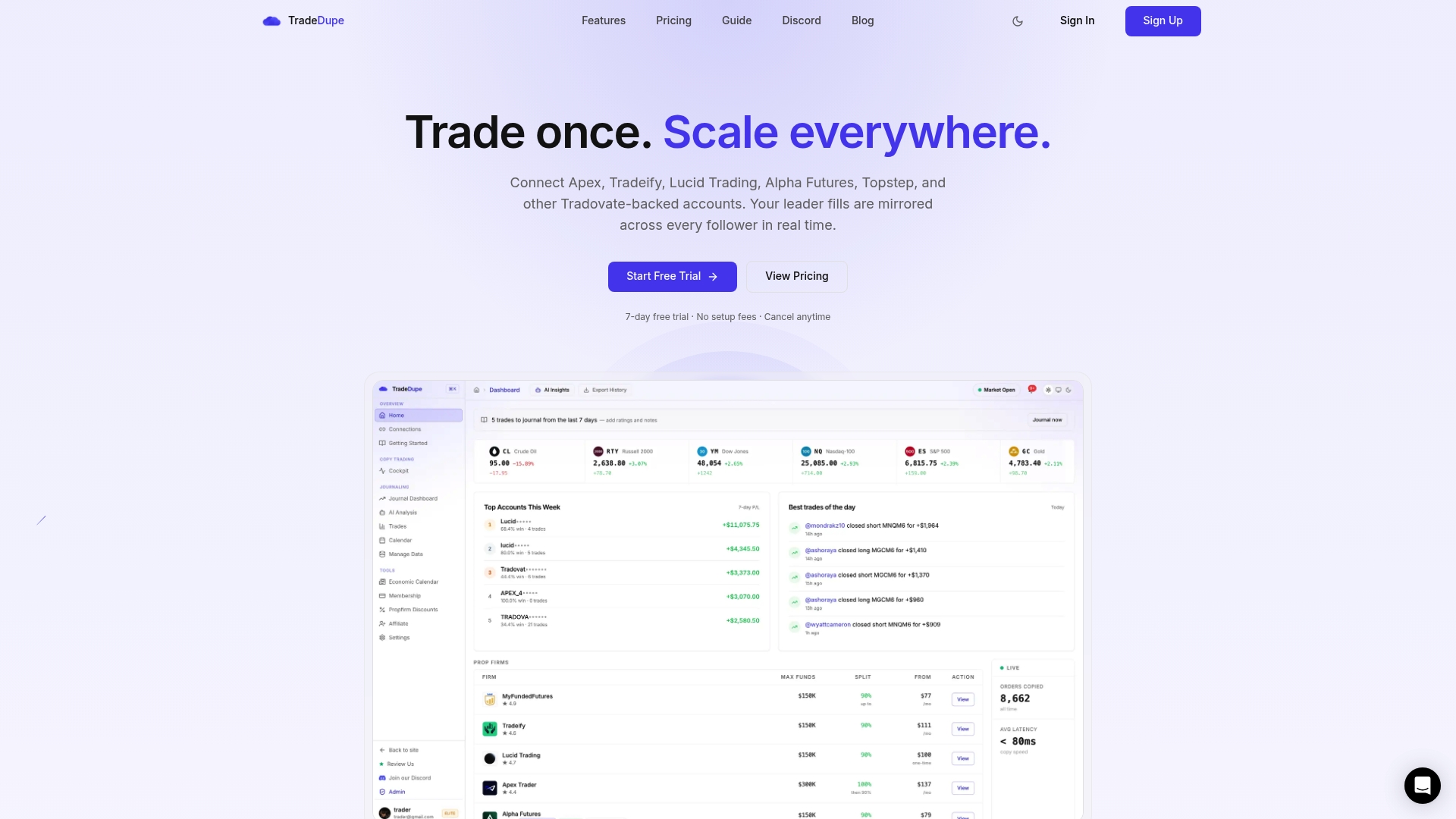
Tradedupe was built specifically for this. The platform mirrors trades in real time from a single lead account to multiple follower accounts with a median latency of 34ms. That means your strategy executes consistently across all your funded accounts without the manual overhead or timing variance that creates rule breaches. Tradedupe includes rogue-trade detection, auto-recovery, and per-account toggle controls so you stay within firm risk parameters across every account simultaneously. Whether you are managing two accounts or building a prop desk, Tradedupe's copy trading platform gives you the execution infrastructure to operate at scale without sacrificing compliance.
FAQ
What are funded accounts in prop trading?
Funded accounts are trading accounts provided by proprietary trading firms that give skilled traders access to firm capital after passing an evaluation. Traders keep 70% to 90% of profits while the firm limits its exposure through strict drawdown rules.
Why do prop firms offer funded accounts instead of trading themselves?
Prop firms use funded accounts to source trading talent at scale while capping their financial exposure through drawdown limits. The model generates revenue from evaluation fees and profit splits without requiring the firm to employ full-time in-house traders.
Is instant funding better than evaluation-based funding?
Evaluation-based funding is generally more favorable for serious traders. Instant funding carries 4x higher breach risk and typically offers lower profit splits and stricter drawdown conditions than programs that include a structured evaluation phase.
What is the real risk to the firm in a funded account?
The firm's actual exposure is capped at the drawdown limit, not the headline account balance. On a $100,000 account with a 10% drawdown, the maximum firm loss is $10,000, making the risk model far more conservative than the large account sizes suggest.
How do prop firms keep their best traders?
The most effective prop firms retain quality traders through fast payout processing within 24 to 48 hours, tiered scaling programs, and active community engagement that reduces rule breaches and builds long-term loyalty.
Recommended
- How to Trade Prop Firms (2026): A Practical Playbook to Pass and Keep a Funded Account | TradeDupe Blog
- What Happens After You Get Funded? Scaling a Prop Firm Account the Right Way | TradeDupe Blog
- What is Apex futures account explained: a guide for prop traders | TradeDupe Blog
- Best Futures Prop Firms 2026 — Updated Rankings | TradeDupe Blog