

Why Reliable Trade Execution Matters for Prop Firms
TradeDupe
12 min read
Discover why prop firms need reliable trade execution. Learn how execution quality impacts performance, especially in volatile markets.
Many prop trading desks still equate execution quality with raw speed, assuming that low-latency routing alone determines whether a strategy performs as designed. That assumption breaks down fast. Volatility acts as a stress test that exposes weaknesses in execution speed, spread stability, and liquidity access simultaneously. For risk managers and prop firms operating multiple Tradovate accounts, the real question is not how fast orders reach the exchange during calm sessions, but whether the entire execution stack holds together when order flow compresses into seconds and markets move against thin liquidity. This article breaks down what true execution reliability looks like, how to measure it, and what separates top-performing firms from those that bleed P&L through hidden execution failures.
*
Table of Contents
- The true cost of unreliable trade execution in prop trading
- What makes trade execution truly 'reliable' for prop firms?
- How prop firms and risk managers evaluate execution reliability
- Core technologies and strategies to achieve execution resilience
- Why most prop firms still underestimate execution reliability, and what separates top performers
- How TradeDupe empowers prop firms seeking reliable trade execution
- Frequently asked questions
Key Takeaways
| Point | Details |
|---|---|
| Reliability beats speed alone | Trade execution must handle stress and maintain fill quality, not just fast average latency. |
| Measure under real conditions | Firms evaluate fills versus orders during volatility, not just in backtests or calm markets. |
| Infrastructure drives results | Invest in resilient, redundant systems to prevent costly failures and slippage at scale. |
| Continuous auditing is key | Regular, stress-tested audits expose weak links before they threaten firmwide P&L. |
| Specialized solutions exist | Platforms like TradeDupe offer built-in reliability features to boost multi-account performance. |
The true cost of unreliable trade execution in prop trading
After previewing how volatility exposes execution weaknesses, it is worth breaking down what unreliable execution actually costs a prop firm on a daily operational basis. The damage is not always visible in a single trade. It accumulates.

Slippage is the most obvious cost. When a limit order intended to fill at a specific price gets executed one or two ticks away, the difference erodes expected edge. Across dozens of accounts running correlated strategies, that slippage multiplies in a way that destroys weekly P&L targets without any single dramatic failure.
Beyond slippage, unreliable execution creates operational noise that risk managers struggle to distinguish from strategy underperformance:
- Order rejections that force manual re-entry, creating unintended position gaps
- Delayed fills that cause entries to occur after the intended price window has closed
- Inconsistent pricing where two identical orders on different accounts receive materially different fills during the same market event
- Partial fills that leave accounts with asymmetric exposure and incomplete position sizing
- Connection drops that interrupt order routing entirely, leaving open positions unmanaged
> "Scaling activity reveals weaknesses in broker and execution operations, especially under volatility, where infrastructure stress magnifies every latency and fill-quality gap."
The compounding effect across multiple accounts is what makes unreliable execution genuinely dangerous at the prop firm level. A single account experiencing a 15% fill rejection rate during a high-volatility news event is a manageable incident. Fifteen accounts experiencing the same failure simultaneously is a risk event. This is exactly why copy trade systems for risk control have become a core part of professional multi-account management, because they allow risk managers to monitor and respond to systemic execution failures, not just individual account anomalies.
The hidden cost that rarely appears in post-trade analysis is opportunity cost. When execution degrades during high-momentum moves, strategies miss entries entirely. The trader sees a flat position and assumes the market did not trigger the signal. The reality is that the order was queued, delayed, or rejected, and the move happened without participation. Over time, this skews the historical performance record and makes strategy evaluation unreliable.
*
What makes trade execution truly 'reliable' for prop firms?
With the risks clear, the next step is defining what a truly reliable execution environment actually requires. Reliability is not a single variable. It is a system property that emerges from multiple interdependent components working correctly under stress.
The following comparison illustrates how execution quality breaks down across different scenarios:
| Execution factor | Calm market performance | Volatile market performance |
|---|---|---|
| Fill rate | 98%+ on limit orders | May drop below 85% without resilient routing |
| Latency | Consistently sub-50ms | Can spike to 200ms+ without redundancy |
| Spread stability | Tight, predictable | Widens significantly without liquidity depth |
| Infrastructure uptime | 99.9%+ | Single-channel setups see more disruption |
| Multi-account consistency | Uniform fill quality | Diverges without smart order routing |
The table makes one thing obvious: speed alone does not guarantee reliability. A broker or platform might route orders in 30 milliseconds under normal conditions but fail to maintain spread and liquidity standards when volatility compresses the book. That is not execution resilience. That is only execution speed.
For prop firms managing multiple accounts through Tradovate, multi-account routing introduces an additional layer of complexity. When a leader account triggers an order and that order must replicate across ten or twenty follower accounts simultaneously, the order routing logic must handle concurrent requests without creating queue delays for later accounts in the sequence. The last account to receive the replicated order should not experience materially worse fills than the first. This requires intelligent sequencing, not just fast data transmission.
Trade copier software features like per-account toggle controls, auto-recovery after connection interruptions, and rogue-trade detection directly address these multi-account routing risks. Without them, a single connection failure can leave a follower account in an unintended state, exposed to a position that the leader has already exited.
Pro Tip: Never evaluate a broker or copy trading platform only during calm market sessions. Specifically test behavior during major economic releases, Federal Open Market Committee announcements, or after-hours gap events. Execution quality during those windows reveals the real infrastructure capacity, not the marketing benchmark.
The concept of security and reliability in trading also extends beyond pure speed. Authentication integrity, session stability, and protection against unauthorized order submission are all components of a truly reliable trading environment, especially when multiple accounts are linked through automated systems.
*
How prop firms and risk managers evaluate execution reliability
Once the requirements for reliability are established, professionals need structured methods to validate execution performance rather than relying on subjective impressions. A systematic evaluation process includes the following steps:
- Establish baseline fill rate data. Collect intended order count versus confirmed fill count over at least 30 trading days, segmented by market session and volatility regime.
- Audit fill quality under stress. Isolate execution data from high-volatility periods, specifically comparing average fill deviation during those periods against calm-session benchmarks. A platform that performs identically in both conditions is demonstrating genuine resilience.
- Measure latency under concurrent load. For multi-account setups, test replication latency when ten or more accounts execute simultaneously. The 95th percentile latency figure matters more than the median.
- Analyze rejection and partial fill rates. Track what percentage of orders are rejected outright or receive partial fills during volatility, and identify whether rejections cluster around specific instruments or times of day.
- Review spread behavior during news events. Compare the effective spread on filled orders during scheduled economic releases versus identical instruments during normal sessions. Spread degradation during volatility is a direct execution cost.
- Test recovery behavior after connection disruption. Simulate a brief connectivity interruption and measure how quickly the system restores full execution capability and whether any open positions were left unmanaged during the gap.
The following table provides a practical reference for the key metrics risk managers should benchmark regularly:
| Metric | Acceptable threshold | Warning threshold | Critical threshold |
|---|---|---|---|
| Fill rate (calm markets) | 98%+ | 94 to 97% | Below 94% |
| Fill rate (volatile markets) | 92%+ | 87 to 91% | Below 87% |
| Average latency | Under 50ms | 50 to 100ms | Over 100ms |
| Stressed latency (95th pct) | Under 150ms | 150 to 300ms | Over 300ms |
| Spread stability | Within 1 tick of quoted | 1 to 2 ticks deviation | Over 2 ticks deviation |
| Recovery time after disruption | Under 5 seconds | 5 to 15 seconds | Over 15 seconds |
Execution reliability should be measured by realized fills versus intended orders under stressed conditions, which is the benchmark framework serious risk managers use. Average-case metrics are starting points, not conclusions.
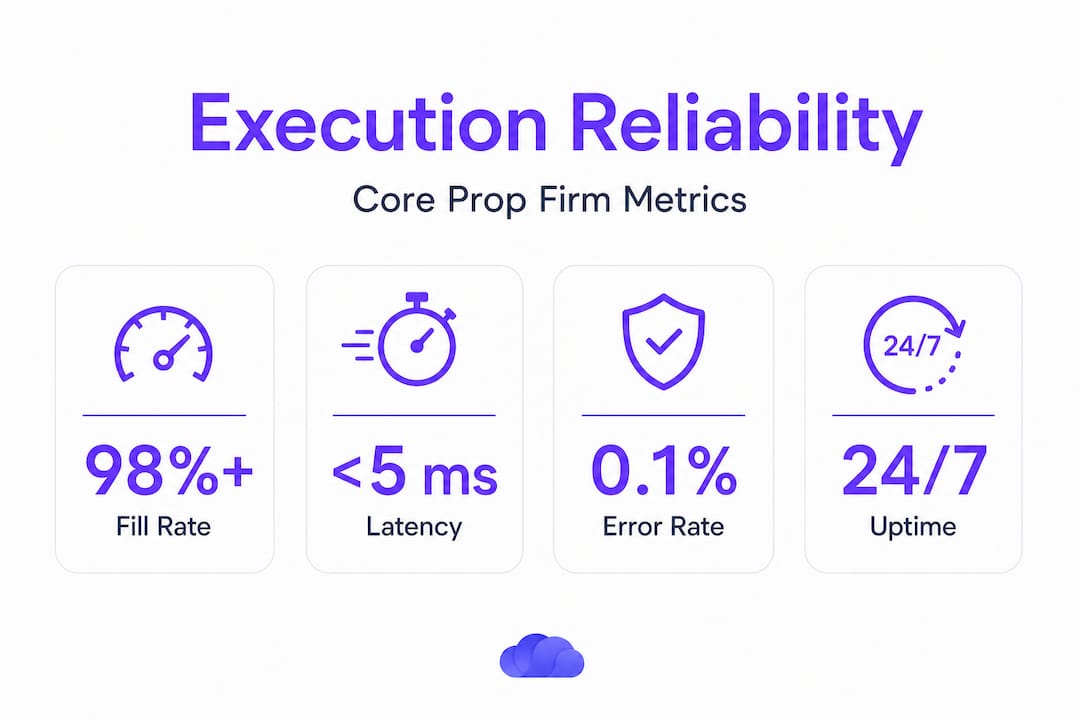
Reviewing execution evaluation benchmarks across different platforms helps establish realistic baselines for what best-in-class performance actually looks like in the Tradovate ecosystem. You can also reference top trade copier benchmarks to understand how leading platforms compare on latency and fill consistency. For Tradovate-specific multi-account environments, real-time account sync strategies add another dimension to the evaluation by addressing how sync delays compound across follower accounts during high-frequency replication.
*
Core technologies and strategies to achieve execution resilience
After establishing what to measure, the practical question becomes: what infrastructure and software choices actually produce resilient execution at scale? Serious firms invest in resilient infrastructure and technology specifically to prevent execution quality degradation during volatile periods. Here is what that investment looks like in practice.
Key technologies for execution resilience:
- Smart order routing (SOR). Routes orders dynamically based on real-time liquidity conditions, avoiding thin books and reducing the probability of partial fills or rejections during volatility.
- Multi-channel redundancy. Maintains parallel data and order pathways so that a single connection failure does not halt execution entirely. When the primary channel degrades, the secondary channel handles routing without manual intervention.
- Co-located or low-latency data feeds. Reduces the time between a market event and order generation, ensuring that signals are generated from current price data rather than stale feeds.
- Auto-recovery mechanisms. Automatically reconnects and resynchronizes account states following session interruptions, preventing open positions from being left unmonitored.
- Rogue-trade detection. Identifies and flags order activity that falls outside pre-defined parameters, protecting against both technical errors and unauthorized executions.
Execution resilience strategies for multi-account prop desks:
- Segment follower accounts by risk tier so that critical accounts receive order priority during high-load replication events
- Conduct weekly stress simulations that replicate the order volume of a high-volatility session to identify bottlenecks before live markets expose them
- Maintain a real-time monitoring dashboard that displays sync status, latency, and fill quality per account rather than relying on aggregate figures
- Establish clear circuit breakers: predefined conditions under which specific accounts are automatically suspended from receiving replicated trades until manual review is completed
- Review the 2026 futures day trading landscape regularly to understand how market structure changes affect execution dynamics across instruments
Pro Tip: Schedule quarterly infrastructure audits that simulate high-volume, high-volatility scenarios across your full account stack. Use those results to update your fill rate thresholds and stress latency benchmarks. Markets evolve, and so should your testing parameters.
The combination of smart routing, redundancy, and active monitoring does not just protect against catastrophic failures. It produces the day-to-day execution consistency that allows strategy performance to reflect actual edge rather than infrastructure noise.
*
Why most prop firms still underestimate execution reliability, and what separates top performers
Here is the uncomfortable reality: most prop firms that experience execution-related losses never correctly attribute those losses to execution. They attribute them to the strategy, the market conditions, or trader discipline. This misattribution persists because execution failures during volatility rarely look like failures. They look like bad fills, slippage, and slightly worse-than-expected performance. Without rigorous fill audit processes, the signal gets lost.
The deeper problem is that many firms optimize for the wrong metric entirely. Firms often focus on latency averages instead of realized fill quality in volatility, missing the true execution risks that actually determine P&L outcomes. A median latency of 34 milliseconds looks excellent in a performance report. But if the 95th percentile latency spikes to 400 milliseconds during news events, that median number is meaningless for risk management purposes.
The firms that consistently outperform their peers on execution reliability share one contrarian trait: they treat their testing process as a living system, not a one-time certification. Markets in 2026 look structurally different from markets in 2022. Liquidity distribution across instruments has shifted. Volatility clustering patterns have changed. A firm that validated its execution infrastructure three years ago and has not retested under current market conditions is operating on outdated assumptions.
The top performers also resist the temptation to conflate platform uptime with execution quality. A platform can be available 99.9% of the time and still produce consistently degraded fills during the 0.1% of the time that matters most, specifically during the high-volatility windows when position sizing and entry timing have the greatest impact on P&L.
What genuinely separates elite prop desks is their commitment to treating execution reliability as a continuous operational discipline rather than a setup-and-forget technical requirement. They audit fills, stress-test their infrastructure, evolve their benchmarks, and hold their tooling providers accountable to measurable standards. That rigor, more than any single technology choice, is what produces durable execution performance.
*
How TradeDupe empowers prop firms seeking reliable trade execution
For prop firms managing multiple Tradovate accounts, the gap between theoretical execution reliability and operational reality often comes down to the tools in the stack. Reliable execution at scale requires more than a fast internet connection and a quality broker.
TradeDupe addresses the specific pain points that multi-account prop desks face, including synchronized order replication with a median latency of 34 milliseconds, rogue-trade detection, per-account toggle controls, and auto-recovery after connection disruptions. These features directly target the failure modes that cost firms P&L through execution inconsistency. The platform's platform reliability architecture is built to maintain sync integrity under the same volatile conditions where other systems degrade. For firms looking to explore Tradovate copy trading with a focus on resilience rather than just speed, TradeDupe provides real-time monitoring dashboards, fill auditing analytics, and easy desktop authentication to keep access secure and session continuity intact across all accounts.
*
Frequently asked questions
How do prop firms identify unreliable trade execution before it causes losses?
They monitor fills versus intended orders during volatile periods and run regular audits for abnormal slippage patterns or elevated order rejection rates, catching degradation before it compounds into significant P&L damage.
Why is average execution speed not enough for true reliability?
Volatility exposes execution weaknesses that average-case metrics miss entirely, meaning a platform with impressive median latency can still fail to deliver quality fills during the high-stakes windows that determine overall profitability.
Which technologies are essential for resilient multi-account trade execution?
Redundant routing, fast and reliable data feeds, and auto-recovery mechanisms are essential foundations, complemented by resilient technology investment in regular infrastructure audits and stress-testing protocols.
What metric matters most for risk managers in trade execution?
The rate of realized fills versus intended orders during market stress is the most critical metric, as it directly measures whether the execution system performs when position accuracy matters most.
How can prop firms regularly test their own execution reliability?
By simulating high-volume trading scenarios across the full account stack and auditing each layer of the trading infrastructure for latency bottlenecks, fill degradation, and recovery gaps under realistic stress conditions.
Recommended
- Prop Firm Consistency Rule Guide (2026): Topstep, Apex, Tradeify, MFFU Rules Explained | TradeDupe Blog
- How to Trade Prop Firms (2026): A Practical Playbook to Pass and Keep a Funded Account | TradeDupe Blog
- Prop Firms With No Consistency Rule (2026): The Honest List
- Best Trade Copier for Prop Firms in 2026 (Honest Comparison) | TradeDupe Blog