Why Prop Traders Mirror Trades: Strategy and Compliance
TradeDupe
11 min read
Discover why prop traders mirror trades to boost efficiency and compliance. Learn how this strategy can amplify profits and simplify trading!
Trade mirroring is the practice of automatically replicating positions from one master account to multiple follower accounts in real time, and prop traders use it to scale a single proven strategy across several funded accounts simultaneously. The industry term for this workflow is account mirroring or trade copying, and understanding why prop traders mirror trades requires examining both the performance benefits and the compliance constraints that shape how it gets done. Platforms like TradeDupe and TradeSyncer have built entire product lines around this need, specifically for traders operating within firms like Apex Trader Funding, Topstep, and Tradeify. Done correctly, mirroring multiplies your earning potential without multiplying your analytical workload.
Why prop traders mirror trades: the core strategic case
The primary reason prop traders mirror trades is capital efficiency. A trader who passes multiple prop firm evaluations holds several funded accounts, each with its own profit target and drawdown limit. Manually executing the same trade across five or ten accounts in real time is operationally impossible. Mirroring software closes that gap by replicating order flow from a single lead account to all follower accounts within milliseconds.
The benefits of copying multiple accounts compound quickly. A trader running five $50,000 funded accounts earns on five separate profit splits rather than one, without generating five separate trade plans. The strategy does the same work; the infrastructure multiplies the output.

There is also a risk management argument. When a trader concentrates all activity in one account, a single drawdown event can end their funded status entirely. Spreading the same strategy across accounts with staggered entry points and independent drawdown clocks creates a form of operational redundancy. One account breaching its trailing drawdown does not automatically terminate the others.
What is trade mirroring and how does it work?
Trade mirroring operates through a leader-follower architecture. The leader account executes trades normally through a broker interface. The mirroring software detects each order event and sends a corresponding instruction to every follower account registered in the system. TradeDupe, for example, achieves a median replication latency of 34ms on the Tradovate platform, which is fast enough to preserve fill quality across accounts.
Internal versus external copying is the foundational distinction every prop trader must understand:
- Internal copying means replicating your own trades from one of your accounts to another of your accounts. Most major prop firms permit this.
- External copying means mirroring trades from a third-party signal provider or another trader's account. Prop firms broadly restrict this because it undermines the skill-based evaluation process.
- Cloud-based copiers route instructions through remote servers, which can expose shared IP addresses and trigger group-trading flags.
- Locally hosted copiers run on your own machine, producing unique IP signatures that more closely resemble manual trading behavior.
- Platform integrations vary: TradeDupe connects natively to Tradovate, while other tools support NinjaTrader and MetaTrader 5.
The mechanics matter because prop firms do not simply trust traders to self-report. They monitor execution data continuously, and the architecture you choose directly affects whether your mirroring activity looks like independent trading or coordinated copying.
Why do prop firms restrict trade mirroring?
Prop firms restrict trade mirroring primarily to control correlated risk. When 50 accounts copy the same failing trade simultaneously, the firm absorbs 50 times the loss exposure from a single bad decision. Mass mirroring creates scaled losses that no risk model can absorb sustainably, which is why group trading clauses appear in nearly every funded account agreement.
Evaluation integrity is the second concern. Prop firm evaluations exist to verify that a trader can generate consistent, independent returns. Copying an external signal source bypasses that test entirely. The critical policy line is whether trades originate from the trader's own analysis or from an outside source, and firms enforce this distinction aggressively.
Detection is more sophisticated than most traders realize. Prop firms use statistical pattern analysis rather than software scans to identify copying. The signals they look for include:
- Nearly identical execution timestamps across multiple accounts, sometimes within milliseconds
- Position-size ratios that match a known signal-scaling formula
- Sequential trade correlation that mirrors a published signal feed
- IP address clustering that suggests accounts are managed from a shared server
> "Compliance failures often arise from synchronization of trade execution timestamps, not just raw profitability. Firms infer copying when multiple accounts act simultaneously within milliseconds." — How Prop Firms Monitor Copy Trading Activity
Understanding this detection framework changes how you configure your mirroring setup. The goal is not to hide activity but to ensure that legitimate internal copying does not produce the same statistical signature as prohibited external copying.
What are the common risks of mirroring across funded accounts?
Mirroring trades across multiple funded accounts introduces operational risks that do not exist when trading a single account. Recognizing them before you scale is the difference between a profitable multi-account operation and a compliance incident.
- Execution latency and slippage. Follower accounts fill after the leader, sometimes at worse prices. In fast-moving futures markets, a 200ms delay on an ES or NQ trade can mean several ticks of slippage. Follower accounts may fill worse or breach drawdown limits due to delays and different account states, which means a trade that is profitable in the leader can be marginally losing in a follower.
- Drawdown rule divergence. Each funded account carries its own drawdown parameters. A trailing drawdown account at Apex Trader Funding behaves differently from a static drawdown account at Topstep. Blindly replicating identical position sizes without accounting for each account's current equity state is a reliable path to rule violations.
- Platform disconnections and partial fills. Network interruptions during a mirroring session can leave follower accounts in open positions while the leader has already closed. This creates unintended overnight exposure and potential margin issues.
- IP address and device fingerprint monitoring. Firms flag accounts exceeding three unique IP addresses in a single day. Logging into multiple accounts from different locations or devices within the same session triggers a compliance review.
- Position sizing mismatches. A $150,000 leader account and a $50,000 follower account cannot carry the same contract count. Failing to apply proportional sizing exposes the smaller account to outsized risk relative to its drawdown limit.
Pro Tip: Before activating mirroring on any new follower account, document its specific drawdown type, daily loss limit, and consistency rule. Build those parameters into your copier's risk settings before the first trade fires.
How can prop traders mirror trades while staying compliant?
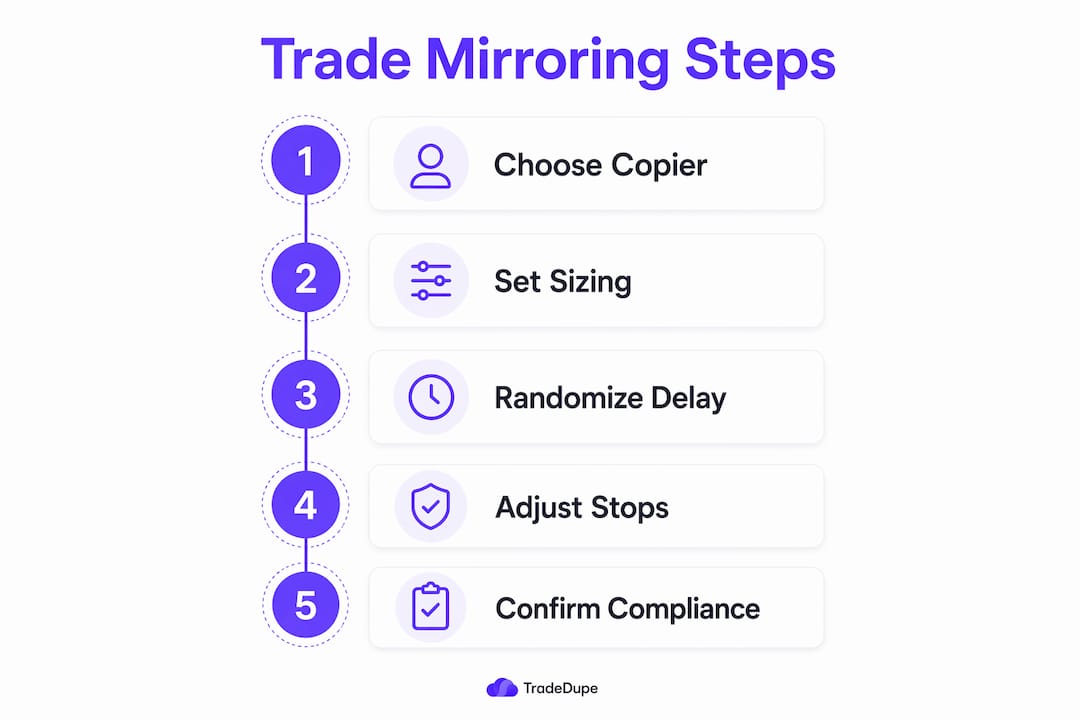
Compliant trade mirroring is achievable with the right configuration. The framework below applies whether you are managing two accounts or twenty.
Use a local copier, not a cloud copier. Local trade copiers running on personal machines produce unique IP addresses and trade patterns that avoid the group-trading detection common in cloud-based solutions. Cloud copiers route through shared server farms, and that shared infrastructure is exactly what compliance algorithms flag.
Apply proportional position sizing. Using a multiplier based on follower-to-master equity ratios is the standard method for maintaining consistent risk levels. If your leader account is $100,000 and a follower is $50,000, the follower should carry half the contract count. This preserves the risk-to-equity relationship across all accounts.
Introduce randomized execution delays. A small, randomized delay of 50 to 500 milliseconds between the leader fill and the follower order prevents the synchronized timestamp pattern that triggers statistical detection. Most professional copier tools include this as a configurable parameter.
Vary stop and target levels modestly. Accounts with identical stop-loss and take-profit levels on every trade create a strong correlation signal. Adjusting these by one or two ticks per account while preserving the overall trade thesis reduces pattern detectability without meaningfully changing risk.
Understand each firm's specific policy. Firms like Apex Trader Funding explicitly address copy trading for eval and PA accounts, and their policies differ from firms like Tradeify. Reading the terms of service for each funded account you hold is not optional. It is the foundation of every compliant mirroring operation.
Pro Tip: Contact your prop firm's support team directly and ask whether internal account mirroring is permitted under your specific account type. Get the answer in writing. This single step eliminates ambiguity and protects you if a compliance question arises later.
What technologies support effective trade mirroring for prop traders?
The trade copier market has matured significantly, and the tools available in 2026 are purpose-built for prop trading environments. The table below compares the primary options:
| Tool | Platform support | Hosting model | Key prop feature |
|---|---|---|---|
| TradeDupe | Tradovate | Local/desktop | 34ms median latency, rogue-trade detection, per-account toggles |
| TradeSyncer | NinjaTrader, Tradovate | Cloud | Multi-account dashboard, risk scaling |
| Replikanto | NinjaTrader | Local | Granular lot sizing, strategy filters |
TradeDupe is purpose-built for the Tradovate ecosystem, which makes it the natural choice for traders holding accounts at Apex Trader Funding, Tradeify, Lucid Trading, Alpha Futures, and Topstep. Its real-time account sync includes automated risk controls, stop-loss replication, and per-account toggle controls that let you pause mirroring on a specific follower without interrupting the others.
The distinction between cloud and local hosting is not just technical. It is a compliance decision. Cloud copiers are convenient but introduce shared infrastructure that resembles the server-farm signature prop firms monitor. Local desktop tools keep your trading footprint on your own machine, which is where independent traders are supposed to operate from.
Prop firm rules affecting trade copying evolve regularly, and the best tools update their feature sets accordingly. Automated risk limits, equity-based position scaling, and latency optimization are not luxury features. They are the minimum viable configuration for anyone running more than two funded accounts simultaneously.
Key takeaways
Trade mirroring scales prop trading performance across multiple funded accounts, but compliance with each firm's specific rules determines whether that scale is sustainable or short-lived.
| Point | Details |
|---|---|
| Internal vs. external copying | Internal copying is widely permitted; external signal copying violates evaluation integrity at most firms. |
| Correlated risk is the firm's concern | Fifty accounts copying one bad trade creates fifty times the loss exposure for the prop firm. |
| Detection is statistical, not software-based | Firms identify copying through timestamp synchronization and position-size ratios, not by scanning your machine. |
| Proportional sizing is non-negotiable | Apply a follower-to-master equity multiplier on every account to preserve consistent risk levels. |
| Local copiers reduce compliance risk | Desktop-hosted tools produce unique IP signatures that avoid the group-trading flags triggered by cloud copiers. |
The part most traders skip until it costs them
The traders I see run into trouble with mirroring are almost never doing anything intentionally wrong. They pass multiple evaluations, set up a copier, and start running. What they miss is that each funded account is an independent risk contract, not a clone of the master. A trailing drawdown account and a static drawdown account respond to the same trade sequence in completely different ways. Treating them identically is the operational equivalent of running the same position size on a $200,000 account and a $25,000 account.
The other mistake I see consistently is rigid copier settings. Traders configure their tool once during setup and never revisit it. Account equity changes over time. A follower account that started at $50,000 may be sitting at $42,000 after a drawdown period, which means the original sizing multiplier is now wrong. Reviewing your copier configuration monthly is not excessive. It is basic account hygiene.
My honest view is that transparency with your prop firm is underrated as a risk management tool. Most firms have compliance teams that will answer direct questions about what is and is not permitted. Traders who ask those questions before configuring their setup almost never face account terminations. Traders who assume they know the rules and proceed without checking are the ones who discover edge cases the hard way.
The technology side of this has genuinely improved. Tools like TradeDupe have made compliant internal mirroring accessible to individual traders who are not running institutional infrastructure. But the technology only works as well as the configuration behind it. Understand the rules first, then build the setup around them.
> — Andres
Scale your prop accounts with TradeDupe
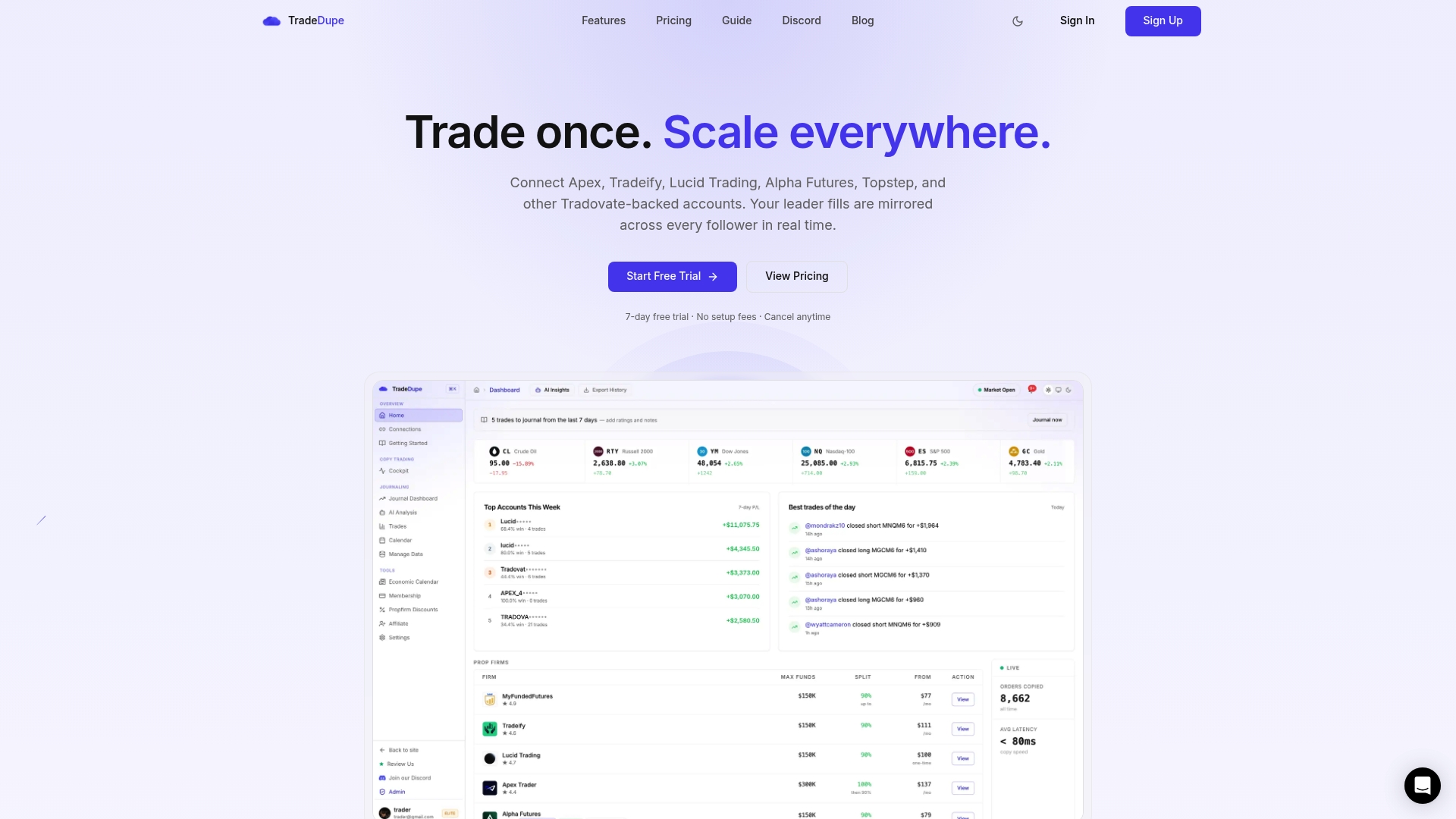
TradeDupe is built specifically for prop traders managing multiple Tradovate-connected funded accounts. Its real-time mirroring engine delivers a median latency of 34ms, with rogue-trade detection and per-account toggle controls that give you precise oversight of every follower in your stack. Whether you are running accounts at Apex Trader Funding, Tradeify, Topstep, or Lucid Trading, TradeDupe's risk controls and proportional sizing tools keep your operation within each firm's specific rules. Start mirroring your accounts today, or explore the full feature set at TradeDupe to see how the platform fits your current funded account setup.
FAQ
What does it mean to mirror trades in prop trading?
Trade mirroring means automatically replicating positions from one master account to one or more follower accounts in real time using dedicated software. Prop traders use this method to scale a single strategy across multiple funded accounts without executing each trade manually.
Is trade mirroring allowed by prop firms?
Most prop firms allow internal mirroring, where a trader copies their own trades between their own accounts, but restrict external copying from third-party signal providers. Policies vary by firm, so reviewing each funded account agreement before configuring a copier is required.
How do prop firms detect copy trading?
Prop firms use statistical pattern detection rather than software scans, looking for synchronized execution timestamps, matching position-size ratios, and IP address clustering that indicates accounts are managed from a shared server.
What is the biggest compliance risk when mirroring funded accounts?
The most common compliance failure is synchronized trade timestamps across multiple accounts, which signals coordinated copying to the firm's monitoring systems. Introducing randomized execution delays and using a locally hosted copier significantly reduces this risk.
How should position sizes be calculated when mirroring?
Position sizes should be scaled using a follower-to-master equity ratio. If the leader account holds $100,000 and the follower holds $50,000, the follower should carry half the contract count to maintain proportional risk across both accounts.