
How Trade Reporting Works for Prop Traders in 2026
TradeDupe
12 min read
Discover how trade reporting works for prop traders in 2026. Improve compliance, enhance execution speed, and minimize costs effectively.
Understanding how trade reporting works for prop traders is not a compliance formality you hand off to your back office. It is an operational discipline that directly shapes your risk posture, payout eligibility, and your firm's regulatory standing. Most prop traders treat reporting as something that happens after the trade. That mental model is wrong, and it costs firms real money. This guide breaks down the regulatory requirements, technical architecture, operational best practices, and the tools that make multi-account reporting manageable without letting reporting logic become a drag on execution speed.
Table of Contents
- Key takeaways
- How trade reporting works for prop traders: the regulatory foundation
- Technical architecture for reliable trade reporting
- Managing trade reporting across multiple accounts
- Practical tools for prop trader reporting
- Common mistakes in prop trader trade reporting
- My take on trade reporting as a prop trader
- How Tradedupe supports your multi-account reporting workflow
- FAQ
Key takeaways
| Point | Details |
|---|---|
| Reporting is not post-trade housekeeping | Regulatory trade reports must often be submitted by T+1 or in real time, making system design critical. |
| Separate execution from reporting | Decoupling reporting logic from trade execution prevents reporting failures from halting live trades. |
| Timestamps determine compliance | Mixing Eastern Time and UTC without proper conversion is one of the most frequent causes of rejected reports. |
| Tag trades at the point of entry | Labeling trades by category (news vs. non-news) supports both compliance monitoring and strategy performance review. |
| Simulated environments carry real risk | Firms offering shadow trading environments without real-time data validation can obscure true payout eligibility. |
How trade reporting works for prop traders: the regulatory foundation
Prop traders operate under a patchwork of regulatory frameworks, and the obligations differ significantly depending on your jurisdiction, asset class, and the size of your firm's assets under management.
MiFID II is the benchmark for traders operating in European markets. It mandates transaction reporting with up to 65 fields per trade and requires millisecond-level timestamp precision in certain jurisdictions. Penalties for reporting errors can reach 5% of a firm's annual turnover. Deadlines are typically T+1 end-of-day, but real-time reporting applies to specific derivatives. That is not a forgiving window when you are executing dozens of trades per session across multiple accounts.
In the U.S., FINRA's TRACE (Trade Reporting and Compliance Engine) governs fixed income securities. FINRA members must submit corrections immediately upon identifying inaccurate reports, including accurate contra-party identification. Incomplete audit trails resulting from missed corrections are a direct audit liability.
The SEC and CFTC landscape is also shifting. Proposed amendments to Form PF aim to reduce reporting burdens for private fund advisers, though these currently apply only to advisers managing $150M or more in AUM, with a comment period extending through June 2026.
Here is a quick reference for the major regulatory frameworks relevant to prop firms:
| Regulation | Jurisdiction | Reporting Deadline | Key Requirement |
|---|---|---|---|
| MiFID II | EU/UK | T+1 (real-time for derivatives) | 65+ fields, millisecond timestamps |
| FINRA TRACE | United States | 15 minutes post-trade | Contra-party ID, immediate corrections |
| SEC Form PF | United States | Quarterly/annual | AUM thresholds, fund strategy data |
| CFTC Part 45 | United States | Real-time (swaps) | Swap data repository submission |
Understanding prop firm compliance obligations at this level is not optional for traders managing funded accounts at scale. Regulators do not distinguish between a solo trader and a 20-account prop desk when violations occur.
Technical architecture for reliable trade reporting
The single most important design principle in any trade reporting system is also the one most frequently ignored at smaller prop shops: decouple your reporting logic from your execution engine.

When these two systems are tightly coupled, a failure at an Approved Reporting Mechanism (ARM) can block trade execution entirely. Separating execution from reporting reduces the risk of trade halts during reporting outages, keeping your order flow uninterrupted regardless of what happens downstream. Think of your execution engine as the front office and your reporting layer as a parallel back office. They need to share data but never share risk.
The technical methods for submitting reports vary by regulation and broker infrastructure:
- FIX protocol is the standard for high-frequency and institutional environments. It handles real-time trade capture, supports complex field mapping, and integrates cleanly with risk management systems. UTC timestamps are required here.
- Web portal submission is used by TRACE participants and many smaller firms. Eastern Time in military format is the required standard for web portal entries, not UTC. Confusing the two is among the most common causes of rejected reports.
- Batch file submission handles daily reconciliation for most equity and fixed income reports. ARM acknowledgements must be monitored in real time so that rejected reports are caught and resubmitted before the deadline window closes.
Two additional architecture concepts matter enormously at scale. First, idempotency: your reporting system must be designed so that duplicate submissions are avoided even when retries occur after a failed delivery. Without this, a single network interruption can generate duplicate trade records, triggering regulatory flags. Second, validation pipelines: trade data should pass through a pre-submission validation layer that checks required fields, timestamp format, and counterparty identifiers before the report is ever dispatched.
Pro Tip: Build your retry logic with idempotency keys tied to a unique trade identifier. This ensures that even if your reporting system fires the same report twice, the ARM or trade repository will recognize and discard the duplicate rather than recording it as a new transaction.
For more on building reliable execution systems that do not let infrastructure failures compromise your trading operations, TradeDupe's security architecture provides a practical model.
Managing trade reporting across multiple accounts
Running a single funded account is manageable. Running five, ten, or twenty accounts simultaneously across prop firms like Apex, Topstep, or Alpha Futures introduces reporting complexity that scales faster than most traders expect.
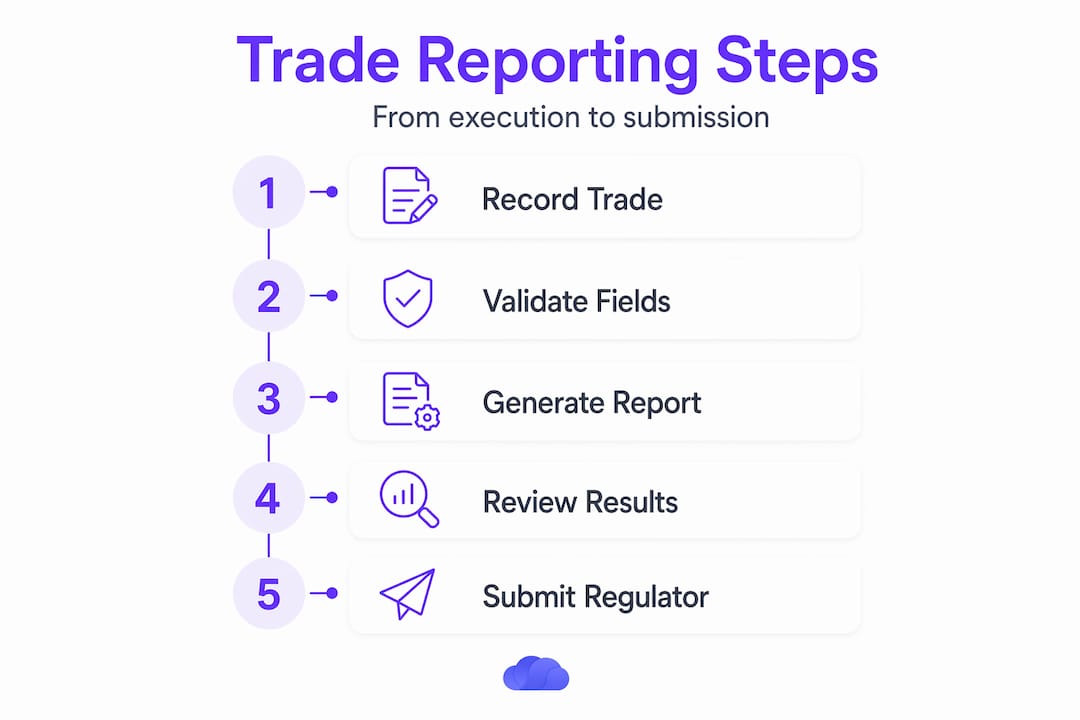
The first distinction you need to internalize is the difference between internal risk logs and external regulatory reports. These are not the same document with different audiences. Internal logs capture granular execution data including order flow, fill slippage, and risk flag events. Regulatory reports are structured filings with mandated fields. Conflating the two leads to reporting gaps during audits, because internal logs rarely contain the precise timestamp precision or counterparty fields regulators require.
Here is a practical framework for organizing trade reporting across multiple prop accounts:
- Assign a unique account identifier to every funded account before live trading begins. This identifier should propagate through every internal log entry and every regulatory report, making reconciliation between the two a deterministic process rather than a manual effort.
- Tag every trade at the point of entry by category. Tagging news vs. non-news trades allows you to isolate strategy performance issues from execution errors during post-trade review. It also supports compliance monitoring by clearly marking which trades occurred during restricted news windows.
- Maintain synchronized audit trails across all accounts. Synchronized logs across internal and external reports prevent reconciliation errors during audits and form the backbone of any compliance defense.
- Separate simulated and live trade data at the infrastructure level. Many traders run paper trading or evaluation accounts alongside funded accounts. If your reporting system does not cleanly separate these data streams, you risk contaminating live regulatory reports with simulated trade records.
- Schedule daily reconciliation checks between your internal position records and submitted reports. Discrepancies caught at T+0 are correctable. Discrepancies discovered by an auditor at T+90 are a liability.
Pro Tip: Use your performance metrics dashboard to cross-reference trade tags against reported results. Patterns in news-tagged trades that show outsized drawdowns are a signal worth investigating at the strategy level, not just the compliance level.
The shadow environment risk deserves particular attention. Firms using simulated environments without real-time validated market data retain full discretion over payout eligibility, because the trader never had access to actual market prices. Your compliance and reporting infrastructure cannot protect you from a firm that controls the data you traded on. Verifying the authenticity of your trading environment before scaling up is part of operational due diligence, not paranoia.
Practical tools for prop trader reporting
Choosing the right prop trader reporting tools reduces manual reconciliation time and eliminates the class of errors that come from human data entry. Here is how the main tool categories compare:
| Tool Type | Primary Use Case | Reporting Benefit | Key Limitation |
|---|---|---|---|
| Trade copying platforms | Multi-account replication | Synchronized audit trails across accounts | Requires Tradovate or compatible broker |
| Compliance reporting software | Regulatory submission | Automated field mapping and timestamp correction | High cost for smaller firms |
| Risk management systems | Internal position monitoring | Real-time risk flags and drawdown alerts | Not designed for regulatory filing |
| Web portal submission tools | TRACE and smaller filings | Direct submission with error feedback | Manual process, prone to entry error |
For traders managing multiple funded accounts, trade copying platforms deliver the most leverage. A platform that replicates trades from a lead account to multiple follower accounts in real time does not just save execution time. It produces a uniform, timestamped record across every account simultaneously. That uniformity is exactly what audit trails for multiple accounts require.
Pro Tip: When evaluating any trade copying or reporting platform, ask specifically how it handles rejected trades and retry logic. A platform that silently drops failed replications creates invisible gaps in your audit trail that surface only during regulatory review.
Integrating your trade copying infrastructure with a real-time validated market data feed also closes the shadow environment vulnerability. When your executed prices are independently verifiable against live market data, you have a defensible record regardless of what any individual prop firm's internal system shows.
Common mistakes in prop trader trade reporting
Most reporting failures do not come from deliberate non-compliance. They come from predictable, recurring technical errors that accumulate over time.
- Timestamp format errors are the most frequent cause of rejected reports. Mixing Eastern Time and UTC without proper conversion breaks validation checks at the ARM level. Every system in your stack needs a defined time zone standard and a single conversion layer.
- Missing or incomplete required fields such as counterparty LEI codes, instrument identifiers, or trade quantities trigger automatic rejections under MiFID II and TRACE. Pre-submission validation catches these before they become a compliance event.
- Failure to monitor ARM acknowledgements means rejected reports go unnoticed until the deadline passes. Automated monitoring with alert thresholds is the only reliable defense.
- Trading in unverified environments creates a reporting problem that no software can fix after the fact. Shadow environments without real-time data validation produce trade records that cannot be independently verified, which is a structural compliance risk.
- Duplicate submissions without idempotency controls flood the reporting system with conflicting records. Each duplicate requires manual resolution with the regulator, which consumes compliance resources disproportionate to the original error.
Understanding trade execution reliability at the infrastructure level is what separates firms that handle regulatory scrutiny cleanly from those that scramble every time an audit request arrives.
My take on trade reporting as a prop trader
I have worked with traders who treated their reporting infrastructure as an afterthought and paid for it during their first serious audit. The pattern is consistent. You build an execution setup that works brilliantly, scale to multiple accounts, and then realize your reporting layer was never designed for that volume. Reconciliation breaks down, timestamps are inconsistent, and suddenly you are spending a week reconstructing audit trails manually.
What I have learned is that the traders who sleep well during compliance reviews are the ones who designed their reporting architecture before they scaled, not after. The separation of execution and reporting is not just a technical best practice. It reflects a discipline about operational risk that carries over into how you manage positions, how you tag trades, and how you evaluate your own performance.
The trade tagging point matters more than most traders acknowledge. When you separate news-tagged trades from non-news trades in your reporting system, you are not just satisfying a compliance requirement at certain prop firms. You are creating a performance attribution framework that tells you exactly which conditions your strategy actually works in. That is information that makes you a better trader, not just a more compliant one.
My advice: do not wait for a rejected report or a payout dispute to audit your reporting stack. Run a reconciliation drill against your last 30 days of trades. If you cannot match every internal log entry to a corresponding report field in under an hour, your system needs work.
> — Andres
How Tradedupe supports your multi-account reporting workflow
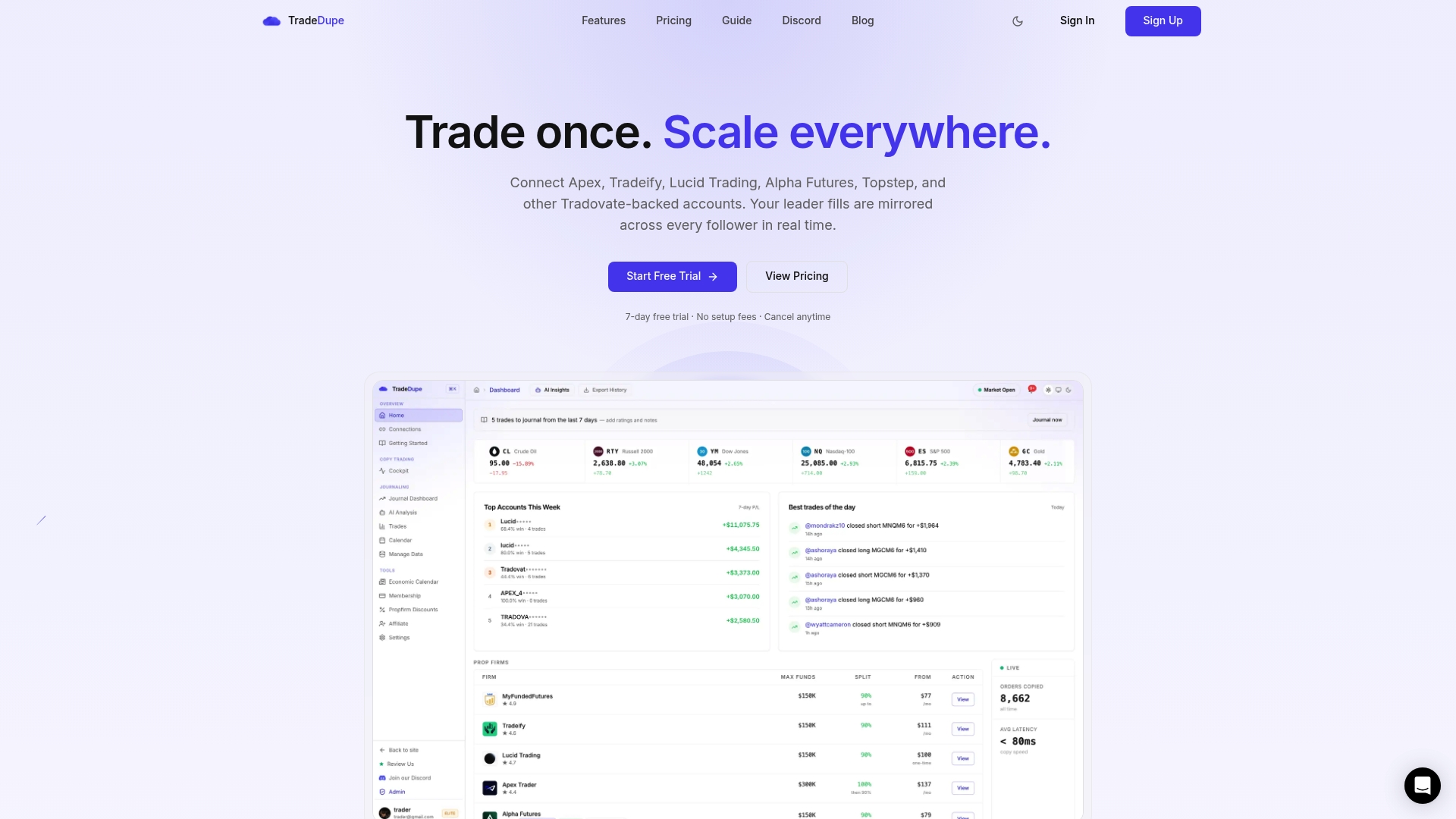
Tradedupe was built for professional prop traders who need their multi-account trade infrastructure to be both fast and auditable. The platform mirrors trades from a single lead account to unlimited follower accounts across Tradovate with a median latency of 34 milliseconds, while generating synchronized, timestamped records across every account simultaneously. That uniformity is exactly what regulators and prop firms expect when they review your multi-account trading activity.
Tradedupe integrates natively with Apex, Topstep, Tradeify, Lucid Trading, and Alpha Futures, and its dashboard provides real-time monitoring of sync status, rogue-trade detection, and per-account toggle controls. For prop traders who need their execution records and audit trails to align, explore the Tradedupe platform and see how it fits your compliance and operational stack.
FAQ
What regulations govern trade reporting for prop traders?
Prop traders in the EU face MiFID II, which requires up to 65 data fields per trade with millisecond timestamps. U.S.-based traders dealing in fixed income report through FINRA TRACE, while swap dealers file under CFTC Part 45.
Why should execution and reporting be separated in prop trading systems?
Keeping reporting logic separate from trade execution ensures that a reporting system failure or ARM outage does not block live trade orders from being placed or filled.
How do timestamp errors cause trade reporting rejections?
Regulatory systems validate timestamps against specific format and timezone requirements. Submitting Eastern Time data to a system expecting UTC, or vice versa, triggers automatic field-level rejections that require manual correction.
What is a shadow trading environment and why does it matter?
A shadow environment is a simulated trading setup that does not use real-time validated market data. Firms offering these environments retain full discretion over payout decisions because trades are never verified against actual market prices.
How does trade tagging improve both compliance and performance analysis?
Tagging trades by category, such as news versus non-news, creates a clean compliance record for restricted period monitoring while simultaneously producing a performance attribution layer that shows which market conditions your strategy actually performs in.