
Apex 3.0 Payout Rules Changed, So Check the 30% Cap First
TradeDupe
11 min read
Learn how Apex 3.0 payout rules affect qualifying days, the $500 minimum, safety net, 30% consistency cap, and requests before you withdraw funds.
You can request an Apex payout on a continuous basis once you meet the qualifying trading days requirement, which Apex moved to eight days under Apex 3.0. Reported figures include a $500 minimum withdrawal and a 30% cap on any single day's share of your profit balance. Confirm your account-specific terms in your Apex dashboard before you request funds.
*
> TL;DR: > > - Apex 3.0 requires eight qualifying days, but some account materials cite five profitable days with at least $50 each; verify which rule applies to your account. > - The commonly reported withdrawal minimum is $500; larger requests require enough balance above your account’s safety net to cover the amount requested. > - For PA accounts, the 30% cap applies until your sixth payout or a move to live; compare your largest day with profits since your last payout. > - Trading beyond contract limits can remove profits or trigger warnings, probation, denial, or closure; an account rollback also resets qualifying days and delays eligibility.
*
Table of Contents
- Which days count toward your first Apex payout?
- What is the Apex minimum withdrawal and how does the safety net work?
- How does the Apex profit split work?
- How does the Apex 30% consistency rule work?
- How do trailing drawdown and scaling rules affect your payout?
- How do you request an Apex payout and how fast does it process?
- Why do Apex payouts get denied, and what should you do next?
- How can you manage multiple Tradovate accounts without tripping payout rules?
- A quick pre-request checklist from a trader's point of view
- Run several Tradovate Apex accounts from one place with TradeDupe
- FAQ
- Sources
Which days count toward your first Apex payout?
Apex dropped fixed payout request windows. According to its support and announcement material, you now request payouts continuously once you meet the qualifying days requirement. Public coverage of Apex 3.0 also reports the move from 10 to 8 qualifying trading days, so the old ten-day math no longer applies.
Evaluation accounts and Performance Accounts (PA) do not play by the same rules. Evaluation accounts focus on the profit goal and drawdown, and Apex's PA and live account documentation states that evaluation accounts carry no consistency rules. Once you hold a PA or live account, the consistency rule, the negative P&L rule and the safety net come into play. Apex materials also describe a variant where qualifying requires five profitable days, each with at least $50 in profit. Treat that as a floor, and confirm how it applies to your specific account type with Apex support.
Run this checklist before you think about requesting anything:
- Count your qualifying trading days since your account started or since your last payout.
- Verify that the days you are counting meet the per-day profit threshold, including the $50 minimum where it applies.
- Check your dashboard for any account-level flags, such as a recent rule violation or a rolled-back account.
- Note the date of your last payout, because several rules measure from that point.
- Confirm in the Apex payout and trading rules article that nothing has changed since you last looked.
If any item fails, fix it first. A payout request that gets denied costs you more time than a few extra clean trading days.
What is the Apex minimum withdrawal and how does the safety net work?
The commonly reported floor is $500. Above that floor, the safety net decides how much you can pull. Apex's example logic says that to request more than $500, your account balance must exceed the safety net by the additional amount you are asking for. The safety net is the balance point that protects the account's trailing drawdown, so a payout can never push you below it.
Here is a worked example using illustrative numbers. Say your balance is above your safety net by the amount you want to request.
- Start with your balance.
- Subtract the safety net to find the room above it.
- Compare that room with your request. The request fits only if it does not exceed the room available.
- Check the remaining balance after the payout and consider whether you want to leave a buffer above the safety net.
- A smaller request leaves more cushion above the safety net, which may be preferable if you plan to keep trading.
Exact safety net calculations differ by account size, so read the number on your own account page instead of assuming the example above applies to you. Apex's documentation also warns that funds earned during non-compliant periods may be removed, which can shrink the amount you can actually withdraw. The TradeDupe profit calculator is a quick way to rerun this math with your own figures.
How does the Apex profit split work?
We will not hand you one universal split number, because the split depends on your contract terms and can change with promotions or policy updates. Third-party roundups such as this payout policy explainer summarize reported payout frequency, minimums and qualifying requirements, but the split that applies to you is the one in your own Apex account or onboarding materials.
What matters in practice:
- Splits can be tiered or promotional. If you signed up during a promotion, your terms may differ from a trader who joined later.
- The split applies to what you are allowed to withdraw. The safety net and the minimum threshold decide the size of the request first. The split then determines what lands in your bank account.
- Policy updates can shift terms. Apex 3.0 changed qualifying days and request timing, so assume nothing from an old forum thread.
- Your documents are the authority. Check your contract-specific split in your Apex dashboard or onboarding email, and ask support if the two disagree.
A quick habit helps: write down your split, your minimum request and your safety net level in one note. Then every payout decision starts from numbers you verified yourself rather than numbers you half remember.
How does the Apex 30% consistency rule work?
The rule is simple to state and easy to trip. Per Apex's PA and live account rules, no single trading day can represent more than 30% of your profit balance when you request a payout. It applies until your sixth payout or until the account moves to live.
The math takes four steps:
- Add up your total profit balance since your last payout.
- Find your largest single day of profit.
- Divide that day by the total profit balance.
- If the result is above 30%, you fail the check.
The figures above are illustrative, not Apex data. If you fail, the usual fix is to keep trading compliantly until the ratio falls below 30%, since each new profitable day grows the denominator. A violation can also lead to forfeiture or probation in serious cases, and the ratio resets after a payout, so your next cycle starts clean.
For a deeper walkthrough with more scenarios, see our guide to the Apex consistency rule and the 30% math, and our prop firm consistency rule comparison if you hold accounts at several firms.
Pro Tip: Keep a running "profit since last payout" ledger and update it after every session, so you see your best-day percentage drift toward 30% before it becomes a denial.

How do trailing drawdown and scaling rules affect your payout?
Trailing drawdown follows your peak unrealized balance upward until the account reaches its safety net point. After that, the drawdown stops trailing and locks in. That is why one great intraday run, even if you give some of it back, can raise your drawdown line and shrink your room for error.
Contract and scaling limits work as a second fence. Apex's documentation describes different consequences for a single violation versus repeated ones:
- Single violation: profits from the violating trades can be removed, and you may get a warning. Close any excess contracts immediately if you notice you broke a max-contract limit.
- Repeated violations: expect harsher action, including probation, payout denial or, for blatant repeat offenses, account closure.
- Rolled-back accounts: if Apex rolls your account back, expect your qualifying days to reset, which pushes your payout date out.
- Removed profits: profit earned while out of compliance does not count toward your withdrawable balance, which can undo the safety net math from the previous section.
The practical rule: know your max contracts for the current balance tier before you size up, because scaling limits change as your account grows. If you are unsure of a limit, confirm it with Apex before you place the trade, not after.
How do you request an Apex payout and how fast does it process?
Payout requests start from your Apex account dashboard. The system checks your qualifying days, safety net position and compliance status, and Apex support can step in if something needs a manual look. Since the announced removal of payout windows, you no longer wait for a calendar slot once you qualify. Public coverage of Apex 3.0 also reports much faster processing, with same-day or next-day approvals described in recent periods. Treat those as reported outcomes, not a guarantee.
Follow this sequence:
- Confirm your qualifying days and that your last several sessions were clean on contracts and drawdown.
- Re-run the 30% calculation and the safety net check from the sections above.
- Open your dashboard, choose the payout request option and enter an amount that clears the $500 floor and leaves your intended buffer.
- Submit the request, then watch your dashboard and email for status changes.
- If the request stalls, open a support ticket with your dates, amounts and trade logs attached, and allow some time for verification.
Faster processing does not mean skipped checks. A request that fails the consistency rule or the safety net test still gets denied quickly, just sooner than it used to.
Why do Apex payouts get denied, and what should you do next?
Denials trace back to a short list of causes:
- Consistency violations: one oversized day pushes you above the 30% cap.
- Scaling or contract violations: trading more contracts than your balance tier allows.
- Trading outside allowed parameters: breaking any rule in the account's trading terms.
- Removed profits: earnings from non-compliant trading are stripped from your withdrawable balance.
Penalties scale with severity. Apex documentation describes written warnings, probation, profit removal, payout denial and, for repeated blatant violations, account closure.
If you get hit, act methodically. Gather your trade logs and note exact timestamps. Open a clear support ticket that states what happened, what you believe the rule says and what you want reviewed. Then keep trading compliantly while it resolves, because a clean record afterward helps the ratio and your standing. Do not argue in vague terms; specifics get answered faster.
How can you manage multiple Tradovate accounts without tripping payout rules?
If you run several Apex accounts on Tradovate, rule mistakes multiply: one oversized order copied by hand to five accounts is five potential violations. We built TradeDupe for exactly that situation. It mirrors fills from your leader account to your enabled follower accounts in real time, typically under 100ms, using Tradovate's official OAuth flow so your password is never stored.
Here is how that supports payout compliance:
- Per-account copy toggles: switch off any account that is near a contract limit, so a copied order does not push it over.
- Daily loss limits: set limits directly on Tradovate that align with your drawdown, so the broker enforces them rather than your discipline.
- Rogue-trade detection: flags follower trades the copier did not place, so you catch unexpected activity quickly.
- Trade journal and analytics: document your qualifying days and track your best-day share against the 30% cap, with records ready for a support ticket.
Automation helps you follow the rules, but it does not replace them. Confirm your Apex terms with Apex support before relying on any tool, and keep checking your dashboard.
A quick pre-request checklist from a trader's point of view
My view: most denials come from rushing. Traders chase the payout after a big day and never run the 30% math or recheck their contract limits. Slow down and check the requirements before requesting a payout.
- Confirm your qualifying days under the 8-day and five-day rules.
- Re-run the 30% calculation with your latest numbers.
- Verify your balance exceeds the safety net by the amount you plan to request.
- Check that you have no recent scaling or contract violations.
- Save trade logs in case support asks for them.
> — Andres
Run several Tradovate Apex accounts from one place with TradeDupe
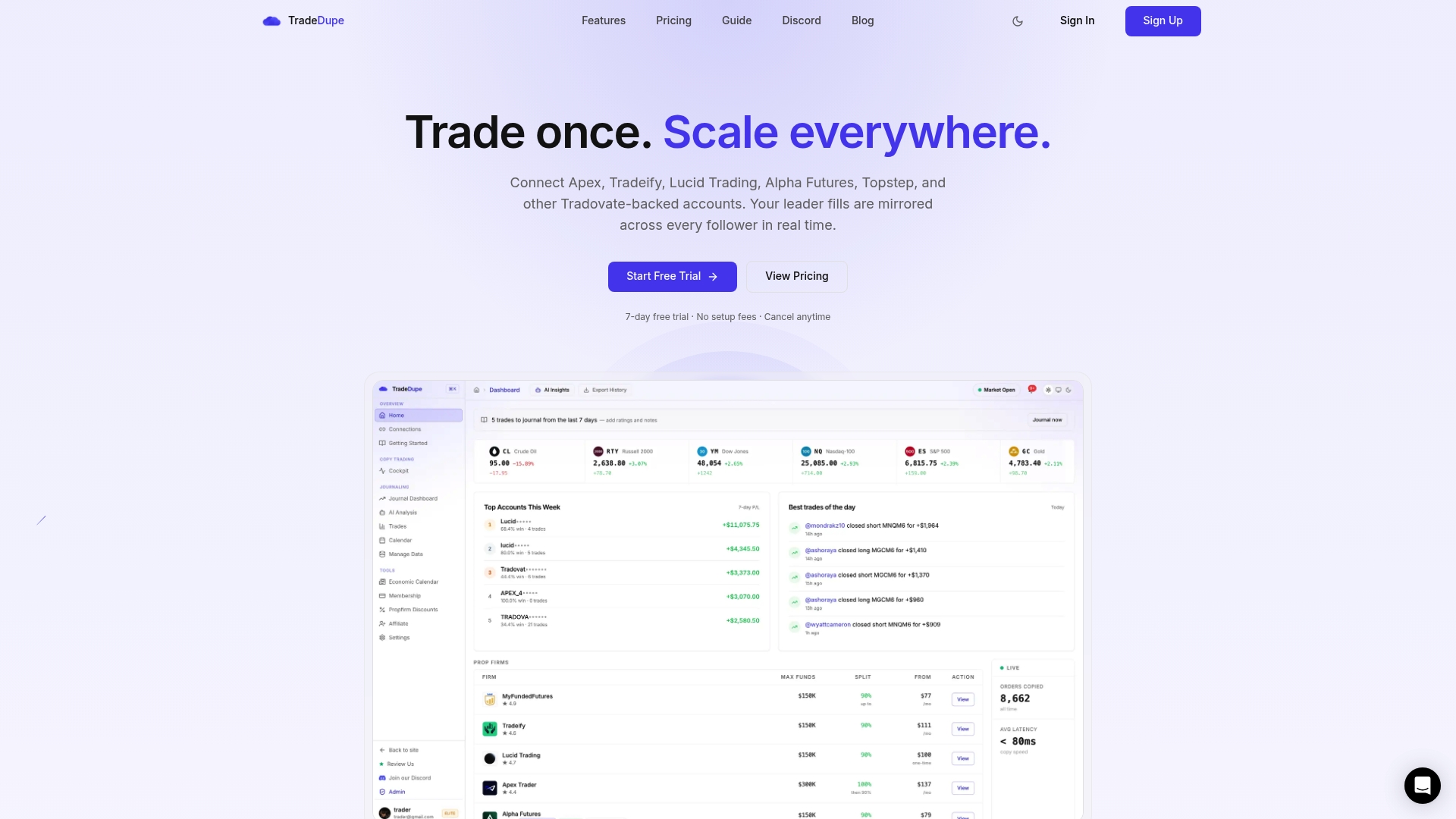
If you hold multiple Tradovate prop firm accounts, we designed TradeDupe to remove the manual mistakes that put payouts at risk. Here is what you get:
- Official Tradovate OAuth connections: your password is never stored.
- Real-time mirroring: fills copy to your enabled followers, typically under 100ms.
- Rogue-trade detection and per-account toggles: keep one account from drifting past a limit.
- Daily loss limits and a trade journal: limits enforced on Tradovate, plus records for your own review.
We work with Tradovate-based firms including Apex Trader Funding, and every plan includes a free trial with one-click cancellation. Read how copy trading works for futures traders, then see our plans and pricing and start your free trial when you are ready.
FAQ
How many trading days do you need before an Apex payout?
Apex reports a requirement of eight qualifying trading days under Apex 3.0, down from ten. Evaluation-phase materials also describe five profitable days of at least $50 each. Confirm which applies to your account in your dashboard.
What is the minimum Apex payout amount?
The commonly reported minimum withdrawal is $500. To request more, your balance generally must exceed the safety net by the additional amount you ask for. Check your account page for your exact figures.
What is the Apex 30% consistency rule?
No single trading day can account for more than 30% of your profit balance when you request a payout. It applies until your sixth payout or transfer to a live account. Divide your best day by your total profit to test it.
How fast do Apex payouts arrive?
Apex removed fixed request windows, and public coverage reports same-day or next-day approvals in recent periods. Speed varies with verification needs, so allow some buffer after you submit.
Recommended
- Apex Trader Funding Consistency Rule (2026): How It Works & The 30% Math
- Consistency Rule by Prop Firm (2026): Apex 30%, MFFU 40%, Tradeify, Topstep 50%
For educational purposes only. Not financial advice. Futures trading involves substantial risk of loss and is not suitable for every investor.