
Best Scalable Copy Trading Infrastructure for Prop Desks
TradeDupe
20 min read
Discover the best scalable copy trading infrastructure for prop desks, leveraging microservices and Kafka for low latency and robust performance.
For prop trading desks, the best scalable copy trading infrastructure combines a microservices-based, API-first, event-driven architecture deployed on AWS with Apache Kafka handling leader-to-follower fanout, FIX protocol adapters at the execution gateway, and a dedicated risk layer operating independently of the replication engine. Tradedupe serves as a production-validated reference implementation for Tradovate-based desks, delivering a median replication latency of 34ms with rogue-trade detection and per-account controls already built in.
Before your first sprint, an architect should complete three immediate steps: size your leader-to-follower fanout ratio and peak concurrent account load, select your message bus (Kafka for high-throughput partitioned fanout, Pulsar for multi-tenancy), and run FIX connectivity and order lifecycle tests against your target broker API. These three gates determine whether your PoC will survive contact with production traffic.
Why this architecture wins:
- Horizontal scaling at the replication layer without touching the risk or execution services
- Failure isolation: a crashed follower adapter cannot cascade to the copy engine
- Immutable event streams provide a built-in audit trail for regulatory reviews
- Per-account toggles and circuit breakers allow surgical intervention without global downtime
> Latency benchmark: A well-tuned Kafka-backed copy engine on AWS, co-located near broker endpoints, targets sub-100ms end-to-end order replication. Tradedupe's published median replication latency is 34ms on its managed infrastructure.
*
Table of Contents
- Why copy trading scalability is different from generic trading scalability
- Architectural principles that enable horizontal scalability
- What every copy trading stack needs at the component level
- Which protocols and broker integrations actually matter
- Practical scaling strategies and technology choices
- Designing for high availability, auditability, and regulatory compliance
- Deployment patterns, networking, and latency tuning
- How to test, validate, and safely roll out copy trading at scale
- Tradedupe enterprise features and real-world metrics
- Key Takeaways
- What vendors often miss and what architects should demand
- Tradedupe: a fast path to production for prop desks
- Authoritative links and further reading
Why copy trading scalability is different from generic trading scalability
Generic trading platforms scale for one account's order flow. Copy trading multiplies that problem by every follower account on the desk, and the failure modes are categorically different.
The core challenge is multi-account fanout: a single leader trade event must produce N synchronized follower orders, each with its own sizing, risk limits, and broker session. At 100 followers, that is manageable. At 1,000 followers across multiple prop firm accounts like Apex, Tradeify, and Lucid Trading, a single leader tick can generate thousands of downstream order submissions within milliseconds. The throughput math changes entirely.
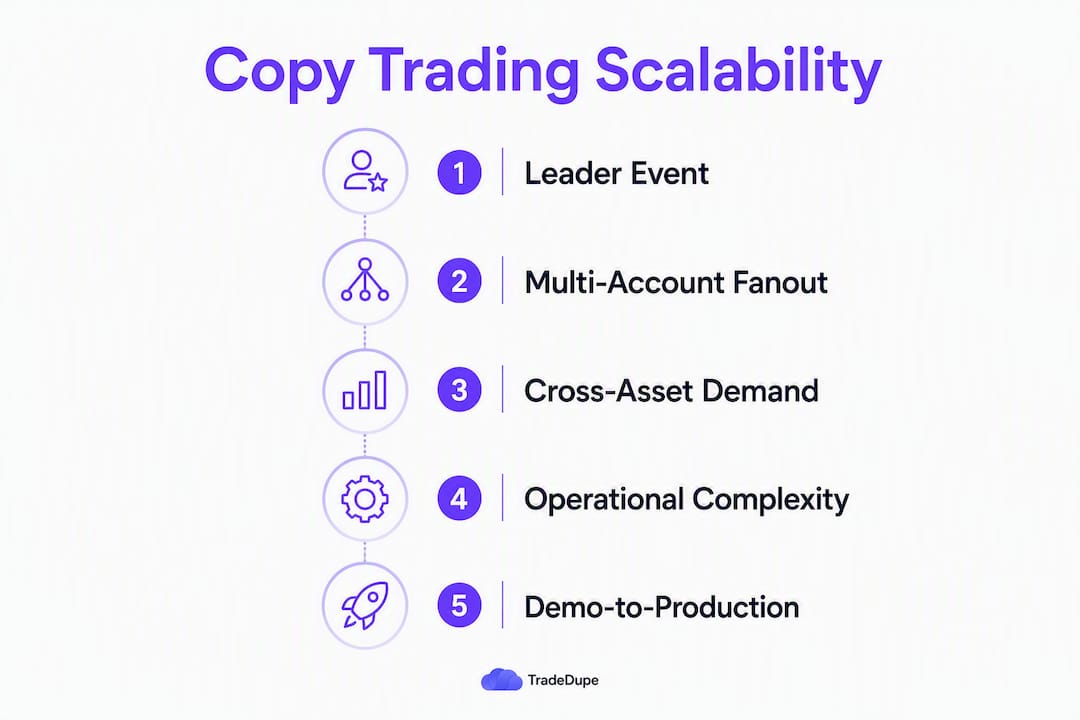
Cross-asset demand adds another dimension. A desk running futures on Tradovate alongside equity or crypto positions faces heterogeneous execution paths, each with different order lifecycle semantics, margin rules, and fill confirmation patterns. The replication engine must normalize these into a canonical event schema before dispatching, or reconciliation becomes a manual nightmare.
Operational demands compound the technical ones. Fee accounting, per-account P&L attribution, and settlement reconciliation must run in near-real-time, not as a nightly batch. Per-account toggle controls, meaning the ability to pause or resume copying for a single follower without disrupting others, are not a convenience feature. They are a risk management requirement when a follower account hits a drawdown limit mid-session.
Pro Tip: The most common capacity underestimate happens at the demo-to-production transition. Demo environments typically run 10–20 simulated followers; production desks often deploy 200–500 within the first quarter. Size your Kafka partitions and consumer groups for 5x your expected launch fanout, not your current one.
*
Architectural principles that enable horizontal scalability
The engineering principles below are not aspirational. They are the specific design decisions that separate a system that survives a 500-follower fanout from one that collapses under it.

Microservices with bounded contexts means the copy engine, risk/compliance layer, execution gateway, and billing/reconciliation service each own their domain and deploy independently. A latency spike in the fee engine should never block order dispatch. Separation of concerns allows each service to scale on its own axis: the replication engine scales on CPU and message throughput, the execution gateway on network I/O and broker session concurrency, and the reconciliation service on database write throughput.
API-first and contract-driven design requires every service boundary to expose a versioned REST or gRPC surface with an OpenAPI specification. This is not just good hygiene. It is the mechanism by which you can swap a broker adapter, upgrade a risk model, or integrate a new prop firm without a full-stack regression cycle. OpenAPI contracts and documented sandbox environments measurably reduce integration time and operational risk.
Event-driven patterns with idempotency are non-negotiable for copy trading. Every leader trade event enters an immutable append-only log. Consumers process events with idempotency keys, so a retry after a network partition does not produce a duplicate follower order. This single design choice eliminates an entire class of reconciliation errors.
Stateless workers, stateful stores. Replication consumers should carry no durable state themselves. Account positions, open order maps, and session state live in partitioned databases or distributed caches. Workers can be killed and restarted without data loss, which is what makes horizontal autoscaling safe.
Observability as a first-class requirement means distributed tracing across every service hop, per-account replication lag metrics, and SLOs defined for both replication latency and execution confirmation. You cannot operate a 1,000-follower desk without knowing, in real time, which accounts are lagging and why.
Pro Tip: Decide which services need sticky state early. The execution gateway needs session affinity to a broker connection; the replication consumer does not. Mixing these assumptions leads to subtle race conditions that only appear under load.
*
What every copy trading stack needs at the component level
The table below maps the minimal component set to its primary scaling axis and state ownership. Every production copy trading platform, whether built in-house or procured, must account for all of these.
| Component | Responsibility | State Owner | Primary Scaling Axis |
|---|---|---|---|
| Leader ingestion / dispatcher | Captures leader order events and fans out to replication queues | Message bus (Kafka topic) | CPU / throughput |
| Replication / transform engine | Normalizes and sizes follower orders from leader events | Stateless workers + cache | CPU / concurrency |
| Order / execution gateway | Submits orders to broker APIs, enforces sequencing and idempotency | Session store + order DB | Network I/O |
| Broker adapters (FIX / WebSocket) | Translates canonical events to broker-specific protocols | Adapter session state | Network / connection count |
| Risk / compliance layer | Validates orders against per-account limits, triggers circuit breakers | Risk DB + event stream | Memory / read throughput |
| Fee and settlement engine | Calculates per-follower fees, P&L attribution, and settlement records | Ledger DB | Write throughput |
| Account manager | Manages per-account toggles, status, and configuration | Config store | Low; mostly read-heavy |
| Reconciliation and ledger | Matches fills to orders, flags discrepancies, produces audit records | Immutable append-only log | Write / query throughput |
| Monitoring and admin UI | Real-time sync status, leader/follower activity, alerting | Time-series DB | Read / query |
Separation of concerns here is not architectural elegance for its own sake. It is what allows the replication engine to scale independently of the risk layer, so a compliance check queue backup does not stall order dispatch for unaffected followers.
Immutable append-only logs at the reconciliation layer serve double duty: they are the audit trail for regulatory reviews and the source of truth for P&L attribution. Idempotent consumer logic on top of these logs eliminates duplicate executions during retry storms, which are common during broker API instability.
Tradedupe's trade copier software covers the execution gateway, broker adapter (Tradovate-native), rogue-trade detection as a risk layer function, per-account toggles via the account manager, and the admin monitoring UI. The fee engine and external reconciliation ledger remain customer-owned in most deployment configurations, which is the correct boundary: Tradedupe handles the latency-sensitive execution path; your internal systems own the financial record of truth.
*
Which protocols and broker integrations actually matter
FIX protocol remains the institutional standard for order submission, execution reports, and order lifecycle events between execution gateways and venues. Adapter logic should normalize FIX messages into a canonical internal event schema immediately on ingestion, so the rest of the stack never touches raw FIX. This normalization boundary is where you absorb broker-specific quirks: field mapping differences, sequence number gaps, and partial fill handling.
For retail broker APIs like Tradovate, the connectivity path is typically WebSocket for streaming market data and order updates, with REST for account management and configuration. The adapter pattern is the same: translate to canonical schema at the boundary, publish to the internal event stream, and let downstream consumers remain broker-agnostic.
Key adapter design requirements:
- Retry logic with exponential backoff and jitter at the broker connection layer
- Sequence number tracking and gap detection for FIX sessions
- Idempotency keys on every outbound order submission to prevent duplicate fills during reconnects
- Backpressure signaling from the execution gateway back to the replication engine when broker rate limits are approached
- Dead-letter queues for orders that exhaust retry budgets, with alerting and manual review paths
The Tradovate integration is a practical example of the WebSocket/REST pattern. Order submissions go via REST; fill confirmations and position updates stream over WebSocket. The adapter must handle WebSocket reconnections gracefully, replaying any missed events from the broker's sequence log before resuming normal dispatch.
Pro Tip: During integration testing, verify full order lifecycle parity across every broker API you plan to support: submit, partial fill, full fill, cancel, and reject. Brokers frequently differ on how they signal partial fills and how they handle cancel-on-disconnect behavior. Discovering these gaps in staging is far cheaper than discovering them with live follower accounts.
*
Practical scaling strategies and technology choices
Apache Kafka is the default choice for leader-to-follower fanout at enterprise scale. Its partitioned, durable append-only log maps naturally to the copy trading problem: each leader account gets one or more dedicated partitions, consumer groups for follower replication workers scale horizontally without coordination, and the log itself serves as the durable event store for replay and audit.
| Technology | Role | Capacity Notes |
|---|---|---|
| Apache Kafka | Message bus and durable event log | Partition per leader; consumer group per follower tier |
| Apache Pulsar | Alternative bus for multi-tenant isolation | Better native multi-tenancy; higher ops complexity |
| Redis | Hot-data cache (positions, account state) | Sub-millisecond reads; use for frequently accessed account config |
| PostgreSQL / CockroachDB | Relational state (orders, fills, accounts) | CockroachDB for geo-distributed desks; Postgres for single-region |
| ClickHouse | Analytics and reconciliation queries | Columnar; handles high-volume fill history efficiently |
| AWS EKS / Kubernetes | Container orchestration and autoscaling | Horizontal pod autoscaling tied to Kafka consumer lag metrics |
Sharding and hot-shard mitigation require deliberate partition key design. Keying by leader account ID distributes load evenly when leaders are roughly equal in trade frequency. When one leader generates 10x the order flow of others, that partition becomes a hot shard. The mitigation is sub-partitioning by instrument or time window, or routing high-frequency leaders to a dedicated consumer group with more worker replicas.
Batching follower updates is appropriate only when replication lag SLOs permit it. For a 1:1 real-time mirroring requirement, passthrough streaming is correct. For a desk where followers accept up to 500ms lag, micro-batching reduces broker API call volume and smooths out burst traffic. The decision belongs in your SLO definition, not your architecture.
Pro Tip: For a 1,000-leader to 10,000-follower fanout, start with 100 Kafka partitions per leader topic tier, 10 consumer group instances per partition tier, and a Redis cache with a 60-second TTL for account configuration reads. Benchmark under 2x expected peak load before go-live, and set Kafka consumer lag alerts at 500ms to catch replication drift before it becomes a client-visible problem.
*
Designing for high availability, auditability, and regulatory compliance
High-availability patterns for a US-jurisdiction prop desk start with AWS multi-AZ deployment: critical services (execution gateway, risk layer, Kafka brokers) run across at least two availability zones with automatic failover. Active-passive is sufficient for the execution gateway if your failover time is under 30 seconds; active-active requires careful leader election to avoid duplicate order submission, which is a harder problem than most teams anticipate.
For the copy engine itself, Kafka's consumer group rebalancing provides automatic failover when a worker pod fails. The rebalance time, typically 10–30 seconds, defines your replication gap SLO during a worker failure. Design your follower-side order management to tolerate this gap without generating spurious cancel or re-entry orders.
Auditability and tamper-evident logs are a design constraint, not an afterthought. LSEG's compliance-focused execution platforms require that order flows, execution fills, and user modifications be logged in tamper-evident stores to meet audit and regulatory requirements. For a US prop desk, this means append-only storage with cryptographic chaining or write-once object storage (AWS S3 with Object Lock), retention periods aligned with FINRA and SEC recordkeeping rules, and query access that does not require modifying the log.
SLA and SLO targets to define before go-live:
- Replication lag: median under 100ms, 99th percentile under 500ms
- Execution confirmation: median under 200ms from order submission to fill acknowledgment
- Reconciliation accuracy: 100% fill-to-order match within 60 seconds of session close
- Uptime: 99.9% during market hours, with defined maintenance windows outside RTH
Security essentials: TLS 1.3 in transit for all service-to-service and broker connections, AES-256 at rest for order and account data, role-based access control with least-privilege service accounts, and secrets management via AWS Secrets Manager or HashiCorp Vault. Broker API credentials must never appear in environment variables or application logs.
> Benchmark: Tradedupe reports a median replication latency of 34ms, which represents a realistic production target for a Tradovate-based desk on managed infrastructure with server-side execution.
Pro Tip: Automated circuit breakers for rogue leader behavior should operate at two levels: a per-follower circuit breaker that pauses copying for a single account when its drawdown limit is breached, and a global circuit breaker that halts all replication from a leader when its order rate or position size exceeds a configurable threshold. The risk management design should allow the global breaker to fire without stopping replication for leaders that are behaving normally.
*
Deployment patterns, networking, and latency tuning
The hosting decision comes down to three variables: your latency target, your operational maturity, and your data sovereignty requirements.
AWS multi-AZ is the right default for most prop desks. Managed Kubernetes (EKS), managed Kafka (MSK), and RDS give you production-grade reliability without a dedicated infrastructure team. Latency to Tradovate's endpoints from AWS us-east-1 is typically competitive for copy trading purposes, where the replication latency budget is measured in tens of milliseconds rather than microseconds.
Dedicated VPS or bare-metal makes sense when you need predictable low-latency without the noisy-neighbor effects of shared cloud infrastructure. For a desk running high-frequency strategies where every millisecond of replication lag affects follower fill quality, a dedicated server co-located near the broker's matching engine is worth the operational overhead.
Colocation is the right answer only when you are chasing sub-10ms exchange adjacency latency. For copy trading, where the bottleneck is usually broker API round-trip time rather than network distance, colocation rarely justifies its cost unless you are also running proprietary execution strategies on the same infrastructure.
Operational controls for zero-downtime deployments:
- Infrastructure as Code (Terraform or AWS CDK) for all environment definitions
- CI/CD pipelines with automated integration tests as a merge gate
- Canary deployments for the replication engine: route 5% of leader traffic to the new version, validate fill rates and latency, then promote
- Blue/green for the execution gateway to avoid in-flight order disruption during upgrades
Deployment timeline: Standard enterprise integrations for white-label copy trading infrastructure typically complete in 5–10 business days for standard configurations; customization or multi-broker setups extend that window. A PoC on Tradedupe's managed infrastructure can be live in under a day given Tradovate connectivity is already built in.
Pro Tip: Build your incident runbook before go-live, not after the first outage. For copy trading specifically, the runbook must cover: broker API disconnect during market hours (pause replication or switch to cached last-known state?), Kafka consumer lag exceeding SLO (scale workers or shed load?), and rogue leader detection (auto-halt or alert-and-wait?). Each scenario needs a documented decision tree and a named on-call owner.
*
How to test, validate, and safely roll out copy trading at scale
Testing a copy trading system requires more than unit tests and a staging environment. The failure modes, duplicate orders, missed fills, reconciliation drift, and cascade failures during broker reconnects, only appear under realistic fanout load.
Testing tiers:
- Unit tests: adapter normalization logic, idempotency key generation, fee calculation formulas, and circuit breaker state transitions
- Integration tests: full order lifecycle (submit, partial fill, full fill, cancel, reject) against a broker sandbox API for every supported broker
- End-to-end tests: simulated leader traffic driving follower order generation, with fill confirmation and reconciliation validation against expected P&L
Load and chaos testing is where most teams underinvest. Run realistic fanout simulations at 2x expected peak: if your production target is 500 followers, test at 1,000. Inject broker adapter failures mid-test to validate that the dead-letter queue captures undelivered orders and that the replication engine continues for unaffected followers. Simulate Kafka broker restarts to verify consumer group rebalancing completes within your SLO window.
Release strategies should follow a staged progression: canary at 5% of follower accounts, monitor for 30 minutes, expand to 25%, monitor for two hours, then full rollout. Automated rollback gates should trigger on replication lag exceeding 1 second or fill confirmation error rate exceeding 0.1%.
Pre-production parity requires replaying production message logs against the staging environment to validate that reconciliation and fee settlement produce identical outputs. This is the only reliable way to catch schema drift between environments before it affects real accounts.
Pro Tip: Before enabling any real-money followers, run this reconciliation validation checklist: (1) confirm every simulated leader order produced exactly one follower order per enabled account, (2) verify fill confirmations match order submissions with no duplicates, (3) validate fee calculations against expected rates for at least 1,000 synthetic trades, and (4) confirm the audit log contains a complete, ordered record of every event with no gaps.
*
Tradedupe enterprise features and real-world metrics
Tradedupe maps directly to the architecture described above, covering the components that are hardest to build correctly: the execution gateway, broker adapter, risk layer, and admin monitoring surface.
> Benchmark: Tradedupe's published median replication latency is 34ms, measured on its managed server-side infrastructure for Tradovate-based prop desks.
Architecture mapping:
- Leader ingestion and dispatch: handled server-side; leader account activity is captured and queued without client-side software running on the leader's machine
- Execution gateway and Tradovate adapter: native Tradovate connectivity with WebSocket and REST integration, including order lifecycle tracking and fill confirmation
- Risk layer: rogue-trade detection flags anomalous leader behavior (position size outliers, rapid reversal patterns) and can halt replication before followers are affected
- Account manager: per-account toggle controls allow individual follower accounts to be paused, resumed, or excluded without interrupting replication for the rest of the desk
- Auto-recovery: if a follower session drops, Tradedupe reconnects and resynchronizes position state automatically, reducing manual intervention during market hours
- Admin dashboard: real-time sync status, leader and follower activity feeds, and analytics reporting give operations teams the visibility they need to manage a multi-account desk
Supported prop firm integrations include Apex, Tradeify, Lucid Trading, and Alpha Futures, which covers the majority of US-based evaluation and funded account workflows. For desks running Apex copy trading across evaluation and PA accounts simultaneously, Tradedupe's per-account toggle and auto-recovery features directly address the operational complexity of managing accounts at different funding stages.
What Tradedupe does not replace: the fee and settlement engine, external reconciliation ledger, and regulatory reporting remain customer-owned. This is the correct boundary for a SaaS implementation: Tradedupe owns the latency-sensitive execution path; your compliance team owns the financial record.
*
Key Takeaways
The best scalable copy trading infrastructure is a microservices, event-driven stack on AWS with Kafka-backed fanout, FIX/WebSocket broker adapters, a dedicated risk layer, and immutable audit logs — with Tradedupe providing a production-validated implementation for Tradovate-based prop desks at 34ms median latency.
| Point | Details |
|---|---|
| Architecture pattern | Microservices with event-driven Kafka fanout and a dedicated risk layer is the proven pattern for enterprise copy trading. |
| Latency target | Sub-100ms end-to-end replication is the enterprise benchmark; Tradedupe achieves a published median replication latency of 34ms on managed infrastructure. |
| Compliance requirement | Immutable, tamper-evident audit logs for order flows and fills are a regulatory requirement for US prop desks, not an optional feature. |
| Testing gate | Load-test at 2x expected peak fanout and validate reconciliation accuracy before enabling any real-money followers. |
| Tradedupe fit | Tradedupe covers the execution gateway, Tradovate adapter, risk layer, and admin monitoring for prop desks, with a PoC achievable in under a day. |
*
What vendors often miss and what architects should demand
The gap between a vendor's latency claim and what you will actually observe in production is almost always larger than the sales deck suggests. Vendors quote median latency under ideal conditions: a single leader, a handful of followers, no broker API rate limiting, and no consumer group rebalancing in progress. Your production environment will have all of these, simultaneously, during peak market hours.
The deeper problem is black-box telemetry. Many copy trading platforms expose a dashboard that shows green lights and aggregate metrics, but provide no access to per-account replication lag, per-order lifecycle traces, or consumer group offset data. When something goes wrong at 9:35 AM during the open, you need to know within seconds whether the problem is in the replication engine, the broker adapter, or the execution gateway. A dashboard that shows "all systems operational" while followers are missing fills is worse than no dashboard at all.
Idempotency guarantees are frequently understated in vendor documentation. Ask directly: what happens when a follower order is submitted but the fill confirmation is lost due to a network partition? Does the system retry, and if so, does it check for an existing open order before submitting a new one? The answer reveals whether the platform has genuinely solved the duplicate-execution problem or has simply not encountered it at scale yet.
Red flags when evaluating vendor latency and fanout claims:
- Latency figures quoted without specifying the measurement point (leader event capture to follower order submission, or leader event to fill confirmation?)
- Fanout capacity numbers from synthetic benchmarks with no broker API in the loop
- No published SLA for replication lag or execution confirmation
- Inability to provide access to raw telemetry or distributed traces during a PoC
Non-negotiables to include in any RFP or PoC:
- Open API specification for every integration surface
- Access to per-account replication lag metrics during the PoC
- A documented failover drill: kill the execution gateway and measure recovery time
- Written SLA for replication lag at the 99th percentile, not just the median
Pro Tip: Use the PoC period as a negotiation lever. Request a production-realistic load test as part of the PoC acceptance criteria: your actual expected follower count, your actual broker API, and a simulated broker disconnect mid-test. Any vendor confident in their platform will agree. Hesitation is data.
*
Tradedupe: a fast path to production for prop desks
Prop desks that need a production-grade futures trade copier without building the execution gateway, broker adapter, and risk layer from scratch have a direct path with Tradedupe. The platform delivers server-side execution on Tradovate, native support for Apex, Tradeify, Lucid Trading, and Alpha Futures accounts, rogue-trade detection, per-account toggle controls, and a real-time admin dashboard — all of the components that take the most time to build correctly and the most operational discipline to run reliably.
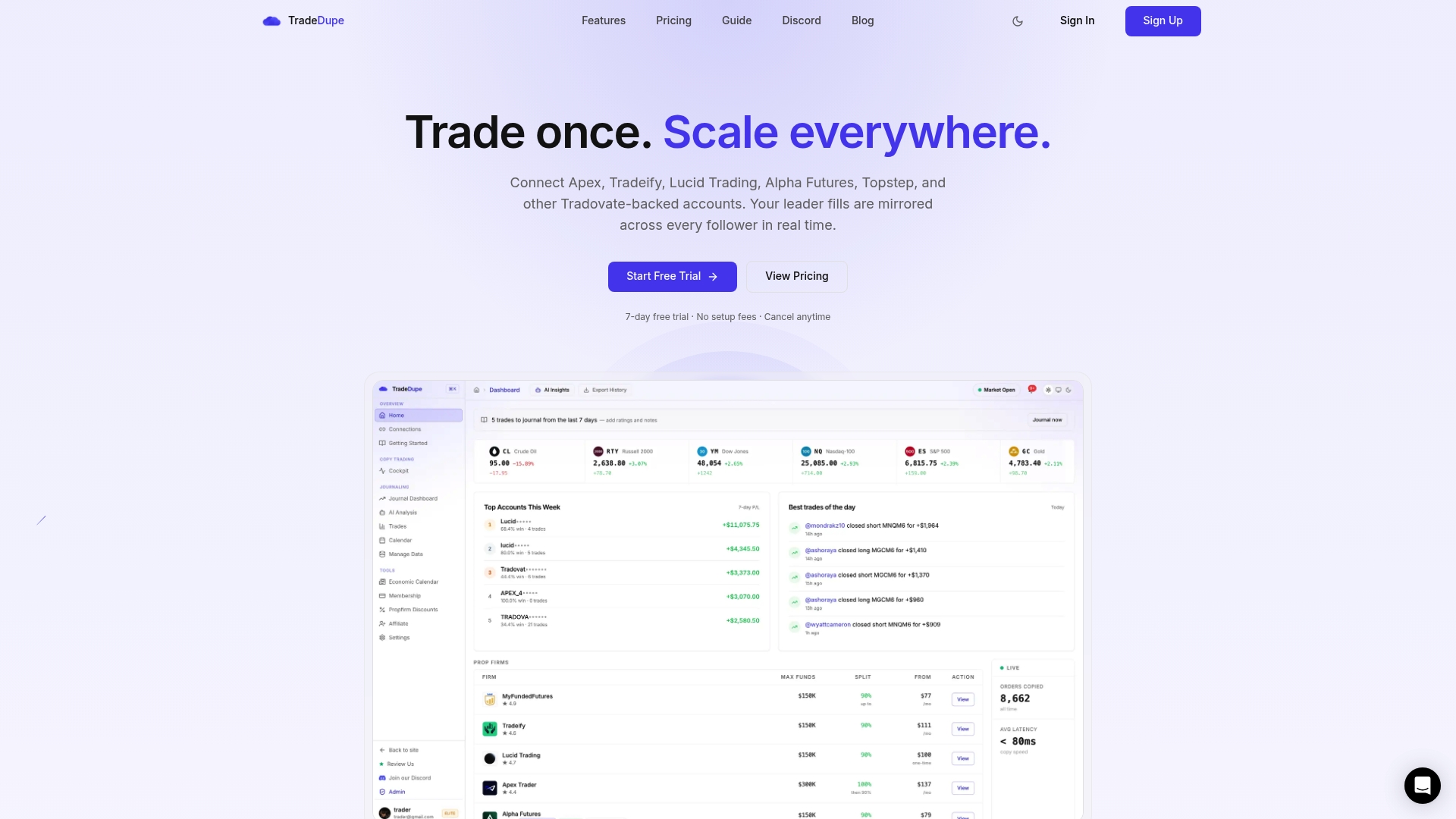
Deployment is measured in hours, not sprints. A standard Tradovate-connected desk can complete a PoC in under a day using Tradedupe's getting started guide, with tiered subscription plans that scale from individual traders to enterprise desks with unlimited broker connections. The AI-powered trade analysis layer adds a reporting dimension that most in-house builds defer indefinitely.
For architects evaluating whether to build or buy the execution and risk components, Tradedupe's security and reliability documentation covers uptime commitments, encryption standards, and architecture assurances in the detail that enterprise buyers need before signing off on a production deployment. Start your PoC there.
*
Authoritative links and further reading
| Source | Type | What you will learn |
|---|---|---|
| TradeDupe — Tradovate Copy Trading for Prop Firms | Vendor / product | Platform overview, feature set, and PoC contact for Tradovate-based desks |
| TradeDupe Trade Copier Software | Vendor / technical | Detailed feature mapping, security signals, and integration options for architects |
| TradeDupe Futures Trade Copier | Vendor / product | Futures-specific deployment patterns and Tradovate integration details |
| TradeDupe Security and Reliability | Vendor / compliance | Uptime commitments, encryption standards, and architecture assurances |
| LSEG TORA Multi-Asset Trading | Industry / standard | Enterprise OEMS architecture, multi-asset execution, and compliance-focused design patterns |
| Apache Kafka Documentation | Open source / standard | Partitioning, consumer groups, retention, and throughput configuration for event-driven systems |
| FIX Trading Community | Protocol standard | FIX protocol specifications, order lifecycle semantics, and adapter implementation guidance |
| AWS Well-Architected Framework | Cloud / standard | Multi-AZ reliability patterns, autoscaling, and security best practices for financial workloads |