

Does MyFundedFutures Allow Copy Trading? Only Your Own Accounts
TradeDupe
12 min read
MyFundedFutures allows copy trading across your accounts, but you remain liable for every order. Learn how ownership, device, and consistency rules apply.
Yes, MyFundedFutures allows copy trading across its account types, but the permission comes with conditions. MFFU's help center explicitly permits copy trading while disclaiming liability for any software you use to do it. You stay fully responsible for every order placed, and you still have to follow account-owner, device-sharing, and consistency rules.
*
> TL;DR: > > - MFFU disclaims responsibility for copier software and offers no troubleshooting, resets, or technical support, leaving you liable for unintended orders and rule breaches. > - Only account owners may trade their accounts, and copying another trader or sharing a device or payment method can lead to termination. > - Identical copied trades do not guarantee consistency, because MFFU assesses position size, stop placement, and profit targets separately for each account. > - Before scaling up, confirm copier permission for your account type, set loss limits with the broker, size accounts independently, and monitor a small test session.
*
Table of Contents
- What MFFU's help center actually says about copy trading
- How consistency, device-sharing, and ownership rules affect copied trades
- Checklist to set up safe copy trading across your own accounts
- Questions to ask MFFU support and what to document
- Common pitfalls worth avoiding
- Step-by-step guide to setting up copy trading with MFFU on Tradovate
- How MFFU's copy trading rules compare with other Tradovate prop firms
- Leader and follower roles, and how permissions work
- Troubleshooting copy trading issues on MFFU accounts
- What the rules actually mean for traders running multiple accounts
- How TradeDupe supports MFFU-compatible copy trading
- FAQ
- Sources
What MFFU's help center actually says about copy trading
MFFU's own documentation is the clearest starting point, and it settles the core question directly: copy trading is allowed. The copy trading article references broker-integrated copier features as well as third-party copier solutions as usable options for traders who want to mirror trades across accounts.
That permission comes wrapped in disclaimers that matter more than the headline. MFFU states it carries no liability for the software or services you choose to use for copying trades, and the guidance includes language that puts the burden of any issues back on you, the account holder. In practice, that means MFFU treats a copier as a convenience you opt into, not a feature it guarantees or supports.
A few specifics worth holding onto:
- MFFU names broker group copier functionality and external copier tools as acceptable methods, without endorsing a specific product.
- The firm states it will not be obligated to provide troubleshooting, resets, or technical support for issues tied to copier use.
- Liability for mistakes, misfires, or unintended trades from a copier sits with you, not with MFFU.
This is a meaningful distinction for anyone running MFFU alongside other Tradovate-based prop firms like Apex Trader Funding, Tradeify, Lucid Trading, Alpha Futures, or TakeProfit Trader. A copier is an execution aid. It is not a compliance shield, and it will not excuse a rule violation just because the trades were generated automatically rather than typed in by hand. If a copied order breaches a drawdown limit, a position-size cap, or a consistency rule, the account still bears the consequence, regardless of which piece of software sent the order.
How consistency, device-sharing, and ownership rules affect copied trades
Three separate MFFU policies intersect once you start copying trades across accounts, and conflating them is where most confusion starts.
- Device and account-owner rules. MFFU's fair-play guidance prohibits copying other traders' trades, sharing a device with another trader, and hedging across accounts. Separately, MFFU's account-ownership guidance states that only the account owner may trade it, and using someone else's device or payment method to do so can lead to termination.
- Consistency rules. Passing an evaluation or keeping a funded account depends on consistent trading behavior, meaning your position sizing, stop placement, and profit targets stay reasonably uniform across your trading history. MFFU's consistency guidance frames this as a balance between freedom and responsibility: Pro accounts grant flexibility, but misuse of that flexibility can still trigger restrictions, penalties, or termination.
- Consequences for breaches. Violations of fair-play or consistency rules can mean account restrictions, financial penalties, loss of a funded account, or a permanent ban from the firm.
The part traders miss most often: identical trades across your own accounts do not automatically satisfy consistency rules. If one account runs a different contract size or a wider stop than another, you can fail a consistency check even though every trade originated from the same copier. Keep your accounts and devices genuinely separate, size each one according to its own rules, and never let the copier itself become the excuse for a setup that looks like account sharing from the outside.
Checklist to set up safe copy trading across your own accounts
Before you flip on automatic copying between MFFU and your other funded or evaluation accounts, work through this list.
- Confirm you personally own every account in the chain and that no shared device, login, or payment method connects you to another trader.
- Verify your chosen copier method is permitted for your specific MFFU account type, and save written confirmation from support.
- Match position sizing, stop distance, and profit targets across accounts so each one independently satisfies its own consistency requirements.
- Set daily loss limits and profit targets directly on the broker side wherever possible, so the limit is enforced by Tradovate rather than only by the copier's software.
- Start with minimal size on a new copier connection, watch fills and logs live for the first sessions, and keep a manual way to stop copying instantly if something looks wrong.
Pro Tip: Test any new copier setup on your smallest or sim-funded account first, and only scale up once you've confirmed a full session of clean, matching fills.
Questions to ask MFFU support and what to document
A short conversation with support before you commit to a copier setup can save you a dispute later.
- Ask directly whether your specific copier tool is permitted for your account type, and whether MFFU logs or flags linked accounts in any way.
- Confirm the firm's position on device sharing, payment-method ownership, and how disputes tied to copier activity get resolved, since using someone else's payment method is treated as grounds for termination.
- Request any written policy references or screenshots that back up what support tells you, and keep a dated log of every reply.
Written confirmation does not change the rules, but it gives you a record to point to if an automated flag or a manual review ever questions your setup.
Common pitfalls worth avoiding
The most frequent mistakes are not exotic: they are a shared laptop between two accounts, or a copier that mirrors contract count one-to-one without adjusting for each account's own sizing limits, which quietly trips a consistency check. Conservative defaults head off most of this. Smaller size on new connections, per-account toggles you can switch off individually, and active monitoring during the first stretch of any new copier relationship all reduce operational risk without costing you much in flexibility. We built TradeDupe around that same logic: it connects through Tradovate's own OAuth flow and gives you per-account controls so you can keep each MFFU account aligned with its own rules rather than treating every linked account as identical.
> — Andres
Step-by-step guide to setting up copy trading with MFFU on Tradovate
Setting up a copier between your MFFU account and your other Tradovate-connected accounts follows a consistent sequence regardless of which tool you use.
First, confirm your MFFU account type and its specific rules around copier use, since Pro and sim-funded accounts can carry different consistency expectations. Second, connect each account through the broker's own authentication, such as Tradovate's OAuth login, rather than handing over a password to a third party. Third, designate one account as the leader, the account whose trades will be mirrored, and enable the others as followers. Fourth, set position-sizing ratios per follower account so each one respects its own contract limits and daily loss caps, rather than copying contract counts one-to-one. Fifth, enable any daily loss limits and profit targets directly on the broker side so Tradovate itself enforces them, independent of the copier software. Sixth, run a test session with minimal size, watching fills in real time across every connected account, before trusting the setup with your normal size. Finally, review your consistency metrics after a few sessions to confirm position sizing and stop placement still line up with MFFU's expectations on each account individually. If anything about a step is unclear for your specific plan, confirm it with MFFU support before you scale up.

How MFFU's copy trading rules compare with other Tradovate prop firms
MFFU's approach, explicit permission paired with a liability disclaimer and consistency requirements, is broadly consistent with how other Tradovate-based funded account providers handle the same issue. Firms like Apex Trader Funding, Tradeify, Lucid Trading, Alpha Futures, and TakeProfit Trader each publish their own rules on account ownership, device sharing, and consistency, and those rules differ in detail even when the underlying principle, you own and operate your account, stays the same. None of these firms guarantee support for third-party copier software, and each expects you to confirm compliance independently rather than assume one firm's rules apply to another.
The practical takeaway for anyone running several funded accounts across different firms on Tradovate: never assume a copier setup that satisfies one firm's rules automatically satisfies another's. Position-sizing limits, daily loss caps, and consistency definitions vary firm to firm, so a copier configuration needs per-account settings rather than a single blanket ratio. This is the exact gap a dedicated Tradovate copier is built to close, since it lets you apply different sizing and risk rules to each connected account instead of forcing identical behavior across firms with different requirements.
Leader and follower roles, and how permissions work
Copy trading setups generally use two roles: a leader account, whose trades get mirrored, and one or more follower accounts, which receive those mirrored trades automatically. Understanding this distinction matters for MFFU compliance because the leader is where your actual trading decisions happen, while followers are purely executing what the leader does, adjusted for each account's own size and risk settings.
Permissions management means controlling which follower accounts are active at any given time, rather than leaving every connection switched on by default. A well-built copier lets you toggle individual follower accounts off without disrupting the others, which matters if one MFFU account is in a different evaluation phase than the rest of your lineup. It also means controlling execution mode per follower, since some accounts may need a slightly different fill approach depending on their own rules or current drawdown cushion. Treat each follower as its own compliance unit, not an extension of the leader, and permission management stays manageable even across five or six accounts.
Troubleshooting copy trading issues on MFFU accounts
Most copier problems on MFFU accounts trace back to one of three causes: a connection that dropped silently, a position-sizing mismatch that made one account's fills look inconsistent with its own trading history, or a device-sharing setup that triggered a fair-play flag unrelated to the copier itself.
If fills stop mirroring, check the connection status on each account first rather than assuming the copier failed outright. If one account's consistency metrics look off after a session, compare its position sizing and stop placement against its own historical average rather than against the leader account, since consistency is evaluated per account. For anything that looks like a fair-play or ownership flag, MFFU's support channel is the right first stop, and having your documented confirmation from earlier conversations will speed up resolution considerably. Keep a simple log of every session where the copier was active: timestamps, fills, and any discrepancies. That log becomes your evidence if a dispute ever comes up, and it is far easier to build in real time than to reconstruct after the fact.
What the rules actually mean for traders running multiple accounts
The conventional advice on this topic tends to stop at "copy trading is allowed," which is true but incomplete. The more useful read of MFFU's policies is that permission and protection are two different things: MFFU allows the mechanism but offers no backstop if your configuration causes a rule breach. That distinction should change how you approach setup far more than it should change whether you use a copier at all.

The priority, in order, is ownership clarity, then per-account consistency, then automation convenience. Traders who get this backward, chasing the convenience of one-to-one mirroring before confirming each account's own limits, are the ones who end up explaining a consistency flag to support after the fact. Confirm the rules for each account you run, size each one on its own terms, and only then let a copier handle the repetitive execution work.
How TradeDupe supports MFFU-compatible copy trading
We built TradeDupe specifically for traders juggling several Tradovate-based funded and evaluation accounts, MFFU included, who want one leader account's fills mirrored to the rest without manually re-entering every order.
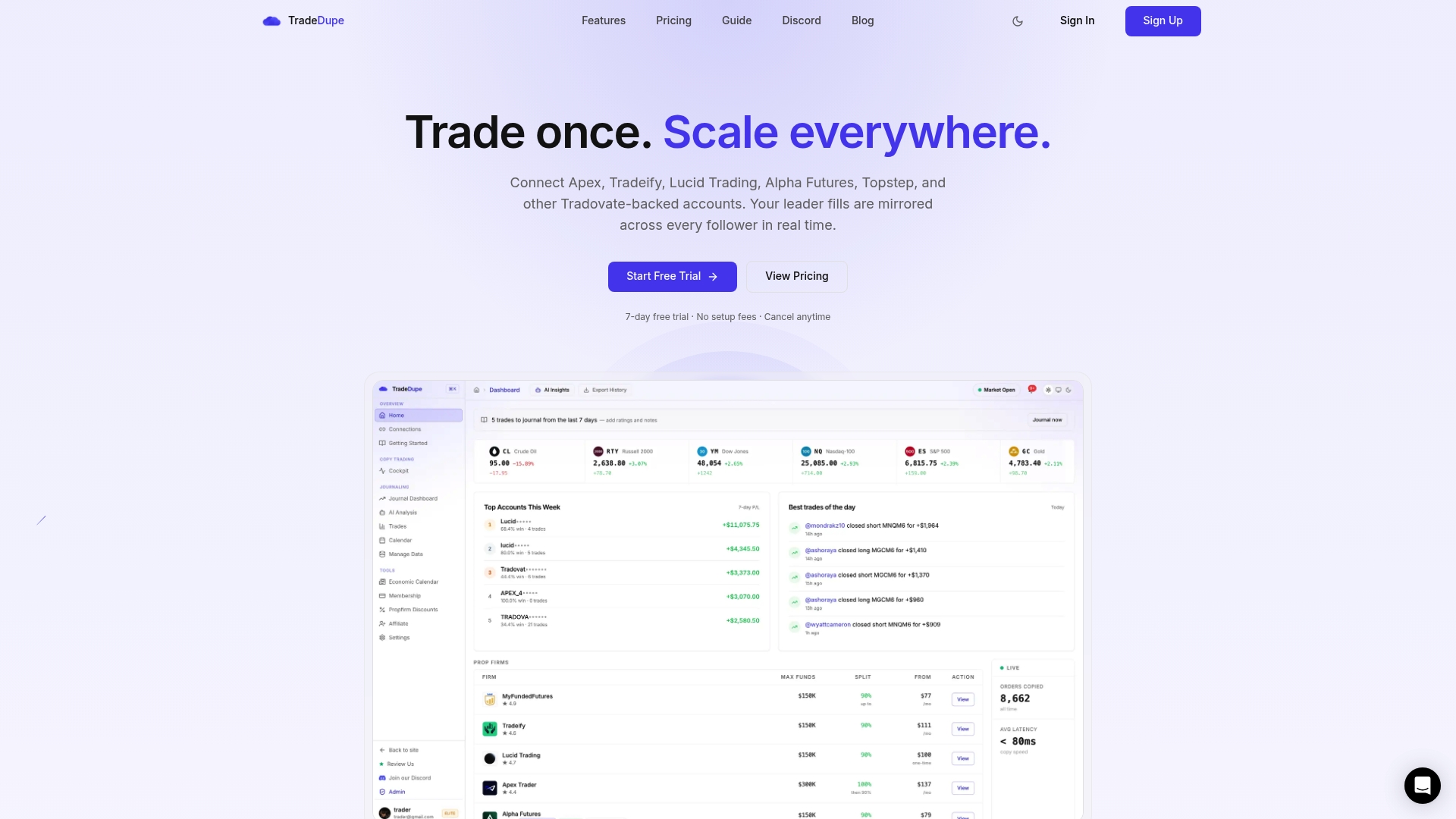
Our platform connects through Tradovate's own OAuth flow, so your password never passes through us, and mirrored fills typically land under 100ms. Beyond the mirroring itself, we built in the safeguards this kind of setup needs:
- Per-account toggles so you can pause or activate any single follower independently.
- Rogue-trade detection that flags follower orders the copier did not place.
- Execution-mode controls and daily loss limits enforced directly on Tradovate, so the broker, not just software, helps enforce the limits, typically under 100ms latency.
Every plan starts with a 7-day free trial and one-click cancellation. If you want to see how the setup works for your own account mix, visit our copy trading overview or check current plans to get started.
FAQ
Does MyFundedFutures allow copy trading on funded accounts?
Yes, MFFU's help center confirms copy trading is permitted across its account types. You remain fully responsible for every order, and MFFU disclaims liability for the copier software itself.
What does it mean for a broker to "allow" copy trading?
When a firm says a practice is "allowed," it means the activity itself is not a rule violation, not that the firm supports, guarantees, or takes responsibility for how you carry it out. MFFU's guidance follows that exact pattern: the mechanism is permitted, but the outcome of using it is on you.
Can someone else manage or trade my MFFU account through a copier?
No. MFFU's ownership guidance states only the account owner may trade the account, and letting someone else enter, exit, or manage trades, including through a shared device, can lead to termination.
Will copying identical trades across accounts guarantee I pass consistency checks?
No. MFFU's consistency guidance evaluates position sizing, stops, and targets on a per-account basis, so identical trades without matching sizing can still fail a consistency review.
What should I confirm with MFFU before enabling a copier?
Ask whether your specific copier method is permitted for your account type, how MFFU handles disputes tied to copier activity, and whether linked accounts get flagged or logged. Keep a dated record of support's answers in case you need it later.
Sources
- Copy Trading at MyFundedFutures | My Funded Futures Help Center
- Fair Play and Prohibited Trading Practices | My Funded Futures Help Center
- Can someone else trade my account? | My Funded Futures Help Center
- Balancing Freedom and Responsibility: Consistency for Sim-Funded Pro Accounts at MFFU | My Funded Futures Help Center
Recommended
- MyFundedFutures (MFFU) Copy Trading (2026): Mirror Every Account
- Funded Futures Family Copy Trading (2026): Mirror Every Account
- Apex Trader Funding Copy Trading Rules (2026): Multiple Accounts, Limits & Compliance
For educational purposes only. Not financial advice. Futures trading involves substantial risk of loss and is not suitable for every investor.