

How Prop Firms Evaluate Trading Platform Vendors
TradeDupe
10 min read
Discover how prop firms evaluate trading platform vendors to ensure reliable trade execution and maximize performance. Learn the key criteria here.
Prop firm vendor selection is defined as the structured process by which proprietary trading firms assess, score, and contract with trading platform providers to support trade execution and account management. How prop firms evaluate trading platform vendors directly determines whether traders experience clean fills, accurate rule enforcement, and reliable payouts. The wrong vendor choice creates execution slippage, compliance gaps, and operational failures that compound quickly across hundreds of funded accounts. This guide breaks down the exact criteria, frameworks, and trade-offs that prop firm operators use to make that decision correctly.
How prop firms evaluate trading platform vendors: core criteria
The evaluation process starts with execution quality. Prop firms treat fill speed and order accuracy as the foundation of every other metric. A platform that slips fills by even a few milliseconds at scale creates measurable P&L drag across a funded trader pool.
The five criteria that carry the most weight in any formal vendor assessment are:
- Execution quality and latency. Fill speed and slippage directly affect trader performance and challenge pass rates. Firms running futures accounts need sub-100ms execution as a baseline expectation.
- API reliability and flexibility. The platform's API must support custom challenge rules, automated account controls, and real-time data feeds. Challenge rule enforcement depends entirely on how well the API exposes account state and trade data.
- Cost structure. Licensing fees, per-seat pricing, setup costs, and transaction fees all compound quickly. A platform priced attractively at 50 accounts becomes expensive at 5,000.
- Integration capability. The platform must exchange data cleanly with risk engines, KYC/AML providers, payment processors, and CRM systems. Gaps in this layer create revenue leaks and compliance exposure.
- Vendor responsiveness. Vendor responsiveness during the first 90 days is a leading indicator of long-term partnership quality. Slow ticket resolution during onboarding predicts worse behavior under production stress.
Pro Tip: Request a live support response test before signing any contract. Send a technical question through the vendor's official support channel and measure the response time. That number tells you more than any sales presentation.
Prop firms typically allocate a 4-to-6-week window for vendor evaluation and platform testing before launch. That window is tight. Firms that skip structured criteria scoring during this period often discover critical gaps only after going live.

How do weighted scorecards reduce bias in vendor selection?
Weighted scorecards are the most reliable method for removing marketing influence from the trading platform evaluation process. The approach assigns a numeric weight to each criterion based on its strategic importance, then rates each vendor on a 1-to-5 scale per category.
A standard scorecard for prop firm vendor assessment works as follows:
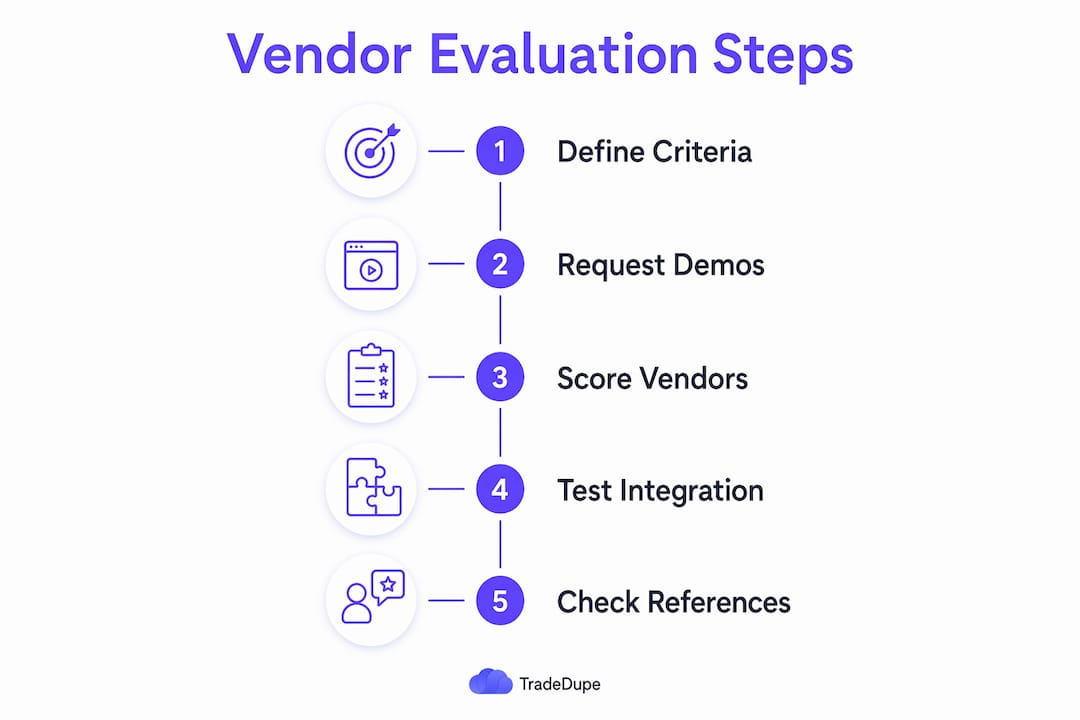
- List all evaluation criteria. Start with execution quality, API reliability, latency, cost structure, integration depth, and vendor support. Add firm-specific criteria like white-label flexibility or regulatory reporting.
- Assign percentage weights. Execution quality weighting typically runs 25–35% of the total score, reflecting how central fill quality is to trader outcomes. Distribute the remaining weight across other criteria based on your firm's priorities.
- Rate each vendor from 1 to 5 per criterion. Use objective benchmarks where possible. For latency, use measured round-trip times from a demo environment. For API reliability, use uptime SLA documentation.
- Multiply each rating by its weight and sum the results. The vendor with the highest weighted total wins on paper. Use that score as the starting point for final deliberation, not the ending point.
- Involve cross-functional reviewers. Include your risk team, operations lead, and a senior trader in the scoring process. Each function surfaces blind spots the others miss.
Pro Tip: Run the scorecard twice: once before vendor demos and once after. The delta between your pre-demo and post-demo scores reveals how much a vendor's presentation influenced your judgment rather than their actual product.
Scorecards also protect against a common failure mode in prop trading performance decisions: overweighting the most recent demo. A vendor who presents last benefits from recency bias. The scorecard anchors the decision to documented evidence instead.
What are the trade-offs among platform types used by prop firms?
The four dominant trading platform choices in 2026 are DXtrade, cTrader, Match-Trader, and MetaTrader 5. Each carries a different set of trade-offs across trader familiarity, rule enforcement capability, and engineering demands.
| Platform type | Trader familiarity | API-based rule enforcement | Time to launch | Best fit |
|---|---|---|---|---|
| MetaTrader 5 | Very high | Limited natively | 8–12 weeks (white-label) | Firms prioritizing trader reach |
| cTrader | High | Strong | 8–12 weeks (white-label) | Firms needing API-driven challenge rules |
| DXtrade | Moderate | Strong | 8–12 weeks (white-label) | Firms wanting custom UI and rule flexibility |
| Match-Trader | Moderate | Moderate | 8–12 weeks (white-label) | Firms seeking a balanced turnkey option |
| Custom-stitched stack | Low at launch | Fully custom | 6–9 months | Firms with engineering resources and differentiation goals |
MT5 carries the largest trader base but presents enforcement challenges for firms that need granular challenge rule control. cTrader and DXtrade are favored specifically because their APIs expose account state in ways that support automated rule enforcement.
The white-label versus custom-stack decision is not just a technology choice. It is a time-to-market decision. Turnkey white-label implementations take 8–12 weeks. Custom-stitched vendor integrations take 6–9 months. A firm that chooses a custom stack without the engineering capacity to support it will miss its launch window and burn runway.
Pre-certified broker connections reduce integration friction and improve execution management system effectiveness directly. Platforms that arrive with pre-built connectivity to major liquidity providers save weeks of integration work and reduce the risk of execution quality degradation at launch.
The right platform type depends on what your firm is optimizing for. If trader acquisition speed matters most, choose the platform your target traders already know. If rule enforcement precision matters most, choose the platform with the strongest API surface.
How do integration and operational factors shape vendor evaluation?
Integration complexity is the most underestimated factor in prop firm vendor selection. Most operators evaluate platforms in isolation. The real evaluation question is how well the platform connects to every other layer in the technology stack.
Treating prop firm technology as a single procurement decision is a common and costly mistake. The stack has six distinct layers: trading platform, risk engine, KYC/AML, payment processor, CRM, and affiliate management. Each layer must exchange data cleanly with the others. A failure at any connection point creates revenue leaks or compliance exposure.
Key integration questions to resolve before signing a vendor contract:
- Does the platform emit real-time webhooks for trade events, account state changes, and breach notifications?
- How does the platform handle webhook retries when the downstream system is temporarily unavailable?
- Can the platform export all trader data, challenge history, and payout records in a portable format?
- What happens to your data if you terminate the contract?
> "Vendor lock-in often masquerades as stability." Firms should demand contract flexibility and full data export rights before committing. Rigid pricing and export restrictions limit growth and make vendor migration prohibitively expensive.
Operational truth-checking during demos is a best practice that separates serious vendors from slideware sellers. Ask the vendor to walk through a complete payout cycle in the demo environment. Ask them to simulate a partial webhook failure and show you how the system recovers. Vendors who cannot demonstrate these scenarios in a live environment are telling you something important about their production reliability.
Pro Tip: Ask every vendor for three references from firms that launched within the last 12 months. Specifically ask those references about the first 90 days of operation. That period reveals how the vendor behaves when things go wrong, not just when they are selling.
Algorithmic trading environments demand granular risk controls and strong data discipline that retail-grade platforms rarely provide. Prop firms running automated strategies need to confirm that the platform's risk engine supports position-level controls, not just account-level limits.
Key Takeaways
Prop firms that use weighted scorecards, test integration depth, and verify vendor responsiveness before signing contracts consistently outperform firms that rely on demo presentations alone.
| Point | Details |
|---|---|
| Execution quality leads scoring | Weight execution quality at 25–35% of your vendor scorecard to reflect its direct impact on trader outcomes. |
| Scorecards remove bias | Rate vendors on a 1-to-5 scale per criterion before and after demos to isolate product quality from sales performance. |
| Platform type drives launch timing | White-label implementations take 8–12 weeks; custom stacks take 6–9 months. Choose based on your actual engineering capacity. |
| Integration depth is non-negotiable | Confirm webhook reliability, data portability, and clean API connectivity across all six technology stack layers before signing. |
| First 90 days predict partnership quality | Vendor responsiveness during early operation is a stronger signal of long-term reliability than any feature list. |
The evaluation mistake most prop firms make
The biggest mistake I see prop firm operators make is treating vendor evaluation as a feature comparison exercise. They build a spreadsheet of capabilities, run a demo, and pick the platform with the longest feature list. That approach fails almost every time.
What actually determines whether a vendor relationship succeeds is operational behavior under stress. Does the vendor answer a critical support ticket at 2 a.m. on a Sunday when a payout cycle breaks? Does their webhook system recover gracefully when your payment processor goes down for 20 minutes? Those questions never appear on a feature comparison slide.
The second mistake is underestimating integration complexity. I have watched firms sign a platform contract, assume the rest of the stack would "just connect," and then spend four months and significant engineering budget building bridges that should have been evaluated upfront. The six-layer stack model exists precisely to force that conversation early.
My practical advice: run your weighted scorecard, but weight vendor responsiveness and integration depth at least as heavily as execution quality. A platform with slightly slower fills but a vendor who answers the phone is worth more than a technically superior platform backed by a support team that disappears after the contract is signed. The best trade copier solutions for prop firms share this same principle: operational reliability matters more than headline specs.
> — Andres
Tradedupe's role in prop firm platform integration
Prop firm operators who have completed their platform evaluation and are ready to deploy copy trading across multiple funded accounts have a direct next step available.
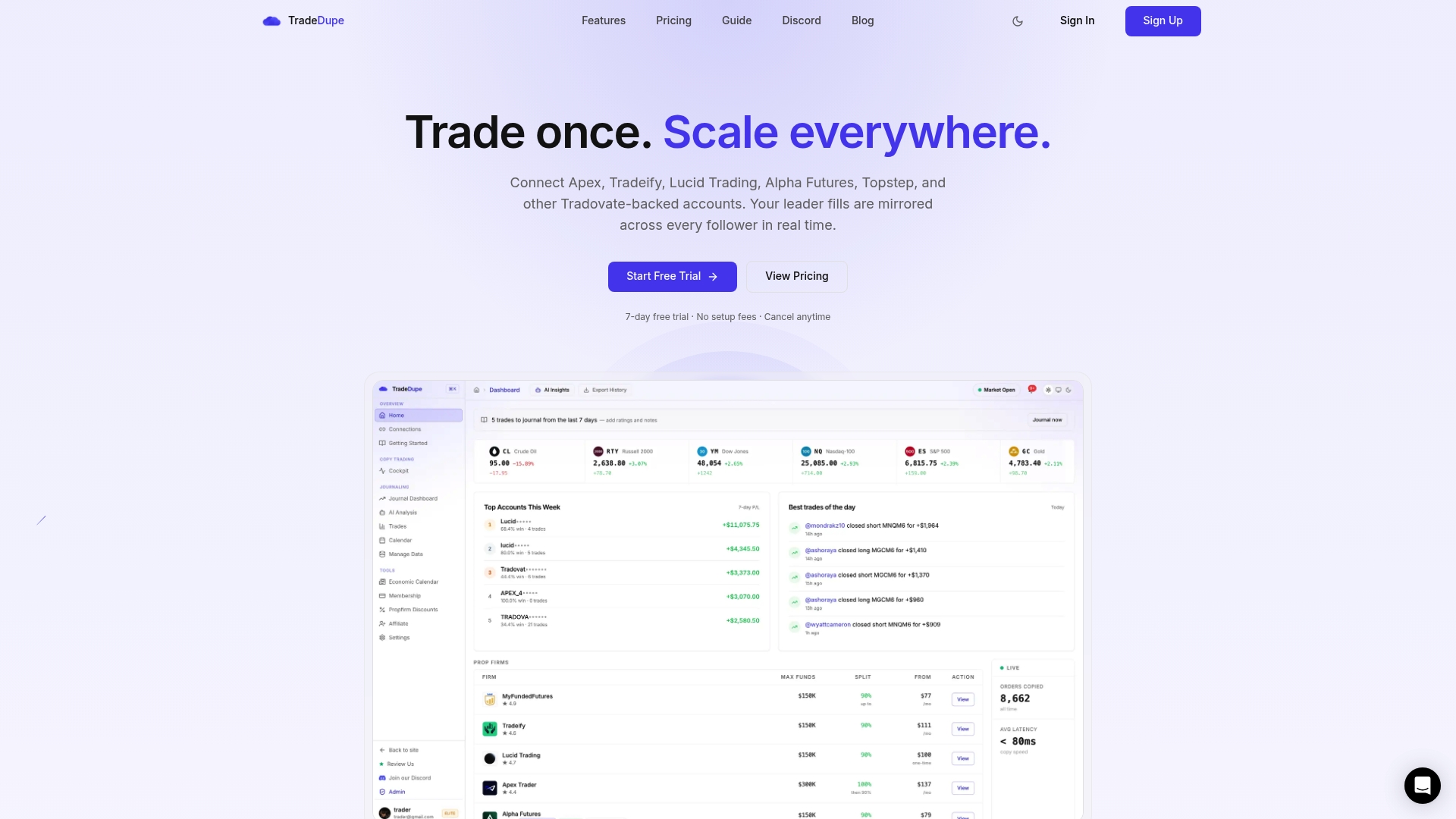
Tradedupe is a specialized copy trading platform built specifically for prop firms using Tradovate as their brokerage. It mirrors trades from a single lead account to unlimited follower accounts with a median latency of 34ms. Tradedupe supports accounts across Apex, Tradeify, Lucid Trading, and Alpha Futures, making it a practical fit for firms managing multi-account operations. The platform includes rogue-trade detection, auto-recovery, and per-account toggle controls that align directly with the operational reliability standards discussed in this guide. Explore Tradedupe's copy trading setup to see how it fits your firm's technology stack.
FAQ
What criteria do prop firms prioritize when evaluating trading platforms?
Prop firms prioritize execution quality, API reliability, cost structure, integration depth, and vendor responsiveness. Execution quality typically carries 25–35% of the total scorecard weight.
How long does the prop firm vendor evaluation process take?
Prop firms typically allocate a 4-to-6-week window for vendor evaluation and testing before launch. White-label implementations then take 8–12 weeks to deploy; custom integrations take 6–9 months.
What is a weighted scorecard in trading platform evaluation?
A weighted scorecard assigns percentage weights to evaluation criteria and rates each vendor from 1 to 5 per category. Multiplying ratings by weights produces an objective total score that reduces bias from vendor presentations.
Why does vendor lock-in matter in prop firm platform selection?
Vendor lock-in limits a firm's ability to migrate, renegotiate pricing, or export trader and payout data. Firms should require full data export rights and contract flexibility before signing any platform agreement.
How should prop firms test vendors during the demo phase?
Firms should ask vendors to walk through a complete payout cycle and simulate edge cases like webhook failures during the demo. Vendors who cannot demonstrate live recovery scenarios are signaling real production reliability gaps.
Recommended
- Best Futures Prop Firms 2026 — Updated Rankings | TradeDupe Blog
- Best Trade Copier for Prop Firms in 2026 (Honest Comparison) | TradeDupe Blog
- How to Trade Prop Firms (2026): A Practical Playbook to Pass and Keep a Funded Account | TradeDupe Blog
- Prop Firms With No Consistency Rule (2026): The Honest List