
How to compare prop firm subscription plans effectively
TradeDupe
13 min read
Master the prop firm subscription plan comparison criteria! Discover essential factors to ensure your automated trading success and safeguard your funds.
Selecting a prop firm subscription plan for automated trade mirroring is one of the most consequential decisions a professional trader or trading desk can make, yet most comparisons stop at price and platform logos. The real risk lies beneath the surface: mismatched session architecture, missing account-level risk controls, or a copier that has no awareness of your firm's consistency rules can silently erode funded accounts before you even realize what went wrong. This article breaks down the concrete criteria you need to evaluate prop firm subscription plans with precision, so you can match automation tools to your actual trading reality rather than a marketing checklist.
Table of Contents
- Essential criteria for comparing prop firm subscription plans
- Firm rules and compliance: What you must know
- Copier plan features: Connections, architecture, and risk controls
- Key edge cases: Where subscription plans can fail
- Practical recommendations: Matching plans to trading use cases
- The overlooked reason copier plans fail: Why subtle criteria matter most
- Automate safely: The smarter way to mirror trades with Tradovate prop firms
- Frequently asked questions
Key Takeaways
| Point | Details |
|---|---|
| Separate firm and plan criteria | Always distinguish between prop firm rules and copier plan limits when evaluating a subscription. |
| Prioritize risk controls | Choose plans with robust account-level risk management to protect against missed limits or firm violations. |
| Check session architecture | The reliability of cloud versus local connection models affects both uptime and compliance risk in multi-account setups. |
| Monitor rule-coupling edge cases | Edge cases like slippage or drawdown desynchronization are common failure points not solved by advertised features alone. |
| Compliance is critical | Using automation responsibly is about more than features—ensure your copier workflow meets firm requirements to avoid bans. |
Essential criteria for comparing prop firm subscription plans
Effective comparison starts with a clean mental model. Separating firm rules from copier limits is the foundational discipline for evaluating any prop firm subscription plan used in automated mirroring. Firm-side rules are non-negotiable constraints imposed by the funding company. Copier plan limits are the operational mechanics of the tool you use to execute within those constraints. Conflating the two is where most traders go wrong.
The best trade copier criteria always account for both dimensions simultaneously. When you evaluate only the copier's features without mapping them against firm rules, you risk building a workflow that is technically functional but operationally non-compliant. That gap is where funded accounts get forfeited.
Here are the core criteria you must evaluate when comparing plans:
- Firm rules and risk constraints: Maximum drawdown thresholds, daily loss limits, profit targets, and consistency requirements imposed by the prop firm itself.
- Copier plan connection limits: The maximum number of follower accounts or simultaneous sessions the plan supports.
- Session architecture: Whether the copier operates via cloud infrastructure or a local machine, and how each handles session persistence and reconnection.
- Account-level risk controls: Whether the plan offers per-follower flatten-on-loss, drawdown tracking, or automated position exit at defined thresholds.
- Operational compliance tooling: Features that help you document and prove account control, such as audit logs, per-account toggle controls, and rogue-trade detection.
Understanding prop firm rule variations across different funding firms is equally important, because a plan that works well for one firm's rule set may be dangerously mismatched for another's. Firms like Apex, Tradeify, and Topstep each have distinct drawdown structures and session monitoring behaviors that directly affect which copier architecture you should deploy.
Pro Tip: Always verify whether your subscription plan supports account-level risk controls before committing. A plan that can flatten a single follower account at its specific drawdown threshold, without affecting other accounts in your stack, is not a luxury feature. It is a necessity for multi-account prop trading.

With these criteria in hand, let's break down the two main dimensions you need to evaluate: firm-imposed rules and the operational characteristics of the subscription plan or copier tool.
Firm rules and compliance: What you must know
Prop firm rules are not uniform, and they evolve. Before selecting any subscription plan, you need to map the specific constraints of every firm you trade with. Here are the major rule categories that directly influence your plan selection:
- Maximum drawdown limits: Most firms enforce either a trailing or static drawdown. Trailing drawdown rises with your account equity, meaning a profitable day can actually tighten your risk buffer. Your copier must account for this dynamically.
- Daily profit and loss caps: Some firms impose daily profit targets or loss ceilings that reset each session. Mirroring trades without awareness of these thresholds can cause violations even on winning days.
- Consistency requirements: Many firms require that no single trading day represents more than a defined percentage of total profits. A copier that mirrors a large position from a leader account into a follower that has a different profit history can trigger a consistency violation invisibly.
- Session monitoring and order structure: Certain firms require bracket orders on submission or flag accounts that submit orders in patterns inconsistent with manual trading. Understanding how your copier structures and submits orders is critical.
- Proof-of-control requirements: Even when copy trading is permitted, firms often require that you demonstrate individual control over each account. Ghost trading, where accounts appear to be controlled by an external signal rather than the account holder, is grounds for disqualification.
You can review prop firm drawdown guides to understand how different drawdown structures interact with automated execution workflows. The interaction between trailing drawdown and copier latency, for example, is a risk that most traders underestimate until it costs them a funded account.
> "Operational compliance risk: prop firms often detect disallowed copy trading and can ban traders or forfeit challenges if the trading behavior violates rules; detection may include technical signals and manual reviews." How do prop firms detect copy trading
This is not a theoretical risk. Firms actively monitor for behavioral fingerprints that suggest synchronized trading across accounts. Even if your strategy is profitable and your copier is technically sound, a compliance failure can forfeit the entire challenge or funded account. Reviewing risk manager compliance actions gives you a clearer picture of how professional risk managers structure their workflows to stay on the right side of these rules.
After clarifying the role of firm constraints, it is equally important to look at the copier or plan side, which can either help or hinder your ability to stay compliant and efficient.
Copier plan features: Connections, architecture, and risk controls
Once you understand the firm-side rules, you can evaluate copier plans against them with precision. The connection and session architecture of a copier is often the deciding factor between a plan that scales cleanly and one that creates operational fragility across multiple funded accounts.
Here are the key trade-offs between cloud-based and local copier architectures:
- Cloud-based copiers: Sessions are maintained on remote infrastructure, meaning your accounts stay connected even if your local machine goes offline. This is critical for overnight positions or news-driven volatility. The trade-off is slightly higher latency compared to local execution.
- Local copiers: Execution happens on your machine or a VPS, which can reduce latency to sub-20ms in optimal conditions. However, session persistence depends entirely on your local uptime, and a dropped connection during a live trade can cause a partial fill on the leader with no corresponding action on followers.
- Hybrid architectures: Some platforms offer a combination, using cloud infrastructure for session management while routing execution locally for speed. This is the most robust setup for high-frequency prop trading environments.
The account-level risk controls available within a plan are equally important. Not all copiers treat follower accounts as independent risk units. Some apply a single risk threshold across all followers, which means one account approaching its drawdown limit can trigger a global flatten that disrupts accounts that were perfectly healthy.
| Feature | Cloud-based plan | Local copier plan |
|---|---|---|
| Session persistence | High, maintained remotely | Dependent on local uptime |
| Execution latency | Moderate (50-150ms typical) | Low (10-50ms on good VPS) |
| Per-account risk controls | Varies by platform | Varies by platform |
| Drawdown-aware mirroring | Rare, platform-dependent | Rare, platform-dependent |
| Scalability (follower accounts) | Generally higher limits | Often limited by machine resources |
| Compliance audit logging | More common in cloud platforms | Less common, manual tracking needed |
Traders managing Tradovate-capable copiers across Apex or similar firms should pay close attention to the session persistence column. Apex's trailing drawdown structure means that a session drop during a live trade is not just an operational inconvenience. It is a potential drawdown event if the leader closes profitably but the follower remains open.
Tradovate copy trading tools that are purpose-built for the Tradovate ecosystem handle broker-specific session authentication and reconnection logic in ways that generic copiers do not. This matters because Tradovate's API has specific session token behaviors that can cause connection drops if not handled correctly.
Pro Tip: Before scaling to more than three follower accounts, test your copier's behavior during a simulated session drop. Manually disconnect your leader account mid-trade and observe how each follower responds. This single test reveals more about a plan's reliability than any feature list.
Tradeify copy trading for prop firms introduces additional complexity because Tradeify uses specific order validation logic that some copiers do not handle correctly, resulting in rejected orders on the follower side even when the leader fills cleanly.
Key edge cases: Where subscription plans can fail
Even a well-configured copier on a robust plan can fail in ways that are not immediately visible. These edge cases are where funded accounts are actually lost, not in strategy performance, but in rule-copier mismatch.
The most common edge cases in automated mirroring include:
- Slippage divergence: The leader fills at one price, the follower fills at a slightly different price due to latency or liquidity differences. Over time, this creates P&L divergence between accounts that can trigger consistency rule violations on the follower.
- Drawdown desynchronization: The leader account's drawdown state is not visible to the copier, so the copier continues mirroring trades even when the leader is approaching its own threshold. The follower may then mirror a trade that pushes it past its own drawdown limit.
- Consistency rule violations: A large winning trade on the leader, mirrored to a follower with a different profit history, can cause the follower to fail its consistency check even though the trade itself was profitable.
- Order structure mismatch: Firms that require bracket orders on submission will reject market orders submitted by a copier that does not replicate the full order structure from the leader.
| Edge case | Example scenario | Consequence |
|---|---|---|
| Slippage divergence | Leader fills ES at 5200.00, follower fills at 5200.25 | P&L gap grows, consistency violation risk |
| Drawdown desync | Copier mirrors trade while follower is at 95% drawdown | Follower account breaches limit, forfeited |
| Consistency violation | Large single-day profit mirrors to follower with low baseline | Follower fails consistency check |
| Order structure mismatch | Firm requires bracket orders, copier sends market orders | Orders rejected, position not opened |
Reviewing how TradeDupe handles these edge cases versus other copier platforms gives you a practical benchmark for what robust edge-case handling actually looks like in production environments.
Practical recommendations: Matching plans to trading use cases
With all comparison dimensions mapped, the final step is matching the right plan to your specific trading context. Rule coupling is the real failure mode in automated mirroring, not strategy performance, and your plan selection should reflect that reality.
Here are practical recommendations by use case:
- Small-scale evaluators (1-3 accounts): Prioritize per-account risk controls and compliance audit logging over raw connection capacity. A local copier with good session recovery is often sufficient at this scale.
- Prop fund managers (5-20 accounts): Cloud architecture becomes essential for session reliability. Prioritize platforms with drawdown-aware mirroring and per-follower flatten controls. Compliance documentation features are non-negotiable.
- Solo automation traders: Low-latency execution matters most. Use a local copier on a co-located VPS, but build a manual session-recovery protocol for downtime events.
- Compliance-wary traders: Only deploy cloud mirroring when explicitly permitted by your firm. Maintain a proof-of-control workflow, including per-account login records and order modification logs.
When you compare TradeDupe versus TradeSyncer for multi-account prop trading, the differentiating factors are almost always in the risk control depth and session recovery behavior, not in the base feature set. Both platforms mirror trades. The question is what happens when something goes wrong.
The overlooked reason copier plans fail: Why subtle criteria matter most
Here is the perspective that most subscription plan comparisons never reach: the traders who lose funded accounts to copier failures are rarely using broken tools. They are using tools that work perfectly under normal conditions but were never designed to handle the specific edge cases their firm's rules create.
The advertised features, connection counts, supported platforms, and latency numbers, are the easy part of the comparison. What actually determines whether you keep a funded account is whether your copier understands the relationship between the leader's state and the follower's risk position at every moment. Most copiers do not. They are stateless mirrors. They see an order on the leader and replicate it. They do not know that the follower is 200 dollars from its trailing drawdown limit, or that today's profit on the follower already represents 45 percent of its total challenge profit.
The best-funded traders we observe are obsessive about the quiet, unglamorous features: session health dashboards, per-account drawdown trackers, rogue-trade detection, and auto-recovery behavior after a disconnection. These are not exciting selling points. They are the difference between a funded account that compounds and one that gets forfeited on a Tuesday morning when the VPS reboots.
Proven real-world automation at the professional level is built around failure mode awareness, not feature accumulation. Before you select a plan based on its connection limit or its latency claim, ask the vendor one question: what happens to my follower accounts if the leader disconnects mid-trade? The answer tells you everything about whether that platform was built by people who actually trade prop accounts.
Automate safely: The smarter way to mirror trades with Tradovate prop firms
If this analysis has clarified what you need from a subscription plan, TradeDupe is built precisely for this environment. It is a purpose-built Tradovate automation platform that prioritizes session integrity, per-account risk controls, and compliance-aware mirroring across Apex, Tradeify, Topstep, and other major prop firms.
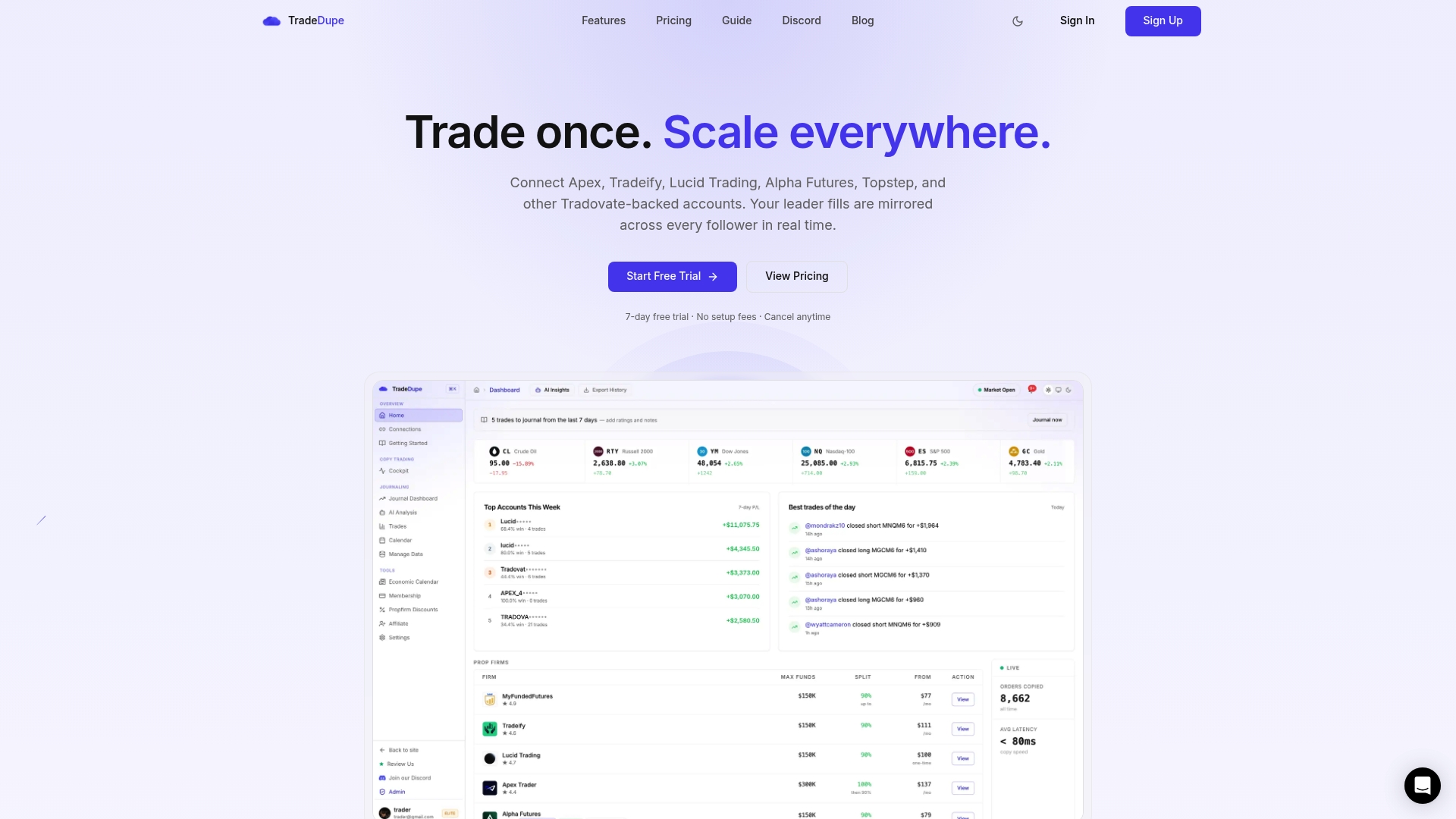
TradeDupe's architecture addresses the edge cases covered in this article directly: rogue-trade detection, auto-recovery after session drops, per-follower flatten-on-loss controls, and a real-time dashboard that shows you the sync status of every account in your stack. Explore the full range of Tradovate copier plans to find the tier that matches your account count and risk management requirements. You can also review the TradeSyncer vs TradeCopia breakdown to understand how different architectural approaches stack up before you commit to a platform.
Frequently asked questions
What's the difference between firm rules and copier plan limits?
Firm rules are risk and trading requirements set by the prop firm, such as max drawdown and session control, while copier plan limits govern operational features like how many accounts you can mirror and how sessions are managed. Separating these two categories is the foundation of any effective subscription plan comparison.
Can prop firms ban traders for using copy trading software?
Yes. Many prop firms detect unauthorized copy trading through technical signals and manual review, and may ban or forfeit trader accounts if the behavior violates their rules, even if the trading itself was profitable.
Why do some copiers fail even when trades are mirrored correctly?
Execution and rule-desynchronization edge cases such as slippage divergence, drawdown desynchronization, and consistency rule mismatches can cause hidden violations even when the copier appears to be functioning normally.
Does local or cloud-based architecture matter for copier reliability?
Yes. Cloud copiers maintain session persistence without depending on a local machine, which is critical for multi-account prop trading. Local copiers can offer lower latency but require careful session management to avoid mid-trade disconnections.
What are the main criteria for comparing subscription plans?
The key criteria include firm trading rules, the copier's connection and session limits, account-level risk controls, compliance features, and session architecture. Separating firm constraints from copier mechanics ensures you evaluate both dimensions without conflating them.