
How to Mirror Trades Across Prop Accounts: 2026 Playbook
TradeDupe
17 min read
Discover how to effectively mirror trades across prop accounts using advanced Tradovate trade copiers, ensuring real-time monitoring and compliance.
The most reliable way to mirror trades across prop accounts is a server-side, Tradovate-native trade copier with per-account risk enforcement, real-time monitoring, and automated compliance checks. That architecture keeps execution latency low, centralizes your risk controls, and generates the audit trail every funded desk needs. Platforms like Apex, Tradeify, and Lucid Trading all operate within this framework when paired with the right infrastructure.
Three components are non-negotiable for a production-safe setup:
- Leader→follower sync with idempotent order processing and deduplication logic so a network hiccup never doubles a position.
- Per-account position sizing and drawdown enforcement applied pre-trade, not post-trade, so a single bad fill on one follower cannot cascade into a rule violation.
- Real-time monitoring with auto-recovery so the system self-heals when a session drops, rather than leaving followers in an unsynced state.
Client-side EAs running on desktop MT4/MT5 instances can technically replicate orders, but they introduce session-dependency risk and are harder to audit. For a professional multi-account prop desk, server-side execution is the architecture worth building on.
*
Key Takeaways
Mirroring trades across prop accounts requires a server-side architecture, verified firm-by-firm compliance, and a staged rollout with pre-trade risk controls enforced at the account level.
| Point | Details |
|---|---|
| Verify compliance first | Check `copy_trading_allowed` and eval-vs-funded rules for every firm before connecting any copier. |
| Use server-side architecture | Server-side execution delivers lower latency and centralized auditability compared to client-side EAs. |
| Enforce pre-trade risk controls | Set internal daily loss limits below the firm's hard stop to catch runaway followers before a violation. |
| Stage the rollout | Run sandbox proof, then a 2–5 account live pilot, then batch scale with gating KPIs at each stage. |
| Tradedupe for Tradovate desks | Tradedupe's server-side copier with 34ms median latency, rogue-trade detection, and per-account toggles maps directly to the recommended production architecture. |
*
Table of Contents
- Can you mirror trades across multiple prop-firm accounts?
- What trade-copier architecture should you use for prop accounts?
- Which platforms and integrations should you plan for?
- How does leader→follower mirroring work, and what risk controls must you enforce?
- What should you extract from every prop firm's rule book before mirroring?
- How do you roll out mirroring from demo to full scale without blowing accounts?
- What operational mistakes commonly blow accounts or trigger bans?
- What data sources and performance claims should you verify?
- The part of mirroring most traders skip until it's too late
- Why Tradedupe fits the architecture this playbook recommends
- Sources
Can you mirror trades across multiple prop-firm accounts?
The short answer: yes, often, but with firm-specific conditions that can disqualify you before you place a single mirrored order. Many firms permit internal multi-account mirroring on funded accounts while explicitly banning it during evaluations. Copy-trading between evaluation and challenge accounts is banned at virtually every firm, making the evaluation phase the single highest-risk gate to check first.
Run this checklist against every firm's published rule book before enabling any automated replication:
- `copy_trading_allowed`: Does the firm explicitly permit copy trading or signal following? Look for this in the automation/EA policy section.
- Eval vs. funded distinction: Is mirroring permitted on funded accounts but forbidden during the challenge phase? Many firms treat these separately.
- EA/automation policy: Does the firm allow algorithmic order entry? Some firms permit EAs but ban third-party signal services.
- News/event trading windows: Are there blackout periods around high-impact economic releases (NFP, FOMC) where automated entries are prohibited?
- Weekend holds: Does the firm require flat positions before market close on Friday? Mirrored positions that carry over can trigger violations.
- Account ownership and third-party access: Does the firm require that only the account owner places trades? Third-party access through a copier may violate terms even when automation is otherwise allowed.
On the operational side, mismatched leverage between your leader and follower accounts is one of the fastest blockers. A leader account running 10:1 leverage with a follower at 5:1 will produce proportionally different margin consumption, which can push a follower into a margin call the leader never experienced. Verify margin rules and platform compatibility before the first live test, and always run a full sandbox proof before touching a funded account.
*
What trade-copier architecture should you use for prop accounts?
Four architectures exist for replicating orders across accounts. Each carries distinct tradeoffs in latency, reliability, and auditability that matter significantly in a prop trading context.
Server-side execution runs the replication engine on a hosted server, independent of any trader's local machine. Orders are dispatched to follower accounts the moment the leader's fill is confirmed. This is the most deterministic architecture for latency and the easiest to monitor centrally.
Client-side (MT4/MT5 EAs) run on a local desktop or VPS and replicate orders by reading the leader's terminal state. They work, but they depend on the local session staying alive, introduce variable latency based on machine load, and are harder to audit across dozens of accounts.
API-driven replication uses broker REST or WebSocket APIs to capture order events from the leader and replay them on followers at the order level. This approach gives you the most granular control over order mapping and fill semantics, but it requires engineering resources to build and maintain.
Broker-side native copy features are offered by some brokers as a built-in feature. They are convenient but typically lack the per-account risk controls and audit depth a professional prop desk needs.
For a multi-account prop operation, server-side wins on every axis that matters:
- Latency: Server-side solutions running close to the broker's matching engine can achieve median execution latencies in the range of tens of milliseconds. Tradedupe publishes a median latency of 34ms for its Tradovate-native copier, which is a meaningful benchmark for futures markets where order-book conditions can shift in under 100ms.
- Reliability: No dependency on a local machine session; auto-recovery can reconnect and reconcile without manual intervention.
- Auditability: Centralized logs capture every order event, fill, rejection, and reconciliation cycle in one place.
*
Which platforms and integrations should you plan for?
Platform compatibility shapes the entire mirroring architecture. Get this wrong and you will spend more time debugging symbol mismatches than trading.
Tradovate is the most API-friendly choice for futures prop trading. Its WebSocket-based order API supports real-time event streaming, which makes it the natural foundation for a server-side copier. Tradedupe is built natively on Tradovate, which means symbol normalization, contract month handling, and session management are handled at the platform level rather than patched together with middleware.
NinjaTrader supports automated order entry through its ATM strategy framework and third-party add-ons. It is widely used among U.S. futures traders, but its replication integrations tend to be client-side, which reintroduces the session-dependency risk described above.
MT4/MT5 remain common for forex-adjacent prop firms. Replication on these platforms typically runs through EA-based copiers that read the leader's open positions and mirror them on followers. Symbol format differences between brokers (e.g., "EURUSD" vs. "EURUSDm") and contract size mismatches are the most common integration failures.
Generic broker APIs (REST/WebSocket or FIX gateways) give you the most flexibility but require the most engineering. FIX is standard for institutional execution but overkill for most prop desk setups unless you are running hundreds of accounts.
Compatibility gotchas to resolve before going live:
- Symbol format normalization: Map every instrument the leader trades to its exact equivalent on each follower's broker/platform.
- Contract month alignment: Futures roll dates differ by broker. Automate roll detection or your copier will attempt to fill an expired contract.
- Order type mapping: A stop-limit on Tradovate may not have a direct equivalent on MT5. Define fallback behavior explicitly.
- Fill semantics: Some brokers report partial fills as a sequence of events; others report a single fill. Your deduplication logic must handle both.
*
How does leader→follower mirroring work, and what risk controls must you enforce?
When the leader account fills an order, the copier captures the fill event (instrument, direction, quantity, fill price) and dispatches equivalent orders to each follower. The mapping step is where most production failures originate.
Position sizing modes determine how the leader's quantity translates to each follower:
- Fixed lot: every follower receives the same quantity regardless of account size. Simple, but ignores account equity differences.
- Proportional scaling: follower quantity scales by the ratio of follower equity to leader equity. More accurate but requires live equity polling.
- Equity-percent: each follower risks a fixed percentage of its own equity per trade, recalculated at order time.
Partial fills require explicit handling. If the leader fills 3 of 5 contracts, the copier must decide whether to send 3 contracts to each follower immediately or wait for the full fill. Most production setups use fill-and-scale: send the partial fill immediately, then send the remainder when it arrives, treating each as a separate order event.
Prop-trading strategy guides emphasize strict position sizing, drawdown controls, and trailing-drawdown behavior as the core risk practices that separate funded traders who stay funded from those who do not. The same logic applies at the infrastructure level.
Per-account risk controls to enforce pre-trade:
| Risk Control | Enforcement Point | Recommended Default (Prop Accounts) |
|---|---|---|
| Max position size (contracts) | Pre-trade | Firm's stated max lot size minus 10% buffer |
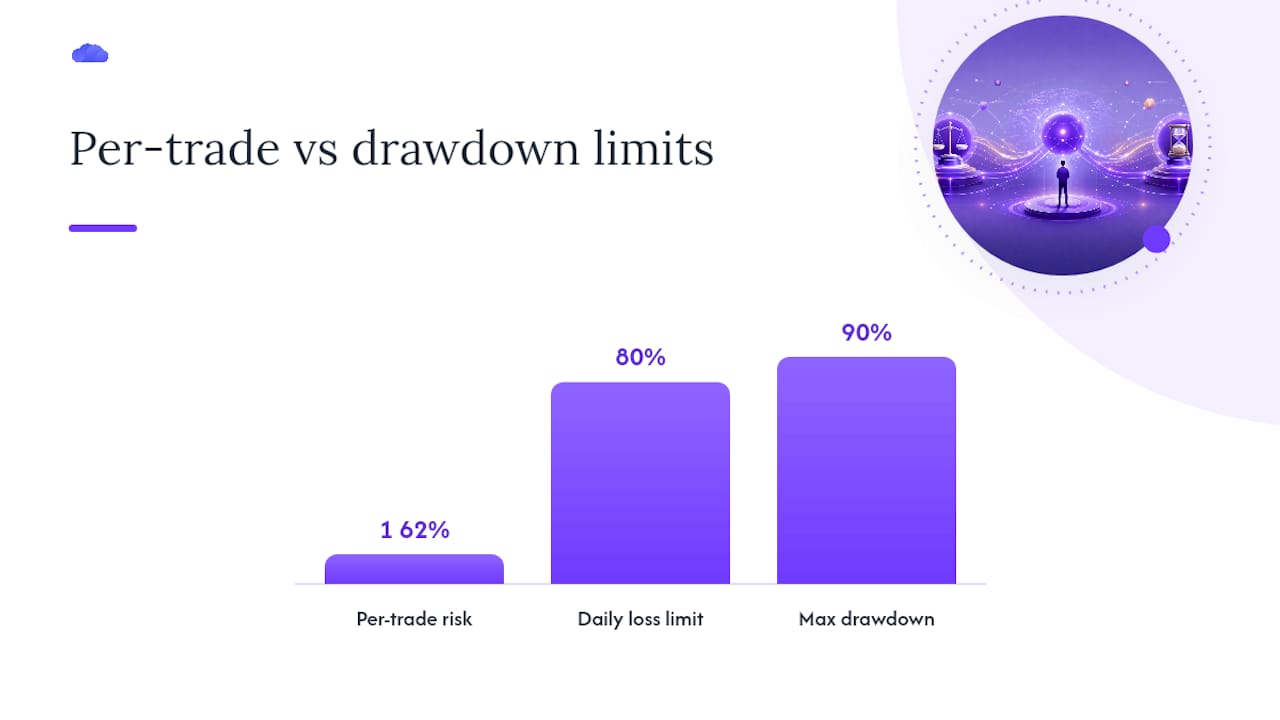
| Per-trade risk (% of account equity) | Pre-trade | 1–2% per trade |
| Daily loss limit | Pre-trade + intraday monitor | 80% of firm's daily drawdown limit |
| Max drawdown (trailing or static) | Continuous monitor | 90% of firm's max drawdown threshold |
| Max open positions | Pre-trade | Firm's stated limit or 3–5 concurrent |
| Prohibited instruments | Pre-trade filter | Per firm's instrument exclusion list |
| News blackout enforcement | Time-based pre-trade gate | 2 minutes before and after high-impact releases |
Sync robustness depends on three mechanisms: deduplication (each order carries a unique ID so a retry cannot create a duplicate fill), idempotent order processing (sending the same order twice produces the same result, not two fills), and a reconciliation loop that compares leader and follower positions on a fixed cadence (every 30–60 seconds is typical) and flags any drift.
*
What should you extract from every prop firm's rule book before mirroring?
Treat each firm's rule book as a structured data source, not a PDF to skim once. The community-maintained prop-firm rules database on GitHub catalogs rule-book items across 50+ firms in a CSV/JSON format that includes `copy_trading_allowed`, daily and max drawdown fields, news rules, and direct source URLs. Use it as a starting point, then verify against each firm's current published rules.
Extract and document these fields for every firm you onboard:
- `copy_trading_allowed` (boolean): the primary gate. If false, stop here.
- Eval vs. funded account distinction: document separately for each phase.
- Daily drawdown format: is it a percentage of starting balance, a trailing high-water mark, or a fixed dollar amount? The format changes how you calculate your internal limit.
- Max drawdown format: static or trailing? Trailing drawdown that locks in at the starting balance is the most restrictive variant.
- News trading policy: which releases are restricted, and is the blackout window 2 minutes, 5 minutes, or the full session?
- Weekend hold policy: must all positions be flat by a specific time on Friday?
- EA/automation policy: permitted, permitted with restrictions, or banned?
- Account ownership and third-party access: does the firm's terms of service restrict who can place orders?
Per-firm variation is significant. Some firms explicitly permit news trading on certain account types while others forbid it entirely, as documented in Velotrade's prop firm rules guide. Never assume one firm's rules apply to another.
Pro Tip: Maintain a firm-by-firm `mirroring_allowed` boolean in your onboarding database. Add a short exception list for account sizes or phases where mirroring is forbidden (e.g., "Apex: allowed on PA accounts, banned during eval"). Version-control this file and review it every 90 days, since firms update rules without announcement.
The NFA's security futures disclosure guidance is the regulatory baseline for member obligations in futures execution. When your mirroring arrangement routes orders through NFA member firms, confirm that your setup does not create undisclosed third-party trading relationships that conflict with member disclosure requirements.
Automate rule extraction as part of account onboarding. A simple script that reads the GitHub CSV, filters by `copy_trading_allowed = true`, and flags any account where the firm's source URL has changed since your last review will catch rule updates before they become violations.
*
How do you roll out mirroring from demo to full scale without blowing accounts?
A staged rollout is not optional. It is the difference between catching a symbol mapping error in a sandbox and catching it on 40 funded accounts simultaneously.
- Sandbox proof (Days 1–7): Connect the leader and 2–3 demo/paper accounts. Verify symbol mapping, order type translation, and fill semantics. Run 50+ order cycles covering market orders, limit orders, partial fills, and rejections. Pass criteria: zero symbol mismatches, zero duplicate fills, reconciliation mismatch rate below 1%.
- Staggered live pilot (Days 8–21): Enable 2–5 funded follower accounts with position sizes at 25% of normal. Monitor sync latency median and p95, failed order rate, and per-account drawdown in real time. Run a deliberate failover test: disconnect the leader session and confirm auto-recovery reconnects and reconciles within your SLA window. Pass criteria: median sync latency under 100ms, failed order rate below 2%, zero unplanned position size deviations.
- Controlled scale (Days 22–45): Add accounts in batches of 5–10. Gate each batch on the previous batch's 7-day KPI report. Run a full reconciliation audit at the end of each week. Pass criteria: reconciliation mismatch rate below 0.5%, no accounts hitting daily loss limits due to infrastructure errors.
- Full scale (Day 46+): All target accounts active. Monitoring KPIs shift to automated alerting. Review the firm-by-firm rule file every 90 days.
The Tradedupe getting-started guide provides a practical quickstart for Tradovate-native setups that maps well to the sandbox-to-pilot transition.
Monitoring KPIs to track continuously: sync latency median and p95, failed order rate per account, reconciliation mismatch rate, per-account drawdown versus daily limit, and system heartbeat/uptime.
*
What operational mistakes commonly blow accounts or trigger bans?
The highest-impact failures in production mirroring are almost never latency problems. They are policy and configuration failures that were avoidable with a proper checklist.
Ignoring per-firm drawdown formats is the most common account killer. A firm using trailing drawdown that locks in at the starting balance will breach at a different equity level than one using a static percentage. If your internal limit is calibrated to the wrong format, you will hit the firm's hard stop before your own alert fires.
Mismatched leverage and margin assumptions between leader and follower accounts cause followers to receive position sizes their margin cannot support. The follower's broker rejects the order, the position goes unsynced, and the reconciliation loop flags a mismatch that requires manual intervention.
Copying during restricted news windows is a disqualification vector at most firms. An automated copier that does not enforce a news blackout will happily replicate a leader's NFP entry to every follower, violating each account's news policy simultaneously.
Untested client-side EAs in production are an operational liability. Common prop trading resources consistently warn against deploying untested EAs on funded accounts, and the risk compounds when one EA is responsible for replicating to multiple funded followers.
> When a red flag appears, follow this sequence immediately: > > 1. Isolate affected followers by toggling them off at the account level. > 2. Pause replication on the leader to prevent further propagation. > 3. Run a full reconciliation to identify the exact position discrepancy. > 4. Manually close any positions that exceed the firm's risk parameters. > 5. Contact the prop firm's support team if any account has already breached a rule, before they contact you.
Red flags to monitor in real time: a sudden spike in failed orders on a specific follower (often a margin or symbol issue), a follower position size that is materially larger than the scaled equivalent of the leader's position (rogue-trade detection should catch this), recurrent reconciliation mismatches on the same account, or multiple accounts hitting daily loss limits within the same session window.
*
What data sources and performance claims should you verify?
Two data sources form the foundation of a defensible mirroring setup: a structured prop-firm rules database and verified platform performance claims.
The prop-firm rules database on GitHub is a community-maintained CSV/JSON covering 50+ firms. Its columns include `copy_trading_allowed`, daily drawdown format, max drawdown format, news rules, weekend hold policy, EA/automation policy, and a direct source URL for each firm's published rule book. Use it programmatically: filter by `copy_trading_allowed = true`, then cross-reference the source URL to confirm the rule has not changed since the last repo update.
| Column | Use Case |
|---|---|
| `copy_trading_allowed` | Primary onboarding gate: filter to `true` before any other check |
| `daily_drawdown_format` | Calibrate internal daily loss limit to the correct format (%, $, trailing) |
| `max_drawdown_format` | Determine whether trailing or static drawdown applies |
| `news_rules` | Configure news blackout windows in the copier's time-based pre-trade gate |
| `ea_automation_policy` | Confirm automated order entry is permitted before connecting the copier |
| `source_url` | Verify current rules directly from the firm's published documentation |
Tradedupe publishes vendor claims about its Tradovate-native, server-side futures trade copier: median execution latency of 34ms, rogue-trade detection, per-account toggle controls, auto-recovery, and a real-time monitoring dashboard. Treat these as vendor statements and verify them during your sandbox and pilot stages. The 34ms median latency figure is the benchmark to test against your own observed p50 and p95 during the live pilot.
The NFA security futures disclosure is the regulatory reference for member obligations in futures execution arrangements. Review it when your mirroring setup involves routing orders through NFA member firms or when a third-party copier service is involved in order placement.
*
The part of mirroring most traders skip until it's too late
Most traders building a multi-account prop desk spend the first two weeks on the exciting part: connecting accounts, watching orders replicate, and calculating theoretical P&L at scale. The part they skip is the rule-book audit, and it is the part that ends funded accounts.
The operational reality of mirroring across prop accounts is that the infrastructure is the easy problem. A well-configured server-side copier with proper symbol mapping and a reconciliation loop will work reliably. What will not work reliably is a copier pointed at accounts where you have not confirmed the firm's current automation policy, drawdown format, and news rules. Firms update their rule books without announcement. An account that was compliant in January may be in violation by March if the firm tightened its EA policy and you did not catch the change.
The traders who stay funded at scale are the ones who treat rule-book maintenance as an ongoing operational task, not a one-time setup step. A 90-day rule review cadence, a version-controlled firm database, and automated alerts when source URLs change are not overhead. They are the margin of safety that keeps capital in funded accounts instead of in violation notices.
The staged rollout matters for the same reason. Every stage of the sandbox-to-scale process is designed to surface a specific class of failure before it reaches a funded account. Skipping the sandbox because "it worked on paper" is how you discover a symbol mapping error on 20 funded accounts at once.
*
Why Tradedupe fits the architecture this playbook recommends
If you have worked through this playbook and concluded that a server-side, Tradovate-native copier with per-account risk enforcement is the right architecture, Tradedupe is the production SaaS option built specifically for that setup.
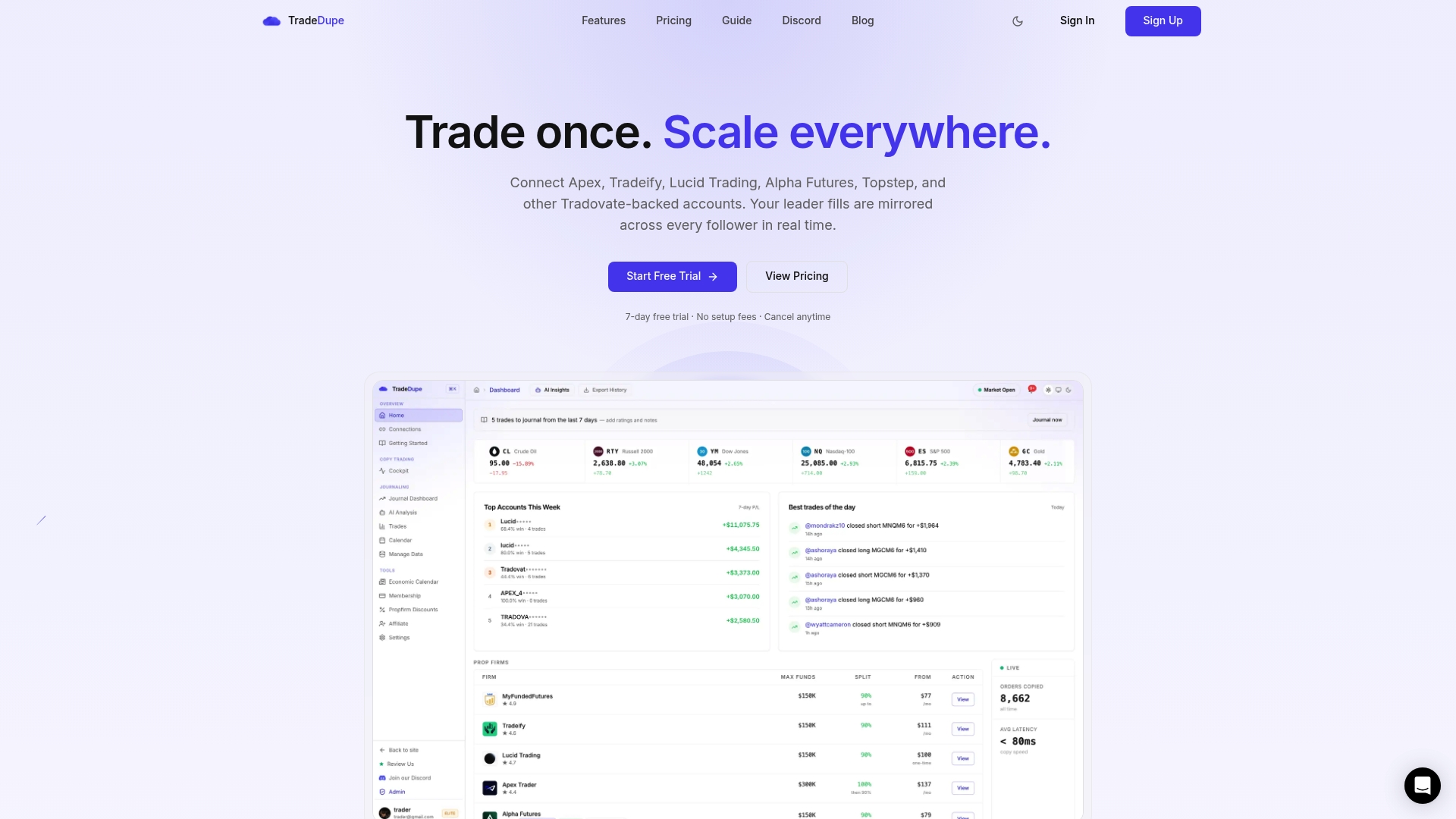
The feature set maps directly to the requirements covered here: server-side execution with a published median latency of 34ms, rogue-trade detection that flags position size anomalies before they propagate to all followers, per-account toggle controls for isolating individual accounts without pausing the full desk, auto-recovery on session drops, and a real-time dashboard covering sync status, leader/follower activity, and drawdown monitoring. Supported prop firm integrations include Apex, Tradeify, Lucid Trading, and Alpha Futures, all operating within the Tradovate ecosystem.
The build-vs-buy decision comes down to engineering bandwidth and SLA requirements. A homegrown API-driven copier is viable if you have a dedicated engineer and can accept the maintenance overhead. For most prop desks managing 10 or more funded accounts, the cost of a SaaS subscription is lower than the cost of a single compliance violation on a funded account. Tradedupe offers tiered plans covering individual traders through enterprise-level prop desks, with a free trial to run the sandbox proof described in the rollout section above.
Start your pilot at Tradedupe or review the full feature set at Tradedupe.
*
Sources
Use these resources to verify prop-firm rules, test integrations, and begin your rollout:
- NFA security futures disclosure
- prop-firm-rules-database (GitHub)
- 5 Proven Strategies to Pass a Prop Firm Challenge | For Traders
- 10 Best Prop Trading Strategies for Consistent Profits (2026) | Audacity Capital
This article is general information, not a substitute for advice from a qualified financial advisor. Consult a qualified financial professional about your own circumstances before acting on anything here.