
Prop Trading Workflow Explained for Serious Traders
TradeDupe
10 min read
Discover what a prop trading workflow is and learn to master each stage for sustained success. Elevate your trading game today!
Understanding what is a prop trading workflow separates traders who pass evaluations once and lose their accounts from those who build repeatable, scalable income across multiple funded accounts. The workflow is not just a checklist. It is a sequential operating system covering challenge selection, evaluation execution, funded account management, risk discipline, and scaling. Each phase has its own rules, psychology, and performance benchmarks. This article breaks down every stage with the specificity you need to manage prop trading operations like a professional, not a gambler.
Table of Contents
- Key takeaways
- What is a prop trading workflow, step by step
- Funded account management and ongoing obligations
- Core risk management within the workflow
- Evaluating firms and platform quality
- My take on what prop trading workflows actually demand
- How Tradedupe supports your prop trading workflow
- FAQ
Key takeaways
| Point | Details |
|---|---|
| Evaluation is the entry gate | Challenge fees range from $15 to $500, with profit targets of 6–10% and drawdown limits of 4–10%. |
| Risk rules never pause | Daily loss limits and max drawdown thresholds apply during evaluation and funded stages equally. |
| Profit splits reward discipline | Most funded accounts offer 70–90% profit splits, but payouts require meeting minimum thresholds first. |
| Firm selection shapes your workflow | Platform quality, trading style allowances, and challenge transparency matter more than split percentages alone. |
| Scaling is the real opportunity | Consistent performance triggers periodic account size increases, where long-term prop trading income is actually built. |
What is a prop trading workflow, step by step
The prop trading process begins long before you place a single trade. It starts with selecting the right challenge structure for your strategy and capital goals. The prop firm workflow involves selecting a challenge account, paying an entry fee, passing evaluation phases by hitting profit targets while respecting drawdowns, then trading a funded account with profit splits. That sentence sounds simple. Executing it consistently is not.
Challenge types fall into two primary structures:
- One-phase evaluations require you to hit a single profit target, typically 8–10% of the account size, while staying within drawdown limits. These are faster but often carry tighter daily loss rules.
- Two-phase evaluations split the process into a challenge phase and a verification phase. Phase one targets are usually 8–10%, phase two targets drop to 4–5%, giving the firm more data on your consistency before funding you.
Capital ranges across reputable firms span from $10,000 accounts up to $200,000 or more, and evaluation fees range from $15 to $500 depending on account size and firm. One detail most new traders overlook: challenge entry fees are refundable upon your first funded payout at most reputable firms. That reframing matters. Viewing the fee as a refundable deposit changes your behavior during the challenge. You trade with discipline rather than desperation to recover a sunk cost.
Pro Tip: Before choosing a challenge, map your average weekly profit rate from your trading journal. If your historical edge produces 2% per week, a two-phase 8%/4% challenge is achievable in 4–6 weeks. If your edge is 0.5% per week, you are likely to violate time pressure or take uncharacteristic risk. Match the challenge structure to your actual performance data.
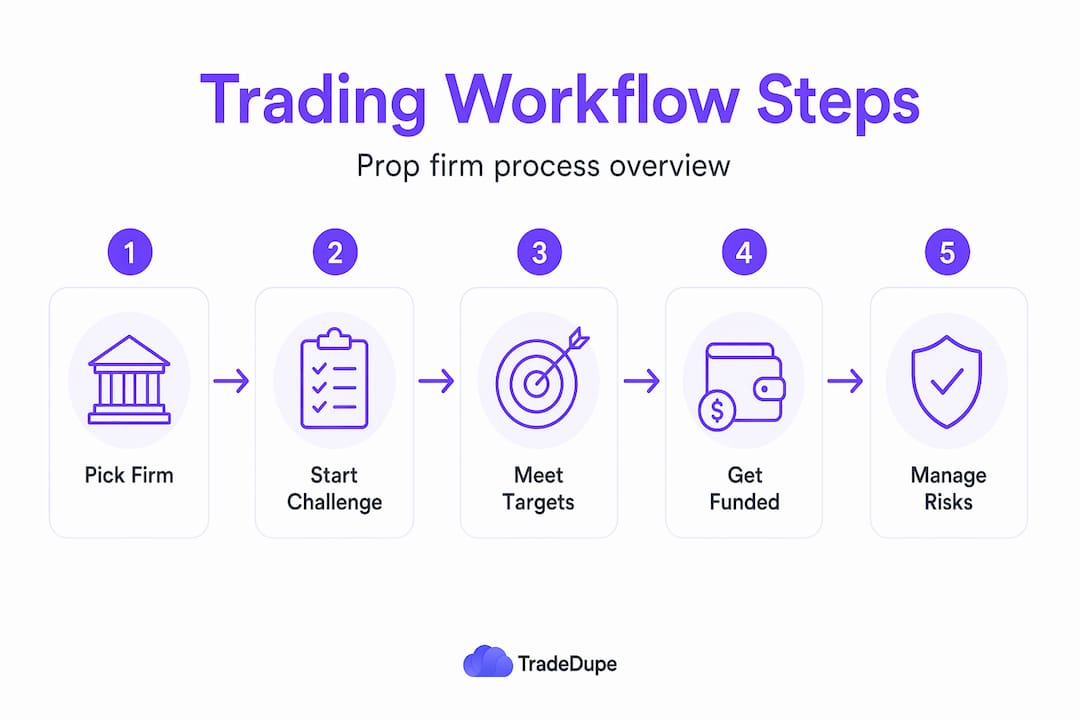

Risk parameters during evaluation are non-negotiable. Breaching daily loss limits of 4–5% or maximum drawdowns of 8–10% leads to immediate evaluation failure. Many traders blow evaluations not from poor strategy but from one oversized position on a high-volatility news event. The evaluation phase is as much a behavioral test as a technical one.
Funded account management and ongoing obligations
Passing the evaluation is a milestone, not a finish line. What follows is where the real prop trading process begins. Most funded accounts operate on firm capital, meaning you are trading a simulated or live pool provided by the firm, not your own money. The key distinction is that your obligations to the firm's risk parameters do not relax after funding. They intensify, because the capital at risk is larger.
Here is how the funded account workflow typically unfolds:
- Account activation. After passing evaluation, the firm provisions your funded account, usually within one to three business days. You receive login credentials tied to your trading platform of choice.
- Trading under live rules. The same drawdown and daily loss limits from your evaluation carry forward. Some firms tighten these limits after funding, so read the funded account agreement carefully before your first trade.
- Profit accumulation toward first withdrawal. Withdrawal requests are often fulfilled within 1–3 business days, but most firms require you to reach a minimum profit threshold before your first payout is eligible. This threshold varies by firm, but it typically represents 4–5% of account balance.
- Profit split distribution. Standard funded account structures offer 70–90% profit splits. You keep the majority. The firm retains a portion as compensation for providing capital and absorbing downside risk.
- Ongoing performance review. Firms monitor trading activity continuously. Unusual position sizing, trading through restricted news events, or holding positions over weekends without permission can trigger warnings or account termination.
> "Protecting capital through defense-focused risk management is more important than chasing aggressive profit targets in prop trading." — Mike Bellafiore
That quote reflects a truth most funded traders learn the hard way. After you receive your first funded account, the psychology shifts. Suddenly you are trading real capital, and the temptation to swing for outsized profits to accelerate payouts creates the same reckless behavior that fails evaluation accounts. The traders who scale prop firm accounts successfully are the ones who treat each funded day like day one of the evaluation, with the same measured risk and process focus.
Core risk management within the workflow
Risk management is not one element of prop trading operations. It is the architecture that holds the entire workflow together. Every phase depends on it.
The most common misunderstanding among newer prop traders is treating risk as a percentage of account balance applied uniformly across all instruments and sessions. Setup-based risk management means measuring the typical volatility or movement range of an instrument before entry, then sizing your stop to match that actual behavior rather than a fixed percentage. A 10-tick stop on the NQ might be appropriate in a low-volatility pre-market session. In the first 15 minutes after a CPI print, that same stop gets swept before price has even committed to direction.
The table below contrasts generic percentage-based risk with setup-based risk:
| Approach | Stop placement | Result under volatility | Prop firm compatibility |
|---|---|---|---|
| Generic percentage cap | Fixed % of account regardless of setup | Frequent unnecessary stop-outs | Adequate but wasteful |
| Setup-based sizing | Calibrated to instrument's actual "wiggle" | Stops positioned at logical invalidation zones | High. Preserves drawdown buffer effectively |
Pro Tip: Before entering any position, check the average true range (ATR) of your instrument for the current session. If the 5-minute ATR is 8 ticks and your stop is 4 ticks, you are not trading based on market structure. You are trading based on your fear of losing dollars. Those are not the same thing.
Trading psychology sits inside risk management, not separate from it. The traders who focus on 1–2 instruments achieve measurably better consistency than those bouncing between instruments searching for favorable conditions. Familiarity with a single instrument's order flow patterns, typical liquidity sweeps, and fair value gap behavior gives you an edge that raw strategy alone cannot provide. Specialization is a risk management decision, not a limitation. You can review prop firm risk parameters in detail to understand how firms enforce these limits technically.
Evaluating firms and platform quality
Once you understand the core elements of prop trading, the next decision is which firm and platform setup best supports your workflow. This is where many traders make a costly mistake: they select a firm based almost entirely on profit split percentages while ignoring factors that have a far larger impact on day-to-day execution.
Modern traders should prioritize platform quality, challenge transparency, and trading flexibility over advertised account sizes. Trading flexibility in this context means specific permissions that vary significantly by firm:
- News trading allowances. Some firms prohibit holding positions through scheduled economic releases like NFP or FOMC announcements. If your strategy involves trading order flow around these events, a firm that restricts news trading is structurally incompatible with your approach.
- Overnight and weekend holding. Swing traders and position traders who hold trades beyond the session close need explicit permission to do so. Closing a profitable swing trade prematurely to meet a session-end rule destroys edge.
- Scaling programs. The scaling program after funding involves periodic account size increases of approximately 40% upon consistent profitable performance. This is where long-term prop trading income compounds. A firm without a clear scaling path limits your growth ceiling arbitrarily.
- Platform and execution reliability. Latency, order rejection rates, and platform downtime are operational risks that directly affect your ability to execute your edge. A fill that arrives 300ms late on an NQ scalp is a different trade than the one you entered.
- Challenge rule transparency. Reputable firms publish exact drawdown calculation methods, whether trailing or static, along with whether daily loss limits reset at midnight, at the start of your trading session, or on a rolling 24-hour basis. Ambiguity in these rules is a red flag, not a minor detail.
Challenge transparency and realistic rules matter more than headline profit splits for long-term sustainability. A firm offering 90% splits with opaque drawdown calculations and inconsistent payouts is a worse deal than one offering 80% splits with published rules and a track record of timely payouts. Read the fine print, not the marketing.
My take on what prop trading workflows actually demand
I've seen hundreds of traders approach prop firm evaluations with technically sound strategies and still fail repeatedly. What I've learned watching this pattern is that the workflow breakdown almost never happens at the strategy level. It happens at the decision-making level under stress.
In my experience, the traders who build durable funded account careers share one behavioral trait: they treat risk limits as the outer boundary of a performance zone, not as a punishment mechanism. When you see the daily loss limit as a fence keeping you from disaster, you make different decisions than when you see it as a constraint on your freedom. That reframe is worth more than any entry technique.
What I've found actually works versus what sounds good in theory: sizing discipline based on session volatility, not account percentage, has a bigger impact on long-term survival than any specific setup. Focusing tightly on performance metrics that reflect your actual process, win rate on A-grade setups, average risk-to-reward on executed trades, and daily drawdown consumed, gives you data to improve the workflow rather than emotions to react to. The traders I respect most in this space have notebooks full of process data, not just P&L screenshots.
> — Andres
How Tradedupe supports your prop trading workflow
Managing a single funded account demands discipline. Managing several across firms like Apex, Topstep, Lucid Trading, and Tradeify simultaneously multiplies the operational load considerably.
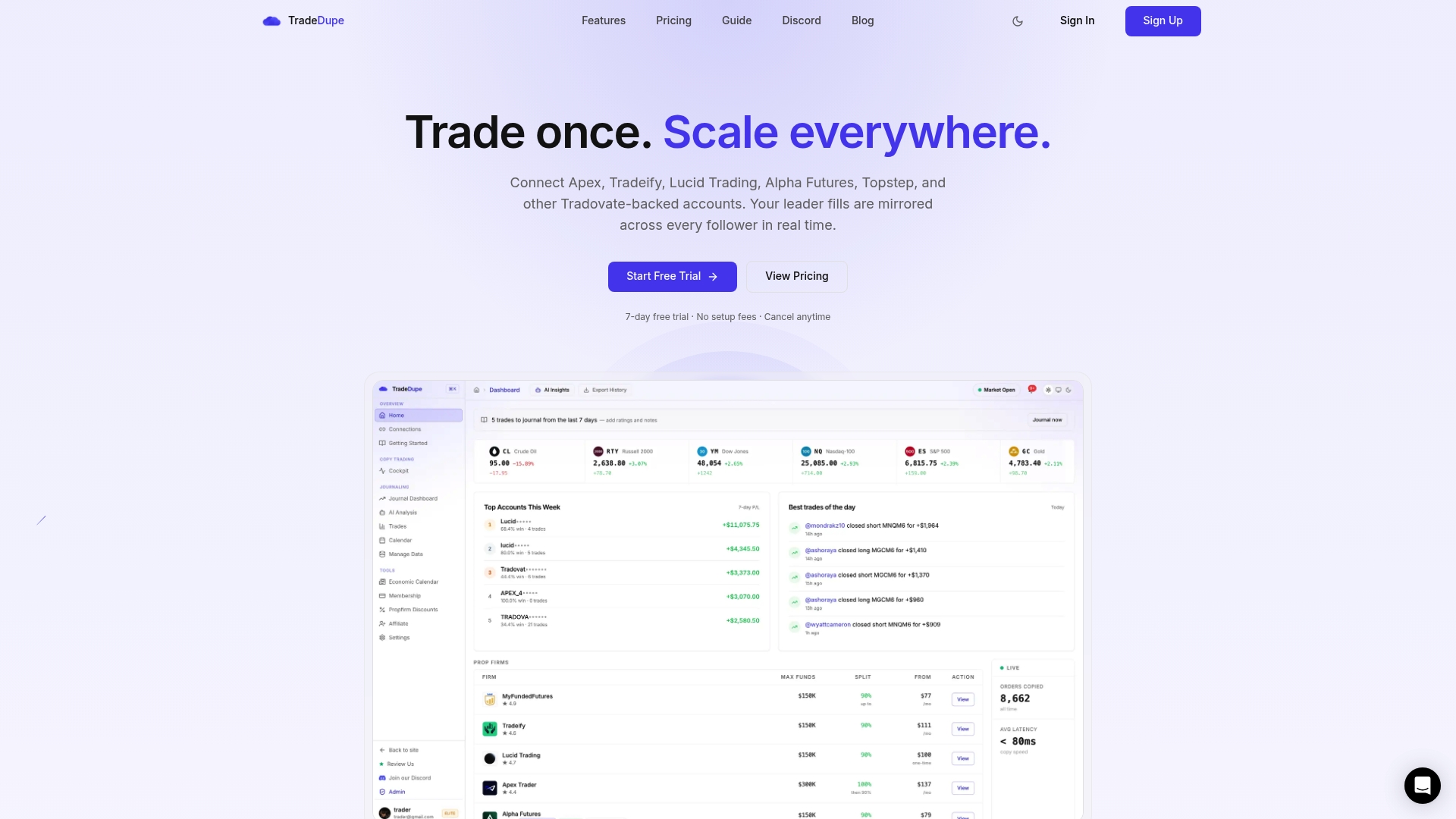
Tradedupe was built specifically for this challenge. Its real-time trade mirroring for prop firms replicates positions from a single lead account across multiple follower accounts with a median latency of 34ms, keeping every account synchronized without manual intervention. The platform includes rogue-trade detection, per-account toggle controls, and auto-recovery features that protect funded accounts from unintended exposure. If your workflow involves running multiple evaluations while managing live funded accounts, Tradedupe's dashboard gives you a centralized view of sync status, risk exposure, and account activity. For traders exploring copy trading setup options, Tradedupe offers a step-by-step onboarding experience designed to get your Tradovate accounts connected and mirroring in under 10 minutes.
FAQ
What is a prop trading workflow?
A prop trading workflow is the sequential process covering challenge selection, evaluation execution, funded account management, risk rule adherence, and scaling. Each phase has specific profit targets, drawdown limits, and behavioral requirements that must be met to progress.
How long does it take to pass a prop firm evaluation?
Timelines vary by challenge structure and trader performance. One-phase evaluations can be completed in days if profit targets are met quickly, while two-phase challenges typically take two to six weeks depending on the firm's minimum trading day requirements.
What profit splits do funded prop traders receive?
Most reputable prop firms offer profit splits of 70–90% to the trader. The firm retains the remainder as compensation for providing capital and absorbing downside risk on the funded account.
Why do traders fail funded prop accounts?
The most common cause is risk rule violations, specifically breaching daily loss limits or maximum drawdown thresholds. Many new traders fail by switching instruments frequently rather than mastering a stable, repeatable setup on one or two markets.
How does scaling work in prop trading?
After demonstrating consistent profitability on a funded account, traders become eligible for account size increases. Scaling occurs periodically with account increases of approximately 40% contingent on performance reviews, and it represents the primary path to compounding income in prop trading.