

Prop Traders: 100ms Mirroring for Server Logs in Tradovate
TradeDupe
10 min read
Tradovate guide to audit ready server logs for trading systems. Learn 100ms mirroring, CFTC level retention, and TradeDupe's implementation.
For Tradovate-based copy trading, your audit logs need millisecond execution timestamps, correlated command and execution IDs, account IDs, and copy-event status on every fill. Capture that data primarily through WebSocket streams, then backfill gaps with the Reporting API. Anything less leaves you're guessing during a dispute, an audit, or a debugging session at 2 a.m.
*
> TL;DR: > > - A comprehensive audit log for Tradovate copy trading must include millisecond timestamps, linked order IDs, account IDs, and status flags for accurate event tracing. > - Use WebSocket streams to capture real-time order and fill updates, supplemented by the Reporting API to backfill any missed data during disconnections. > - Ensuring all relevant fields such as correlation ID and session details are logged enables quick reconciliation and compliance with regulatory standards. > - Troubleshooting missing fills or discrepancies involves verifying execution reports, sequence numbers, and session integrity rather than relying on status codes alone. > - TradeDupe's platform implements these best practices by securely connecting via OAuth, persistently logging all trades, and facilitating straightforward audit and reconciliation processes.
*
Table of Contents
- What Belongs in a Copy-Trading Audit Log Schema
- Capturing Events Reliably: WebSocket Plus Reporting API
- Reconciling Leader Commands Against Follower Fills
- Troubleshooting Missing Copies, Late Fills, and Bad P&L
- How TradeDupe Handles Audit Logging in Practice
- Retention, Access Control, and SLAs for Audit-Ready Logs
- Why Audit-Grade Logs Are a Risk Control, Not Paperwork
- Get Audit-Ready Logging Without Building It Yourself
- Sources
- FAQ
What Belongs in a Copy-Trading Audit Log Schema
A usable audit log for server logs for trading systems isn't a giant dump of raw JSON. It's a structured record built around one job: proving what happened, in what order, and why. If you can't answer "did the follower actually get filled, and when" in under a minute, your schema is missing something.
At minimum, every logged event needs to prove an execution occurred and tie the leader order to the follower order that mirrored it. Beyond that floor, a few additional fields turn a bare compliance record into a genuine troubleshooting and performance tool.
- Core fields: millisecond timestamp, order ID, fill ID, leader account ID, follower account ID, side, quantity, price, order status
- Linking fields: correlation ID or client order ID shared between the leader command and the follower execution
- Flags: AutoLiq indicator, initiator (trader vs. platform vs. broker), execution mode
- Recommended extras: latency between leader fill and follower fill, symbol/contract code, session ID, WebSocket sequence number
- Metadata for tracing: request ID from the original API call, response code, and the commandReport ID that eventually confirmed it
Skip any one of the linking fields and you lose the ability to trace a follower fill back to the leader event that caused it. That's the single most common gap in homegrown logging setups.
Capturing Events Reliably: WebSocket Plus Reporting API
Real-time fidelity is the whole point of trading system log analysis, and that rules out REST polling as your primary source. Tradovate's own guidance is to use a WebSocket connection with the `user/syncrequest` pattern for live order-flow and execution updates, because REST polling can miss fills entirely during high-frequency bursts. A poll every two seconds simply isn't fast enough when a follower account needs to mirror a fill within 100 milliseconds.
The practical build looks like this:
- Open a WebSocket session and issue `user/syncrequest` to subscribe to account, order, and fill updates.
- Treat every inbound message as an event to persist immediately, not something to query later.
- Store the sequence number (`seq_num`) on every message so you can detect drops or reordering.
- Correlate each outbound command with its resulting commandReport and executionReport using a shared correlation ID.
- On reconnect, use the Reporting API to backfill anything missed while the socket was down, since standard REST endpoints can return empty historical arrays over OAuth.
Pro Tip: Never overwrite a stored event. If a commandReport arrives after you already logged the executionReport, append it as a linked record rather than replacing anything. Audit logs should only ever grow, never mutate.
This hybrid pattern, streaming for live data and Reporting API for gaps, is what most third-party platforms settle on once they've been burned by a missing fill during a busy open.
Reconciling Leader Commands Against Follower Fills

Reconciliation is where trading system log analysis actually pays off. It's also where most manual processes fall apart, because a spreadsheet built to catch obvious errors won't catch a silently orphaned order.
A workable daily reconciliation workflow runs in four passes:
- Ingest: pull every WebSocket event and any Reporting API export for the period into one store.
- Normalize: convert timestamps to a single millisecond-precision format and standardize account and order ID formats across leader and follower.
- Join: match leader commands to follower executions using the correlation ID, then flag anything without a matching pair.
- Escalate: route orphaned orders, mismatched quantities, or price discrepancies to manual review before they hit your P&L reports.
Regulatory expectations shape which fields are non-negotiable in that process. Millisecond timestamps, initiator identity, and account-level attribution aren't optional extras. CFTC and exchange audit-trail guidance requires data granular enough to reconstruct a transaction after the fact, and CME's own oversight materials describe the same tiered, millisecond-resolution standard. Retention isn't a quarter or two, either. Recordkeeping rules tied to Regulations 1.31, 1.35, and 38.551 point toward multi-year retention windows for firms subject to them, so a log management for traders policy built around 90 days of storage will not hold up if a dispute surfaces a year later.
Troubleshooting Missing Copies, Late Fills, and Bad P&L
When a follower account shows a fill that doesn't match the leader, or shows nothing at all, work the problem in this order rather than guessing:
- Confirm the ExecutionReport exists. If there's no executionReport for the order, the exchange never filled it, regardless of what your dashboard shows.
- Don't trust the 200 OK. An HTTP 200 only means Tradovate received your command. It says nothing about whether the order actually filled, was rejected, or was cancelled.
- Check the seq_num chain. A gap in sequence numbers usually means a dropped WebSocket message, and that's your missing fill.
- Look for orphaned commands. If a command was sent but never generated a matching commandReport, the exchange likely rejected it before it reached the book.
- Check the AutoLiq and initiator flags. A "missing" fill is sometimes a broker-initiated liquidation the follower account triggered independently, not a copy failure at all.
- Verify session state. An expired OAuth token or a WebSocket that silently disconnected and reconnected without a proper backfill will produce exactly the symptoms of a missing copy.
Most "the copier is broken" tickets trace back to step 2 or step 6.
How TradeDupe Handles Audit Logging in Practice
TradeDupe was built around the same principles laid out above, because a copy trading platform that can't reconstruct its own events isn't one prop firms should trust with real accounts. Every account connects through Tradovate's official OAuth flow, so credentials are never stored on TradeDupe's servers or on a trader's PC. Every leader fill is mirrored to enabled follower accounts over a live WebSocket stream, typically within 100 milliseconds, with the underlying command and executionReport data persisted and correlated rather than discarded once the trade closes.
That persistence layer is what makes the platform's safeguards auditable rather than just theoretical:
- Rogue-trade detection logs any follower-side trade that didn't originate from a leader command.
- Per-account copy toggles record when copying was enabled or disabled for a given follower, so a gap in mirrored activity has a documented cause.
- Execution-mode controls and daily loss and profit limits are enforced by Tradovate itself, with the enforcement event captured alongside the trade record.
For desk-level reconciliation, that data surfaces through exportable reports rather than a support ticket, giving compliance teams something they can hand over without reconstructing events manually.
Retention, Access Control, and SLAs for Audit-Ready Logs
Best practices for server logs come down to three commitments most desks underinvest in: what you keep, who can touch it, and how fast you can produce it on demand.
On retention, keep three tiers rather than one flat archive: raw event streams for the shortest recent window, normalized and joined records for the audit period your jurisdiction requires, and compressed extracts for anything older that you're keeping purely for historical reconciliation. This keeps storage costs sane without sacrificing the detail regulators or prop firms might ask for.
- Apply least-privilege access so only OAuth-authenticated roles can query raw logs.
- Use tamper-evident storage (append-only, hash-chained, or write-once) so a modified record is detectable.
- Run reconciliation on a fixed cadence, daily at minimum for active accounts, rather than only when something looks wrong.
- Define an incident response step for missing data before you need it, not while a prop firm is waiting on an answer.
Pro Tip: Test your export process quarterly by pulling a random day's logs and reconciling them cold, as if you'd never seen the account before. If you can't do it in under an hour, your schema or your tooling needs work.
Why Audit-Grade Logs Are a Risk Control, Not Paperwork
Most traders treat logging as something you fix after a dispute forces the issue. That's backwards. The firms that never have a bad reconciliation conversation are the ones that treated ExecutionReport-based capture and correlation IDs as core infrastructure from day one, not a compliance afterthought bolted on later. Go check your own setup today: can you trace a single follower fill back to its leader command in under a minute? If not, that gap is the risk, not the logging effort it takes to close it.
> — Andres
Get Audit-Ready Logging Without Building It Yourself
Running your own reconciliation pipeline means building WebSocket ingestion, Reporting API backfills, and correlation logic before you've mirrored a single trade. TradeDupe gives traders infrastructure with OAuth-based account connections with no stored passwords, real-time WebSocket mirroring, and persistent, correlated logs of every command and execution behind rogue-trade detection and per-account controls.
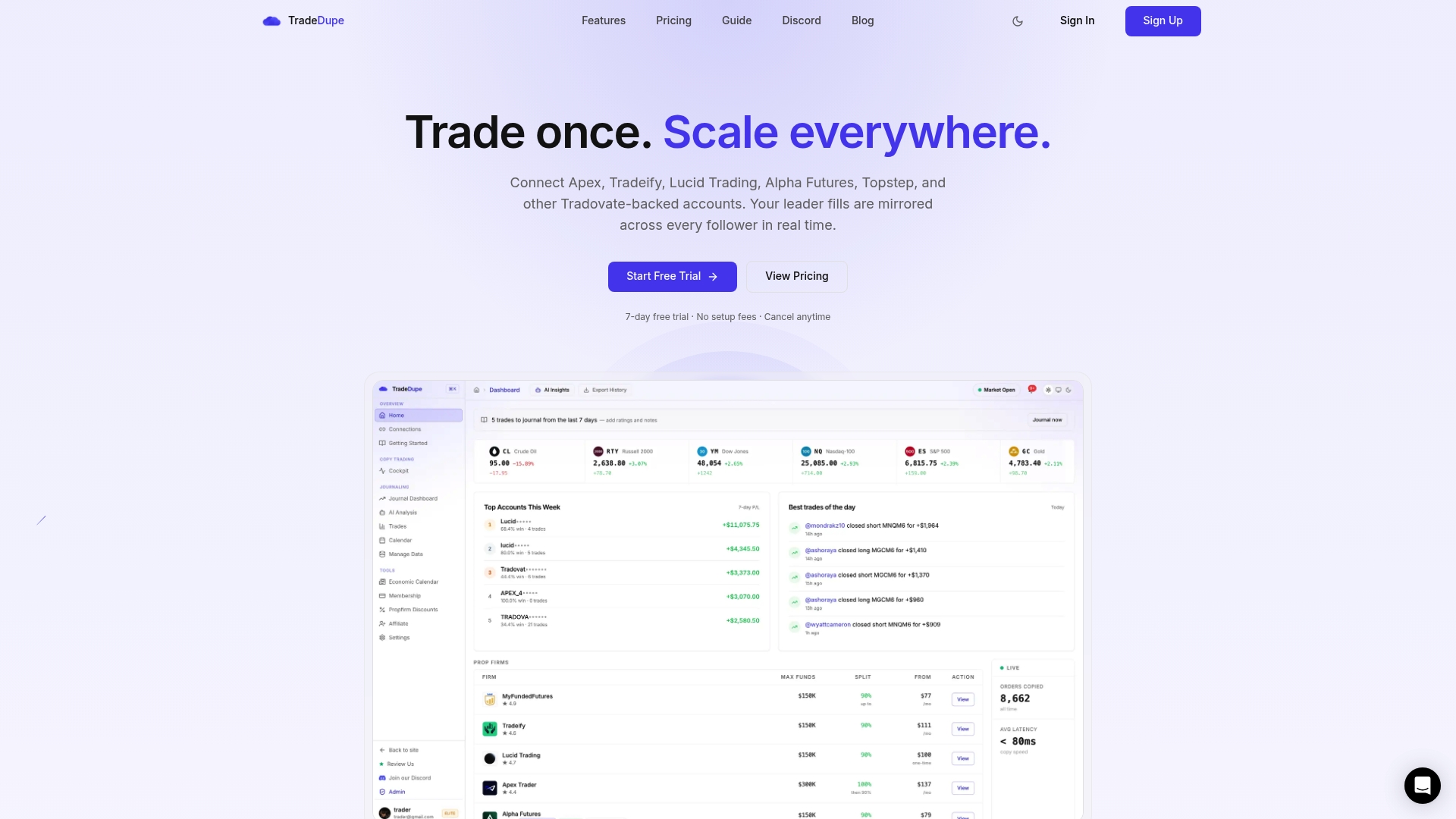
Instead of stitching together your own log management for traders stack, you get a system where every copy event is already traceable back to its leader command. Plans start at a monthly fee billed yearly, and every plan includes a free trial with one-click cancellation. If you're ready to see how it maps to your accounts, set up your first connection or check out the Tradovate trade copier to see the mirroring in action.
Sources
- Tradovate API
- Websocket API command confirmations - Tradovate community
- CFTC / FIA Audit Trail guidance
FAQ
What Fields Are Mandatory in a Trading Audit Log?
At minimum you need a millisecond timestamp, order and fill IDs, leader and follower account IDs, side, quantity, price, and an AutoLiq or initiator flag. Without a correlation ID linking leader commands to follower executions, you can't prove causation during a dispute.
Why Shouldn't I Rely on REST Polling Alone?
REST polling checks state at intervals, so it can miss fills that happen between requests during fast markets. Tradovate recommends WebSocket streaming with `user/syncrequest` for real-time updates, reserving REST and the Reporting API for historical backfills.
Does an HTTP 200 Response Mean My Order Filled?
No. A 200 OK only confirms Tradovate received the command, not that the exchange executed it. ExecutionReports and commandReports are the actual proof of a fill, cancellation, or rejection, and they arrive asynchronously.
How Long Should I Retain Copy-Trading Logs?
Retention should follow the multi-year expectations tied to CFTC recordkeeping regulations rather than a short, convenient window. Keep raw, normalized, and compressed tiers so older records stay cheap to store but still retrievable.
How Does TradeDupe Handle Audit Logging for Copy Trades?
TradeDupe connects to Tradovate through official OAuth, mirrors leader fills to followers over WebSocket typically within 100 milliseconds, and persists correlated command and execution data for every copy event. That includes logged safeguards like rogue-trade detection and per-account toggles, exportable for desk-level reconciliation.
What's the Difference Between an ExecutionReport and a CommandReport?
A CommandReport confirms Tradovate processed your order command, while an ExecutionReport confirms what actually happened at the exchange, a fill, partial fill, or rejection. Reliable trading system error logs treat the ExecutionReport as the final word, not the command acknowledgment.
For educational purposes only. Not financial advice. Futures trading involves substantial risk of loss and is not suitable for every investor.